
A Detailed Transcript Can Still Leave the Main Question Open
Take an accurate transcript of a ten-minute sales or service call and read it from beginning to end. The caller explains the need. An employee answers questions, discusses timing, and promises a next step. Names, dates, prices, and objections appear correctly. The exchange is polite, detailed, and easy to follow on the page.
Then the ordinary business questions begin. Did the caller proceed? Was the requested option still available later that day? Did the employee send the information they promised? Did another staff member change the price or timing? Was the caller actually a suitable customer, or did an important qualification issue emerge afterward?
AI call transcripts can show that someone said, “I’ll send that this afternoon.” They cannot verify that the message was sent. They can preserve a customer’s statement that the price sounds reasonable, but they cannot establish that the customer bought. They can document availability discussed at 10:15 a.m. without knowing that the last opening was taken at noon.
This distinction matters because transcript detail can feel conclusive. A manager sees a page of precise dialogue and naturally assumes there is enough material to assess the call. The names are right, the key phrase is highlighted, and the summary identifies a follow-up. Yet the manager may still need to open the scheduling system, search the shared inbox, check the customer record, and ask an employee what happened next.
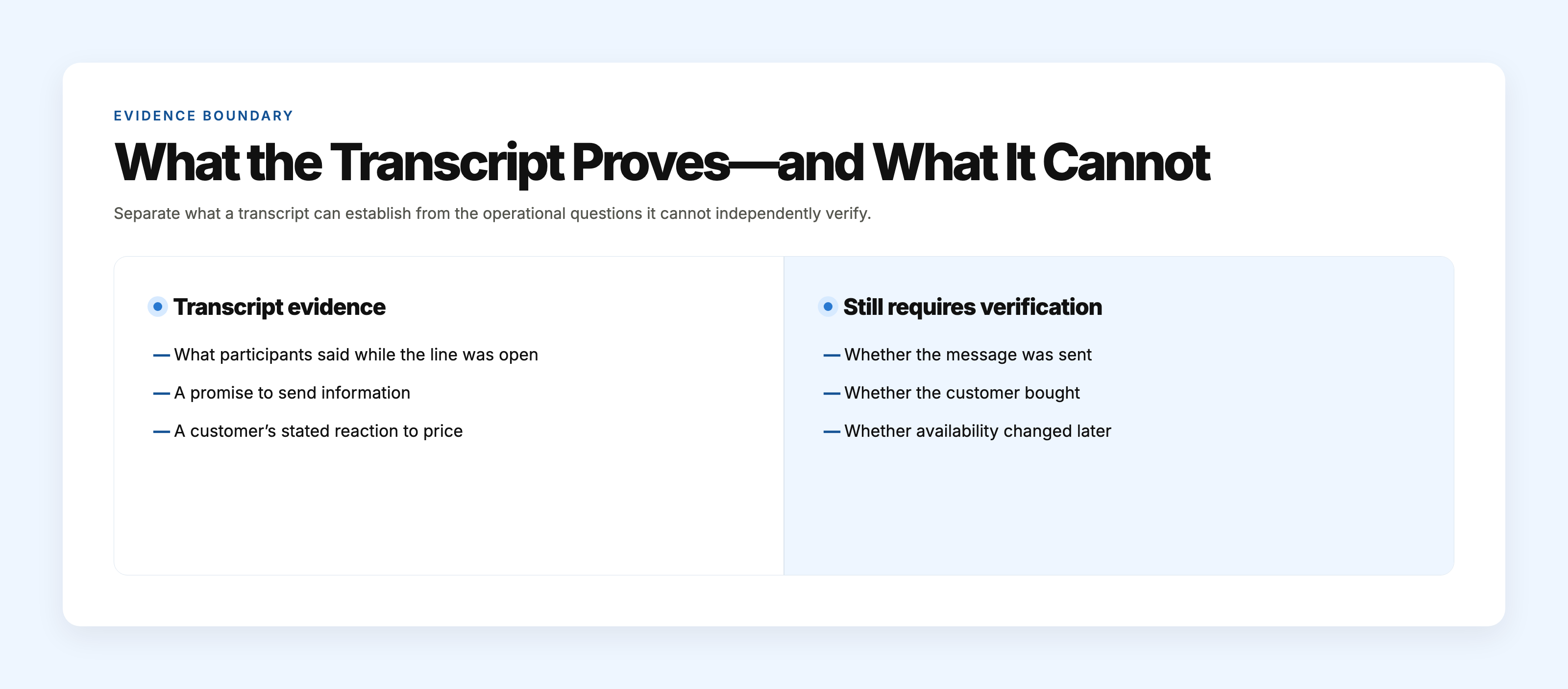
A transcript remains evidence from one moment. It describes what the participants said while the line was open. It does not independently know what the business had in stock, what another employee had already promised, or whether the next person in the workflow completed their part.
That does not reduce the value of transcription. Accurate wording is useful when checking whether a price was quoted correctly, reviewing how employees explain a policy, locating a specific request, or confirming that a caller raised a concern. The practical mistake is asking the transcript to prove more than its source can support.
The Call Is Only One Step in How Customers Decide
Customers frequently use a phone call to narrow their options rather than make an immediate decision. They may need to consult a spouse, supervisor, business partner, or family member. They may compare the answer with another provider, complete a form online, or wait to see whether a date becomes available. Even a positive call may be one checkpoint in a decision that unfolds over several days.
Consider a parent contacting a tutoring center. During the call, the parent asks about math placement, Tuesday availability, session length, and whether payment is due before an assessment. The coordinator explains the process and mentions one possible opening. The parent says the program sounds promising and agrees to review the registration link that evening.
The language sounds encouraging. Still, the parent may open the link, notice that the Tuesday time conflicts with transportation, and pause. The next morning, another center replies with a Wednesday option. The parent does not reject the first center or call to explain the comparison. They simply continue with the option that is easier to arrange.
From inside the tutoring center, that silence can be misread. The coordinator may assume the family is still considering the program. The director may classify the call as a strong inquiry because the parent asked detailed questions and stayed on the line. A staff member reviewing the transcript on Friday may see the same positive language and reach the same conclusion. Meanwhile, the registration form remains unfinished because schedule fit—not the coordinator’s explanation or the program price—shaped the result.
Delay also changes how customers interpret the business. If promised placement details arrive a day late, the customer may not complain. They may quietly wonder whether future communication will be similarly slow. What staff experience as an ordinary handoff error can look deliberate from the outside because the customer cannot see the scheduling discussion, the crowded inbox, or the coworker who thought someone else had replied. In practice, trust often weakens through these small unanswered questions before anyone formally says no.
What the Spoken Words Can Establish
A transcript is strongest when the question concerns language used during the call. It can help establish which products were discussed, what questions the customer asked, how an employee described a process, and whether a specific concern surfaced. When names and numbers are captured accurately, it can also reduce the effort needed to locate a key part of a long recording.
For example, a property-management office receives a call from a prospective tenant who wants to move within three weeks and has a medium-sized dog. The leasing employee explains the stated pet policy, mentions a unit that may be available, and describes the application steps. The transcript gives a manager useful evidence about whether the employee explained the process clearly and whether the caller disclosed the dog.
It may also reveal useful patterns across calls. If several prospects ask whether deposits can be divided across two payments, management has a concrete reason to review how payment terms are presented. If callers repeatedly ask about the same application requirement, the office may need clearer website language or a better explanation early in the call. Here, the spoken questions themselves are relevant evidence.
The operational limit appears when the review moves from wording to current conditions. The leasing employee may have been looking at an availability screen that had not yet been updated after another applicant paid a holding deposit. The caller may have estimated the move-in date before receiving notice from a current landlord. The pet may fall within the stated size policy but still require documentation that the caller does not have. None of those possibilities makes the transcript inaccurate. They change what the business can safely conclude from it.
This is why transcript accuracy and decision reliability are separate questions. Accuracy asks whether the words were reproduced correctly. Decision reliability asks whether those words are enough for the decision now in front of the manager. The first can be checked against the audio. The second depends on the surrounding work: the current unit record, the submitted application, the follow-up message, or the employee action that came after the call.
What Changed Outside the Call
At 9:10 on Monday morning, a parent calls a tutoring center about support for an eighth-grade student. Maya, the enrollment coordinator, discusses an assessment, a Tuesday opening, and the first payment. She tells the parent that she will confirm the instructor assignment after speaking with Daniel, the academic director. The parent sounds interested and asks Maya to send the registration materials.
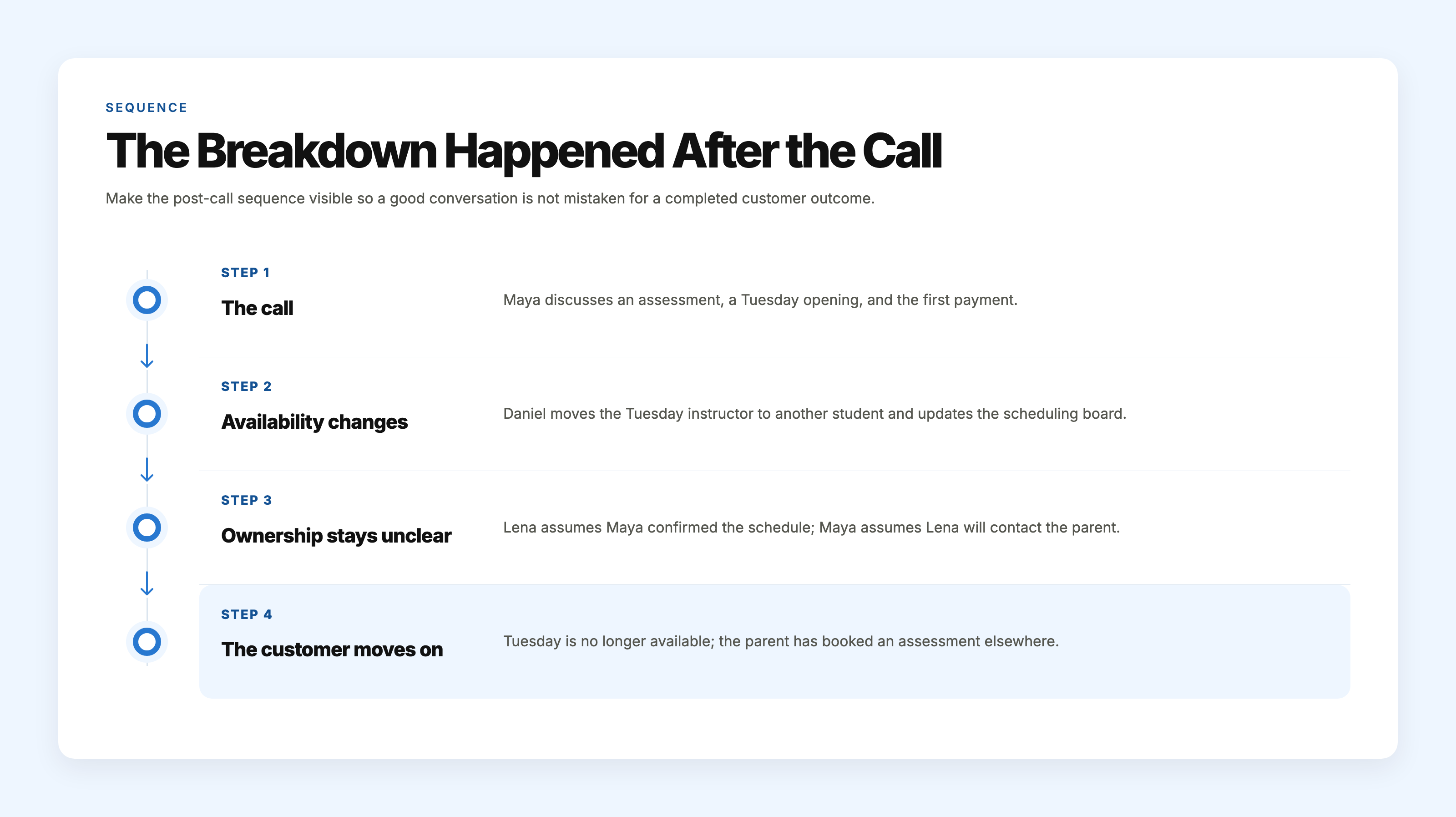
At 11:30, Daniel moves the Tuesday instructor to another student whose existing schedule changed. He notes the update on the scheduling board but does not know that Maya has an active inquiry tied to that opening. Maya, meanwhile, sends the registration link but waits for Daniel to confirm the instructor before sending a personal follow-up. The transcript still reflects the availability as it existed during the morning call.
Late that afternoon, office assistant Lena sees the submitted registration form. She assumes Maya has already confirmed the schedule because Maya handled the call. Maya assumes Lena will contact the parent because Lena processes new forms. Daniel believes no action is needed until someone asks him about staffing. This is the familiar internal moment: “I thought you handled it,” repeated by people who were each completing a reasonable part of the work.
The parent waits until Tuesday morning, then emails to ask whether the time is confirmed. Lena replies that Tuesday is no longer available and offers Thursday. By then, the parent has booked an assessment elsewhere. The consequence is not traceable to poor call language. The call was handled well. The breakdown occurred through a schedule change, an unclear handoff, and a delayed confirmation.
A manager opening only the transcript may praise Maya’s explanation, note the parent’s interest, and mark the call for follow-up. Opening the registration system adds another fact: the form was submitted. The scheduling board adds the lost Tuesday opening. The shared inbox reveals when the parent asked for confirmation and when Lena answered. Only together do those records show why a promising inquiry ended elsewhere.
The transcript still has an important role. It establishes what Maya promised and when she promised it. It helps separate a call-handling issue from a workflow failure. The later records identify the staffing change, the ownership gap, and the delay that the customer experienced. The words explain the interaction; the connected events explain the result.
The Review Time That Produces No Clear Answer
Transcript review has a labor cost, especially when the reviewer must leave the transcript and search several other places before reaching a conclusion. The individual amount can look trivial: a few minutes in the call platform, another few minutes in a scheduling or order system, then a message to an employee. How to Assign, Track, and Close Customer Conversations Efficiently offers valuable insights into reducing such repeated follow-up verification by improving ownership visibility and operational continuity.
Across many calls, that verification work becomes substantial.
Suppose a small business reviews 45 AI call transcripts each week. A manager spends an average of six minutes reading or checking each one. On 60 percent of those calls, the result is not visible in the transcript, so the manager spends another seven minutes checking an application system, order platform, email thread, or staff note.
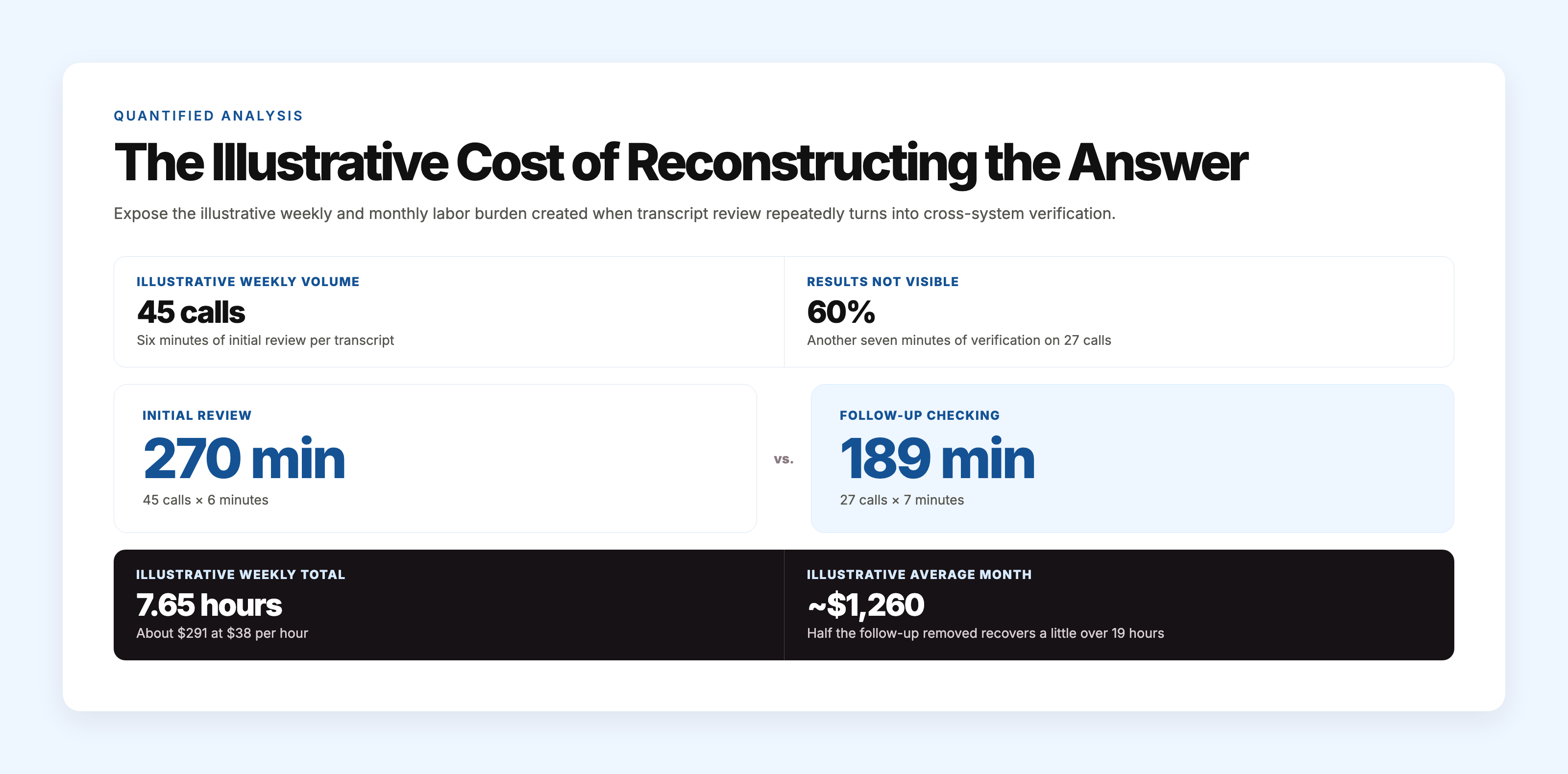
The weekly math is straightforward. Initial review takes 45 calls multiplied by six minutes, or 270 minutes. Follow-up checking applies to 27 calls and takes 189 minutes. That produces 459 minutes—7.65 hours of review and verification each week. At a loaded labor cost of $38 per hour, the work costs about $291 weekly, or roughly $1,260 in an average month. These figures are illustrative, but the work pattern is recognizable: open the transcript, search another system, send a message, wait for a reply, and reopen the record later.
That expense is not caused by transcription itself. Some review would happen regardless, and many businesses gain real value from having searchable text. The avoidable portion comes from repeatedly reconstructing the same chain of events because the result or owner is not visible where the review begins. If half of the follow-up verification in this example could be removed, the business would recover a little over 19 hours per month.
Repeated work also appears at the employee level. A manager asks a sales representative whether a quote was sent. The representative searches the sent folder and replies that operations was supposed to revise the freight charge first. Operations then checks the order notes and forwards a message showing that the revised amount was sent to sales two days earlier. Three people revisit the same inquiry, not because the call was unavailable, but because the handoff and final action were not recorded in one usable chain.
The larger opportunity is better learning. If managers label calls as successful because the caller sounded positive, conversion reporting becomes unreliable. A wholesale food distributor may hear a recurring buyer agree to an order adjustment, only to have inventory changes force a substitution later. The sales representative may leave the call expecting a 40-case order, while the warehouse can supply only 24 cases of the requested item. Purchasing approves a substitute, but the buyer reduces the total because the replacement does not fit the week’s menu. If the shipped order is never connected to the call, management may credit the original conversation for revenue that did not materialize—or miss the inventory condition that changed the order.
A Practical Test for What the Transcript Can Actually Support
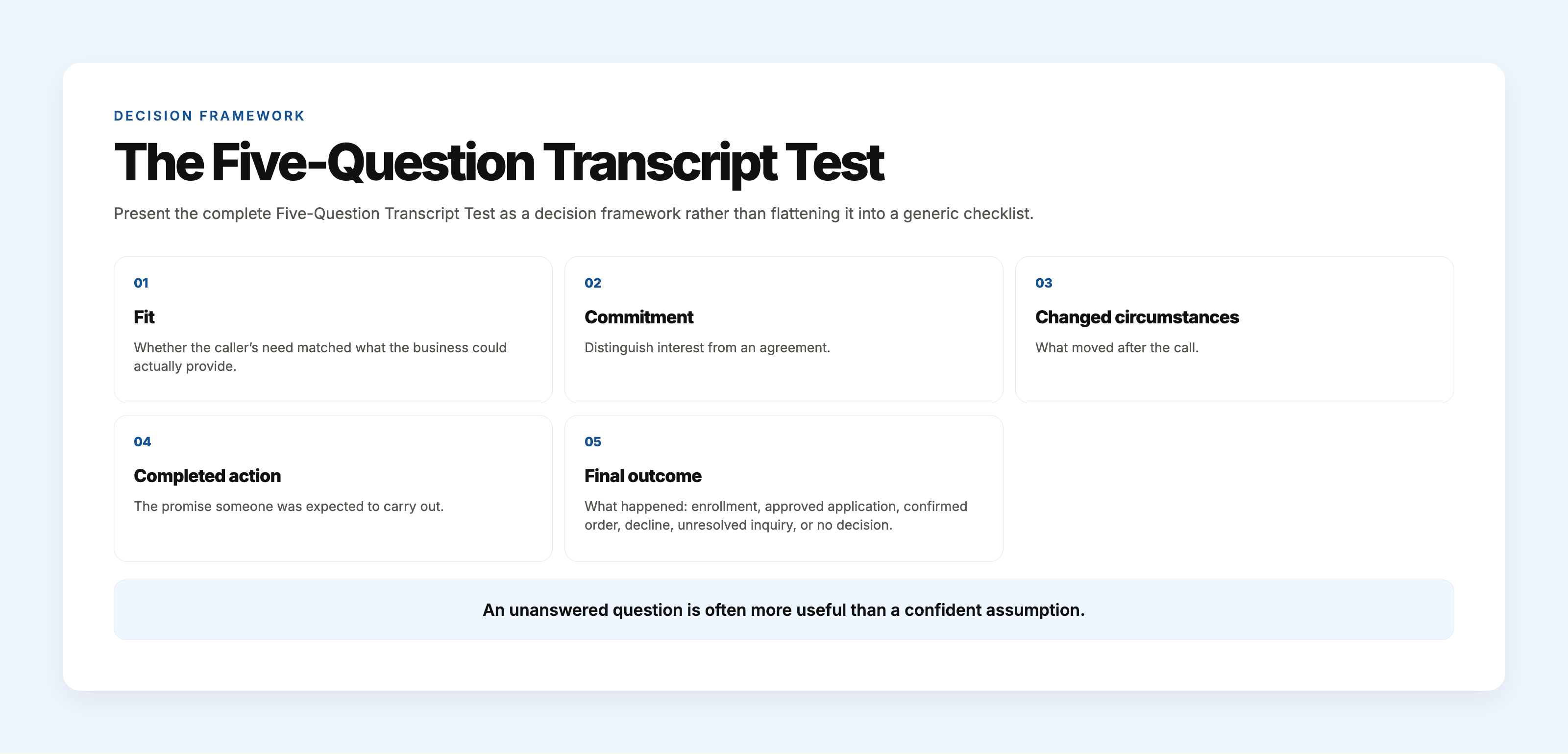
A useful way to review AI call transcripts is the Five-Question Transcript Test. It is not a score for employee performance or a proprietary rating model. It reflects the questions managers already ask when a call looks promising but the business result is unclear: fit, commitment, changed circumstances, completed action, and final outcome.
Fit concerns whether the caller’s need matched what the business could actually provide. In the tutoring-center call, the parent wants a particular subject, grade level, and workable day. The transcript captures those stated needs, but a manager reviewing the inquiry still has to determine whether an instructor and suitable time were genuinely available. In a leasing office, the same review may turn on move-in timing, pet requirements, income documentation, or unit capacity. The operational mistake is not missing a positive phrase. It is allowing enthusiasm to stand in for qualification when a decisive condition remains unchecked.
Commitment distinguishes interest from an agreement. “That sounds good” may mean the caller wants to continue the conversation. It does not carry the same operational weight as a paid deposit, an approved order, a signed application, or acceptance of a confirmed date. Staff feel this difference when one person enters the inquiry as likely to close while another is still waiting for payment before reserving capacity. If the language does not establish a definite commitment, the record remains open rather than becoming a completed decision.
Changed circumstances concern what moved after the call. A reviewer may find that the employee’s statement was correct at 9:10 a.m. and unusable by 11:30 because staffing changed. A distributor may have had inventory when the buyer called but encountered a warehouse shortage before the order was released. A quoted price may require revision after delivery details arrive. This question keeps a later problem from being incorrectly attributed to the original conversation.
Completed action concerns the promise someone was expected to carry out. When the transcript says, “I’ll send the specifications today,” the practical review question is whether a sent message, completed task, or account note exists. If Maya promised confirmation, the next record needs to show who owned that confirmation and whether it occurred. Otherwise, the business has visible activity without settled responsibility. A promise without an owner often survives in the transcript longer than it survives in the workflow.
Final outcome concerns what ultimately happened: enrollment, approved application, confirmed order, declined request, unresolved inquiry, or no decision. This is the point where the manager stops inferring from tone and looks for the actual business event. The tutoring-center parent submitted a form but enrolled elsewhere. The wholesale buyer verbally accepted an adjustment but received a smaller shipment. Those are not contradictions in the transcript; they are later outcomes that complete the record.
The five questions do not require every answer to appear inside the call. Most of the time, they expose exactly where another source is needed. They also prevent a common review error: turning a well-handled conversation into a success label before the promised work, changed conditions, and customer decision are known. In operational review, an unanswered question is often more useful than a confident assumption.
Connecting the Call to the Result Without Overstating the Evidence
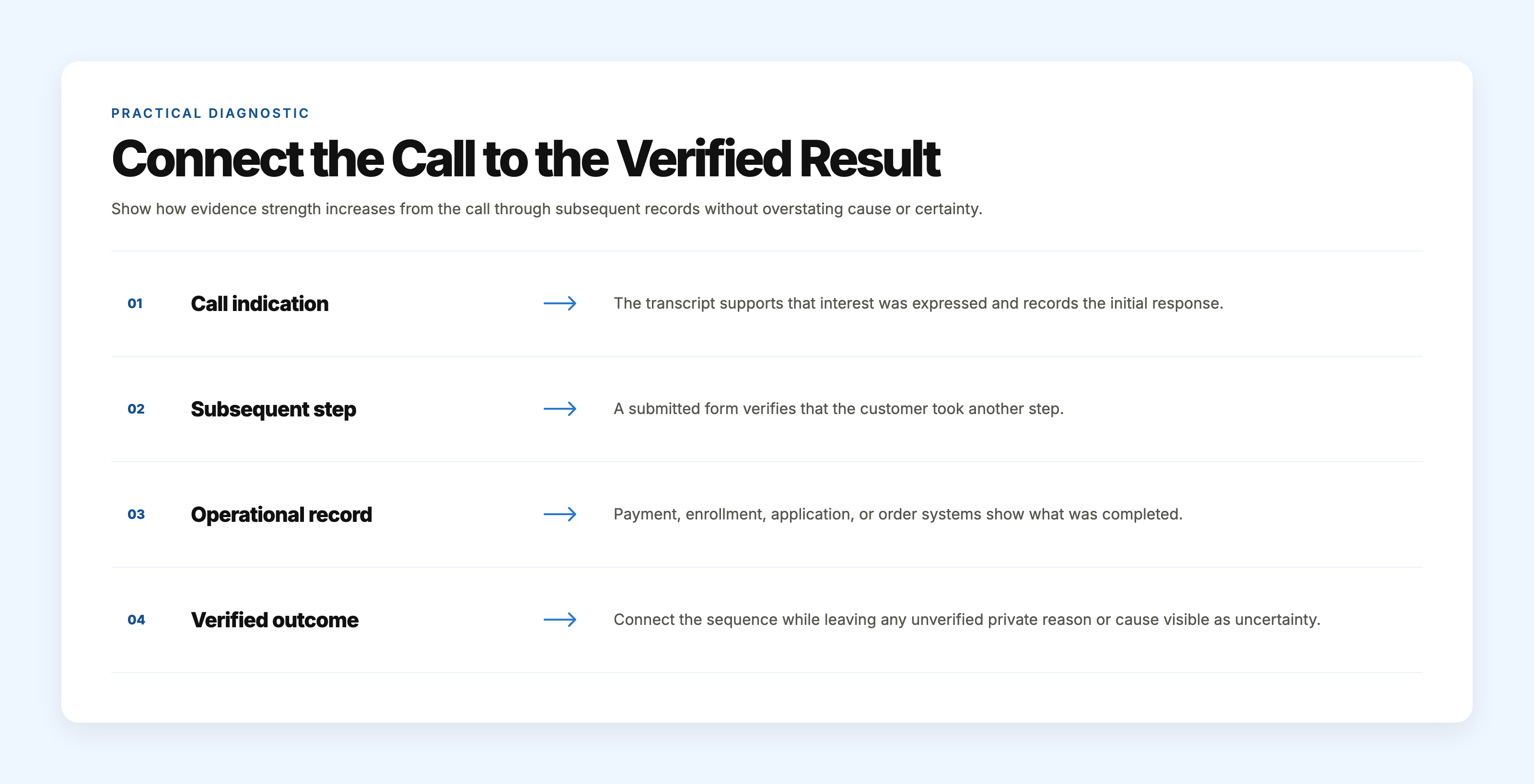
Connecting a call to a later result begins with a modest standard: keep what the call indicates separate from what subsequent records verify. If a parent asks for registration materials, the transcript supports the statement that interest was expressed. A submitted form verifies that the parent took another step. Payment or an active enrollment record establishes a stronger outcome.
The same approach applies to a property application or wholesale order. A prospective tenant may say they intend to apply, but the application system shows whether they did and whether the application could proceed. A buyer may verbally accept a substitution, while the order system shows the quantity eventually confirmed and shipped. The call record explains the request and the initial response. The operational systems show what the business and customer ultimately completed.
The connection does not need to become a large implementation project. Some businesses begin with one recurring call type, such as new enrollment inquiries, leasing calls, or order adjustments. A consistent call identifier or customer reference then follows the inquiry into the later application, order, or account event. During review, the manager is no longer trying to recognize a caller from memory or asking three employees whether anyone knows what happened.
Even a narrow connection can expose ownership problems. If a registration form arrives after a call, the record can show whether the coordinator, office assistant, or director owns the next response. If an order changes after a buyer conversation, the account history can show who must confirm the revised quantity. The value is not merely cleaner reporting. It is fewer situations in which two employees each believe the other person completed the customer-facing action.
Care is still needed when assigning cause. A completed sale does not prove that every part of the call was effective. A lost opportunity does not prove that the employee handled it poorly. Price, timing, competitor availability, internal approval, and personal circumstances may all affect the decision. Sometimes the records establish the sequence without revealing the customer’s private reason. That uncertainty is better left visible than replaced with a confident label based on tone.
This is where call analysis begins to support operational improvement. Managers can examine whether clear commitments were followed by completed actions, whether qualification questions identified workable customers, and whether delays repeatedly appeared before incomplete outcomes. The strongest review is not the one that extracts the most meaning from the transcript. It is the one that knows where the transcript’s evidence ends.
Where TMMN Fits Into a More Complete View of Voice Interactions
TMMN approaches voice interactions as part of the operating path around the call, not as an isolated body of text. The practical questions are familiar: where the call enters, which employee answers, what commitment is made, where the next task is recorded, who owns the handoff, and which system holds the final result. That perspective keeps transcription in its proper role while exposing the gaps that affect customers after the line goes quiet.
A phone environment may capture the call and produce an accurate transcript, while the actual work continues through a shared inbox, scheduling board, customer record, order platform, or application system. When those paths are reviewed separately, a manager can hear an excellent conversation and still miss an unassigned follow-up. Communication maturity shows up in whether the promise made on the phone can be followed through the business without depending on one employee’s memory.
This operating boundary matters because VoIP and AI tools are often assessed primarily on recording quality, transcription accuracy, summaries, keyword flags, and sentiment labels. How VoIP Can Save Your Business Money further highlights that technology alone is insufficient; integrating communication systems with workflows is essential for operational insight beyond transcription.
Those capabilities improve access to the call. A concise summary can make ten minutes of dialogue easier to scan, and better transcription can correct names or order numbers. Neither one can confirm that Daniel updated Maya, that Lena contacted the parent, or that the distributor shipped the quantity discussed.
TMMN’s systems perspective is most useful at those boundaries. The call platform can preserve the conversation. The scheduling system remains responsible for current availability. The application or order system remains responsible for status. Staff ownership determines whether the next action happens. Review becomes more reliable when each source answers the question it was designed to hold rather than forcing the transcript to serve as the final record for all of them.
Capturing every call creates a larger body of source material, not automatic certainty. Keyword and sentiment flags can direct attention to a complaint, pricing question, or expression of hesitation, but they cannot prove resolution, customer suitability, or conversion. A caller can sound doubtful and still purchase. Another can sound enthusiastic and quietly select a competitor the next morning. The operational response is not to dismiss those signals; it is to verify them against the action and outcome that followed.
Key Takeaways
AI call transcripts establish what was said, not everything that happened next.
Positive language is not the same as customer fit, commitment, or conversion.
Schedule changes, inventory updates, and unclear handoffs can overturn an otherwise well-handled call.
A promised action becomes operationally meaningful only when ownership and completion are visible.
Reliable call analysis connects the conversation to later records without overstating cause.
Conclusion
Voice becomes more useful when the people responsible for the next decision can see enough context to act without reconstructing the entire history. That means respecting what speech reveals, linking it carefully to staff actions and verifiable results, and leaving final records in the systems designed to hold them. Transcription software does not need to replace those systems to become more valuable. It needs a clear place among them.
When assessing AI call transcripts, accuracy remains an important standard, but it is not the final one. A 14-day free trial can help a team test whether clearer communication context improves the continuity of everyday customer work.
The business also needs to know which event followed, which circumstances changed, who owned the promised action, and whether that action was completed. A transcript is valuable source material. Its authority ends where the call ends; operational understanding begins when the rest of the record is connected.

.svg)