“Omnichannel” has become one of those terms that sounds impressive but vague. For many businesses, it feels like something large enterprises talk about — layered systems, complex integrations, and expensive platforms that promise a better customer experience but introduce more friction internally.
That misunderstanding has created a gap. Customers already behave omnichannel. They text, call, follow up, and switch channels naturally based on what they need in the moment. Research on modern customers expecting an omnichannel experience shows that people increasingly assume businesses will maintain continuity as they move between communication channels. The complexity doesn’t come from customer behavior — it comes from how businesses respond to it.
In reality, omnichannel communication isn’t about being everywhere at once. It’s about making conversations feel continuous. When done right, it doesn’t feel complicated to the customer or the team. It feels calm, organized, and trustworthy.
This article breaks down how omnichannel communication builds customer trust — and why it doesn’t require adding layers of complexity to do it well.
Why Customers Associate Consistency With Trust
Trust in business communication isn’t built through big gestures. It’s built through predictability.
When customers reach out to a business, they’re not consciously evaluating systems or tools. They’re paying attention to how the interaction feels. Does the business seem to know what’s going on? Does the conversation move forward smoothly? Does the response align with what was said before?
Consistency answers all of those questions quietly.
Predictability Reduces Effort
Customers trust experiences that don’t make them work. Many small companies discover that simple texting workflows dramatically reduce customer effort while keeping conversations organized, which is exactly why businesses adopt messaging platforms described in Business Texting for Small Companies: What Are the Benefits?
When responses feel aligned, when information doesn’t change depending on who they talk to, and when conversations pick up naturally, customers feel confident that the business is organized. That confidence doesn’t come from speed alone. It comes from knowing what to expect next.
Inconsistent communication creates hesitation. Even small mismatches — a repeated question, a slightly different answer, a missing detail — introduce doubt.
Continuity Signals Competence
A continuous conversation signals that the business is paying attention.
When a customer doesn’t have to restate their issue or explain context again, it creates the impression of competence and care. It shows that the business has systems in place that support the team — and by extension, the customer.
This is why consistency has become such a powerful trust factor. It removes uncertainty, and uncertainty is what erodes confidence fastest.
What Omnichannel Really Means (Without the Jargon)
For many businesses, “omnichannel” sounds like more channels, more software, and more complexity. That assumption misses the point.
Omnichannel communication isn’t about how many ways a customer can contact you. It’s about whether those ways are connected.
It’s Not About Being Everywhere
Being available on multiple channels doesn’t automatically create a better experience. In fact, when those channels don’t talk to each other, it often makes things worse.
A business can offer texting, calling, email, and chat — and still feel disorganized if each interaction exists in isolation. Customers experience that as fragmentation, not flexibility.
Omnichannel Is About One Conversation
At its core, omnichannel means this: no matter how a customer reaches out, the conversation stays intact.
If a customer starts with a text and follows up with a call, the context should carry forward. If a different team member steps in, they should be able to see what’s already been discussed. If a conversation pauses and resumes later, it shouldn’t restart from zero.
When that happens, communication feels natural instead of mechanical.
Simple Omnichannel Feels Invisible
The best omnichannel experiences don’t call attention to themselves. They don’t feel “advanced” or technical. They simply feel smooth.
Customers don’t think, This business has an omnichannel strategy. They think, This is easy. They know what’s going on. That’s the standard omnichannel communication is meant to meet — and it’s far simpler than most businesses expect.
The Difference Between Multichannel and Omnichannel — And Why It Matters
At first glance, multichannel and omnichannel sound similar. Both involve offering customers more than one way to get in touch. That surface-level similarity is what causes so much confusion.
The difference isn’t about channels. It’s about continuity.
Multichannel: Many Doors, Separate Rooms
Multichannel communication means customers can reach your business through different channels — text, phone, email, chat — but each one operates independently.
From the business side, this often looks functional. Each channel has its own tool, its own workflow, and its own metrics. Teams respond quickly. Messages get answered. Calls get returned. From the customer’s perspective, however, each channel feels like a separate doorway into a different conversation.
A customer might text in the morning, then call later with a follow-up. When the person on the phone has no visibility into the earlier messages, the customer experiences a reset. They’re not continuing a conversation. They’re starting over.
That’s multichannel.
Omnichannel: One Conversation Through Every Door
Omnichannel communication works differently.
Instead of treating each channel as a separate interaction, it treats them as different ways of accessing the same conversation. The channel can change, but the context doesn’t.
A customer can begin with a text, switch to a call when things get more complex, and follow up later — without repeating themselves or re-establishing the situation. Internally, the team sees one continuous thread rather than scattered fragments. That continuity is what makes omnichannel feel calm and professional. It signals that the business is organized behind the scenes, even when multiple people or channels are involved.
Why the Distinction Matters
Multichannel availability increases access. Omnichannel continuity builds trust.
Customers don’t reward businesses for offering more contact options. They trust businesses that make communication feel coherent. This is why many businesses begin by aligning texting and voice communication so conversations remain consistent across channels, a principle explored in Business Texting vs Phone Calls: How to Use Both Effectively. The difference between those two approaches is subtle in terminology, but dramatic in experience.
How Disconnected Communication Quietly Breaks Trust
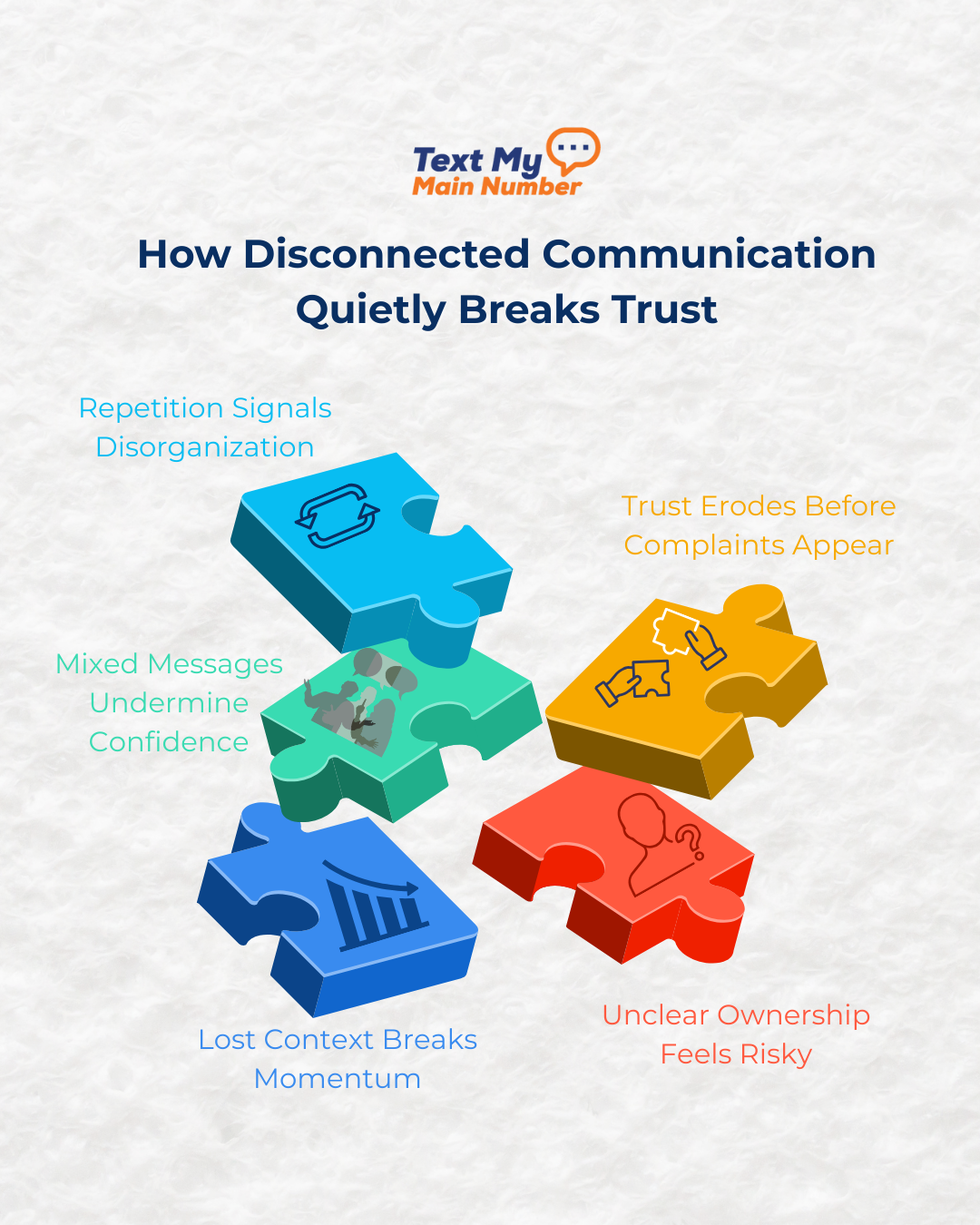
Most communication breakdowns don’t feel dramatic in the moment. They feel small, even understandable. That’s why they’re so easy to overlook. But trust isn’t lost in a single failure. It erodes through repetition.
Repetition Signals Disorganization
When customers are asked to repeat information, it’s not just annoying — it sends a message.
It suggests that the business doesn’t have a clear view of the conversation. Even if the team is friendly and responsive, repetition creates doubt about whether anyone is truly tracking what’s happening. Over time, customers stop expecting continuity — and lower expectations are rarely a good thing.
Mixed Messages Undermine Confidence
Disconnected systems often lead to inconsistent answers.
One person gives an estimate. Another explains a different timeline. A third follows up without referencing either. None of this may be intentional, but from the customer’s perspective, it feels unreliable. Trust depends on alignment. When communication isn’t connected, alignment becomes fragile.
Lost Context Breaks Momentum
Conversations depend on momentum.
When context is lost between messages, calls, or handoffs, progress slows. Customers feel like they’re stuck in neutral, constantly re-establishing ground that should already be covered. Momentum matters because it signals competence. When things keep moving forward, customers feel reassured. When they don’t, trust starts to fade.
Unclear Ownership Feels Risky
Perhaps the most damaging issue is unclear ownership.
When customers don’t know who’s handling their request — or feel like they’re being passed around — confidence drops quickly. Even small uncertainty about responsibility creates hesitation about moving forward.
Trust requires a sense that someone is accountable, informed, and in control.
Trust Erodes Before Complaints Appear
The most important thing to understand is this: customers rarely complain when trust starts to erode. They disengage.
They delay decisions. They stop following up. They look elsewhere. By the time a problem becomes visible, the opportunity is often already lost. Disconnected communication doesn’t just create inconvenience. It quietly reshapes how customers feel about the business — and trust is the first thing to go.
How Omnichannel Communication Builds Trust in Practice

Trust isn’t built by announcing that you’re “omnichannel.” It’s built through a series of small, consistent experiences that make customers feel understood, guided, and taken care of.
When omnichannel communication is done well, most customers never notice the system behind it. They just notice that things feel easier.
Customers Feel Remembered
Imagine a customer texts a business asking about pricing. Later that day, they call to clarify a few details. The person on the phone already knows what was discussed, what the customer is considering, and where the conversation left off.
Nothing needs to be repeated. Nothing needs to be re-explained.
That experience immediately signals competence. The customer feels remembered, not processed. Even without saying it out loud, they trust that the business is paying attention. This isn’t personalization for marketing’s sake. It’s basic continuity — and it goes a long way in building confidence. Consistent communication plays a major role in long-term relationships, which is why businesses that maintain clear messaging workflows often see stronger retention patterns outlined in Customer Loyalty and SMS Texting: Best Practices for Retention.
Conversations Feel Intentional, Not Reactive
In fragmented setups, conversations often feel reactive. Each message responds only to the last thing said, without a clear sense of direction.
Omnichannel communication changes that dynamic. When teams can see the full conversation — across texts, calls, and follow-ups — responses feel more deliberate. Customers sense that there’s a plan, not just a reply. They understand what’s happening next and who’s handling it.
That sense of intention reassures customers that they’re not stuck in an endless loop of messages.
Issues Are Resolved Faster Without Feeling Rushed
Faster resolution doesn’t always mean shorter conversations. It means fewer unnecessary steps.
In real business scenarios, a customer might start with a text, hit a point of confusion, and then move to a quick call. With context already visible, that call can resolve the issue in minutes instead of dragging on across multiple messages. The customer doesn’t feel rushed. They feel helped.
Speed, in this case, comes from clarity — not pressure.
Businesses Feel Organized From the Outside
Customers are remarkably good at sensing organization.
When communication is connected, businesses appear calm and confident. There’s less backtracking, fewer mixed messages, and no visible scrambling behind the scenes. Even small interactions reflect that structure. And when customers perceive an organization, they’re more willing to trust timelines, pricing, and recommendations.
Why Omnichannel Communication Feels Complicated
.png)
For many businesses, the word “omnichannel” triggers a defensive reaction. It sounds like more tools, more setup, and more disruption than they can afford.
That fear is understandable — but it’s based on a misconception.
The Fear Comes From Tool Overload
Most businesses already feel stretched managing multiple systems. Adding another layer sounds like the opposite of progress.
When omnichannel is framed as “support every channel everywhere,” it feels expensive, complex, and unnecessary. That’s not what customers are asking for — and it’s not what effective omnichannel requires.
Complexity Is Usually a Result of Disconnection
What makes communication complicated isn’t the number of channels. It’s the lack of connection between them.
Businesses struggle not because they offer texting and calling, but because those conversations live in separate places. Many teams begin solving this problem by evaluating communication platforms that bring messages into one place, a comparison explored in Best Business Texting Apps for Small Businesses: Compare Features & Free Trials. Teams are forced to switch tools, reconstruct context, and rely on memory to stay aligned.
That’s where the complexity lives — not in omnichannel itself.
Omnichannel Is About Connection, Not Expansion
At its simplest, omnichannel communication is about one thing: keeping conversations intact as they move.
It doesn’t require a massive overhaul. It doesn’t require supporting every platform imaginable. For most growing businesses, it starts with connecting the channels customers already use — usually SMS and voice — and making sure those interactions share context and visibility. When omnichannel is approached as a connection rather than an expansion, it stops feeling intimidating. It feels practical.
And more importantly, it feels like progress that customers can actually experience.
What Simple Omnichannel Actually Looks Like for Growing Businesses
For growing businesses, omnichannel doesn’t mean being everywhere. It means being connected where it matters.
Most customers don’t need ten ways to reach you. They rely on two primary modes of communication: texting for convenience and calling for clarity. Simple omnichannel starts by treating those two channels as part of the same conversation instead of separate workflows.
When SMS and voice are connected, communication begins to feel intentional instead of reactive. A customer might text to ask a quick question, then move to a call when the discussion becomes more detailed. That transition shouldn’t require resetting the conversation or rebuilding context. It should feel natural — because it is.
The second pillar of simple omnichannel is shared visibility. As soon as more than one person is involved in customer communication, private inboxes become a liability. Teams need to see what’s already been said, what’s pending, and who owns the next step. Shared visibility eliminates guesswork and prevents conversations from stalling simply because someone was out of the loop.
Clear handoffs matter just as much. In well-designed omnichannel systems, responsibility doesn’t shift silently. When one team member steps away and another steps in, the conversation continues without friction. Customers don’t feel passed around. Internally, accountability stays intact.
Most importantly, simple omnichannel maintains one conversation, not many disconnected threads. Whether a customer texts today, calls tomorrow, or follows up next week, the interaction feels like a single, continuous exchange. That continuity is what customers interpret as professionalism — and what teams experience as relief.
How Text My Main Number Simplifies Omnichannel Without Adding Complexity
Text My Main Number is built around a clear philosophy: omnichannel communication should reduce complexity, not introduce more of it.
Instead of layering enterprise-style systems on top of already fragmented workflows, TMMN focuses on continuously simplifying how businesses manage customer conversations. It brings SMS and VoIP together into one shared communication platform where context, history, and ownership are always visible.
As teams grow, Text My Main Number evolves with them. Conversations don’t splinter as volume increases. New users don’t create new silos. Communication remains centralized, readable, and easy to step into — even as the business scales.
What makes this approach different is the intention. TMMN isn’t trying to be everything at once. It’s steadily building toward a true omnichannel platform by solving the most common communication problems businesses face: lost context, broken handoffs, duplicated effort, and customer frustration.
That ongoing simplification is what allows teams to feel organized without feeling overwhelmed. Customers experience smoother conversations without knowing or caring what system is behind them — which is exactly the point. For a clearer explanation of how businesses bring texting, calling, and team visibility together without adding complexity, this article breaks down what unified communications actually means for small businesses and why it plays such a big role in building customer trust.
Trust Is Built in How Conversations Continue
Customers don’t decide to trust a business based on a single interaction. Trust is built in the moments between messages — when context carries forward, when nothing has to be repeated, and when communication feels steady rather than scattered.
Omnichannel communication works not because it adds more options, but because it removes friction. When conversations stay connected across text and voice, customers feel understood. Teams feel confident. And communication stops being something you have to manage carefully just to avoid mistakes. Text My Main Number is designed to support that kind of experience — one where SMS and voice work together inside a single, evolving system built to keep conversations clear as your business grows.
If your current setup feels more complicated than it should, this is a simple place to start.
Try a 14-day free trial and see how connected texting and VoIP can make customer communication feel calmer, clearer, and more trustworthy — without adding complexity.

.svg)