

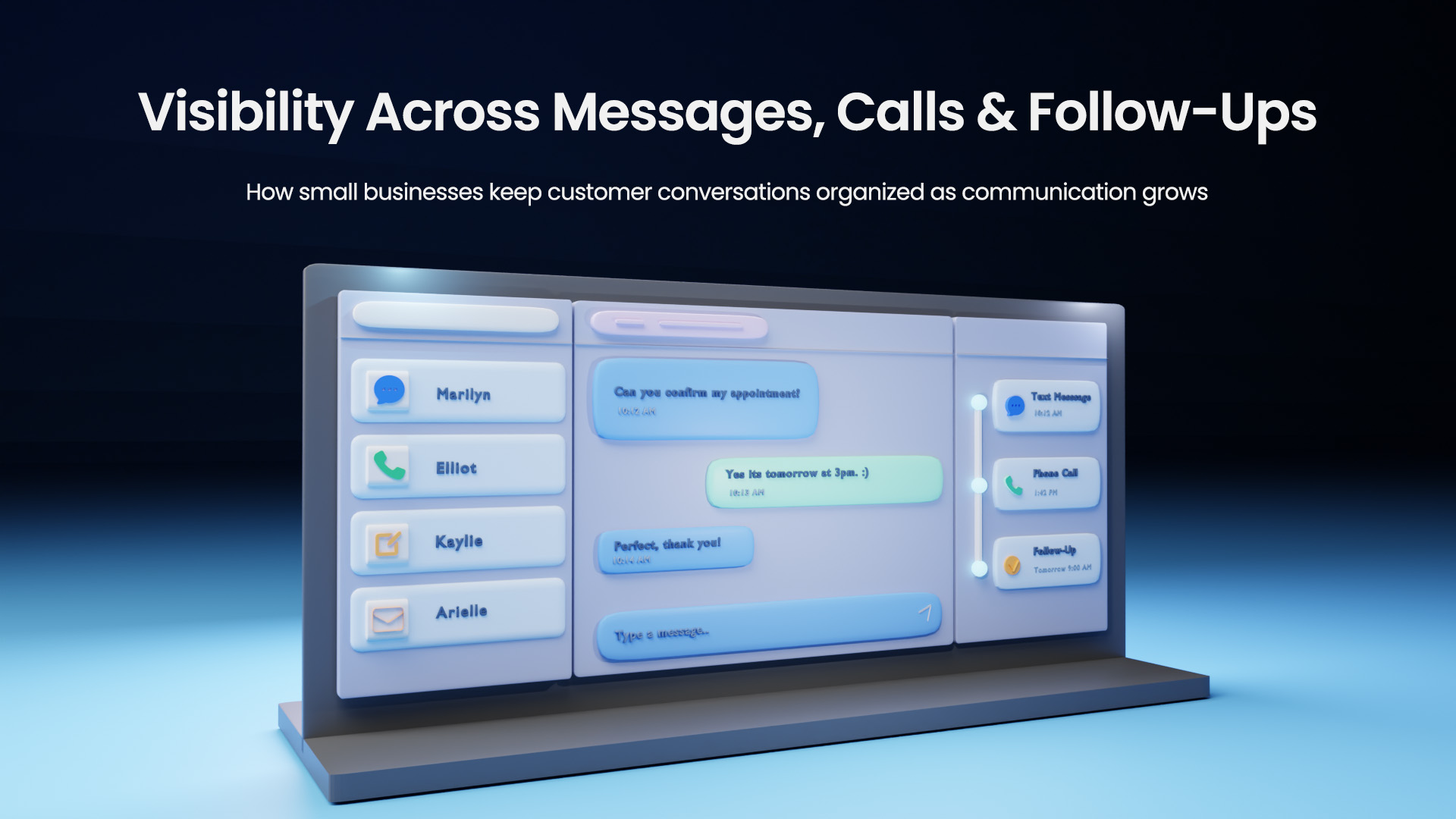

Most small businesses don’t lose customers because they’re slow or careless. They lose customers because communication gets fragmented in ways that are almost invisible while you’re in the middle of running the day. A customer texts a question at 10:12. Someone replies. The same customer calls later. A different person answers. Then there’s a follow-up email, a missed voicemail, and a note someone meant to log but never did. Everyone on your team is “responsive” — yet the customer still feels like they’re dealing with separate departments instead of one business.
That gap is what customer communication visibility solves.
Visibility is what turns scattered touchpoints into a single, continuous conversation. It’s how teams stop guessing what happened last, stop repeating questions that were already answered, and stop letting follow-ups slip just because they weren’t written down in the right place.
And this isn’t just a small-business problem. Research on modern work consistently shows that constant app switching and fragmented communication drain time and focus, even for experienced teams. Harvard Business Review has written about the hidden energy cost of toggling between applications throughout the day, which mirrors exactly what happens when customer conversations live in multiple places. Microsoft’s Work Trend Index research also highlights how frequently people are interrupted by messages, meetings, and notifications, creating a work environment that feels “chaotic and fragmented” even when everyone is technically working.
In customer communication, those interruptions don’t just reduce productivity. They show up as missed context, inconsistent answers, and slow handoffs — which customers interpret as disorganization.
Speed Isn’t the Same as Customer Communication Visibility
A lot of businesses think they have a communication problem when what they really have is a visibility problem inside the systems they use to manage customer conversations. They respond quickly, but they don’t see the full story.
That difference matters because customers don’t judge you on how fast you reply.They judge you on whether your responses make sense in context and whether the conversation moves forward without confusion.
Fast Replies Can Still Create a Bad Experience
Here’s what “fast but low-visibility” looks like in real life:
A customer texts: “Can you confirm my appointment time?”
Your team replies within two minutes: “Yes, what day?”
The customer is annoyed because they already told you the day before yesterday, but that history is sitting in a different thread on a different phone.
From your side, the response was fast. From their side, it feels like you’re not paying attention.
The same thing happens with calls. A customer leaves a voicemail about a billing issue. Someone calls back quickly — but without seeing the prior texts about the same issue. The call becomes a reset instead of a continuation. This tension between speed and context is exactly why many businesses rethink when to text versus when to call, a balance discussed in Business Texting vs Phone Calls: How to Use Both Effectively.
Speed helps, but visibility prevents resets.
Visibility Means One Conversation, Not Three Separate Threads
Visibility is simple in theory: anyone on the team should be able to understand what’s going on with a customer in under 30 seconds.
That requires more than a quick inbox. It requires continuity across the main touchpoints customers use:
- Messages: What did they ask, what did we answer, and what’s still unresolved?
- Calls: Did we speak to them, miss them, or leave a voicemail — and what was said?
- Follow-ups: Who owns the next step, and when is it happening?
Without visibility, a business can be active all day while still moving customers backward.
Why Context Switching Hurts More Than People Realize
When conversations are split across tools and devices, teams pay a hidden “switching tax.” You see it in tiny moments: searching for old messages, asking coworkers what happened, reopening notes, checking missed calls, then returning to the original task.
Those moments feel small, but they compound quickly. Research on task switching shows that shifting between tasks consumes cognitive resources and contributes to mental fatigue and performance loss. And on modern teams, interruptions and constant switching are now the norm — Microsoft’s telemetry-based findings describe attention being fragmented by a steady stream of meetings, email, and notifications.
In a customer-facing business, that same fragmentation shows up externally as hesitation, inconsistency, and dropped follow-ups.
The Trust Angle: Customers Read Fragmentation as Disorganization
This is the part many teams miss: customers don’t interpret broken continuity as an internal tooling issue. They interpret it as a competence issue.
Research on omnichannel experiences shows that consistency across channels builds trust and that inconsistent experiences make customers question an organization’s credibility. So even if your team is working hard and responding quickly, low visibility creates a trust problem. The customer feels like they’re managing the conversation for you.
Visibility flips that dynamic. It makes the business feel steady: one team, one conversation, clear next steps.
What Visibility Really Means in Customer Communication
Visibility in customer communication isn’t just about seeing messages and calls in one place. It’s about understanding the full story of the interaction — not just the latest exchange — and making that story accessible to anyone on your team without guesswork, reconstruction, or memory.
This goes beyond responsiveness. Many businesses can reply fast. What they struggle with is continuity — the ability to see what has already happened, why it matters, and what needs to happen next.
Research in organizational communication supports this. Effective communication systems don’t just transmit information quickly — they preserve context and make it retrievable. A study on knowledge management shows that organizational memory — the ability to retain and reuse past interactions — is a key driver of performance and decision quality.
When visibility exists, teams don’t have to reconstruct conversations from fragments. They can act with confidence.
Seeing the Full Conversation, Not Just the Latest Message
Too often, small business communication tools only show the last touchpoint — the most recent message or call. That’s short-sighted.
Visibility means:
- Conversation history that shows all interactions with a customer, across channels
- Call logs linked to those interactions, not siloed in a phone system
- Follow-up reminders or tasks tied to specific conversation outcomes
- Notes or tags that explain context or decisions from prior interactions
A simple example:
A customer texts about a billing question. Two days later, they call with a related issue. If those interactions are not linked, every agent — and every channel — treats them as separate problems. The customer gets asked to repeat information. They experience delay. They lose confidence.
When visibility ties those touchpoints together, every member of the team sees the entire timeline:
Initial text and what was asked
Follow-up call and what was clarified
Any commitments or next steps
Who owns the follow-up and when it’s due
That’s the difference between transactional replies and informed responses.
Breaking Down Visibility in Practice
To make this concrete, here are practical forms that visibility should take in everyday workflows:
Unified Conversation History
Not just messages, but the sequence of how the interaction evolved, including:
- Texts sent and received
- Calls made, received, or missed
- Internal notes explaining context
Think of this as a timeline, not a collection of isolated events. In healthcare systems research, continuity of information across touchpoints is linked directly to better service outcomes. When clinicians have full histories, errors drop and satisfaction rises. The same applies to customer communication.
Shared Team Visibility
Everyone who interacts with customers should see the same information. That means:
- No personal inboxes where conversations disappear when someone leaves
- No separate phone logs that aren’t linked to customer records
- No fragmented notes in different applications
Shared visibility ensures that any team member can step in without slowing the customer down.
Follow-Up Tracking and Accountability
Visibility isn’t passive observation. It’s about actionability:
- Who is responsible for the next step?
- When should it happen?
- What’s the context for that follow-up?
This prevents stalled conversations simply because no one knew it was their turn to act.
Searchable Context for Faster Decisions
In a fragmented system, teams spend time searching for old messages or asking colleagues what happened. Visibility means those searches are fast and intuitive — like retrieving a complete file instead of assembling pieces from memory.
Why Visibility Isn’t Just “More Data”
Visibility isn’t about dumping all interactions into a dashboard and hoping it helps. It’s about making that information meaningful.
A concept from human-computer interaction research called “information scent” describes how users follow contextual cues to find what’s relevant. In communication systems, the “scent” of context makes it easier for teams to understand what matters quickly, without friction.
That means:
- Clear labels on conversation threads
- Recorded reasons for task assignments
- Time-stamped interactions that show sequence and ownership
- Easy access to previous decisions and commitments
This is visibility that supports human decision-making, not just displays more lines on a screen.
The Trust Dividend of Clear Visibility
When visibility is real, customers notice — even if they don’t describe it that way.
They don’t have to repeat themselves. They don’t feel like they’re explaining context to every person they speak with. They feel like someone in the business knows them, and that creates trust.
Customer experience research consistently shows that continuity in interaction — the sense that the business “remembers” the customer — is a strong predictor of satisfaction and loyalty.
Visibility isn’t a technical luxury. It’s the difference between a customer feeling like they’re being handled and feeling like they’re being heard.
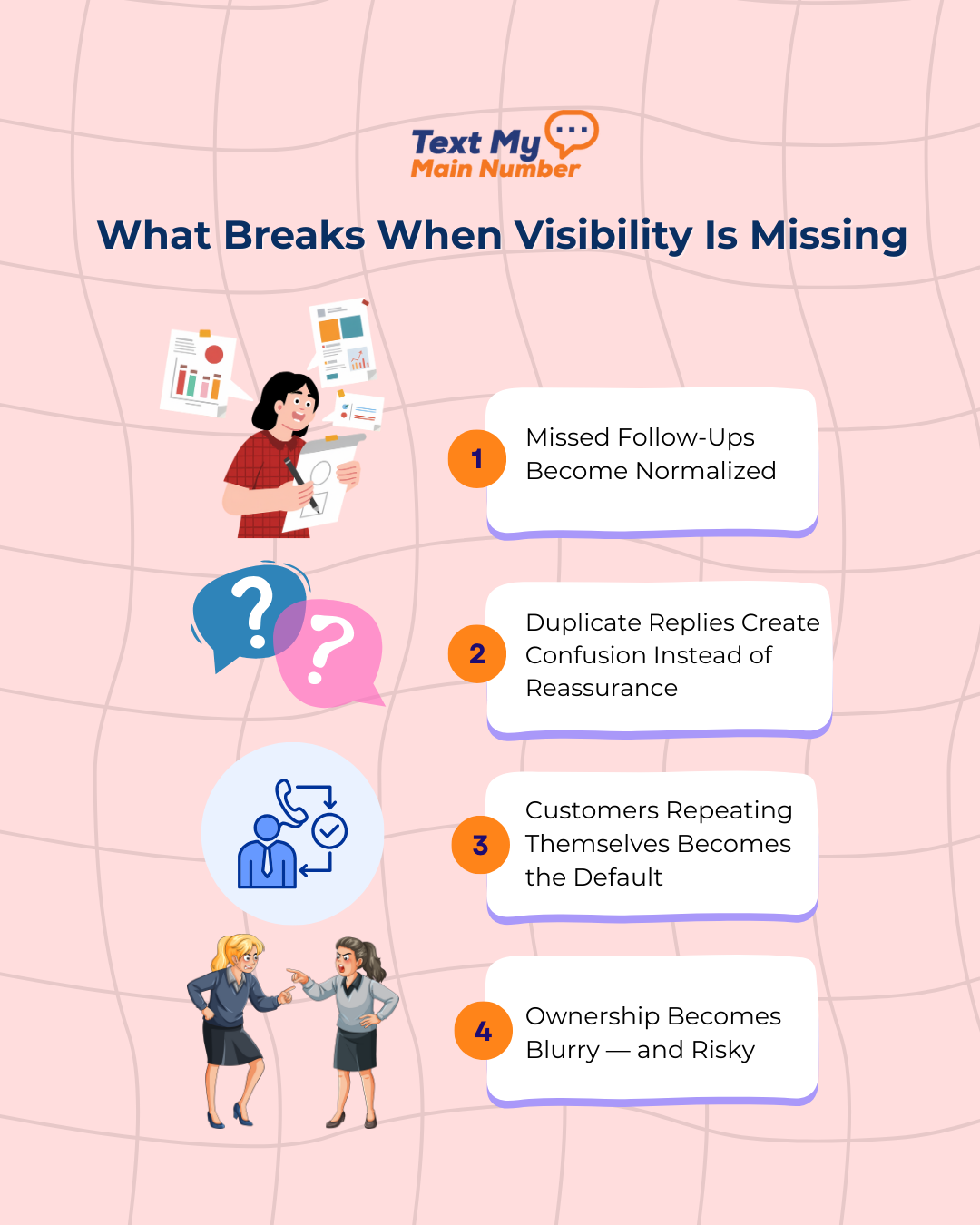
What Breaks When Visibility Is Missing
When visibility is missing, things don’t usually fail all at once. They unravel quietly.
Most small businesses don’t notice the problem immediately because everyone is still working hard. Messages are answered. Calls are returned. Follow-ups happen — sometimes. From the inside, it feels busy. From the outside, it feels disjointed.
That gap is where trust starts to erode.
Missed Follow-Ups Become Normalized
Without shared visibility, follow-ups rely on memory instead of systems.
Someone thinks they’ll reply later. Another assumes it was already handled. A note lives in one inbox, while the call that prompted it lives somewhere else. No one intentionally drops the ball — but the ball still gets dropped.
Research on task management and follow-through shows that when responsibility isn’t clearly visible and tracked, completion rates drop sharply, even among high-performing teams. This is why project management systems emphasize shared task visibility rather than personal reminders. The same principle applies to customer communication.
For customers, a missed follow-up doesn’t feel like a mistake. It feels like indifference.
Duplicate Replies Create Confusion Instead of Reassurance
In low-visibility environments, duplicate replies are common.
Two team members respond to the same message. One answers part of the question, the other answers differently. Or a customer gets a text after already resolving the issue on a call.
Instead of feeling supported, the customer feels uncertain. Which response is correct? Who’s actually handling this?
From a trust perspective, duplication signals lack of coordination — and coordination is closely tied to perceived competence. Studies in service design show that consistency across touchpoints strongly influences how reliable a business feels to customers.
Customers Repeating Themselves Becomes the Default
One of the clearest symptoms of missing visibility is repetition.
Customers explain their issue once by text. Then again on a call. Then again when they follow up. Each repetition adds friction, but more importantly, it sends a message: the business isn’t keeping track.
This aligns with broader customer experience research. Salesforce’s State of the Connected Customer report consistently shows that customers expect companies to understand their needs without requiring repeated explanations — and that failure to do so damages trust and loyalty.
Repetition doesn’t just slow conversations. It changes how customers feel about the business.
Ownership Becomes Blurry — and Risky
When visibility is fragmented, ownership becomes ambiguous.
Who’s responsible for this customer right now? Who promised the follow-up? Who should respond next?
Internally, this creates hesitation. Externally, it feels like being passed around.
Organizational research shows that unclear ownership increases perceived risk for customers, especially in service interactions. When people don’t know who is accountable, they trust the process less — even if individual employees are polite and responsive.
Why These Breakdowns Hurt Trust More Than Speed Ever Could
Here’s the critical insight: customers are far more forgiving of delays than they are of disorganization.
A slow but coherent response feels intentional. A fast but fragmented one feels careless.
Without visibility:
- Conversations lose momentum
- Decisions take longer
- Customers feel like they’re managing the interaction themselves
And when customers feel like they’re doing the work, trust drops — quietly but decisively.
Visibility isn’t about control. It’s about coherence.
When teams can see the full picture — messages, calls, and follow-ups in one place — these breakdowns largely disappear. Not because people try harder, but because the system supports them.
Why This Problem Gets Worse as Teams Grow

When a business is small, communication problems are often masked by proximity and memory.
One or two people handle most conversations. Everyone roughly knows what’s going on. Context lives in someone’s head, and when something slips, it’s easy to patch it up with a quick internal conversation.
That safety net disappears as teams grow.
Growth Replaces Memory With Handoffs
As soon as more people touch customer communication, work starts moving between hands instead of staying with one person. A message comes in during one shift. A call happens later with someone else. A follow-up is scheduled for the next day.
Each handoff increases the risk of lost context.
Without shared visibility, teams rely on assumptions:
- Someone else probably replied
- Someone must be handling this
- I think this was already resolved
None of those assumptions are malicious. They’re natural when systems don’t make ownership and history obvious.
Organizational research shows that as team size increases, informal coordination methods break down quickly unless supported by shared systems. What works with three people rarely works with ten — and almost never works with twenty. This is why scaling organizations replace memory with process. MIT Sloan research on team efficiency and task complexity also shows that collaboration and coordination introduce overhead, especially as the number of participants increases.
Delegation Without Visibility Creates Gaps
Delegation is essential for growth. But delegation without visibility creates blind spots.
When leaders hand off communication responsibilities without giving teams full context, they unintentionally introduce risk. Employees can only act on what they see. If they don’t see the full conversation, they can’t provide continuity — no matter how capable they are.
This is why growing teams often feel like they’re “working harder” but achieving less. Effort increases, but clarity doesn’t.
Volume Magnifies Small Breakdowns
What feels like a small issue at low volume becomes a serious problem at scale.
One missed follow-up a week is manageable. Ten a day is not. One repeated explanation feels annoying. Dozens start to feel systemic.
As volume grows, small communication gaps compound. Customers feel friction more often. Teams feel pressure more intensely. Trust erodes faster because there are more opportunities for it to erode.
Growth doesn’t create communication problems. It exposes the ones that were already there.
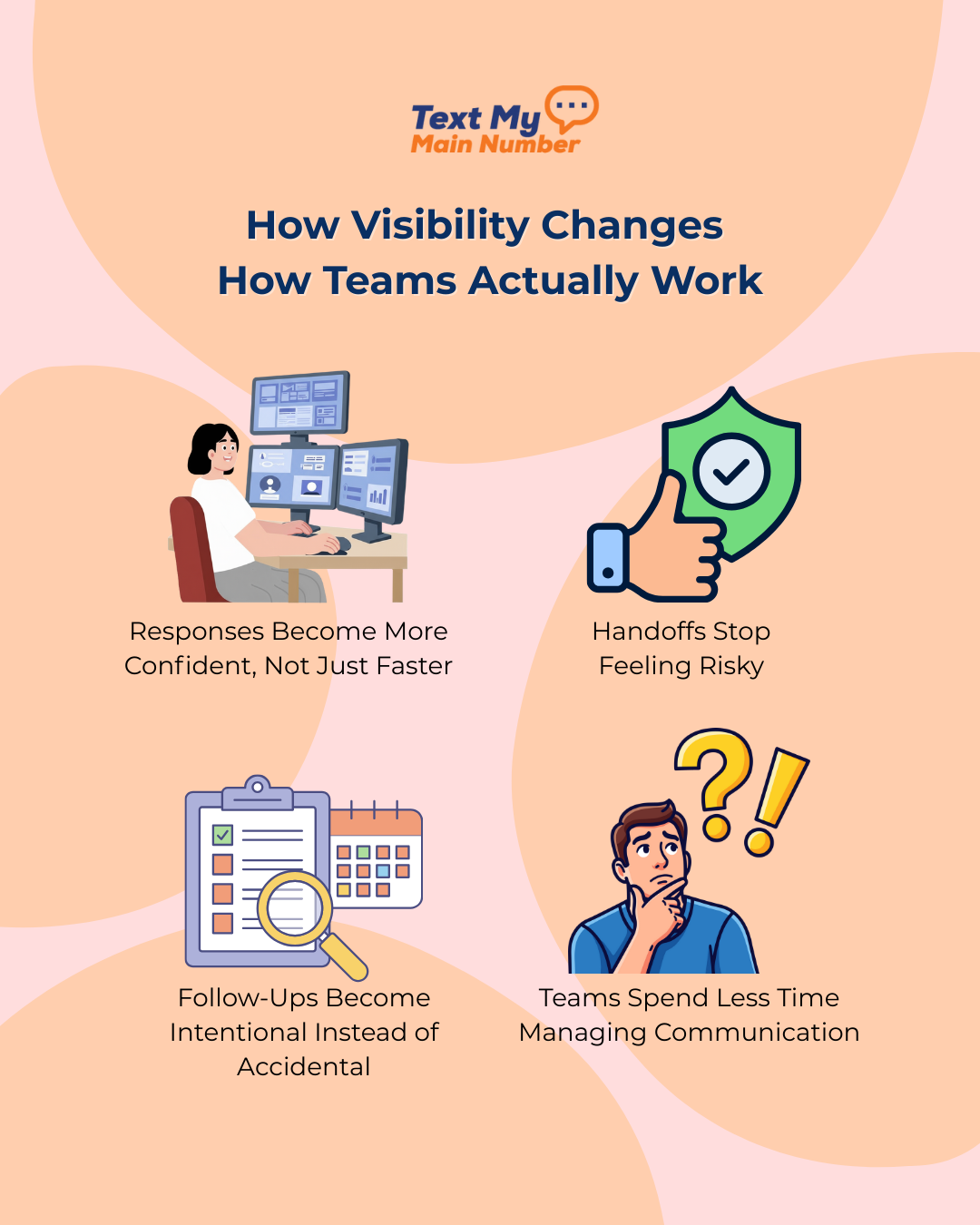
How Visibility Changes How Teams Actually Work
When teams gain real visibility into customer conversations, the change isn’t subtle. It fundamentally alters how people work — and how confident they feel doing it.
Responses Become More Confident, Not Just Faster
With visibility, team members no longer respond in isolation.
They can see:
- What the customer has already shared
- What’s been promised
- Where the conversation is headed
This removes hesitation. Instead of cautiously replying or asking internal questions, teams can respond with confidence. Customers feel that confidence immediately.
Research in decision science shows that access to context significantly improves decision quality and reduces hesitation — especially in time-sensitive interactions.
Handoffs Stop Feeling Risky
One of the biggest stressors in customer-facing teams is handing off a conversation and hoping nothing goes wrong.
Visibility changes that dynamic.
When the next person can see the full history, handoffs feel safe. There’s no need for long explanations or side messages. The system carries the context forward.
This reduces internal coordination and increases trust between team members — not just with customers.
Follow-Ups Become Intentional Instead of Accidental
Visibility makes follow-ups visible.
Instead of relying on memory or personal reminders, teams can clearly see what’s pending, who owns it, and when it should happen. Follow-ups stop being something that might happen and start being something that will happen.
From the customer’s perspective, this feels like reliability. From the team’s perspective, it feels like relief.
Teams Spend Less Time Managing Communication
Perhaps the most overlooked benefit of visibility is mental relief.
When communication is fragmented, teams constantly carry an invisible mental load:
- Remembering who said what
- Wondering what’s unresolved
- Double-checking before responding
Visibility offloads that burden onto the system. People stop managing conversations in their heads and start focusing on solving problems.
And when teams are less mentally taxed, they’re not just more productive — they’re better with customers.
Why Small Businesses Feel This Pain First
Small businesses don’t feel communication breakdowns sooner because they’re worse at service. They feel it sooner because they’re closer to the work.
In a large enterprise, broken communication is often absorbed by layers of process, middle management, and specialized roles. In a small business, every missed message, repeated explanation, or unclear follow-up lands directly on the customer — and often directly on the owner.
There’s No Buffer Between the System and the Customer
In small teams, communication isn’t abstract. It’s personal.
The same people answering messages are also closing deals, resolving issues, scheduling work, and handling billing. When visibility is missing, the friction shows up immediately as:
- Interrupted workdays
- Stressful catch-up conversations
- Customers calling back “just to check.”
There’s no department to hide behind. If something breaks, the business owner feels it first — usually through frustration, lost time, or a customer who quietly doesn’t come back.
Growth Happens Before Systems Catch Up
Most small businesses grow organically.
They add one team member. Then another. They extend hours. They start handing off conversations. But the communication setup often stays the same as it was when one person handled everything.
At that point, the business hasn’t failed — it’s just outgrown its original communication habits.
Research on small business operations shows that early growth stages are where process debt accumulates fastest. Teams move quickly to meet demand, but systems lag behind, creating invisible inefficiencies.
Customers Expect “Big Business” Continuity From Small Teams
This is the unfair part.
Customers don’t lower their expectations because a business is small. That shift in expectations is one reason business messaging has become such a central communication channel, something explained further in Business Texting for Small Companies: What Are the Benefits?
When a small business can’t provide that continuity, it’s not judged as “growing.” It’s judged as disorganized.
That’s why small businesses feel the pain first. Not because they’re behind — but because expectations have moved ahead.
What Simple Visibility Looks Like (Without Enterprise Complexity)
Visibility doesn’t require complex dashboards, long onboarding cycles, or enterprise software.
For small and growing businesses, effective visibility is surprisingly simple — as long as it’s intentional.
One Conversation, Not Multiple Threads
At its core, simple visibility means this: a customer has one conversation with your business, even if they use multiple channels.
Whether they text, call, or follow up later, those interactions belong to the same timeline. Nothing resets. Nothing disappears.
That alone eliminates most of the friction customers experience.
Shared Access Without Shared Confusion
Visibility works when everyone sees the same thing — and understands it the same way.
That includes:
- Messages and calls in one shared view
- Clear indicators of who last responded
- Notes or context that explain what happened and why
This doesn’t mean everyone does everything. It means everyone knows what’s happening.
Clear Ownership, Clearly Shown
Simple systems make ownership obvious.
Who’s handling this conversation? What’s the next step? Is anything waiting on a response?
When ownership is visible, follow-ups don’t depend on memory or heroics. They happen because the system makes them hard to miss.
Context That Travels With the Customer
Perhaps the most important element of simple visibility is portability.
Context shouldn’t live in one person’s inbox or head. It should move with the customer — from text to call, from one team member to another, from today to next week.
This is what allows teams to grow without losing their grip on quality.
Less About Control, More About Confidence
Good visibility doesn’t feel restrictive. It feels calming.
Teams stop second-guessing. Customers stop repeating themselves. Leaders stop worrying about what they can’t see.
That’s the goal. Not more tools. Not more rules. Just enough structure to keep conversations intact as volume and complexity increase.
Where Text My Main Number Fits In: Visibility That Replaces Guessing With Knowing
This is why visibility becomes the difference between guessing and knowing as teams grow. When messages, calls, and follow-ups live in different places, teams are forced to rely on memory, assumptions, and internal check-ins. When everything lives in one shared system, context is always available — and decisions become easier to make.
Text My Main Number was built to give growing teams that visibility without adding complexity. By connecting business texting and voice into a single shared communication layer, conversations stay intact even as more people get involved. Teams can see what’s already happened, who’s responsible, and what needs to happen next — without switching tools or piecing together fragments.
Visibility Is the Difference Between Guessing and Knowing
In fragmented setups, teams guess:
- Did someone already reply to this text?
- Was this issue resolved on a call?
- Who’s supposed to follow up?
Those guesses slow work down and introduce risk, even when everyone is trying to do the right thing.
With Text My Main Number, visibility replaces that uncertainty.
Conversations don’t reset when the channel changes. A text thread doesn’t disappear when a customer calls. A follow-up doesn’t rely on someone’s memory. Everything lives in one shared place, so context is always available — to the next person who picks up the conversation, and to the business as a whole.
Built for Real Teams, Not Perfect Processes
TMMN is designed for how small and growing businesses actually work.
Teams don’t need to overhaul their workflows or learn enterprise software. They simply gain:
- Shared visibility across SMS and voice
- Clear conversation history that anyone can step into
- Fewer handoffs that feel risky
- Fewer moments where someone has to “check with another system”
The result isn’t more structure for the sake of structure. It’s less mental load. Less backtracking. Fewer dropped threads.
Communication That Scales Without Becoming Heavy
As volume increases, visibility becomes more important — not less.
Text My Main Number makes it possible to grow without communication becoming a liability. Instead of layering new tools on top of old ones, teams get a clearer, calmer way to manage conversations as they scale.
That’s what visibility-first communication looks like. Not complicated. Not bloated. Just connected.
Final Thought: Visibility Changes Everything
When teams can see what’s happening, communication stops being reactive. Customers feel remembered. Follow-ups happen when they should. Conversations move forward instead of looping.
Visibility is the difference between guessing and knowing — and knowing is what builds trust at scale.
If your business is feeling the strain of missed messages, unclear follow-ups, or conversations scattered across tools, this is the stage where visibility starts to matter most.
Try Text My Main Number’s 14-day free trial and see what changes when your messages, calls, and follow-ups finally live in one place.

.svg)

