In this article, we explore modern customer communication expectations, including speed, continuity, multi-channel switching, and what today’s consumers no longer tolerate.
Customer expectations didn’t shift in a single moment. They evolved gradually — then accelerated. What changed most is not what customers want, but what they now consider normal.
Practices that once felt responsive, professional, or even impressive have quietly become baseline. A same-day reply is no longer “great service.” Remembering basic context is no longer a bonus. These are now table stakes. When businesses fall short, customers don’t complain — they disengage.
At the same time, tolerance for friction has dropped. Small inconveniences that used to be brushed off now stand out sharply. Delayed responses, disconnected conversations, or the need to repeat information are no longer seen as minor annoyances. They’re signals that a business hasn’t kept up.
In 2026, customers aren’t measuring your communication against competitors in your industry. They’re measuring it against the best digital experiences they have anywhere. The apps they use daily. The services that acknowledge them instantly. The platforms that remember context without effort.
Those experiences have reshaped expectations across the board. When a business interaction feels slower, clunkier, or more fragmented than the rest of a customer’s digital life, it creates immediate friction — even if the business is trying to do everything right.
Understanding this shift is the starting point. Because meeting modern customer expectations isn’t about doing more. It’s about communicating in a way that feels natural in a world where speed, continuity, and clarity are no longer optional.
Customer Expectations Have Changed Faster Than Most Businesses Realize

Customer communication expectations have been reshaped by everyday digital behavior, not by formal service standards.
People now live inside messaging apps, mobile notifications, and real-time platforms. According to the Pew Research Center report “Mobile Fact Sheet”, smartphone adoption and mobile-first behavior now dominate how Americans communicate and access services. They order food, manage finances, and book services with a few taps. As a result, their tolerance for delay, confusion, or disconnected communication has dropped sharply.
Why Mobile-First Behavior Now Dictates Customer Communication Expectations
Customers no longer plan around business hours or desk phones. They reach out when it’s convenient for them — often from a mobile device, often between other tasks.
That shift has consequences:
- Communication is expected to be lightweight and accessible
- Waiting feels unnecessary, even when the request isn’t urgent
- Friction stands out more than ever
If contacting a business feels harder than messaging a friend or booking an app-based service, it immediately feels outdated.
Messaging Apps Reset the Baseline
Apps like WhatsApp, iMessage, and in-app chat have trained people to expect continuity. Conversations don’t reset. Context carries forward. Replies don’t require repeating the same information again and again.
When customers contact a business and that continuity disappears, it creates an immediate sense of disconnect — even if the business is responding quickly.
Modern SaaS Experiences Set the Standard
Customers are used to systems that remember them, acknowledge actions instantly, and guide them clearly to the next step.
They don’t consciously think, This business should behave like a SaaS product.
But subconsciously, they expect the same level of clarity, responsiveness, and structure. This is why expectations have shifted so quickly. Not because customers became demanding — but because everything else got easier.
Customers Expect Immediate Acknowledgment — Not Silence
Speed still matters, but acknowledgment matters more.
In 2026, customers don’t always expect an instant solution. What they do expect is a clear signal that their message was received and that someone is handling it.
The Difference Between Response and Acknowledgment
A response solves the problem.
Acknowledgment reduces uncertainty. Even a short confirmation — “We’ve received your message and will follow up shortly” — reassures customers that they’re not being ignored. Silence, on the other hand, creates doubt.
When customers don’t hear back quickly, they don’t assume you’re busy. They assume something went wrong.
Missed Calls Feel Like a Dead End
A missed call without follow-up feels outdated in 2026.
Customers expect businesses to adapt when a real-time connection fails. That often means a text acknowledgment instead of a voicemail that may never be checked. When a call goes unanswered and nothing follows, the experience feels incomplete and unprofessional — even if the business calls back later.
SMS Signals Modern, Attentive Service
Texting has become the fastest way to acknowledge without interrupting.
It respects the customer’s time. It fits modern behavior. And it communicates attentiveness in a way that voicemail or delayed callbacks no longer do. Businesses that acknowledge quickly — even before fully resolving the issue — feel more reliable, more organized, and more professional.
In 2026, silence isn’t neutral.
It’s interpreted as friction.
Customers Expect You to Remember Them
Customers don’t hate repeating themselves because it’s inconvenient. They hate it because it signals disorganization.
When someone contacts a business in 2026, they expect the interaction to pick up where it left off. That expectation comes from how nearly every modern digital experience works. Conversations persist. History is visible. Context carries forward automatically.
Repetition Feels Like a Breakdown, Not a Mistake
From the customer’s perspective, repeating information isn’t a neutral inconvenience. It feels like something failed behind the scenes.
They already explained the issue. They already shared details. When they’re asked again — especially by a different person — it creates doubt. Is anyone actually tracking this? Does anyone know what’s happening?
Even if the team is responsive and polite, that loss of continuity undermines confidence.
Context Is Part of the Experience Now
Customers expect businesses to remember:
- What they contacted you about previously
- Where the conversation left off
- What has already been promised or discussed
This doesn’t require exceptional service. It requires systems that preserve conversation history instead of scattering it across tools, inboxes, and channels.
When context is visible, responses feel informed instead of reactive. Customers feel recognized instead of processed. And interactions feel smoother without adding effort on either side.
Continuity Builds Trust Quietly
The most effective communication doesn’t call attention to itself. It just feels easy.
When a customer doesn’t have to re-explain, re-send, or re-clarify, the experience feels competent. Trust builds quietly — not through grand gestures, but through consistency.
In 2026, remembering the customer isn’t a personalization feature. It’s the foundation of a functional conversation.
Seamless Channel Switching: Why Customers Hate Fragmented Conversations
Customers don’t think in terms of channels. They think in terms of outcomes.
They reach out in the way that feels easiest in that moment, and they expect the business to adapt as the conversation evolves.
Texting and Calling Serve Different Purposes
Texting is ideal when convenience matters. It’s low-pressure, asynchronous, and easy to fit into a busy day. Customers use it to ask quick questions, confirm details, or initiate contact without committing to a real-time conversation.
Voice becomes important when clarity matters. Complex questions, emotional situations, objections, or urgency often require a call. Tone, nuance, and immediate back-and-forth make a difference.
Customers understand this distinction intuitively. What they don’t understand — or tolerate — is when switching between those modes causes the conversation to reset. This dynamic is explored in Business Texting vs Phone Calls: How to Use Both Together, which breaks down how each channel serves a different purpose — and why they’re strongest when they operate as one continuous experience.
The Expectation Is Connection, Not Choice
Customers don’t expect to choose between texting or calling. They expect both to work together.
If they start with a text and follow up with a call, they assume the person on the phone knows what was discussed. If a call is missed, they expect a text acknowledgment rather than silence. If a text thread becomes complicated, they expect the option to move to voice without friction.
When that connection doesn’t exist, the experience feels disjointed — even if each channel works well on its own. That’s the core idea behind How SMS and Voice Work Better Together for Growing Businesses, which explains why modern communication depends less on choosing a channel and more on connecting them intelligently.
Seamless Switching Feels Professional
The ability to move naturally between channels signals maturity and organization.
It shows that the business isn’t just responding quickly, but responding intelligently. Conversations feel continuous instead of fragmented. Customers feel guided instead of bounced around.
In 2026, seamless channel switching isn’t an advanced capability. It’s part of what makes communication feel modern, respectful, and easy to engage with.
Customers Expect Clear Next Steps, Not Endless Back-and-Forth
Efficiency, from a customer’s point of view, isn’t about speed alone. It’s about direction.
In 2026, customers expect communication to move forward with purpose. They want to know what happens next, who is handling it, and when they’ll hear back. When conversations stall in endless back-and-forth, even quick replies start to feel unproductive.
Why Long Threads Create Fatigue
Long SMS threads are rarely a sign of good communication. More often, they’re a symptom of uncertainty.
When customers don’t get clear next steps, they compensate by asking more questions. Teams respond with partial answers. The conversation grows longer without getting closer to resolution.
This creates decision fatigue on both sides:
- Customers feel unsure whether they’re progressing
- Teams spend time clarifying instead of resolving
- Important details get buried inside the thread
What customers actually want isn’t more messages. It’s clarity.
Resolution Feels Better Than Responsiveness
A fast reply that doesn’t move the issue forward still feels incomplete.
Efficient communication provides:
- A clear answer or explanation
- A defined next step
- A sense of ownership
When customers understand what’s happening next, they stop chasing updates. When they don’t, even frequent replies feel like noise. In 2026, efficiency is measured by how smoothly a conversation reaches resolution — not by how many messages are exchanged along the way.
What Customers No Longer Tolerate in 2026

Customer patience hasn’t disappeared — but tolerance for friction has. There are certain experiences that now signal, instantly, that a business is behind the curve.
Silence After Contact
A missed call with no follow-up feels like a dead end. Customers don’t assume you’ll call back. They assume the process broke.
Slow or Uncertain Responses
Delays aren’t always the issue. Uncertainty is. When customers don’t know if or when they’ll hear back, trust drops quickly.
Disconnected Conversations
When customers have to repeat information because messages, calls, and notes don’t connect, it feels careless — even if the team is trying.
Unclear Ownership
Customers notice when no one seems clearly responsible. Being passed between people, or receiving conflicting answers, undermines confidence fast.
None of these issues feel minor anymore. In 2026, they’re interpreted as signals about how the business operates behind the scenes.
Why These Expectations Matter More as Businesses Grow
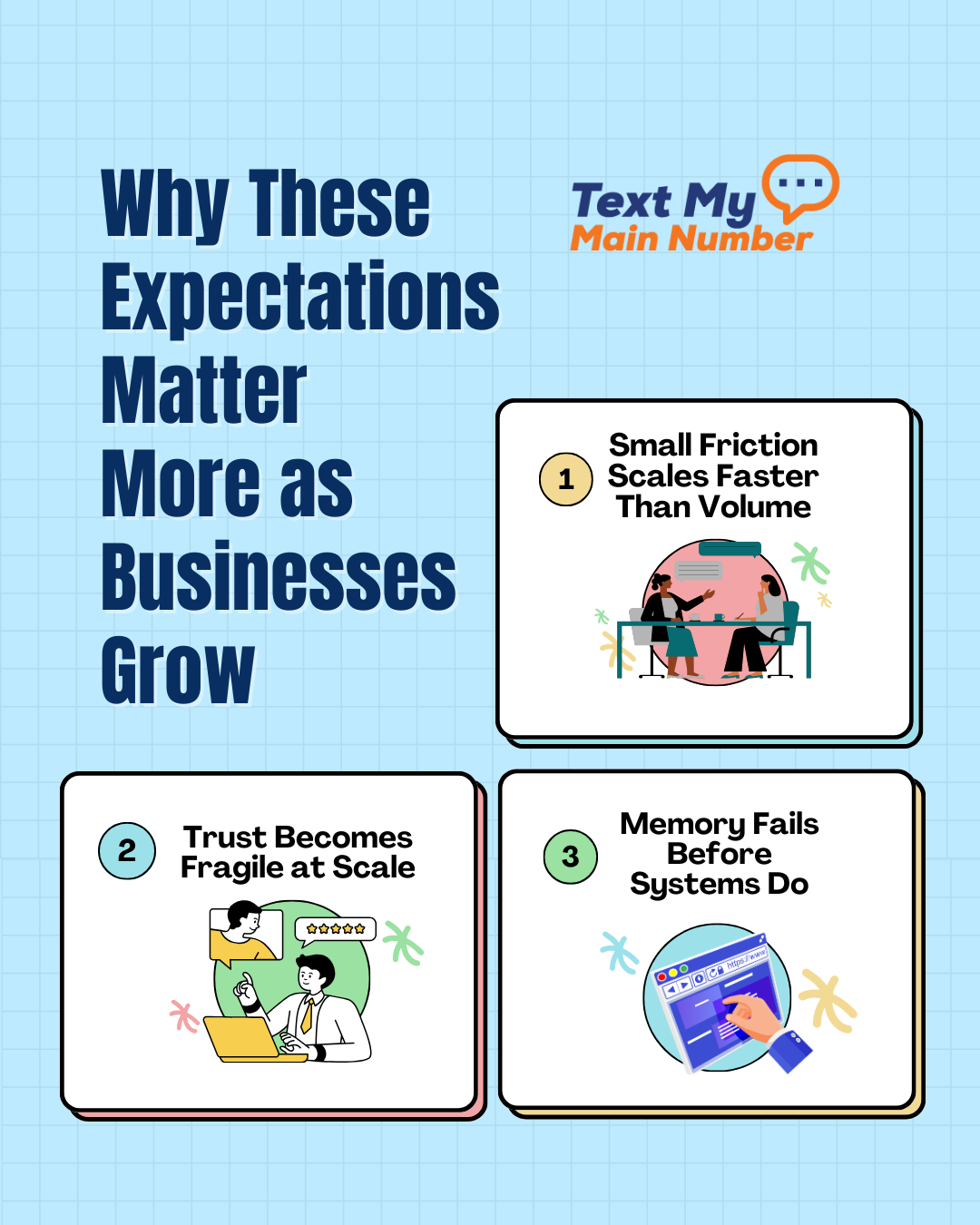
When a business is small, gaps in communication can be patched with effort. People remember conversations. Founders jump in. Context lives in someone’s head. As the business grows, that safety net disappears.
Small Friction Scales Faster Than Volume
What feels like a small inconvenience at low volume becomes a serious issue at scale. Repeated explanations, unclear handoffs, and stalled conversations multiply as more people and more customers get involved.
What once felt manageable starts to feel chaotic — not because the team is weaker, but because the system hasn’t evolved.
Trust Becomes Fragile at Scale
Customers don’t judge intent. They judge experience. At scale, even small breakdowns get interpreted as a lack of professionalism. A single dropped context or unclear follow-up can undo months of trust-building.
This is why growing businesses feel pressure not just to respond faster, but to respond better — with clarity, continuity, and confidence. Meeting modern expectations isn’t about perfection. It’s about having systems that hold up when volume increases and memory no longer can.
The Growing Gap Between Customer Expectations and Business Reality
Most businesses aren’t failing at communication. They’re simply operating with systems designed for a different era. Customers expect continuity, clarity, and responsiveness that reflects how they interact with the rest of the digital world. Many businesses, however, are still relying on fragmented setups where texts, calls, and notes live in separate places and depend on individual memory to stay connected. As outlined in The Hidden Cost of Too Many Communication Tools, fragmentation doesn’t just slow teams down — it quietly erodes clarity, ownership, and customer confidence.
That gap shows up subtly at first. Conversations take longer to resolve. Customers ask more follow-up questions. Teams spend more time coordinating internally. Nothing feels catastrophic — just heavier than it should.
Over time, that friction becomes visible. Customers sense disorganization even when teams are trying hard. Trust erodes not because of poor intent, but because the experience no longer matches modern expectations.
The issue isn’t effort. Its structure.
How Text My Main Number Supports Modern Customer Expectations
Text My Main Number exists for businesses that are doing many things right — but are starting to feel the strain of managing conversations across disconnected tools.
As customer expectations evolve, the challenge isn’t choosing between texting or calling. It’s making sure those conversations stay connected, visible, and easy to manage as volume increases and more people get involved.
Text My Main Number brings business SMS and VoIP voice together into one shared communication system. That means when a customer switches from text to call, the conversation doesn’t reset. When a different team member steps in, the context doesn’t disappear. Everyone can see what’s happened and continue the conversation without guesswork.
This shared visibility changes how teams operate. Instead of switching between inboxes, call logs, and internal notes, communication lives in one place. Ownership is clearer. Handoffs are safer. Customers don’t have to repeat themselves just because the channel or the person changed.
The value isn’t about adding another platform. It’s about reducing friction where it matters most — day-to-day customer communication. When texting and voice work together inside a single system, conversations feel calmer, faster, and more professional on both sides.
For a deeper look at how businesses move from simple texting to fully connected customer conversations as they grow, this article explains How Businesses Scale Communication: From Texting to Full Conversations.
The Future of Customer Communication Is Continuity, Not Channels
The future of business communication isn’t about picking the “right” channel. It’s about making conversations continuous, regardless of how they move. This broader shift is examined in Why Modern Customer Communication Isn’t One Channel, which highlights how continuity — not channel preference — now defines professional service.
Customers will keep switching between text and voice based on convenience, urgency, and context. That behavior won’t reverse. What will change is which businesses are equipped to handle it smoothly.
The companies that stand out won’t be the ones with the most tools or the fastest replies. They’ll be the ones whose communication feels effortless — where conversations carry forward, context is preserved, and customers never feel like they’re starting over.
In 2026 and beyond, great customer communication won’t be defined by channels. It will be defined by continuity.
A Practical Way Forward
Customer expectations in 2026 aren’t unrealistic — they’re simply shaped by the way people already communicate every day. They expect to be acknowledged quickly, remembered accurately, and guided clearly toward resolution, whether the conversation happens by text, by call, or across both.
Meeting those expectations doesn’t require more effort from your team. It requires better structure behind the scenes. Text My Main Number helps businesses bring texting and voice together into one shared system, so conversations stay connected, context doesn’t get lost, and communication feels natural instead of fragmented as volume grows.
If your current setup is starting to feel heavier than it should, a small shift can make a big difference.
Start a 14-day free trial of Text My Main Number and see how unified SMS and VoIP can make customer communication clearer, calmer, and easier to manage as your business grows.

.svg)