
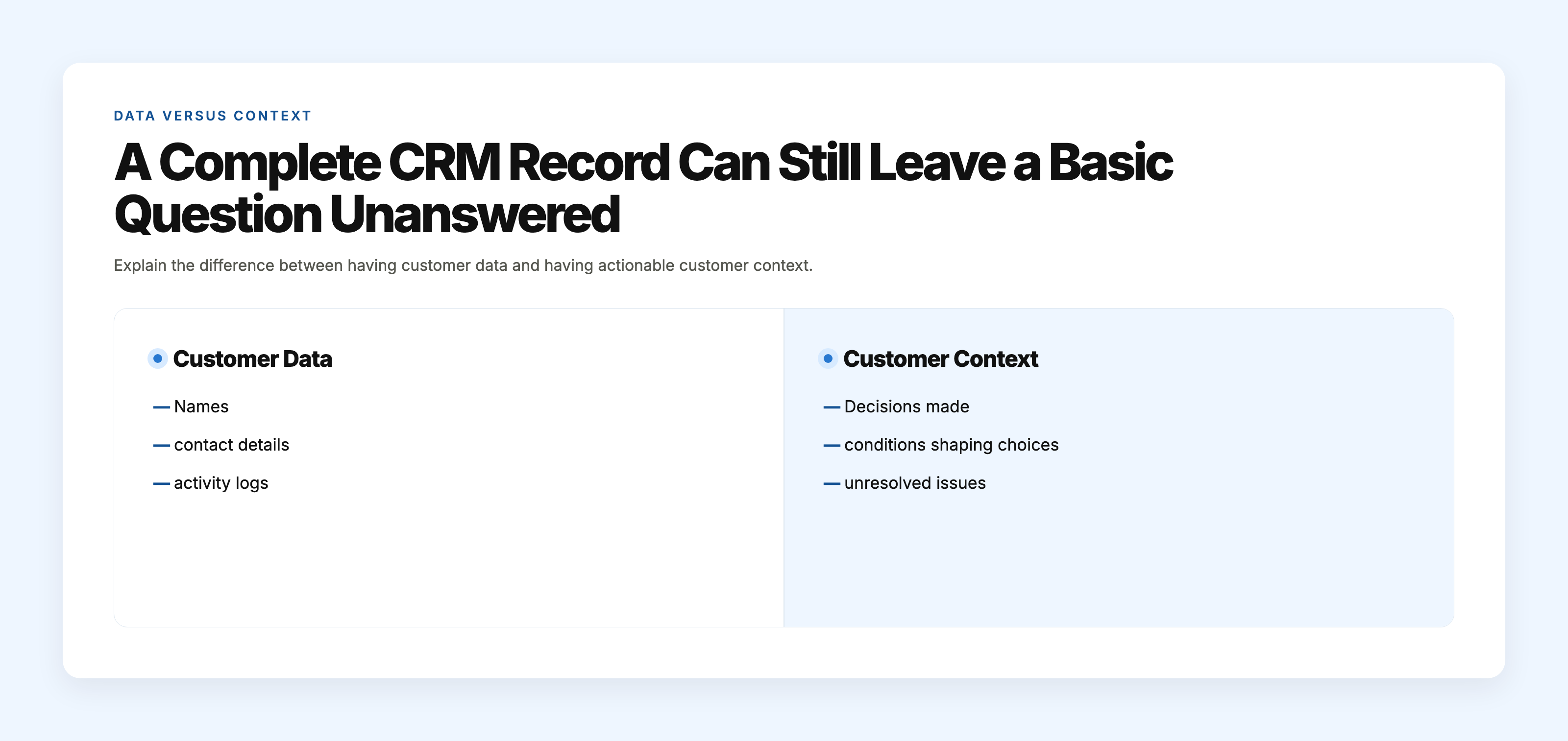
A Complete CRM Record Can Still Leave a Basic Question Unanswered
A CRM can show a customer’s name, contact details, deal stage, activity dates, completed tasks, and several pages of notes. Yet an employee preparing for the next interaction may still be unable to answer a basic customer context question: What matters now?
Consider a homeowner returning to a kitchen and bath showroom after six weeks. Her record shows two showroom visits, a design consultation, three product selections, and a proposal marked “under review.” The activities are logged correctly. The designer’s notes mention cabinet samples, countertop pricing, and a revised floor plan. On paper, the file appears complete.
The employee covering the appointment still cannot tell why the homeowner rejected the first cabinet line, whether the renovation deadline is firm, or which layout concern led to the revised plan. The proposal total is visible, but the reasoning behind it is not. Before the appointment, the employee searches earlier notes and asks the original designer what happened. The designer remembers part of the discussion, but not the exact limitation that ruled out one option.
This is the difference between having customer data and having usable customer context. The CRM proves that work occurred. It may even show the result of each activity. But the employee needs the practical meaning of that work: what the customer decided, which conditions shaped the decision, what remains unsettled, and what judgment should carry into the next interaction.
That distinction matters because reporting and service require different kinds of information. Reporting asks whether the consultation happened and whether the proposal advanced. Real work asks why the proposal took its current form and what would make the next recommendation appropriate. A record can answer the first set of questions while leaving the second unanswered.
What Customers Expect a Business to Remember
Returning customers rarely expect perfect recall of every sentence. They do expect the business to remember decisions that required time, explanation, or compromise. A repeat buyer assumes that an established delivery restriction, material preference, billing practice, or compatibility requirement will still influence the next recommendation.
At a commercial equipment supplier, for example, a buyer may reorder a component used across several sites. During the previous order, the buyer and sales representative discovered that one model would fit the equipment but could not be delivered through the receiving area without different packaging. That qualification matters more than the generic product preference saved in the CRM.
Three months later, a different representative sees the prior order and recommends the standard configuration. The buyer pauses. Rather than immediately correcting the representative, she asks for the dimensions and delivery details in writing. Later, she checks another supplier’s specifications. Nothing dramatic has happened. The business has simply made an established customer less certain that the previous work will carry forward.
That hesitation is easy to misread as price sensitivity or indecision. Often, the customer is testing whether the business understands the situation well enough to make a dependable recommendation. If the answer takes several rounds of clarification, the customer may become quieter while comparing alternatives. Silence in this setting can feel deliberate because the customer has already supplied the relevant information once.
Useful customer context reduces that uncertainty. It tells the next employee which facts are settled, which exceptions apply, and which issues still require judgment. The customer does not need the same employee every time. The customer needs the business to behave as though prior work still counts.
The Difference Between Logging an Event and Preserving Its Meaning
An activity log answers a valuable question: what happened? It may show that a call took place Monday, a proposal was sent Wednesday, and a review task was completed Friday. Those entries help managers monitor workload and understand movement through a process.
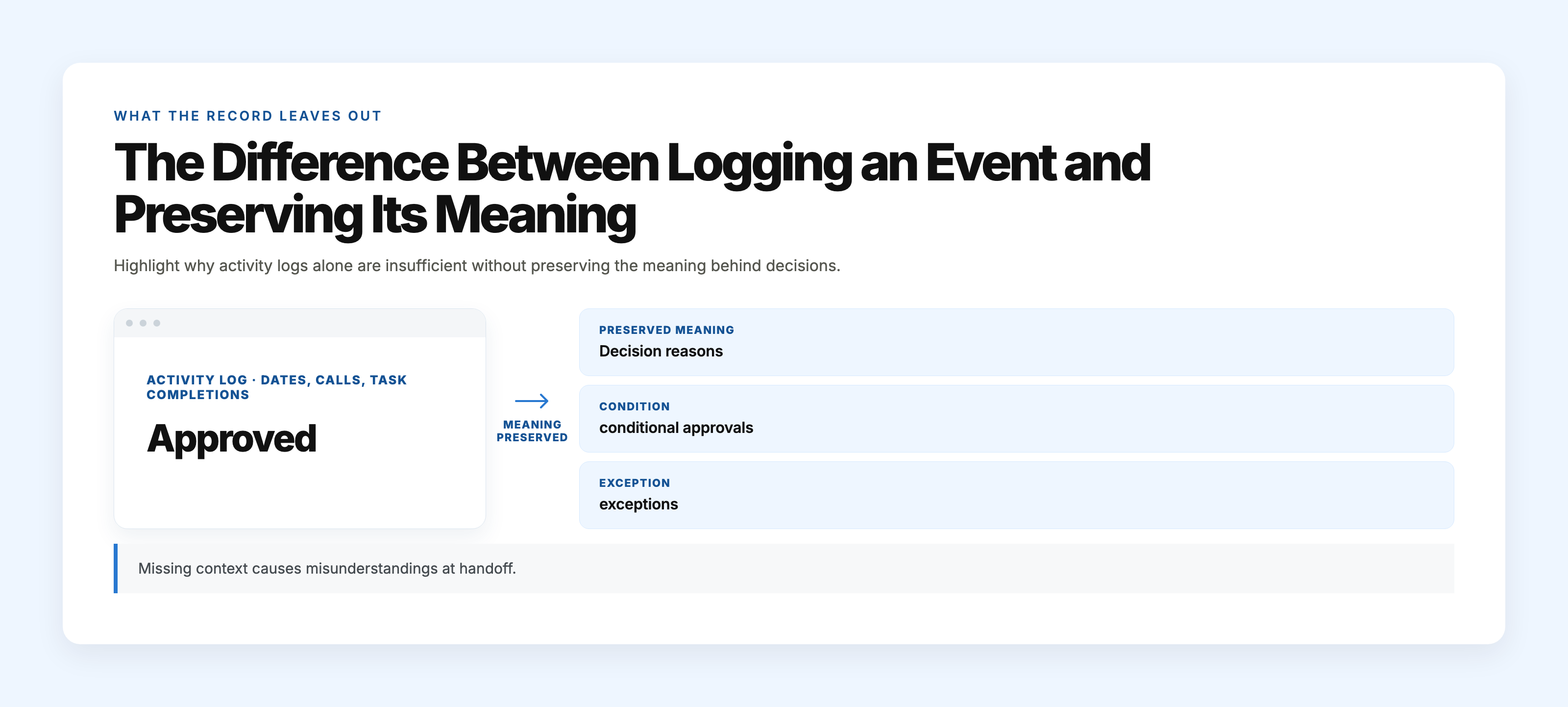
Communication history becomes operationally useful when it also shows what changed because of those activities. A call entry may confirm that an employee spoke with the customer. It does not necessarily explain that the customer chose a more expensive material because the less expensive option could not tolerate a specific cleaning process. Without that sentence, the next employee sees a preference where the customer had actually identified a requirement.
Short CRM notes often capture a result while omitting its boundaries. “Customer approved revised option” sounds sufficient until another employee needs to recommend an accessory, prepare a reorder, or explain a price difference. Which revised option was approved? What prompted the revision? Was the decision final, or was it conditional on a deadline or sample review?
The operational failure usually appears at the handoff. One employee knows that approval is conditional because that employee heard the customer hesitate, discussed the remaining issue, and agreed to confirm it later. A colleague sees “approved,” closes the related task, and proceeds as though no question remains. Both employees can believe they acted correctly because the record flattened a qualified decision into a completed event.
This is how records that look thorough remain thin in practice. The number of entries creates an impression of completeness, but the useful sentence may be buried among meeting summaries, task updates, and copied email text. The employee does not need every word. The employee needs the details with consequences.
Good records are selective rather than exhaustive. They preserve the facts and judgment that affect later work, including rejected choices when the reason still applies, exceptions that alter the standard process, and qualifications attached to promises. Activity records motion. Context shows where that motion left the customer and the business.
The Details That Actually Shape the Next Decision
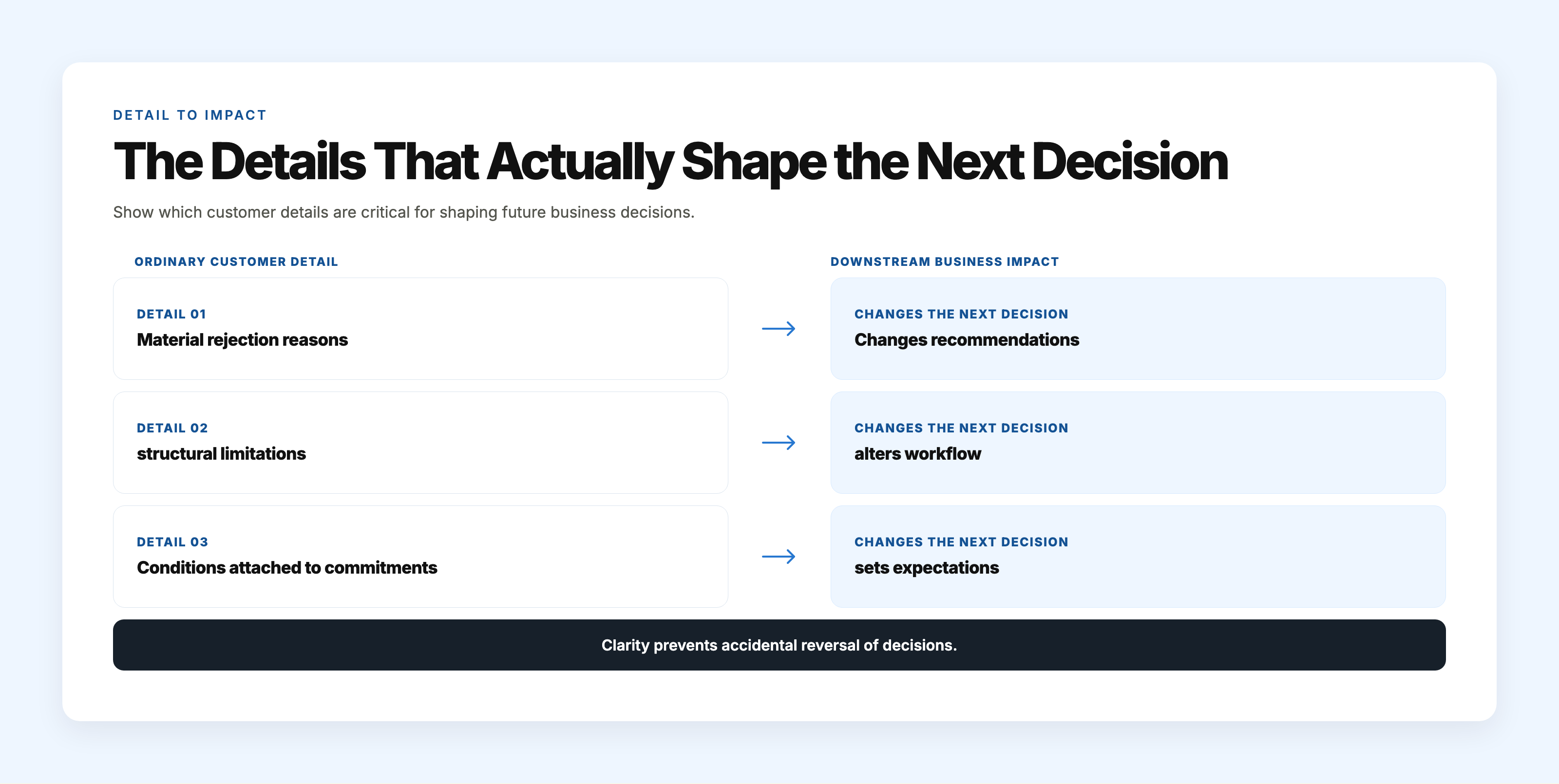
The details worth carrying forward are usually ordinary. They are the prior choice that ruled out an otherwise obvious recommendation, the physical limitation that changed a design, the condition attached to a commitment, the exception that prevents a standard workflow, or the unanswered issue holding up the next action. Their value comes from what they change, not from how much space they occupy in the record.
In the showroom example, the homeowner preferred a natural stone appearance but rejected one material because regular sealing would be difficult. The island dimensions were reduced because a structural post limited the walkway. Installation needed to finish before a family member moved into the home. Each detail changes what a capable employee should suggest next.
Commitments also need their qualifications. “We can hold pricing through May” means something different from “Pricing is held through May if the appliance package is confirmed by the 15th.” Saving only the broad promise makes the record easier to scan, but it creates a misleading expectation later. The condition is part of the commitment, not a side note.
The same issue appears when language is still tentative. An employee may write, “Delivery moved to Friday,” after discussing Friday as a possibility with the warehouse. The customer-facing employee reads the note as confirmation, while operations still considers the date unapproved. By the time the difference is discovered, the customer has arranged access to the site and the business is explaining a promise it never formally made.
Reasoning becomes especially important when a previous employee exercised judgment. At a specialty print shop, a customer may have selected a heavier paper not because it was the preferred finish, but because the lighter stock showed marks during folding. On the next order, recommending the original paper again wastes time and suggests that the prior test had no lasting value.
The practical standard is straightforward: preserve details that could change the next recommendation, action, or expectation. How Small Teams Manage Customer Conversations Without Burnout (2026 Guide) highlights that preserving actionable context prevents repeated backtracking and supports efficient handoffs.
A record does not need to become a transcript. It needs enough clarity for another capable employee to continue without accidentally reversing prior work.
Where Employees Spend Time Rebuilding the Story
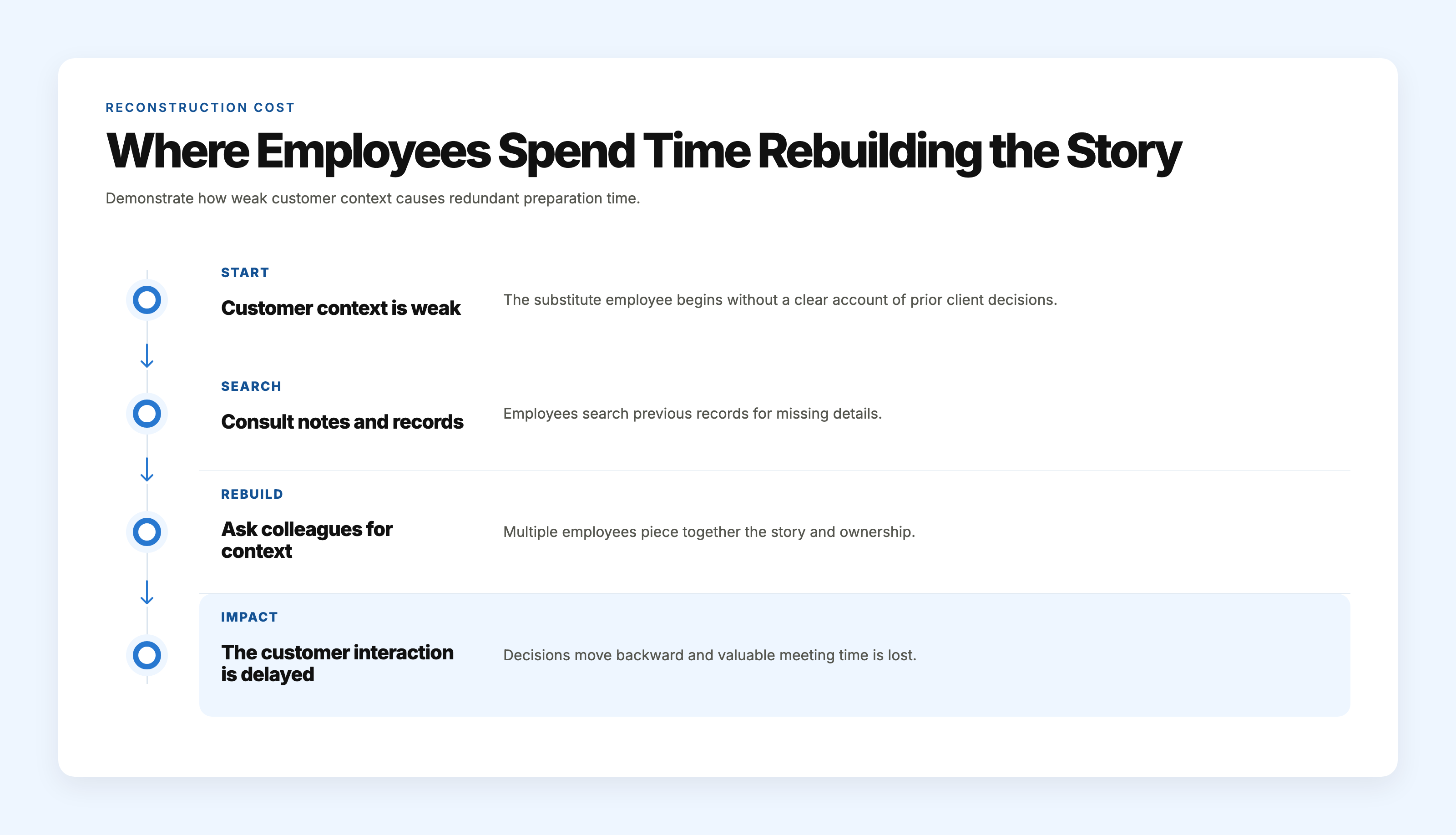
The cost of weak customer context often appears as preparation. An employee opens the CRM, reads the latest note, moves backward through older entries, checks an attached proposal, and searches prior written exchanges. If the reasoning remains unclear, the employee asks someone who participated earlier.
At 9:00 on Tuesday morning, the showroom coordinator sees that the returning homeowner is due at 1:00. The original designer is working off-site, so the coordinator asks another designer to prepare. By 10:30, that designer has found the revised layout and product list but still cannot explain why the cabinet selection changed.
Near noon, the designer messages the sales manager, who remembers a discussion about lead time but assumes the original designer documented the layout limitation. The coordinator assumes the manager has answered the question and moves on to preparing samples. No one explicitly owns the missing answer. Each person has completed a reasonable piece of the preparation, but the handoff remains incomplete.
At 1:00, the homeowner arrives. During the meeting, the substitute designer proposes restoring the larger island because it fits the budget.
The homeowner explains that the larger island was already ruled out because of the structural post and walkway clearance. The designer recovers professionally, but the appointment shifts backward. Time intended for reviewing finishes is spent re-establishing a decision made six weeks earlier. The homeowner leaves without finalizing the countertop because there is no longer enough time to compare samples properly.
Nothing in the CRM was factually wrong. The breakdown occurred in the space between recorded activity, employee assumptions, and unclear ownership. The history existed, but employees had to reconstruct its meaning under a deadline. Information that is merely retrievable can still be expensive when every new participant has to interpret it again.
The Small Labor Cost That Repeats Across the Month
Reconstruction rarely appears as a dedicated expense. It is spread across short periods of searching, rereading, checking attachments, and asking colleagues. Because each episode seems minor, the cumulative labor cost is easy to overlook.
Take a business with five customer-facing employees. Suppose each employee encounters three situations per week that require an additional 12 minutes to rebuild prior reasoning. That is 36 minutes per employee per week. Across five employees, the business spends 180 minutes, or three hours, each week on avoidable preparation.
Over a typical 4.3-week month, that becomes 12.9 hours. At a loaded labor cost of $38 per hour, the direct monthly cost is about $490. Across a year, it approaches $5,900. This is an illustration rather than a benchmark, and the assumptions are modest by design. They exclude longer investigations, manager interruptions, duplicated preparation, and the time customers spend restating established requirements.
There is also an opportunity cost. In the showroom appointment, the missing layout explanation did not instantly lose the sale. It prevented the meeting from reaching the intended decision. If a $9,000 project is delayed into another buying cycle, the business carries the opportunity longer and spends more labor reaching the same point. Some customers return; others continue comparing while the decision remains open.
The issue is not that every extra minute becomes lost revenue. It is that established work keeps being repurchased with employee time. A business can serve the customer correctly in the end and still use more labor than the relationship should require.
A Practical Test for Usable Business Memory
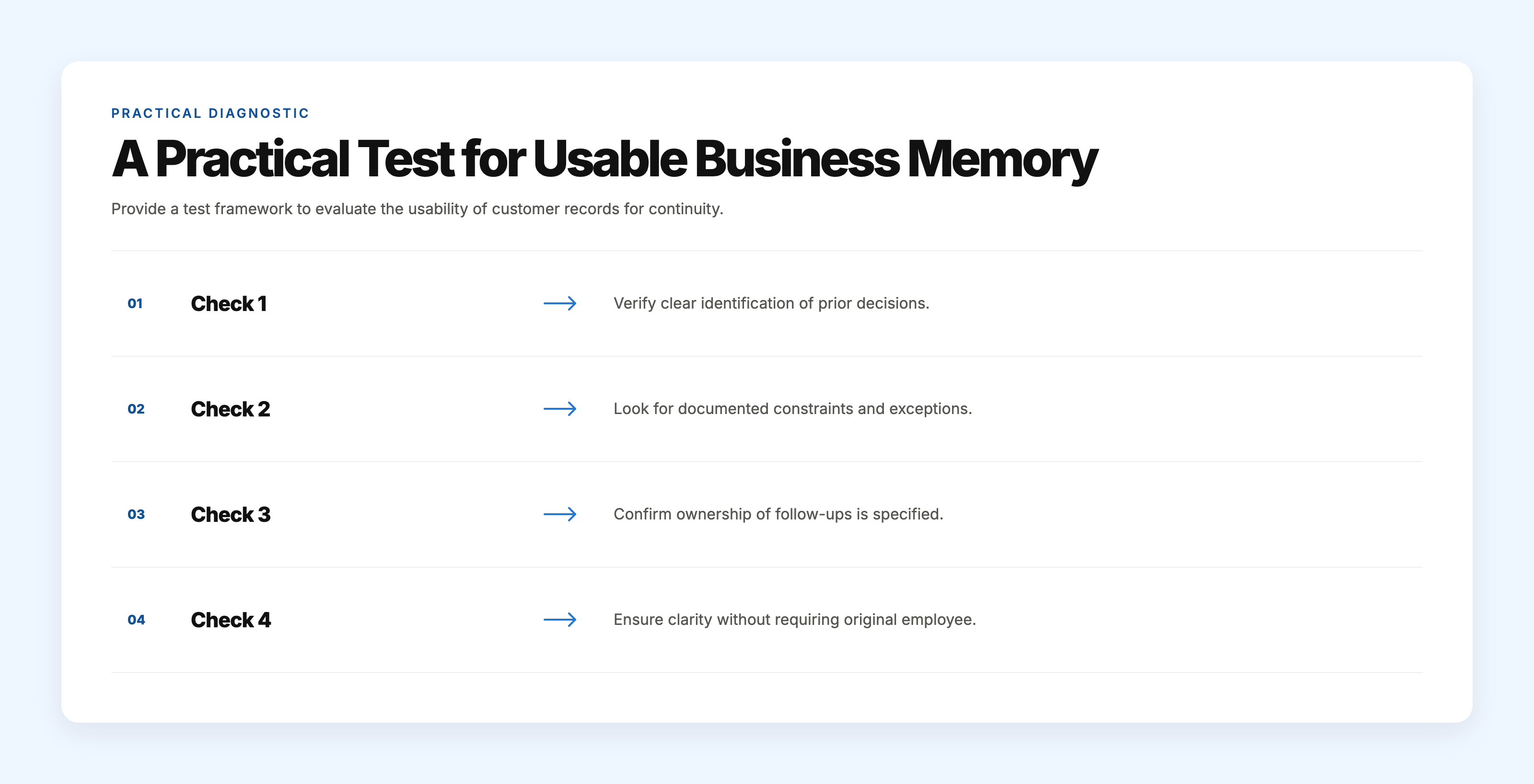
A useful evaluation begins with one recurring interaction, not a company-wide documentation project. Choose a repeat order, account review, project update, renewal discussion, or follow-on recommendation. Then open the record as though the employee who handled the previous work were unavailable.
First, determine whether the prior decisions are obvious. Could another employee identify what the customer accepted, rejected, or postponed? A list of products or completed tasks may show the outcome without showing which alternatives were considered. When the same unsuitable option is raised again, the history is not doing enough work.
This review often exposes language that looked clear to the original employee but is ambiguous to everyone else. “Customer is comfortable with the revised scope” may mean approval, general interest, or approval pending a final price. “Friday works” may refer to delivery, a confirmation call, or the customer’s preferred date if inventory becomes available. Once the employee who wrote the note is absent, casual shorthand starts carrying more certainty than the conversation did.
Next, look for constraints and exceptions. These may include site limitations, delivery rules, documentation practices, approval requirements, budget boundaries, or unusual billing arrangements. At a bookkeeping firm, a client may submit one category of expense differently because its internal approval process does not match the firm’s standard workflow. If that exception lives only in an employee’s memory, the next review begins with avoidable corrections.
Exceptions are also frequently stored where the next employee would not think to look. A delivery restriction may be documented in an old email attachment while the active account field still shows standard delivery. A billing exception may appear in a project note but not in the recurring invoice instructions. The information technically exists, yet the employee following the normal process is unlikely to encounter it before acting.
Then inspect commitments and open questions. A useful record distinguishes among something the business offered, something it promised, and something it promised under a condition. It should also reveal what still needs an answer. Otherwise, an employee may treat a tentative discussion as a final agreement or reopen a decision already made.
This is also where missed ownership becomes visible. A note may say, “Confirm revised lead time with customer,” without naming the person responsible or showing whether the warehouse must respond first. Sales assumes operations will update the customer. Operations assumes sales owns the relationship. The task remains open for two days, and when the customer calls, both teams can point to a record showing that the follow-up was identified. Identification did not create ownership.
Another common finding is that every participant assumed someone else updated the account. The salesperson expects the project coordinator to record the delivery condition. The coordinator expects the salesperson to revise the opportunity note. The manager heard the issue discussed in a meeting and assumes the task owner captured it. The record stays unchanged even though several employees know the answer.
Finally, ask whether the prior judgment can be understood without calling the original employee. That is the strongest test. A capable replacement does not need every detail but should be able to explain the current direction and make the next decision with confidence. If the history requires oral interpretation every time, the business has retained records without retaining enough understanding. In practice, a record becomes operational only when it can survive the absence of the person who created it.
Why More Notes and More Fields Do Not Automatically Solve It
When employees cannot understand a customer quickly, the first response is often to require longer notes. That can help when documentation is genuinely sparse. It can also create a larger reading burden without making the important details easier to identify.
A note that recounts an entire meeting may contain the decisive constraint in its ninth sentence. The next employee scans the opening lines, sees the products discussed, and misses the qualification near the end. More writing has preserved more content, but not necessarily more usefulness. Note quality depends on whether consequences are clear.
Custom fields have a legitimate role. They are effective for stable, standardized facts such as account type, renewal date, equipment model, preferred location, or approved payment terms. Their limits appear when a detail needs explanation. A field can show “delivery restriction: yes” while leaving the employee unaware that unloading is permitted only before 8:00 a.m. and requires a smaller vehicle.
The same problem occurs when an activity log is treated as the full history. Ten calls and four meetings may indicate sustained work, but counts and timestamps do not reveal the judgment produced by those interactions. Relying on the original employee is equally fragile. People forget qualifications, merge similar accounts in their minds, take leave, or become unavailable during a customer appointment.
The answer is not unlimited documentation. It is better emphasis. The consequential part of a decision or commitment needs to be recognizable without forcing employees to read everything ever recorded. The purpose of a record is not to prove effort. It is to prevent the next employee from unknowingly undoing it.
From Stored Customer Data to Business Memory
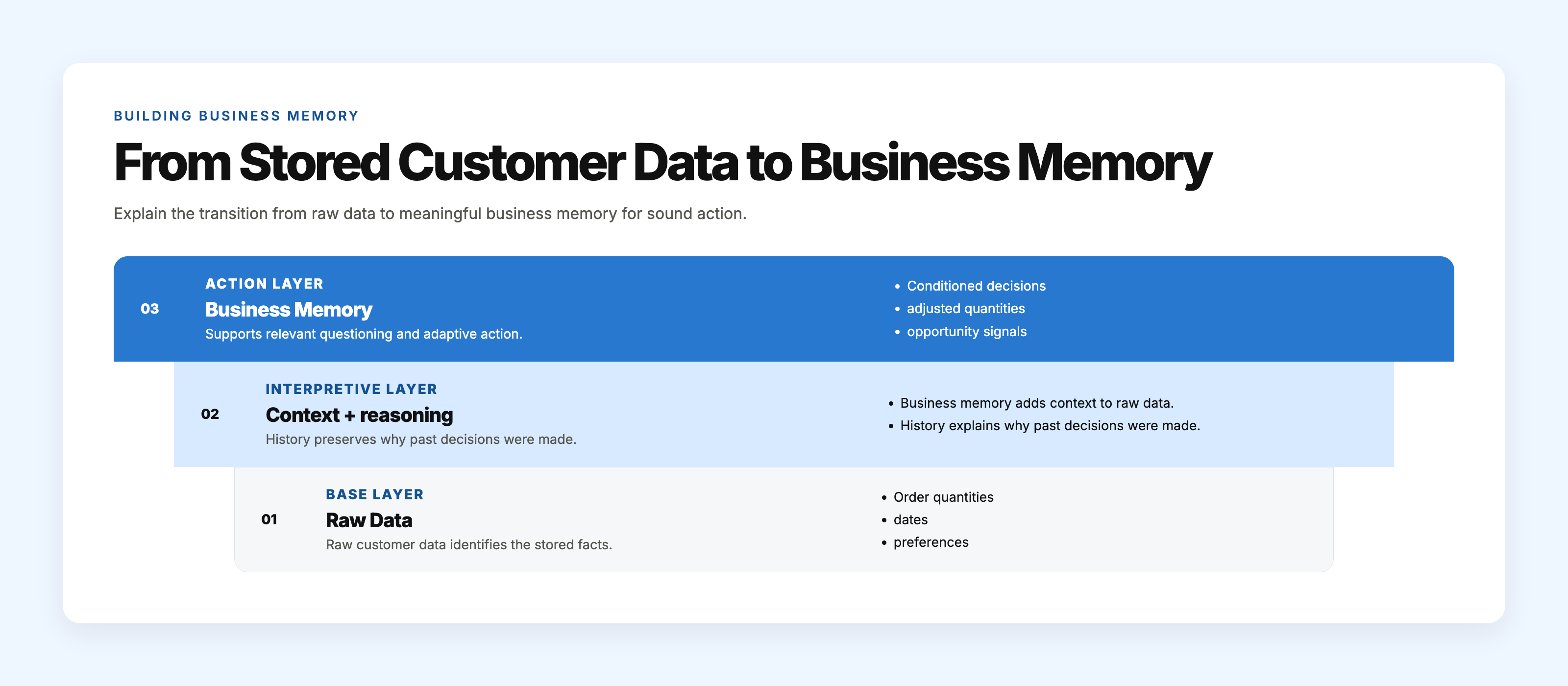
Customer data identifies the account and describes measurable facts. How Businesses Handle 50+ Customer Conversations Per Day Without Chaos explains that managing high volumes requires strong business memory to maintain clarity and continuity across interactions.
Business memory gives those facts enough history to support sound action. The difference becomes visible when an employee must decide whether to repeat the last transaction, question it, or adapt it.
A specialty manufacturer may know that a customer ordered 2,000 units of a particular part in March. The surrounding history explains that the quantity was reduced from 2,500 because storage space was temporarily limited, that the finish was chosen to withstand a new sanitation process, and that the next run may return to the original quantity after a facility expansion.
That understanding can reveal opportunity without requiring aggressive selling. When the customer contacts the manufacturer again, the account representative can ask whether the facility change occurred and whether the temporary quantity limit still applies. The question is relevant because it follows prior reasoning. Without that history, the representative may simply duplicate the last order and overlook a changed need.
Business memory also protects against false certainty. Previous decisions should not harden into permanent assumptions. A customer’s deadline, budget, preference, or internal process may change. Preserved context gives an employee a sound starting point while still leaving room to confirm what remains true. It supports better questions rather than eliminating questions altogether.
A 14-day free trial can help a team test whether clearer communication context improves the continuity of everyday customer work.
This is the operational value of communication history. Spoken and written interactions contain qualifications that database fields often flatten. When those qualifications remain visible, the business can carry judgment across employees, absences, and long gaps between transactions. The test is not whether every exchange was saved. It is whether the next employee can recognize what still matters.
Key Takeaways
- A complete CRM record can document activity without preserving the customer context needed for the next decision.
- Customers expect prior decisions, constraints, and qualified promises to carry across employees.
- Weak business memory creates recurring labor through searching, reconstruction, and repeated clarification.
- More notes do not solve the problem when consequential details remain buried or ambiguous.
- Usable context survives the absence of the employee who originally handled the work.
Where TMMN Fits In
TMMN approaches this issue through communication maturity: how reliably a business carries important understanding from one interaction to the next. The presence of a CRM matters, but so do the habits around handoffs, ownership, exceptions, and the way employees distinguish a completed activity from an unresolved customer issue.
That perspective leaves room for the CRM to do what it does well. Structured fields remain valuable for reporting, pipeline management, forecasting, segmentation, and task tracking. Nuanced conversations do not all need to become new fields, and useful systems do not need to be replaced simply because they cannot express every qualification.
The gap appears when an interaction changes the work but the record does not make that change clear. A call may explain why an exception was approved. A written exchange may narrow a promise. A meeting may reveal that the customer’s stated preference is secondary to a physical limitation. Communication maturity shows up in whether that meaning survives the handoff and reaches the person responsible for the next action.
A practical starting point is one recent customer situation that required reconstruction. Could a capable employee see the prior direction, the limits attached to it, the remaining question, and the owner of the next follow-up without searching extensively or asking around? If not, the useful comparison is between what the record contained and what employees actually needed to continue the work cleanly.
Data collection answers whether information was retained somewhere. Organizational recall is demonstrated when useful understanding returns at the moment of action. A customer relationship does not become durable because the business remembers that something happened. It becomes durable when prior work still shapes what happens next.

.svg)