


A customer standing in a store aisle sees a product they like but wants it in a different color. Another customer is leaving work and needs to know whether an order will be ready before the shop closes. Someone else receives a service confirmation and realizes the business needs a gate code before arriving.
These are small questions. They do not always feel important enough to justify a phone call, yet the answer may determine what the customer does next. Sending a text fits the moment because the customer can ask quickly, put the phone away, and read the response when it arrives.
That ordinary behavior is the basis of two-way business texting. It is not simply a business sending reminders, confirmations, or announcements. It is an exchange in which a customer and a business can ask questions, provide details, clarify a request, and continue within the same recognizable text thread.
The distinction matters because a message can look conversational without operating that way. If a customer replies to a confirmation and receives only an automated acknowledgment, the business has delivered a text but has not necessarily supported a customer-service interaction. Genuine two-way texting begins when the reply can be understood and answered usefully.
Why Customers Start With One Short Text
Customers often choose text for questions that are practical, immediate, and limited in scope. A person may want to know whether a jacket is available in a medium, whether a special order has arrived, or whether curbside pickup is still available at 5:30. The question matters, but it does not require a long conversation.
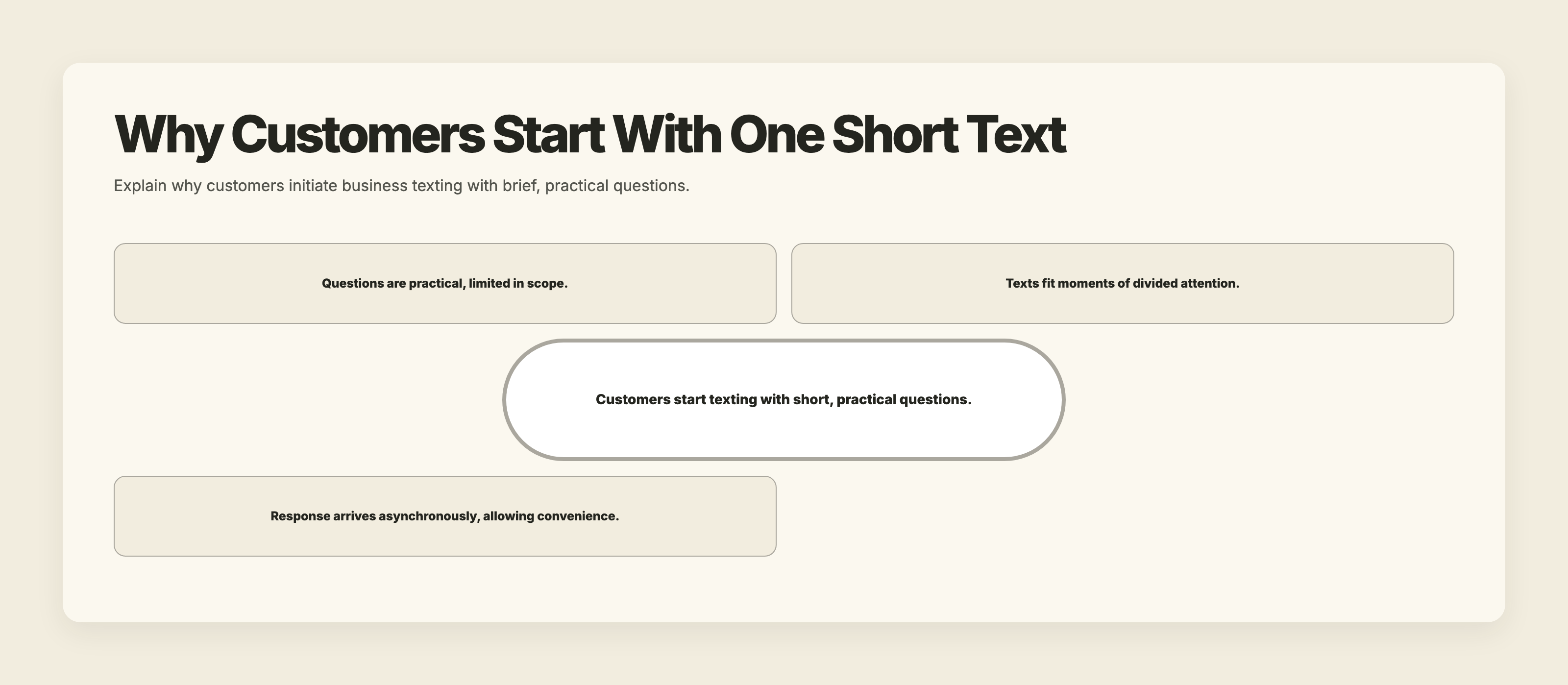
Text also works around divided attention. A customer can send a question between meetings, while riding the train, or before walking into another appointment. They do not have to stay on the line while the business looks up the answer. When the response arrives, the original question is still visible beside it.
Consider a customer named Maya who is shopping for a replacement part for an espresso machine. She finds a local specialty retailer during her lunch break but is not certain whether the listed part fits her model. A phone call would require her to read several model numbers aloud while standing outside a restaurant. Instead, she texts the business: “Does this fit the Barista 860?”
That message is not casual merely because it is short. Maya is close to making a purchase, but she needs one fact first. If the retailer can ask for the serial number or invite her to send a photo of the existing part, the exchange can become useful without becoming burdensome.
Customers also read the availability of texting as a signal about what the number can do. If a business sends a message from what appears to be a normal text thread, replying feels natural. The customer usually does not know whether that message came from a shared business system, a personal phone, or software that cannot display inbound replies.
When a usable answer does not follow, many customers do not announce their disappointment. Maya may search the same part number online, compare another retailer, or decide to deal with the repair later. Her silence does not explain whether she bought elsewhere, postponed the repair, or simply lost confidence that texting the store would help. Quiet customer exits rarely identify the operational failure that caused them.
The Difference Between Sending a Text and Supporting a Conversation
Outbound business messages have useful purposes. For customer service, the practical requirement is the ability to support a two-way conversation, not just send a text.
A confirmation can tell a customer that an order was received. A reminder can place an upcoming service time somewhere easy to find. A status update can reduce the need for a customer to contact the business at all.
Those messages become two-way business texting only when the reply path is functional. The customer needs to be able to respond in ordinary language, and the business needs to receive enough information to understand what the response refers to. Someone then has to provide an answer that addresses the request rather than merely confirming that the message arrived.
An automated acknowledgment can help set expectations. “We received your message and will respond during store hours” tells the customer that the text reached its destination. It does not, however, answer “Can my sister pick up the order if she brings her ID?” The service work begins after the acknowledgment.
The difference becomes obvious at a small bakery taking custom cake orders. The bakery sends a pickup confirmation, and a customer replies, “Can you make the writing blue instead of red?” If replies do not reach the order desk, the customer may arrive expecting a change the production team never saw. From the customer’s perspective, the request was placed in the thread connected to the order. Internally, it may have landed in an unattended inbox or nowhere useful.
A personal mobile phone can support a genuine exchange, but it introduces another consideration: the customer is interacting with an employee’s number and device rather than a stable business identity. If that employee is off the next day, another staff member may not be able to see which color was requested or what the customer was promised.
A text number is therefore only the front door. What makes the experience conversational is what happens after the customer enters: the incoming message is available, its reference is understandable, and the response comes from the business in a way the customer recognizes.
What Happens From the Customer’s First Question to the Business Reply
A normal exchange begins in one of two ways. The customer sends a new message to a published business number, or replies to a text the business has already sent. Either way, the incoming message needs to arrive somewhere an appropriate responder can read it.
At 9:10 on a Tuesday morning, Maya texts the specialty retailer about the espresso-machine part. Lena, a sales associate opening the store, sees the message and checks the catalog. Two similar parts appear, so she replies from the store’s texting number: “Can you send a photo of the connector and the model label?”
Maya sends two pictures at 10:05. Lena recognizes the connector but asks Devon, the inventory lead, to verify the stock code. Devon checks a boxed part in the back room and notes in the thread that it is compatible. Before Lena returns to the message, the floor manager sees Devon’s internal note and texts Maya that the part is available for pickup.
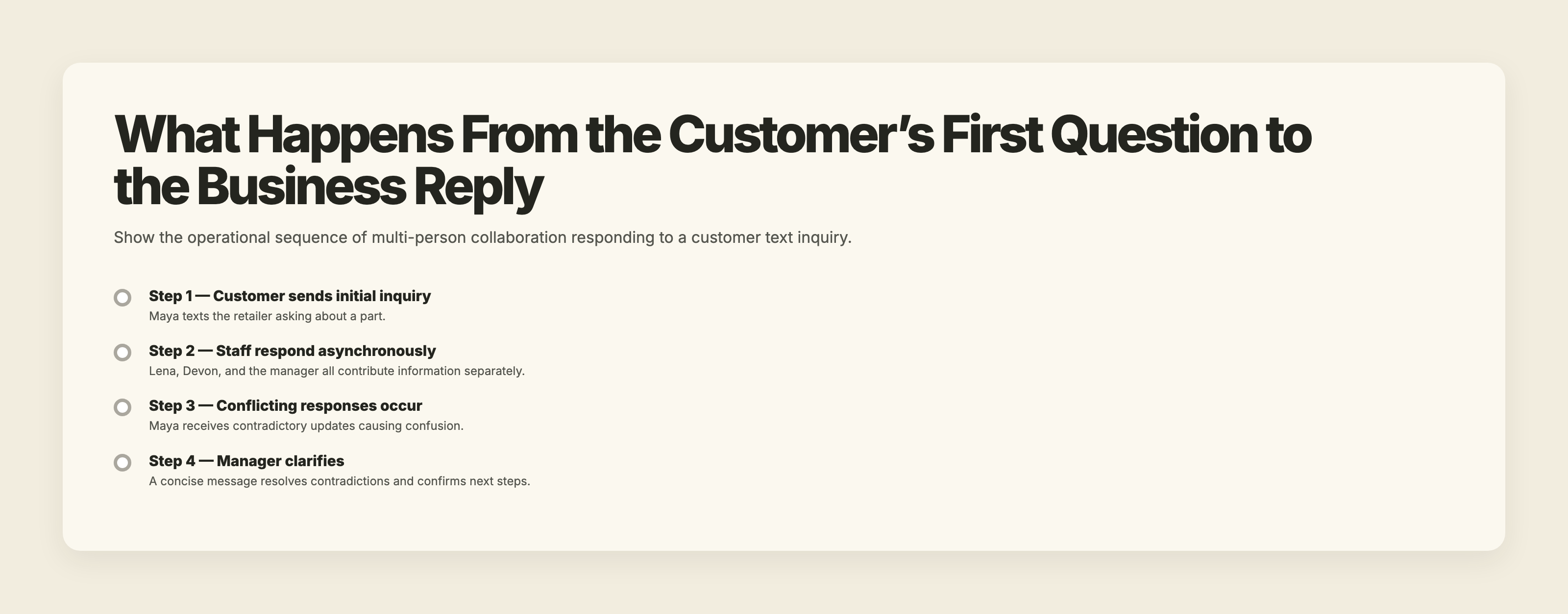
The breakdown comes later that afternoon. Lena returns from helping customers on the floor, sees her original question, and sends a second response saying she is still checking. Maya now has two different signals from the same business number: one says the part is ready, and another suggests the answer is uncertain.
Nothing was ignored. In fact, several people acted. The difficulty came from the state of the exchange being interpreted differently by each person. The manager saw a verified answer; Lena saw her unfinished task. Maya saw one business contradicting itself.
The manager resolves the issue with a concise clarification: “Sorry for the crossed update. Devon verified the part in stock, and we have placed one at the counter under your name until 5:00 tomorrow.” Maya replies that she will collect it after work the next day.
This is what the operational sequence needs to accomplish. The customer asks, the business identifies what is needed, an informed person contributes, and the reply gives the customer a usable next step. The thread is not valuable because it contains messages. It is valuable because each message reflects the current state of the request.
How SMS Carries the Exchange and MMS Adds Useful Detail
SMS works well for concise text: availability questions, pickup instructions, order clarifications, access details, and brief scheduling updates. The format encourages both sides to isolate the practical point. “Yes, the navy version is available” may be all the customer needs.
MMS extends the same exchange by allowing visual information. A customer can send a photo of a connector, product label, damaged package, reference design, or document section. The business can return a product image or show the difference between two similar options.
At a framing shop, for example, a customer may text a picture of a print and ask whether a particular frame style is suitable. The employee cannot make a final color judgment from a phone image, but the photo can establish the print’s dimensions, orientation, and general style. The business can then explain which samples the customer should view in person.
The limitation matters as much as the convenience. A blurry photo may hide a model number. Color can appear differently across screens. A complex repair cannot always be assessed from one image. Good two-way texting does not pretend that a visual attachment settles every question; it uses the attachment to narrow the question and identify the sensible next step.
MMS can also prevent avoidable description work. Rather than asking a customer to explain which of six nearly identical fittings they own, an employee can request a clear photo beside a ruler. The customer spends less time searching for terminology, and the employee has a more concrete reference.
Staff behavior determines whether that advantage survives. If the photo is downloaded to one employee’s phone and discussed separately in a back room, the next responder may see only “customer sent picture” without knowing what was concluded. A useful visual belongs with the exchange it informed.
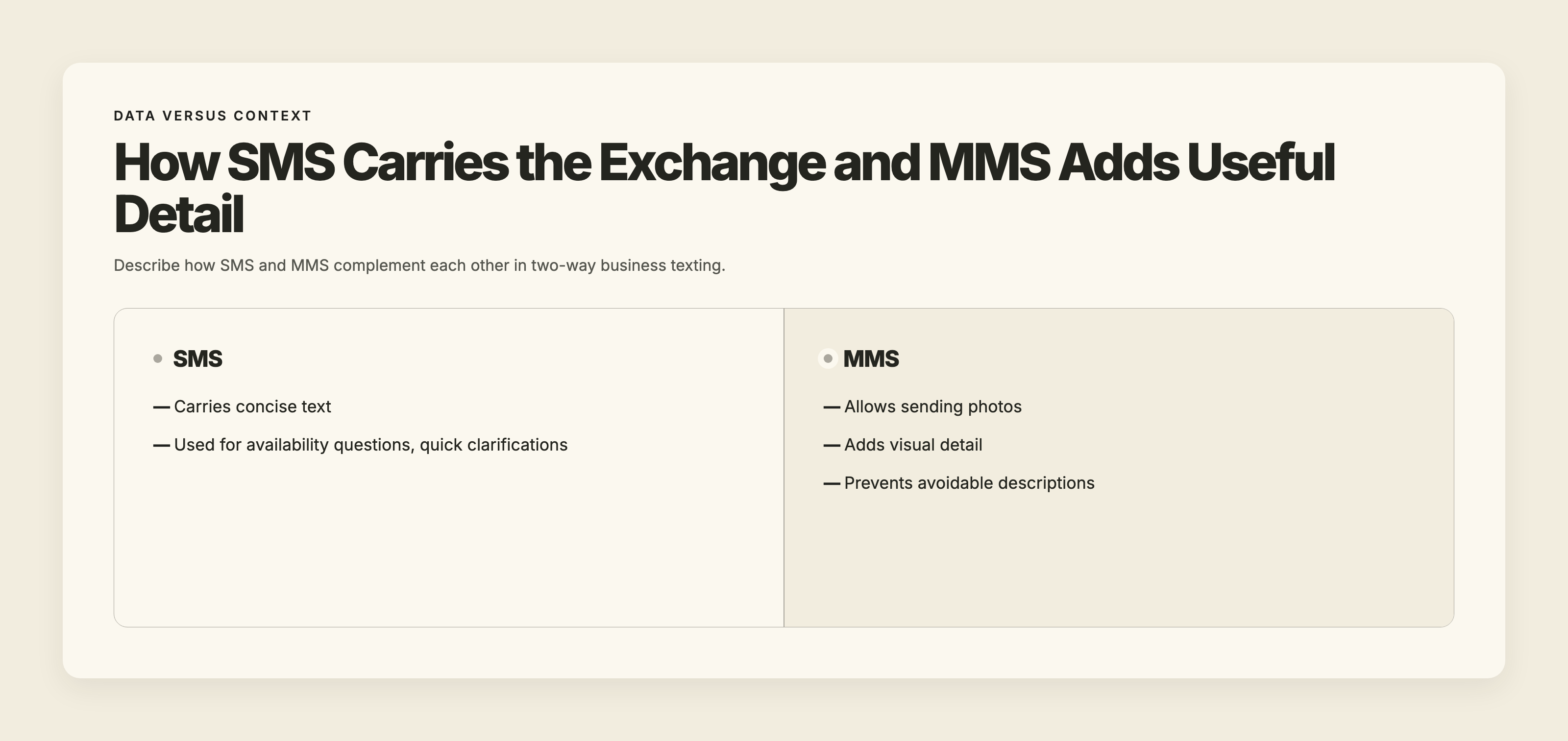
SMS and MMS are therefore parts of the same service interaction. SMS carries the concise language. MMS contributes detail that is easier to show than describe. Both work best when the response is candid about what can be confirmed through text and what still requires inspection, a longer explanation, or another appropriate step.
The Reply Test: Can the Customer Continue Without Starting Again?
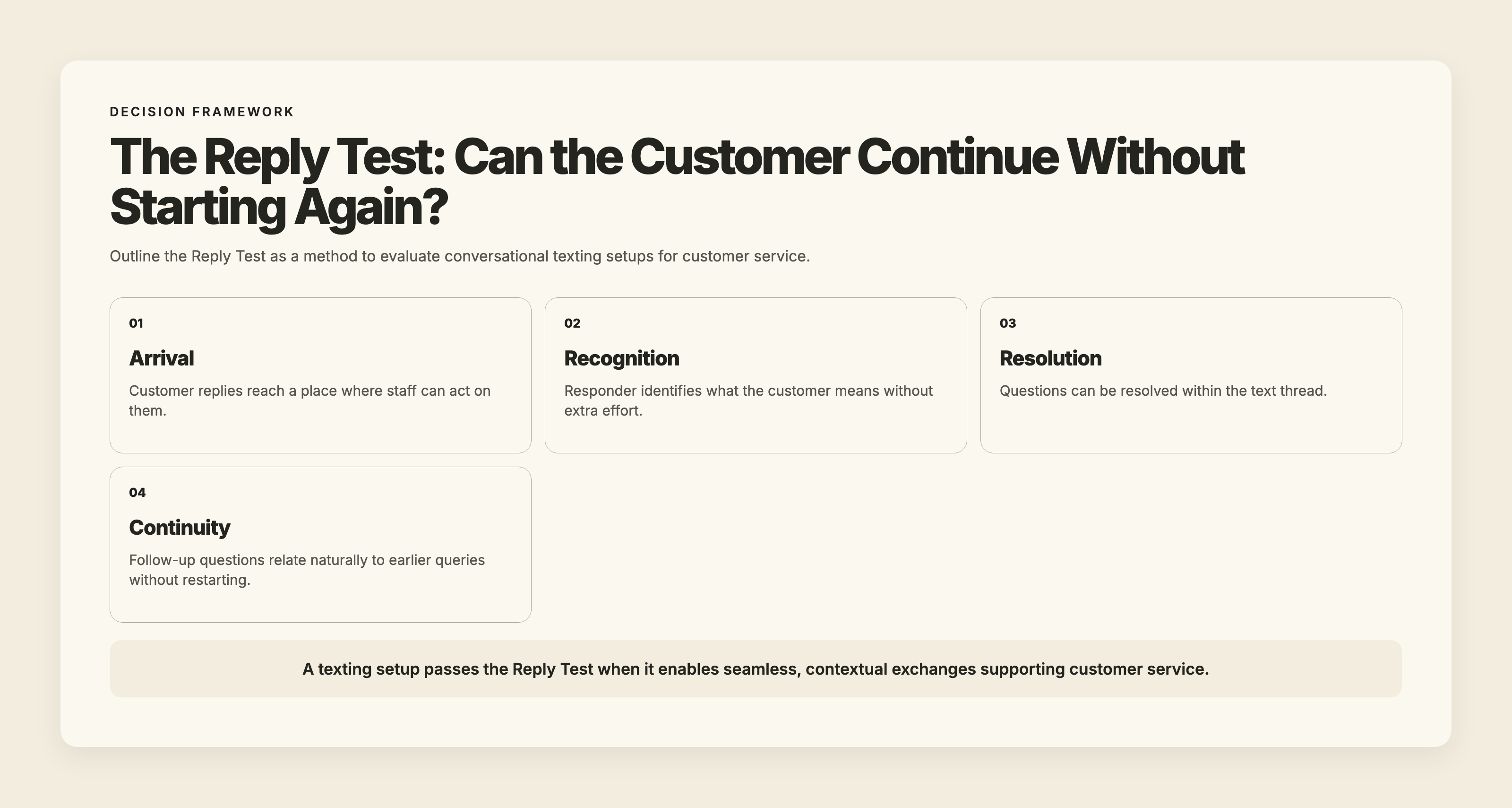
The Reply Test is a practical way to distinguish a conversational texting setup from an outbound notification tool. It follows the customer’s next reply rather than evaluating how easily the business can send the first message.
The test begins with arrival: can the customer’s response reach a place where staff can act on it? Failure here may look like a no-reply number, an unmonitored destination, or an inbox that someone remembers to check only between other tasks. A customer who replies, “I need to change the pickup name,” reasonably believes the request has entered the service process. Inside the business, however, the message may remain untouched until the order is already at the counter.
The next point is recognition: can the responder identify what the customer means without asking them to rebuild the conversation? A message saying “Thursday works” is useful only if the responder can see whether Thursday refers to delivery, installation, pickup, or a proposed callback. Without that reference, a five-word answer becomes a longer task for both parties and makes the customer repeat information the business already appeared to know.
Then comes resolution within the thread. A café customer asking whether an order contains almonds should not reach an employee who can see the question but has no practical path to verify the answer. Staff may need to check a package label, ask the kitchen, or confirm whether cross-contact is possible. A practical reply test for business texting —having another staff member take over mid-thread—shows whether the customer’s details and prior messages survive the handoff.
The important operating distinction is that the internal work can happen without making the customer restart elsewhere. The informed answer returns through the text conversation where the customer is waiting.
The final part is continuity after the answer. If the café confirms that a pastry contains almonds and the customer asks whether another item is suitable, the follow-up still belongs to the same request. When the second question is treated as a new case, routed to another employee, or answered without the prior allergy context, a natural exchange becomes fragmented at the moment context matters most.
Operationally, the weakest point is often not message delivery but request state. A reply may arrive correctly while staff still cannot tell whether the request is new, under review, waiting on another person, or already resolved. That ambiguity is where duplicate answers and missed follow-ups begin.
The Reply Test also shows when texting should give way to a different format. A detailed billing dispute or sensitive personal matter may require a call or secure process. The transition should be explained rather than imposed automatically: why another method is appropriate, who will take over, and what the customer should expect next.
A useful operator observation follows from this test: a reply option is a service promise, even when the business never writes those words. Customers evaluate that promise by what they can accomplish after pressing send.
Counting the Extra Steps Behind a Simple Customer Question
The effect of two-way texting can be estimated without dramatic assumptions. Consider a local retailer receiving 35 routine text questions per week about stock, compatibility, pickup, and order status. These numbers are illustrative, but the handling pattern is common.
Suppose a question that remains in the existing text thread takes an average of four staff minutes. That includes reading the request, checking a product or order record, and writing a concise answer. Thirty-five questions multiplied by four minutes equals 140 minutes, or two hours and 20 minutes per week.
Now suppose the reply path does not support a useful exchange. Staff have to locate a phone number, place a return call, leave some voicemails, reconnect later, and ask customers to repeat details. If the average handling time becomes nine minutes, the same 35 questions require 315 minutes, or five hours and 15 minutes.
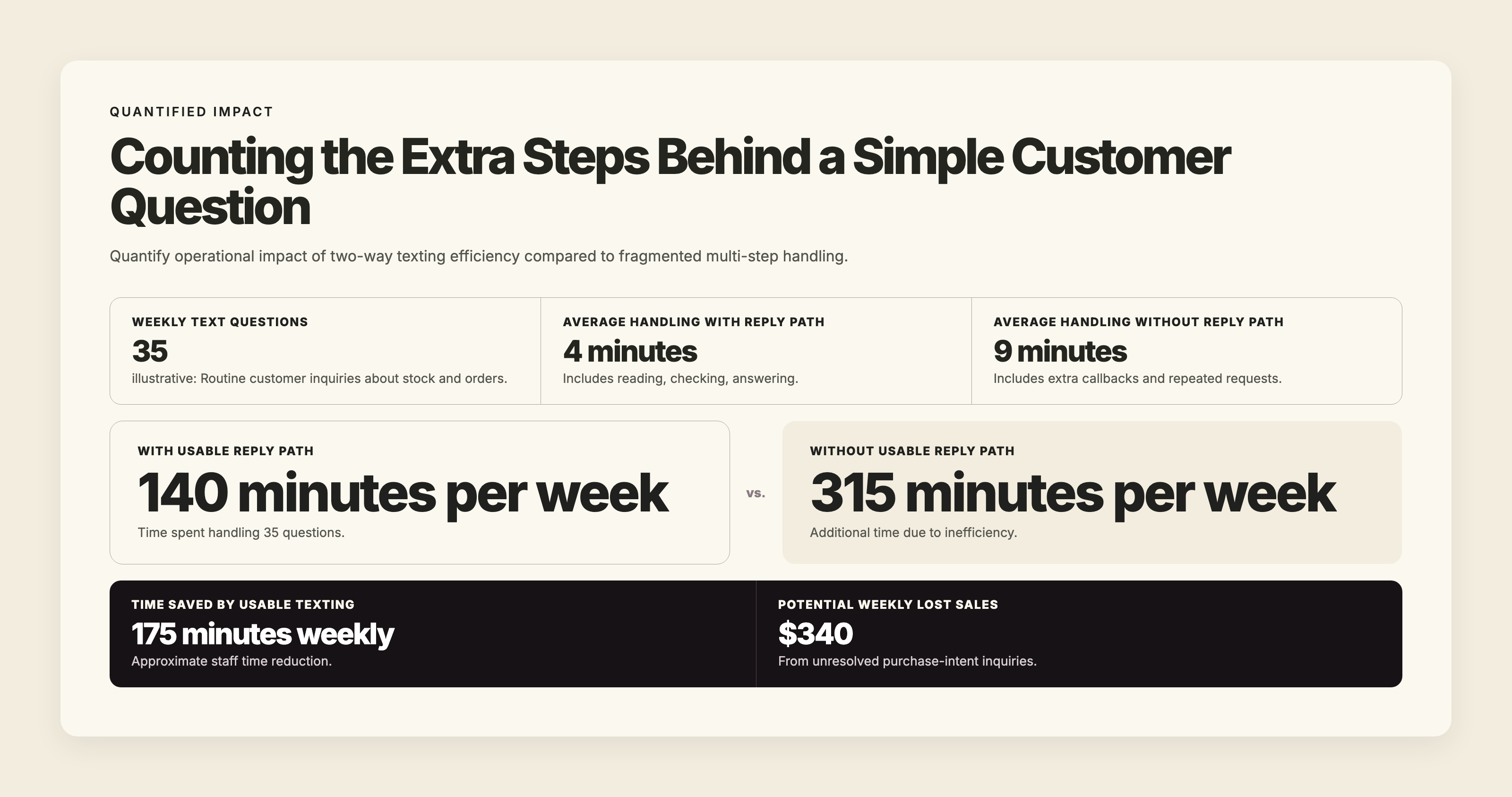
The difference is 175 staff minutes per week. Across four weeks, that is nearly 12 hours. The result does not mean texting always takes four minutes or every call takes nine. It shows how small pieces of repeated work accumulate when a concise inquiry cannot be completed where it began.
There may also be a modest sales effect. Assume 20 of those weekly inquiries come from customers deciding whether to buy or book. If 14 reach a clear next step through a usable reply path, the completion rate is 70 percent. If only 10 continue when customers are asked to call and repeat the request, four purchase-intent inquiries remain unresolved.
At an illustrative average transaction of $85, those four decisions represent $340 in weekly sales opportunity. That is not guaranteed revenue; some customers may return later, and some questions will not result in a purchase. The calculation simply shows why an ordinary compatibility answer or pickup clarification can have commercial value.
The labor calculation is often easier for an operator to verify. A one-month sample of routine inquiries can show how long each takes and how often customers have to restate the request. Observed handling time is more useful than an ambitious projection.
What a Business Needs Behind the Texting Number
A business texting number needs a recognizable identity. Customers should understand that they are speaking with the store, office, or organization rather than guessing which employee owns the phone. A stable identity also allows responsibility to move between staff schedules without making the customer search for a different contact.
Behind that identity, someone has to own the inbox at any given time. “The team monitors it” often sounds clear until a message arrives during a lunch rush, a shift change, or the final half hour before closing. If everyone can see the message but no one is expected to take it, visibility creates the appearance of coverage without actual ownership.
Active work also needs to be recognizable. An employee may open a message, walk to the stockroom, and leave the thread while checking a product. Another employee sees that the message has been read and assumes an answer is underway. The first employee is interrupted at the counter and assumes the second employee will handle it. The customer sees no response, while both employees can point to activity around the request.
A practical handoff preserves more than the text history. It indicates who is carrying the next action, what has already been checked, and whether the customer has been promised a response. In Maya’s retailer exchange, Devon’s verification changed the state of the request. The mistake was not a lack of information; it was that Lena’s unfinished task and Devon’s completed check remained active at the same time.
Internal contributions and customer-facing messages therefore need distinct roles. Devon can verify inventory without becoming the person responsible for wording the reply. A clear conversation assignment and handoff process lets teammates complete necessary checks without shifting ownership of the customer reply.
Lena can remain the customer-facing owner without personally performing every check. The thread becomes unreliable when a private note is mistaken for a sent answer, or when an external response does not clear the earlier assignment.
Responsibility may change hands several times during an ordinary day. The opening employee may receive the question, the inventory lead may investigate it, and the closing manager may be the person available when the customer replies. A usable operation makes that transfer visible before the customer has to ask, “Did anyone find out?”
Promised follow-ups require particular attention. “I’ll check and get back to you this afternoon” creates work that remains open even if the thread goes quiet. The customer may not send another message because the next move belongs to the business. If the promise is not visible when shifts change, the request can appear inactive precisely because the customer is waiting as instructed.
Follow-up also needs a defined end. An exchange may be complete when the question is answered, a pickup is confirmed, or the customer is told what information is still needed. Without that endpoint, a thread can remain technically open even though no further action is expected, or appear complete when a promised update is still pending.
Reasonable expectations should be visible as well. A business that answers texts during operating hours can say so. An automatic receipt can explain when a human response is likely, provided it is not treated as the answer itself. Silence feels more deliberate when the customer has no indication that the business is closed, checking a detail, or planning to respond later.
Behind the number, the operating question is not merely whether staff can see the conversation. It is whether one person can recognize the next obligation, carry it through a handoff, and close the loop from the business identity the customer contacted.
Where TMMN Fits In: Supporting Real Business Exchanges
TMMN’s role in two-way business texting is centered on the path an actual customer exchange takes: where the inbound reply lands, what the responder can see, how another employee contributes, and whether a promised answer remains owned until the customer receives it. Message volume alone does not reveal those conditions.
The most useful examination begins with observable moments. A customer replies to a confirmation with a change. An employee opens the message but needs information from the floor. A photo arrives and has to remain connected to the request. A shift ends before the answer is sent. These are the points where a texting feature either supports service work or leaves employees coordinating through memory, side conversations, and assumptions.
A direct review of a texting setup follows those same moments. A product question arrives from an outside phone. A customer replies to a confirmation with a change or attaches a photo. The first message remains unresolved long enough for another employee to encounter it. What matters is where the reply appears, whether the original reference remains visible, how staff recognize active work, and what the customer ultimately receives.
A live test often reveals more than a feature label because it follows the same path a customer uses. It can show that inbound replies technically arrive but remain unnoticed during busy periods. It can reveal that two employees can answer but cannot tell when the other is already working. It can also expose a promised follow-up that disappears from view once the thread is no longer the newest item in the inbox.
That is the category of communication problem TMMN is positioned to examine: not whether a text was transmitted, but whether the exchange remains understandable and owned from the customer’s first question through the business’s final answer. Any specific messaging, media, routing, or conversation capability still needs to be confirmed against current product information rather than inferred from that operating role.
Not every interaction belongs in text. Some requests require extended discussion, formal documentation, secure information handling, or careful personal attention. The same examination still applies when the exchange moves elsewhere. The customer needs to know why the transition is happening, who is taking responsibility, and whether the information already provided will move with the request.
Spoken Touch belongs within that same operating standard when considering richer forms of business conversation. The name or direction alone does not establish a specific current capability. When assessing TMMN’s approach to SMS automation, operators should look for clear handoffs, visible conversation history, and a named owner when automation reaches its limit.
What matters is whether any supported exchange helps a customer ask, clarify, and receive an informed response without unnecessary repetition or an unexplained break in ownership.
Key Takeaways
- Two-way business texting begins when a customer reply can be understood, owned, and answered usefully.
- A message can arrive successfully while the underlying request still becomes lost between employees.
- SMS carries concise questions; MMS adds visual detail that needs to remain connected to the exchange.
- The practical test is whether the customer can continue without repeating context or restarting elsewhere.
- The strongest operations preserve ownership, request state, and promised follow-up behind one recognizable business identity.
Conclusion
Two-way business texting earns its place in customer service through ordinary moments. A shopper confirms a size before driving across town. A pickup customer supplies the name of an authorized person. A specialty-service customer sends a photo that helps staff understand the request before arranging the next step.
In each case, the text works because it behaves like a real exchange rather than an announcement. The customer can respond naturally, the business can interpret the request, and the answer helps both sides decide what happens next.
The final measure is not that the thread stayed active. It is that the customer did not have to carry the business’s coordination burden. A 14-day free trial can help a team test whether clearer communication context improves the continuity of everyday customer work.
When context, ownership, and the next action remain intact behind the number, a short text can complete real service work.

.svg)

