



Understanding Why One Channel Limits Your Customer Reach
Imagine you own a busy neighborhood bike shop. Your website lists only a phone number and an email address. Receptionist Anna answers all incoming calls, while Mark, the owner, checks emails whenever he can between fitting bikes and tweaking brakes. One Monday morning, Anna takes a call from Sophie, a customer hunting for a specific bike helmet. Sophie wants quick answers and asks a few detailed questions. Anna handles the call smoothly and promises to hold the helmet for Sophie.
Later that afternoon, Mark goes through the email inbox and spots a message from Sophie. Without an official note connecting the email to the morning call, he doesn’t realize it’s the same customer. Sophie’s email asks about price and delivery time; Mark replies with a generic estimate. Sophie feels uncertain—she expected a faster, clearer reply. By Tuesday, she’s already looked at other stores online and sent texts to two different retailers that offer quicker and easier back-and-forth.
This everyday story reveals what happens when communication relies only on voice and email without a clear system. Customer needs can be missed or met with delays, creating a subtle disconnect neither side notices immediately. Yet, it quietly affects how comfortable the customer feels.
Using only one communication channel limits your reach because people don’t all communicate the same way. Many small businesses discover that How Omnichannel Communication Builds Customer Trust (Without Adding Complexity) reflects the practical reality that customers value having choices without creating unnecessary operational complexity. Some prefer phone calls for immediate answers, while others lean on email for detailed questions or written records. Increasingly, texting or chat offers quick, informal touchpoints that make the customer’s journey smoother. Over-reliance on one or two methods naturally excludes or frustrates parts of your audience.
For instance, busy customers might find texting simpler—they can get a quick response without the hold times or background noise of a phone call. Others want written quotes or policies via email as a reference. Ignoring these preferences slows responses, leaves questions unanswered, and drives customers quietly to competitors.
Beyond losing individual leads, this mismatch shapes your business’s reputation. When customers find their preferred channel inconvenient or unavailable, they usually won’t complain directly. Instead, they hesitate, delay following up, shop elsewhere, or choose competitors who accommodate them more naturally.
This isn’t about jumping on every channel at once, especially for small teams with limited resources. The real challenge is to be intentional about which channels to support based on observed customer behavior, use cases, and team capacity. Relying heavily on a single channel might seem simpler, but over time it cuts off accessibility and slows customer conversations in ways that reduce engagement.
How Customers Naturally Switch Channels for Different Needs
A day in the life of Tara, planning catering for a weekend event, shows how customers move between channels depending on their needs.
At 9 a.m., Tara checks the catering site and calls the number listed. She talks briefly with the receptionist about availability. The receptionist gives an estimate but suggests Tara email the event details for a formal quote. Tara hangs up and promptly sends an email outlining the date, headcount, and menu preferences.
By the next day, Tara hasn’t heard back via email and starts feeling anxious. She remembers seeing a text option on the website, so on Tuesday evening she sends a quick message: “Do you have availability for this weekend?” The catering team replies instantly via text with a yes and promises the full quote in the morning.
This kind of back-and-forth across channels happens as customers seek clarity or reassurance. A quick call opens the conversation, email captures detailed info, and text fills in gaps for fast updates.
If the catering business stuck to phone calls alone, Tara might face long hold times or repeated calls. If only email were used, delayed responses would drag out decisions and push her to search elsewhere. Without timely text follow-up, her anxiety would grow, possibly leading her to pick a competitor who answers faster on her favorite channel.
Watching not just which channels customers use but how they move between them reveals real needs. Customer requests change during the buying process. Flexible and responsive communication across channels reassures customers that their questions will be answered promptly, no matter how they reach out.
Different channels serve specific needs. The practical differences between communication methods become clearer over time, a point reflected in Business Texting vs Phone Calls: How to Use Both Effectively has become an increasingly practical discussion for growing businesses. Phone calls work best for complex conversations or urgent decisions. Email handles formal requests and detailed info customers want on record. Text and chat excel for quick clarifications, brief confirmations, and informal check-ins. Ignoring these distinctions by favoring just one channel misaligns expectations, slows dialogue, and pressures customers and staff alike.
Diagnosing Your Current Channel Strategy with Practical Indicators
If you suspect your business relies too much on one communication channel, daily patterns often reveal clues.
One sign is a rise in follow-up contacts shortly after the first interaction. This suggests the initial touchpoint didn’t fully or quickly answer the customer’s questions on the right channel. For example, a customer calls but can’t connect directly, so they email later and later text. Needing to jump between channels adds hassle and risk.
Another sign is internal confusion about who owns messages. The ownership problem often grows as conversations multiply, a challenge that How Teams Actually Handle Customer Conversations Without Losing Context examines from an operational perspective. When a single channel handles all inquiries, and those staff are busy or absent, messages can get overlooked. An unanswered email might prompt a follow-up call to someone else, spreading responsibility thin. This leads to the classic “I thought you handled it” problem where no one actually took charge.
Talking with employees about workflow can reveal bottlenecks. If staff feel overwhelmed or frequently jump between different communication threads, it may mean the chosen channels don’t fit the team’s capacity. Overloaded staff respond inconsistently or take longer, deepening customer frustration.
Tracking response times per channel also helps. If phone calls get answered quickly but emails lag 48 hours, customers who prefer email wait too long. If texting queries aren’t managed alongside calls, urgent notes can slip through the cracks.
Customer behavior uncovers further clues. Do people drop off after an initial message? Do they ask questions through one channel then suddenly stop? Often, this signals dissatisfaction with response speed or channel fit.
Observing these operational signs offers grounded insight to revisit channel strategy. The aim isn’t to add every possible channel but to find a practical mix that matches actual customer habits while avoiding confusion or delay.
Quantifying the Opportunity Lost by Single-Channel Reliance
To grasp the cost of relying on just one channel, consider a small home cleaning business handling about 100 weekly customer inquiries—all by phone.
- About 70 out of 100 calls connect directly to the receptionist on the first try and are answered promptly.
- The other 30 go to voicemail or are missed because staff are busy.
- Of those 30 missed calls, half of the customers don’t leave any message or try to reach back.
- That means roughly 15 missed or lost conversations each week.
This cleaning service depends almost entirely on phone calls and doesn’t actively support emails or texts. But an informal poll shows:
- 40% of new customers prefer sending SMS to ask quick questions like pricing or availability.
- 25% primarily use email for details or to send photos for estimates.
By ignoring these preferences, the business effectively excludes a big share of potential customers each week. The 40 text-preferred customers rarely call, and the 25 email-preferred ones often delay responses or shop around.
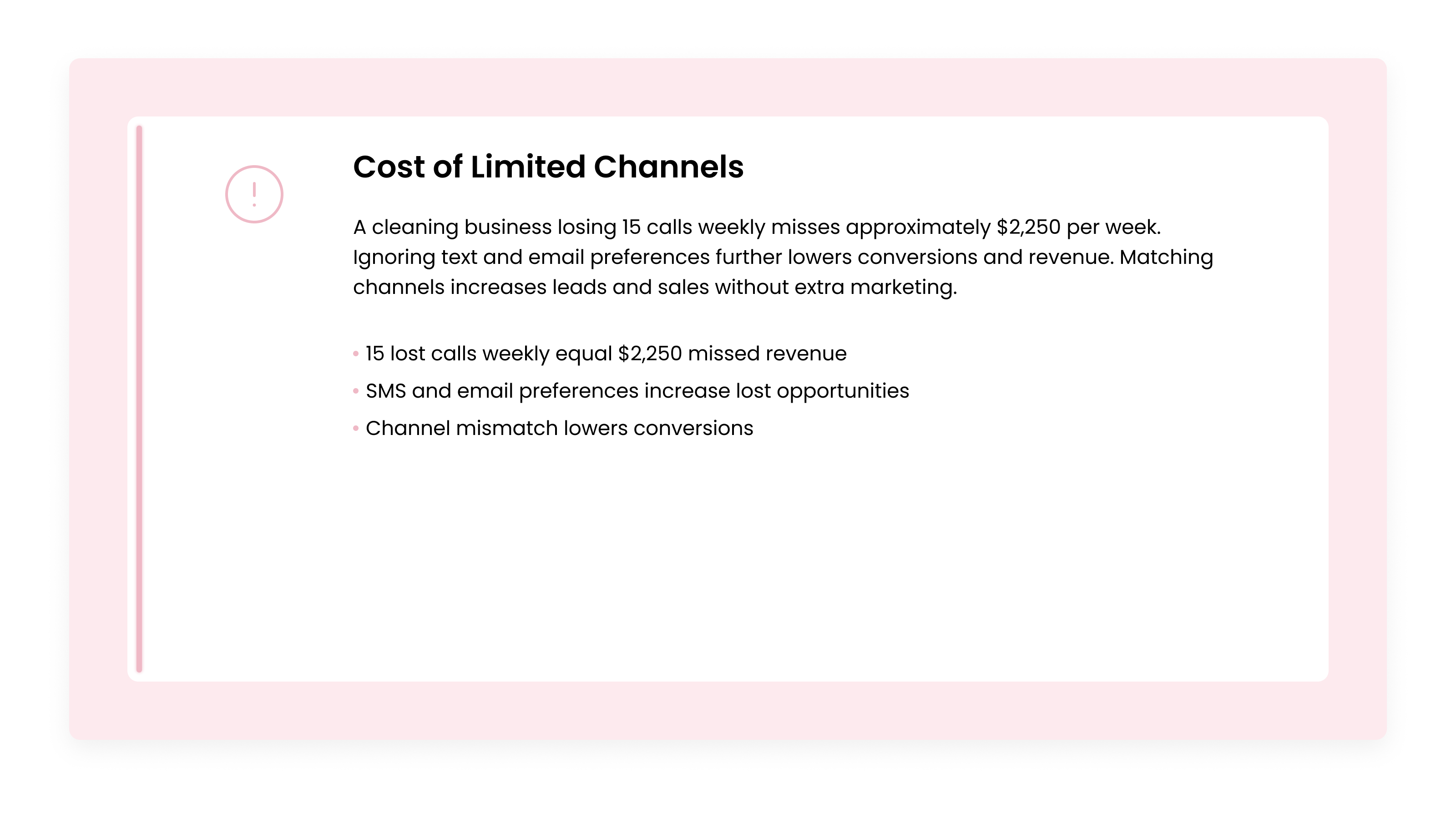
Assuming each job nets $150, losing 15 phone calls plus missed opportunities from text and email potentially costs the business about $2,250 weekly—more than $90,000 annually.
Consider also that calls answered on the right channel convert at 50%, but mismatched follow-ups via email drop conversion to 30%. This shows how channel mismatch lowers final sales rates. If the cleaning service could reach more customers on their preferred contact types or quickly follow up with text, conversion would improve, recapturing a substantial chunk of lost revenue without needing more leads.
This math reveals a quiet leak in operations—not glaring day-to-day but adding up to significant lost business. The root cause is often hidden in customer inconvenience, slow replies, and lack of intentional channel diversity.
Aligning Channel Choice with Real Small Business Operational Constraints
Small businesses juggle limited time and resources, often relying on just a few people covering many tasks. Adding too many communication channels or scattering attention risks burnout or chaos. So, matching channel choice with operational reality is key.
First, clarify which channels serve which customer needs best. For example, use phone calls for urgent inquiries and scheduling, email for formal quotes or documentation, and text for quick confirmations and updates. This spreads workload naturally instead of forcing staff to handle every question in one place, which slows response and annoys customers.
Second, assign clear ownership for each channel or conversation type. Designate who answers and follows up. For example, Anna handles calls during the day, Mark manages email quotes in the afternoon, and the technician handles texts out in the field. A quick daily check-in between them keeps everyone aligned.
Third, gather real feedback by observing actual customer behavior, not just surveys. Watch which channels get used most and where delays happen. Seeing live patterns helps adjust channel support to actual needs. Often, customers try channels spontaneously depending on context.
Fourth, keep things simple. Adding more channels without proper training, tools, or coordination can cause more headache than help. Choose channels that fit naturally with your customers and workflow. For example, if emails pile up, adding text messages—usually brief and easy to manage—can be a better next step.
Finally, small businesses can use tools that unify messages from multiple channels without losing their distinct tone. Bringing conversations together across channels often becomes part of broader growth, an idea reflected in From Texting to Full Conversations: How Businesses Scale Communication Without Losing Leads. These tools help staff see and reply to customers efficiently, keeping conversations smooth. The payoff comes from clear channel roles and accountability that improve speed and experience.
Internal Team Moment: When Channels Collide and Ownership Fades
Back at the bike shop, another scenario unfolds over several days, showing how team friction emerges from limited channels and unclear ownership.
Receptionist Tara gets a voicemail from Jim, a walk-in asking about a repair estimate. Tara plans to pass it to Nick, the technician, but forgets amid a busy call rush. The message sits untouched all morning.
Meanwhile, Jim waits and tries emailing the next day. That lands in Mark’s inbox, but Mark, busy with bike fittings, assumes Tara informed Nick. Mark replies to Jim with a generic price email but doesn’t share this with Nick.
Nick never hears about Jim’s request. After two days without follow-up, Jim calls again. This time Tara answers but is unsure of the status. She has no info on Mark’s email reply nor Nick’s input. Jim hangs up frustrated, thinking about other repair shops.
This internal moment highlights how limited channels plus unclear handoffs cause communication to break down. Each team member assumed someone else handled the inquiry because no shared process made ownership visible. The sparse contact methods amplified the problem: voicemails lagged, emails stayed siloed, and real-time coordination didn’t happen.
The result: missed opportunity and staff frustration. This kind of drift happens often when businesses rely on one or two channels without clear workflows and responsibilities. It slows response, confuses customers, and creates extra work as staff scramble to cover loose ends.

Customer Behavioral Moment: Silence After Delay Speaks Volumes
Sophie, the helmet-seeking customer from earlier, shows how customer behavior can signal dissatisfaction quietly.
After Mark’s delayed email response, Sophie hesitated before following up. She wasn’t sure if her helmet was reserved or if the shop was ready to proceed. Instead of replying, she browsed online reviews, checked other stores, and asked friends for advice.
Without prompt, clear communication in her preferred channel, Sophie’s trust weakened. Days slipped by. She stopped responding altogether. The shop never got direct feedback that they lost her.
This silent fade-out is a common but overlooked customer signal. Customers don’t always voice frustration or disappointment openly. Instead, their silence after slow or incomplete responses signals eroding trust. They mentally compare options and quietly switch providers rather than explain why.
Recognizing this behavior shows why timely, channel-appropriate replies matter. Each unanswered moment builds doubt until the customer disengages. It also reminds us to let conversations flow naturally in the customer’s favored format, reducing the risk they pause or drop out.
Why Customers Leave When Channels Don’t Match Their Needs
Customers choose communication tools based on urgency, convenience, and setting. When a business forces one channel, customers must awkwardly adapt, leading to delays and frustration.
Delays breed doubt. If a customer emails and waits two days, they assume low priority or lack of care. If they keep hitting voicemail, they assume unreadiness. This gap opens the door to silent comparisons with competitors.
A lack of response sends a strong message. Customers read silence as deliberate neglect and conclude their request isn’t valued. This quiet resignation kills potential sales or retention.
Customers often compare experiences subconsciously. If competitors answer quickly via texts or offer multiple ways to connect, customers notice subtly. This pushes them toward vendors they find more responsive and accessible.
In short, customers leave because their communication journey doesn’t match their needs. Businesses relying on a single channel fail to meet customers where and how they naturally express interest.
Operational Friction from Channel Mismatch and Staff Assumptions
For staff, using just one channel—especially without clear roles—creates hidden tensions.
Ownership confusion thrives when everybody assumes someone else owns messages from channels they don’t watch closely. For example, the receptionist thinks Mark manages emails, but Mark expects Tara to follow up calls. No one reliably tracks which conversations remain open.
Hand-offs turn messy. Messages bounce between email, phone, and voicemail with no clear status. Customers repeat questions or get mixed answers because conversations aren’t updated properly.
Missed follow-up happens unnoticed. Staff juggling multiple channels or tasks forget to circle back. Without tools or processes to catch open loops, inquiries stall or vanish.
The “I thought you handled it” moment arrives repeatedly, as the bike shop example showed. These silent assumptions multiply in busy days and drag down response speed.
Fragmentation grows when conversations span multiple channels. A question asked on the phone might get an email reply, then a text confirmation. Without integration, staff lose context and customers’ expectations can go unmet. Responses risk feeling disconnected or contradictory.
Together, these frictions break the link between activity and awareness. A customer reaches out, but nobody on the team owns or tracks that thread. The conversation falters without obvious signals, yet momentum is lost.
Insight line: Activity is obvious. Ownership is hidden—and where things usually fade.
A Practical Framework for Aligning Communication Channels
To address these issues without creating chaos, small businesses can use a simple operational tool called the Channel Purpose Map. This helps clarify channel roles, assign ownership, and set clear expectations grounded in daily experience.
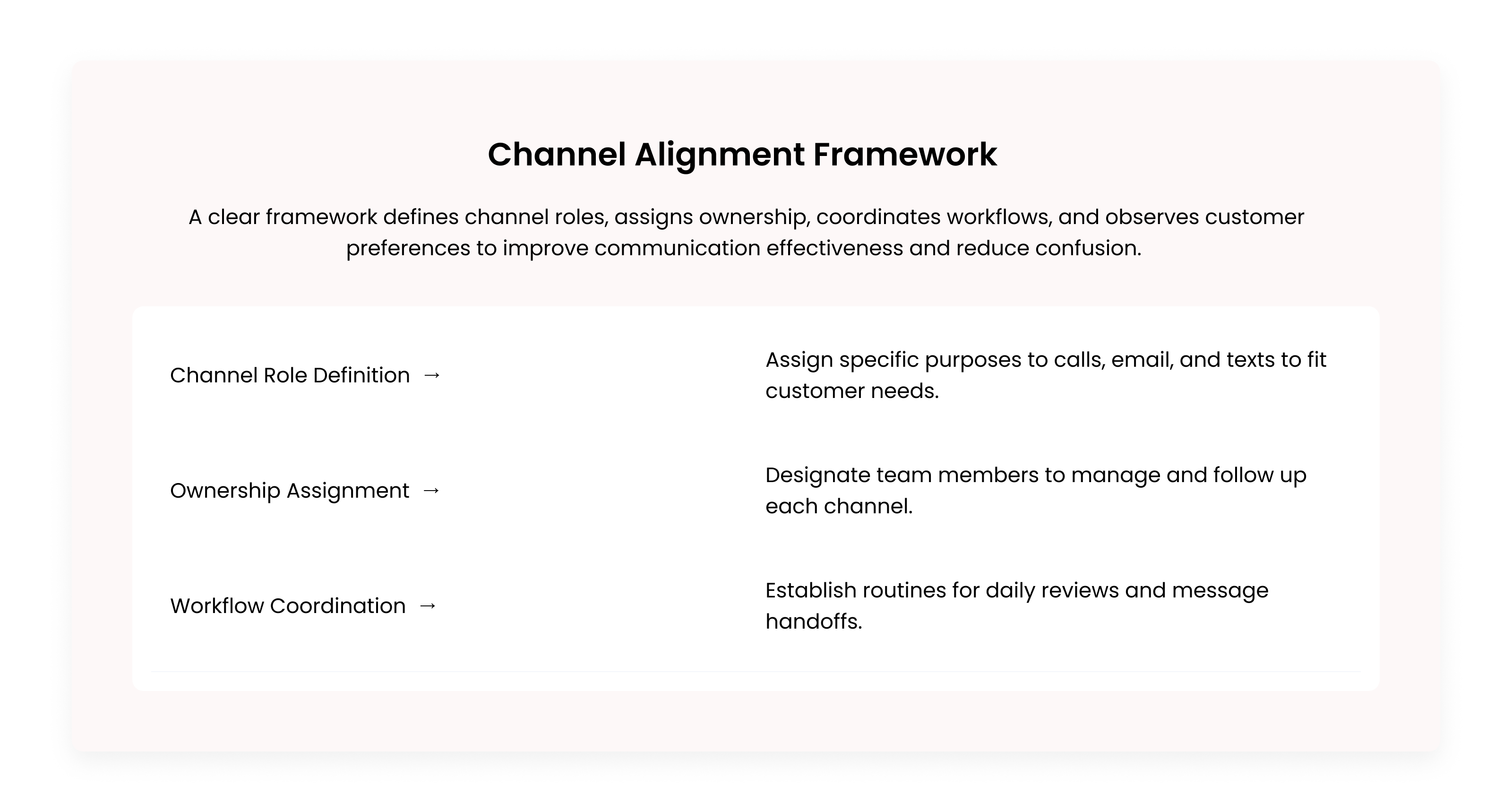
1. Channel Role Definition
Pin down what each communication channel is good for. Phone calls cover urgent or complex talks; email handles detailed or formal questions; texts work for quick updates or confirmations.
Without clear roles, one channel ends up doing everything poorly, frustrating customers and slowing replies.
Defining roles clearly eases confusion for staff and customers alike, speeding communication and making touchpoints clearer.
2. Ownership Assignment
Assign each channel or inquiry type to a specific person. For instance, front desk manages calls during open hours, the owner replies to afternoon emails, and the technician handles field texts.
If ownership is unclear, messages fall through cracks and the “I thought you handled it” issue repeats.
Clear responsibility keeps conversations active and holds team members accountable.
3. Workflow Coordination
Build routine check-ins and handoff procedures. This might mean daily reviews of backlogs, sharing after-call notes, or triaging text messages at certain times.
Without coordination, messages bounce around, causing duplicated work and customer confusion.
Organized workflows prevent mix-ups and help track all conversations.
4. Customer Preference Observation
Watch actual customer channel use and response times, not just survey data. Note where delays or drop-offs happen and adjust channel support accordingly.
Ignoring how customers really act risks backing the wrong channels and missing satisfaction targets.
Aligning with real habits simplifies choices for customers and makes life easier for staff.
Framing channel strategy around these operational realities keeps things simple but effective. The goal isn’t to add every channel under the sun but to find a manageable balance that respects customer preferences and team capacity.
A Subtle Authority Bridge: Practical Concepts Behind the Patterns
Within real small businesses, concepts like intentional channel alignment and respectful communication styles help. Adapting tone, timing, and method to fit customer context isn’t a quick fix or tech addition—it emerges from repeated effort and team discipline.
These ideas highlight how the human element in communication is as vital as the channels themselves. When teams truly own channels and match them to customer rhythms, conversations flow better, misunderstandings drop, and customers feel heard in ways that matter.
Such insights come not from theory but from watching hundreds of days where a missed call or delayed reply quietly shifts loyalty. Understanding these patterns gives practical grounding to organizing communication thoughtfully.
Key Takeaways
- Customers naturally move between channels based on urgent needs, detailed requests, or quick updates; no single channel fits all moment-to-moment demands.
- Over-relying on one communication method fractures internal ownership and slows timely responses, creating silent customer disengagement.
- Operational friction is often hidden in assumptions about who manages what, causing follow-up gaps despite high activity levels.
- Channel roles and ownership clarity reduce customer confusion and internal churn, making communication more fluid and reliable.
- Observing real customer behavior and adjusting channel support accordingly outweighs adding channels indiscriminately or relying on surveys alone.
Conclusion
Looking at real customer and operational patterns, relying on a single communication channel is less convenience and more a hidden risk that limits connection and conversation flow. Customers shift preferences based on urgency, context, and timing—a phone call for urgent needs, email for documentation, text for quick check-ins.
Ignoring this or oversimplifying channel use without clear purpose and ownership causes subtle friction: customer silence, staff confusion, delayed responses, and fragmented answers. These aren’t loud failures but quiet signs of lost contact.
Customers often don’t complain openly; they just slip away. They compare experiences silently in ways businesses can’t always track. Choosing to center one channel is an operational decision with consequences that accumulate over multiple interactions.
Small businesses face this tension regularly, trying to balance simplicity and reach. Clear channel roles, assigned ownership, and simple coordination routines create manageability that respects customer habits without overloading staff.
In practice, it’s not about opening every channel but respecting how and when customers want to connect—and building internal habits to answer those touchpoints responsibly. For businesses looking to put these communication habits into practice, a 14-day free trial offers a practical opportunity to experience how a connected messaging workflow can support everyday customer interactions.
It’s not unusual for a small business to discover a loyal customer quietly went elsewhere—not because they were turned away, but because the conversation flow simply didn’t match their rhythm. These observations, rooted in real interactions rather than theory, often prompt fresh thinking about how communication channels shape the customer relationship every single day.
.svg)

