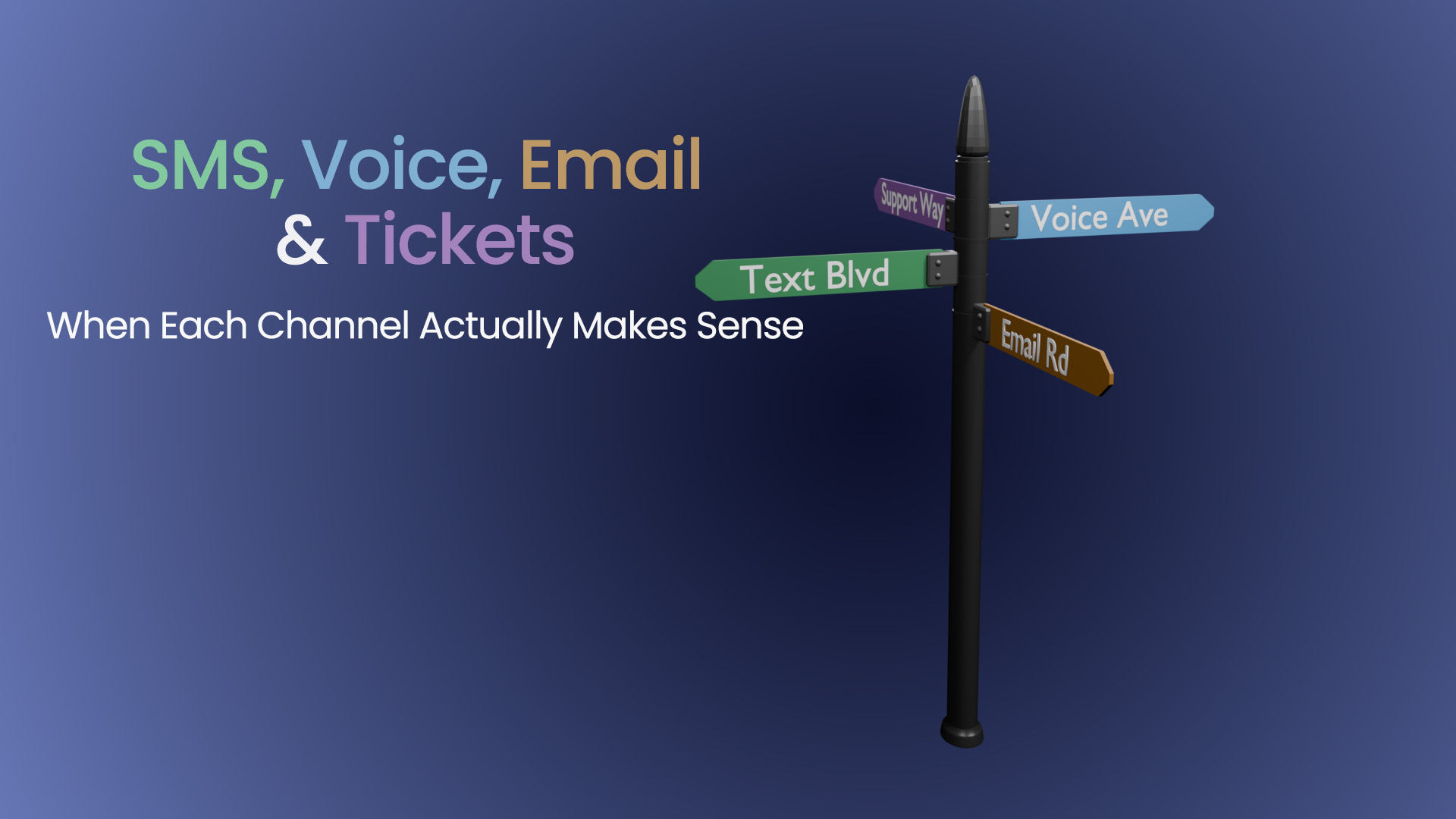

Most small businesses don’t have a “too many channels” problem. They have a mismatched channel problem.
A customer texts a simple question, and the team sends a three-paragraph email back. Another customer calls with something urgent and gets routed into a ticket queue. Someone replies fast, but the conversation still feels messy because the next step is unclear, and the context doesn’t carry forward.
From the business side, it can look like you’re doing everything right. You’re available. You’re responding. You have tools. But the experience still feels heavier than it should for the customer, and the workload still feels heavier than it should for the team.
Here’s what’s really happening: each channel has a job it does well. When you use a channel outside its natural “job,” you create friction that customers experience as confusion and teams experience as rework.
And that friction isn’t theoretical. The modern workday is already fragmented by constant switching, interruptions, and scattered information. Microsoft’s research on the “infinite workday” shows how often people are interrupted by messages, meetings, and notifications, which is exactly why customers gravitate toward whatever feels easiest in the moment and why teams feel drained when communication sprawls across tools. Harvard Business Review has also documented the hidden cost of app switching and “toggling,” which mirrors what happens when businesses force conversations across disconnected channels and tools.
This article gives you a clean, practical framework for when SMS, voice, email, and tickets actually make sense, so conversations feel smoother for customers and lighter for your team.
Customers Don’t Choose Channels — They Choose the Easiest Path
Customers don’t think, Should I use SMS or email? Should I open a ticket? They think, What’s the quickest way to get this handled right now?
That choice is situational.
If they’re at work, they’ll text because it’s quiet and low effort. If something feels urgent, emotional, or confusing, they’ll call because voice compresses time and removes ambiguity. If they need something documented or detailed, email feels safer. If it’s a true support issue with steps and accountability, a ticket can help — as long as it doesn’t replace the human conversation.
This is why the most effective customer communication strategies don’t try to “push everyone” into one channel. They design for flow: the customer starts wherever it’s easiest, and the business guides the conversation into the channel that fits the moment without resetting context.
That concept shows up clearly in usability research, too. Nielsen Norman Group’s research on omnichannel consistency reinforces the same point: customers judge the experience as one journey, not a series of disconnected touchpoints. In other words, customers expect one conversation even when the channel changes.
A real example of “easy path” behavior
A home services customer sees your ad while waiting in a school pickup line. They text:
“Do you have availability this week?”
That’s not a “texting preference.” That’s a moment preference. They need an answer without stepping into a call.
Later, they call because the quote is higher than expected, and they want to understand why. Then they want the estimate and scope in writing, so they ask for an email. If the job moves forward, tickets might help track the work internally, but the customer likely doesn’t want to live inside a ticketing thread.
If your business treats those as four separate conversations, the customer repeats themselves, loses momentum, and starts questioning whether your team is aligned. If your business treats those as one conversation moving through different modes, it feels natural and competent.
The hidden trap: “forcing” a channel creates friction
A lot of businesses accidentally force channels because it’s easier for their tools, not easier for the customer.
You see it when businesses:
- push every question into email, even simple ones that could be answered in one text
- avoid calls even when a two-minute conversation would resolve a fifteen-message thread
- treat tickets as a front-door channel instead of a back-end tracking system
- rely on voicemail without a text follow-up, leaving customers unsure if anyone saw it
Customers don’t describe this as “channel strategy.” They describe it as:
“They’re hard to reach.”
“They don’t really answer questions.”
“It feels like nobody knows what’s going on.”
And those perceptions cost trust long before they show up as a complaint.
The practical takeaway
Choosing the right channel isn’t about being modern or traditional. It’s about matching the channel to the customer’s need in that moment:
- Convenience and speed without interruption → SMS
- Clarity, urgency, emotion, objection handling → Voice
- Documentation and long-form detail → Email
- Structured tracking and accountability → Tickets
When businesses get this right, communication feels effortless. When they get it wrong, teams do more work to produce less clarity. That tension shows up clearly in Business Texting vs Phone Calls: How to Use Both Effectively, especially when a conversation looks simple at first but really needs the speed and clarity of voice.
What SMS Is Actually Best For (And Where It Breaks Down)
.png)
SMS became popular in business communication for a reason. It reduces friction at the moment of contact. It lowers the emotional cost of reaching out. It fits neatly into how people already live on their phones. But SMS works best when it’s used for what it’s good at — not when it’s stretched into roles it was never meant to handle.
Where SMS Truly Excels
SMS is at its strongest when the goal is speed, convenience, and lightweight progress, not deep resolution.
Low-effort engagement
Texting lets customers reach you without interrupting their day. They don’t need a quiet space, a headset, or ten uninterrupted minutes. This is why response rates for business texting are consistently higher than email and voicemail. Mobile behavior research continues to show that people are more likely to engage with short, asynchronous messages than with channels that demand immediate attention.
Quick confirmations and updates
SMS is ideal for:
- appointment confirmations
- reminders
- short availability questions
- simple status updates
In these moments, a call feels heavy, and an email feels slow. Texting keeps momentum without adding pressure.
Reducing friction at the top of the conversation
Many customers hesitate to call a business, especially early in the decision process. Texting removes that hesitation. It creates a soft entry point where curiosity can turn into engagement without commitment.
This aligns with broader UX research around “low-commitment actions,” where users are more likely to take a small, easy step than a demanding one. Once that first step happens, moving the conversation forward becomes easier.
Why SMS Feels So Productive at First
For small teams, SMS often feels like a breakthrough.
Response times drop. Customers seem happier. Conversations feel manageable. Everything fits inside one screen. Early wins come fast, which is why many businesses stop evolving their communication setup right here. But those early wins hide a limitation.
Where SMS Starts to Strain
SMS struggles when conversations need compression, clarity, or emotional nuance.
Long back-and-forth threads
What starts as a simple question can turn into dozens of messages spread across hours or days. Each reply adds time, not clarity. Decision-making slows, even though everyone is “responding.”
Research on communication efficiency shows that asynchronous text works best for simple coordination, but loses effectiveness as complexity and ambiguity increase. At that point, real-time conversation reduces total effort — even if it feels more interruptive in the moment.
Urgent or time-sensitive issues
When something feels urgent, waiting for a text reply increases anxiety. Customers want confirmation that someone is actively handling the issue. Voice provides that reassurance instantly. SMS does not. This is why missed calls without follow-up texts feel especially damaging. The silence creates uncertainty, not patience.
Emotional or high-stakes conversations
Tone matters when money, trust, or frustration is involved. Text removes tone, which increases the chance of misinterpretation. Even well-written messages can come across as cold or unclear when the situation is sensitive.
Voice gives teams access to hesitation, concern, urgency, and relief — cues that simply don’t exist in text.
The Cost of Using SMS for Everything
The biggest mistake businesses make with SMS isn’t using it. It’s overusing it.
When SMS becomes the default for every interaction:
- Conversations drag longer than they should
- issues that need clarity stay unresolved
- Customers feel like they’re doing more work than necessary
Teams stay busy, but outcomes don’t improve at the same rate.
The takeaway isn’t that SMS is flawed. It’s that SMS is a starting point, not a complete communication strategy. That’s exactly why Why Texting Alone Isn’t Enough: Scaling Business Communication with SMS and VoIP matters for growing teams that need texting to stay easy without letting the rest of the customer experience break apart. Used well, texting opens the door. Used alone, it can quietly slow everything down.
Why Voice Still Matters More Than Businesses Admit

For all the convenience SMS brings, voice continues to do something no other channel can replicate: it compresses complexity into clarity.
Many businesses quietly avoid calls because they feel inefficient, disruptive, or outdated. But that perception usually comes from treating voice as a default channel instead of a strategic one. When voice is used at the right moment, it doesn’t slow communication down — it accelerates it.
Voice Resolves Complexity Faster Than Text Ever Can
Some conversations simply carry too much nuance for back-and-forth messaging.
Pricing questions, scope changes, objections, confusion, or anything that requires alignment often stretches into long text threads that still don’t fully resolve the issue. A five-minute call can replace twenty messages and still leave both sides more confident about what was decided.
Research on communication richness supports this. Studies in organizational behavior consistently show that richer channels like voice are better suited for ambiguous or complex topics because they allow immediate feedback, clarification, and emotional cues. Text is efficient for coordination. Voice is efficient for resolution.
Source: Daft & Lengel, Media Richness Theory (summarized widely in management literature)
Urgency Needs Reassurance, Not Just Responsiveness
When something feels urgent, customers aren’t just looking for a reply. They’re looking for certainty.
A text that says “We’re looking into it” still leaves room for doubt. A call communicates presence. It signals that someone is actively engaged, listening, and accountable in real time.
This is why voice remains critical in industries where timing matters: healthcare, real estate, home services, finance, and logistics. In these moments, speed isn’t just about reply time — it’s about reducing anxiety. Customer experience research has shown that perceived responsiveness is often more important than actual speed. Voice creates that perception instantly.
Objections and Trust Are Easier to Handle in Conversation
Text is transactional. Voice is relational.
When a customer hesitates, pushes back, or expresses doubt, text tends to flatten the interaction. Tone is inferred. Intent is guessed. Misunderstandings creep in.
Voice allows teams to hear uncertainty and respond to it directly. Questions can be answered immediately. Concerns can be reframed. Trust can be built in real time.
This is why sales conversations that stall over text often close quickly once a call happens. It’s not pressure — it’s clarity.
Voice Isn’t About Talking More — It’s About Talking at the Right Time
The mistake many businesses make isn’t using voice. It’s using it indiscriminately or avoiding it entirely.
Modern voice, especially VoIP, isn’t meant to replace texting. It’s meant to support it.
The most effective workflows look like this:
- Text to initiate and coordinate
- Call when clarity, urgency, or trust matters
- Return to text for confirmation and follow-up
Used this way, voice doesn’t feel intrusive or outdated. It feels purposeful. That same pattern is central to How SMS and Voice Work Better Together for Growing Businesses, where the real advantage comes from letting each channel do its job without forcing the customer to start over.
The Real Shift: Voice as an Escalation, Not a Default
The role of voice has changed.
It’s no longer the front door for every interaction. It’s the escalation path when a conversation needs depth, speed, or emotional intelligence.
Businesses that understand this don’t fight customer behavior. They work with it.
They let customers start where it’s easiest — and guide them to voice when it’s most effective.
That’s why voice still matters. Not because it’s traditional, but because some problems are better solved when two humans can hear each other.
Where Email Fits — And Why It’s Often Misused
Email hasn’t disappeared from business communication. It’s just been quietly pushed into roles it was never designed to play.
Most frustration with email doesn’t come from the channel itself. It comes from using email as a substitute for conversation, instead of what it actually does best.
What Email Is Actually Good At
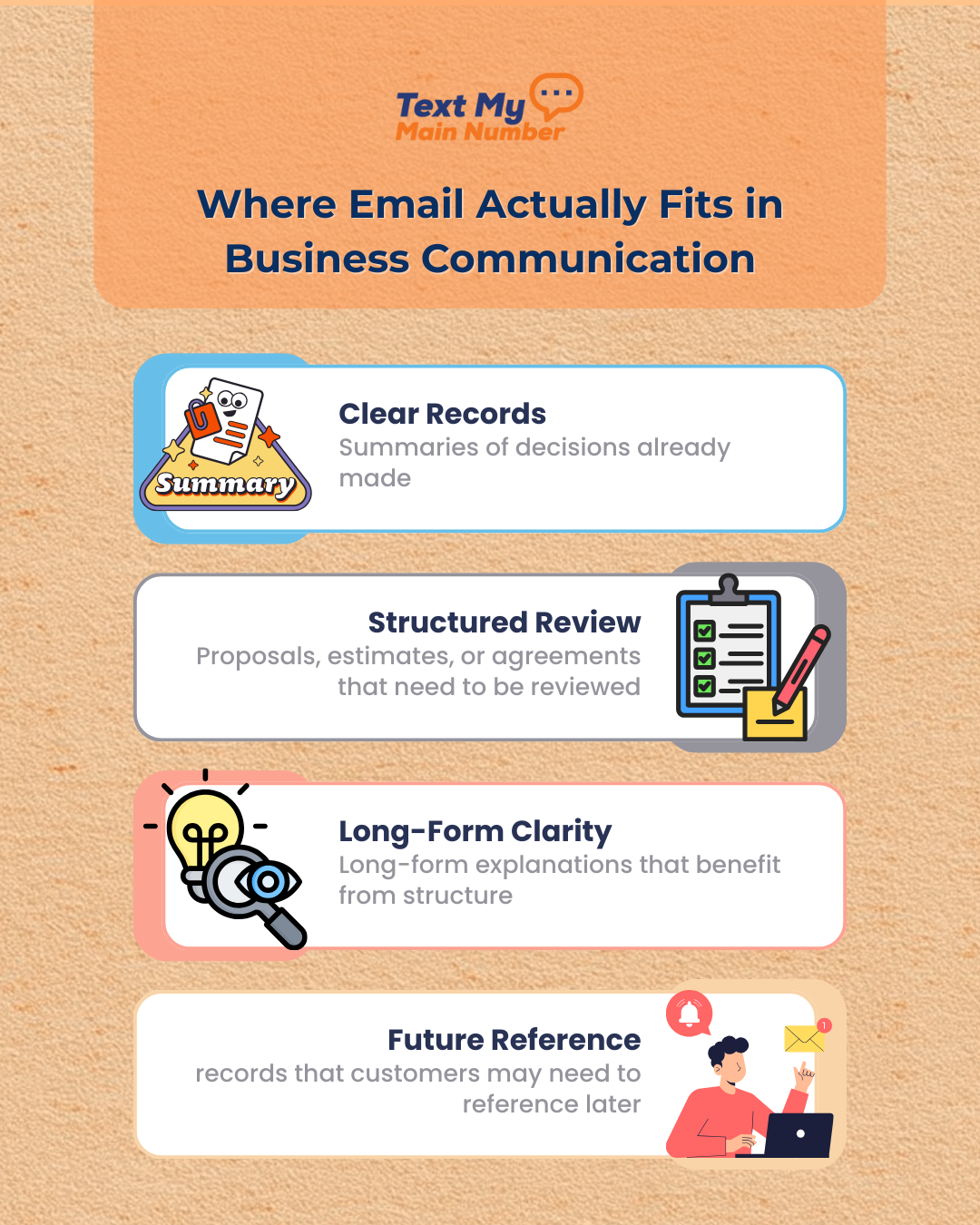
Email excels when the goal is documentation, detail, and permanence, not speed or back-and-forth.
It works best for:
- summaries of decisions already made
- proposals, estimates, or agreements that need to be reviewed
- long-form explanations that benefit from structure
- records that customers may need to reference later
In these situations, email creates clarity. It gives both sides something stable to point back to. That’s why contracts, invoices, scopes of work, and follow-up summaries still belong there.
Research on asynchronous communication shows that written formats are most effective when information needs to be revisited, not negotiated in real time. Email supports memory. It doesn’t replace dialogue.
Why Email Feels Slow (Even When It’s Not)
Email struggles when it’s treated like a conversation.
Back-and-forth clarification over email often feels heavier than it should because every response requires a full context reload. Messages stack. Threads fork. Timing becomes unpredictable.
Customers don’t check email the same way they check texts. A message can sit unread for hours without the sender knowing. What feels “polite” from the business side often feels unresponsive from the customer’s perspective.
This mismatch in expectation is why email often creates friction in early-stage or time-sensitive interactions.
Where Businesses Overuse Email
Email is frequently used as a default when teams want to avoid interruption.
Instead of calling to resolve confusion, they send another message. Instead of texting a quick confirmation, they send a formal note. The intention is efficiency. The outcome is a delay.
This is especially common in internal support and customer service workflows, where email becomes a catch-all for anything that doesn’t fit neatly into another system.
The result isn’t a better organization. It has longer resolution cycles.
The Right Role for Email in a Modern Workflow
Email works best after clarity exists, not while it’s still forming.
A healthy communication flow often looks like this:
- SMS or voice to handle questions, urgency, and alignment
- Email to document what was decided and next steps
- SMS again to confirm receipt or prompt action
Used this way, email strengthens communication instead of slowing it down.
Why Email Should Support Conversations, Not Replace Them
When businesses rely on email to do the work of real-time conversation, customers feel distance. When they use email to support and reinforce conversations that already happened, customers feel professionalism.
The channel isn’t the problem. The expectations placed on it are.
What Support Tickets Are Actually For
Support tickets exist to bring order to complexity — not to replace human conversation.
When used correctly, tickets are one of the most valuable tools a business can have. When used incorrectly, they become a wall between the customer and resolution.
The difference comes down to what role tickets are meant to play in the communication flow.
Tickets Are Designed for Tracking, Not Talking
At their core, tickets are an internal coordination tool.
They work best when an issue:
- requires multiple steps to resolve
- involves more than one team or role
- needs documentation, prioritization, and status tracking
- won’t be resolved in a single interaction
In these cases, tickets provide structure. They make work visible internally. They help teams stay accountable. They prevent issues from falling through the cracks once the conversation moves out of real time.
From an operational perspective, tickets shine because they answer questions teams constantly ask:
- What’s still open?
- What’s blocked?
- Who owns this?
- What’s overdue?
That clarity is invaluable — internally.
Why Customers Often Dislike Ticket-First Experiences
Problems arise when tickets become the front door instead of the backbone.
From the customer’s perspective, a ticket is rarely reassuring on its own. It often feels like:
- being pushed into a queue
- losing access to a real person
- waiting without clear feedback
This is especially true when the issue is emotional, confusing, or time-sensitive. A ticket number doesn’t create trust. Resolution does.
Research in service design consistently shows that customers value progress and human acknowledgment more than formal tracking. When ticketing systems replace conversation too early, satisfaction drops — even if the issue is eventually resolved.
Where Tickets Belong in a Healthy Communication Flow
Tickets work best after the conversation establishes understanding.
A strong pattern looks like this:
- SMS or voice to understand the issue and reassure the customer
- A ticket was created internally to track the work required
- Updates are communicated back to the customer through text or a call
- A clear close-out once the issue is resolved
In this model, the customer never feels trapped inside a system. They feel supported by people, while the system quietly does its job in the background.
The Common Mistake: Using Tickets to Avoid Communication
Many businesses lean too heavily on tickets because they feel safer than conversations.
Tickets are predictable. Conversations are not.
But avoiding conversation often creates more work, not less. Clarifying questions still have to be asked. Misunderstandings still happen. The difference is that they now happen more slowly and with more friction.
Tickets should absorb complexity, not create distance.
Tickets Are a Tool for Teams, Not a Relationship Channel
The most important distinction is this: Tickets manage work; conversations manage relationships. When businesses confuse the two, customers feel processed instead of helped.
When they’re used together — conversation first, tickets as support — teams gain structure without sacrificing trust.
How Smart Businesses Match the Channel to the Moment
The businesses that communicate well aren’t the ones with the most channels. They’re the ones who use each channel with intent.
They don’t default to “text everything” or “call everything.” They treat communication like a decision: What does the customer need right now, and what’s the fastest way to create clarity?
That idea is backed by decades of communication research. Media Richness Theory, for example, explains why richer channels (like voice) are better when situations are ambiguous, emotional, or uncertain, while leaner channels (like text) work well for straightforward coordination. When you match the channel to the complexity of the moment, you reduce confusion and speed up resolution.
And from the customer side, the expectation is even simpler: they want one cohesive experience, even if they move between channels. Nielsen Norman Group’s research on omnichannel experience highlights that consistency across channels builds trust, and that disjointed transitions are where experience breaks down.
So the strategy isn’t “use more channels.” It’s using the right channel at the right time, and keeping the conversation continuous.
A Practical Rule: Match the Channel to the Job
Here’s the cleanest way to think about it:
1) Use SMS when the goal is momentum without interruption
Texting is the best channel for low-friction progress.
Use SMS for:
- quick questions that don’t require discussion
- confirmations, reminders, and updates
- early-stage inquiries where customers want a light first step
- follow-ups that keep the conversation warm without demanding immediate attention
2) Use Voice when the goal is clarity, trust, or compression
Voice is the fastest route to resolution when the conversation has friction.
Use voice when:
- urgency is involved
- The customer is confused or hesitant
- An objection needs to be handled
- The issue is complex and dragging on text
- tone and reassurance matter
Communication research consistently shows that synchronous, real-time communication is better for reducing ambiguity because it allows immediate feedback and clarification.
3) Use Email when the goal is documentation and detail
Email is best when the customer will need to reference what was said later.
Use email for:
- estimates and formal proposals
- post-call summaries and next steps
- instructions that are long or need formatting
- receipts, confirmations, and records
4) Use Tickets when the goal is internal tracking and accountability
Tickets are not a relationship channel. They’re a coordination mechanism.
Use tickets when:
- The issue requires multiple steps or multiple people
- You need assignment, status tracking, and closure
- You want to prevent “we forgot” problems internally
Incident management best practices (ITIL-style) frame tickets as a way to log, assign, track, and resolve issues with clear ownership and process. That’s exactly their value for customer support teams: tickets make work visible and prevent it from disappearing.
The “Best Practice” Isn’t a Channel — It’s a Flow
High-performing businesses build communication flows that look like real life:
- Start with SMS because it’s easy and low-pressure
- Switch to voice when clarity or trust is needed
- Use email to confirm decisions and prevent misunderstandings
- Use tickets behind the scenes to track work and ensure accountability
This isn’t theory. It’s what customers already do naturally: they move channels based on what they need. The business wins when it supports that movement instead of fighting it.
One More Lens That Helps: “Asynchronous vs. Synchronous”
If you want an even simpler gut-check, think in terms of timing:
- Asynchronous channels (SMS, email) are best when the customer doesn’t need immediate back-and-forth.
- Synchronous channels (voice) are best when you need real-time clarity, speed, or emotional nuance.
This is a widely accepted distinction in modern work communication frameworks.
Why This Gets Harder as Teams Grow
Channel decisions feel simple when one or two people handle everything. They get harder — and riskier — as soon as communication becomes a shared responsibility.
Growth introduces handoffs. Handoffs introduce gaps. And gaps are where even good communication strategies start to break. You can see that pressure more clearly in How Small Teams Manage Customer Conversations Without Burnout (2026 Guide), where scattered messages and repeated follow-ups stop being minor annoyances and start draining the team.
Growth Replaces Memory With Coordination
In small teams, context lives in people’s heads. Someone remembers the last call. Someone recalls why a customer was frustrated. Someone knows what was promised.
As teams grow, that informal memory system collapses.
Work moves across shifts, roles, and departments. The same customer might text in the morning, call in the afternoon, and follow up two days later. Without shared visibility, each interaction gets handled as if it’s new — even though it’s part of an ongoing conversation.
Organizational research consistently shows that coordination costs increase nonlinearly with team size. What worked through familiarity and proximity stops working once communication depends on systems instead of people.
Channel Switching Turns Into Context Loss
As more people touch customer conversations, switching channels becomes more dangerous.
A text answered by one team member. A call handled by another. An email was sent later by someone else.
If those channels aren’t connected, context doesn’t travel with the customer. It stays trapped in inboxes, call logs, or ticket queues.
This is where channel misuse starts to feel like incompetence — even when the team is responsive. Customers repeat themselves. Answers feel inconsistent. Trust weakens.
Customer experience research from Salesforce highlights that one of the top drivers of dissatisfaction is having to re-explain information across interactions, especially when multiple employees are involved.
Ownership Becomes Unclear — and Risky
Growth also blurs ownership.
Who’s responsible for this follow-up?
Who last spoke to the customer?
Who’s accountable if nothing happens next?
Without visibility, teams hesitate. They double-check. They ask internally. Progress slows — not because people don’t care, but because no one wants to step on someone else’s work.
This hesitation is well-documented in team psychology. Studies on role clarity show that when ownership isn’t explicit, decision-making slows and error rates increase, even among experienced teams.
American Psychological Association research on role ambiguity and performance:
https://www.apa.org/monitor/nov01/role
Volume Turns Small Mistakes Into Systemic Ones
At low volume, small breakdowns are recoverable.
At scale, they compound.
One missed follow-up a week feels manageable. Ten a day feels like chaos. One repeated explanation is annoying. Repeating yourself every time you call feels disrespectful.
Growth doesn’t create communication problems. It amplifies the cost of not solving them early.
Why Channel Choice Alone Isn’t Enough at Scale
This is the key shift many growing businesses miss:
Choosing the right channel matters — but visibility matters more once teams grow.
Without shared visibility:
- SMS becomes fragmented
- Voice loses continuity
- Email feels disconnected
- Tickets feel impersonal
That’s the core issue behind Why Visibility in Customer Communication Matters for Small Businesses, because once the full conversation disappears across tools, responsiveness alone stops feeling reliable. The problem isn’t that teams are using too many channels. It’s that the conversation doesn’t survive the transition between them.
That’s why communication strategies that work for solo operators often fail quietly as businesses scale. Not because they were wrong — but because they were incomplete.
Where Text My Main Number Fits In (Without Adding Complexity)
Most businesses don’t need more channels. They need fewer disconnects.
This is where Text My Main Number fits — not as another tool to manage, but as a way to connect the communication you’re already doing into a single, shared layer that actually holds together as teams grow.
The goal isn’t expansion. It’s a consolidation.
One Connected Conversation Layer, Not “More Channels”
Text My Main Number doesn’t ask you to rethink how customers reach you. Customers can still text. They can still call. Your team can still follow up.
What changes is what happens behind the scenes.
Instead of conversations splitting the moment a channel changes, TMMN keeps them connected. A text doesn’t disappear when a call happens. A call doesn’t lose context when someone else follows up. The conversation continues — regardless of how it moves.
That’s the difference between adding channels and connecting them. The foundation of that connection comes down to two core channels most businesses rely on every day.
SMS + VoIP as the Foundation
TMMN focuses on the two channels that do the most real work in customer communication:
- SMS for convenience, responsiveness, and low-friction engagement
- Voice (VoIP) for urgency, clarity, trust, and faster resolution
These aren’t treated as separate tools. They’re treated as complementary parts of the same conversation.
A missed call can trigger a text follow-up.
A long text thread can move to a call without resetting context.
A call summary can live right next to the message history.
Nothing gets lost. Nothing has to be reconstructed.
Shared Visibility That Replaces Guessing
As teams grow, the biggest problem isn’t response time. It’s uncertainty.
Who last spoke to this customer?
What was promised?
What still needs to happen?
Text My Main Number solves this by making conversations shared by default, not trapped in personal inboxes or siloed systems. Anyone on the team can step in, see the full picture, and respond with confidence.
That’s not extra process. It’s less mental overhead.
Conversations That Don’t Reset as You Scale
The real value of a connected system shows up over time.
As volume increases and more people get involved, conversations don’t become fragile. They become more resilient. Context travels with the customer. Handoffs feel safe. Follow-ups actually happen.
That’s how communication scales without becoming heavy.
Final Thoughts
Clear communication isn’t about being everywhere. It’s about being connected.
When messages, calls, and follow-ups live in isolation, teams work harder than they should, and customers feel friction they can’t always explain. When conversations stay intact across channels, everything moves faster — decisions, resolutions, and trust. That’s the difference between guessing and knowing. And as businesses grow, that difference matters more every day.
If your team is feeling the strain of scattered conversations or missed follow-ups, it may be time to stop adding tools and start connecting them.
If your team is feeling the strain of scattered conversations or missed follow-ups, it may be time to stop adding tools and start connecting them. Try Text My Main Number’s 14-day free trial and see how communication becomes simpler when everything lives in one shared conversation.
.svg)