


Most business software is designed to document completed events. It can confirm that an invoice was sent, an appointment was booked, a quote was accepted, an order was changed, or a service issue was closed. This recordkeeping matters. Without it, even routine work becomes difficult to manage.
But a record of completed activity answers only one kind of question: What happened in this case?
A different category of software is beginning to help answer a broader question: What keeps happening across similar cases?
That distinction is the foundation of business software that learns. Learning does not mean the software runs the company, makes unapproved decisions, or predicts every customer’s next move. It means the software helps a team recognize recurring operating conditions across the work it already performs, often before those conditions become accepted as normal.
Most Business Software Can Tell You What Already Happened
A scheduling system usually treats each appointment as a separate event. A job is booked for Tuesday morning. The customer reschedules it for Thursday afternoon. The technician completes the visit, and the office closes the job. Every action may be recorded accurately.
What the schedule may not reveal is that Thursday appointments for a certain service frequently move because customers discover too late that an adult must remain on site. Each reschedule looks ordinary when viewed alone. Across thirty similar jobs, however, the timing and reason may indicate that the requirement is being introduced too late.
The same limitation appears in quoting software. A quote can show when it was created, sent, viewed, revised, approved, or declined. It may preserve the selected products and final price. Yet it may not help an owner notice that quotes involving one product category regularly pause after the customer reaches the installation-options section.
Employees often compensate without treating the situation as unusual. A salesperson sends an extra photo because the standard quote leaves a choice unclear. An office coordinator adds a reminder to her own calendar because the scheduled follow-up is too late. A technician calls ahead to confirm access because he has been locked out before. These small accommodations keep individual jobs moving, so they rarely look serious enough to discuss during a busy day. By Friday, they may simply feel like part of the workload.
That is one reason weak processes can look healthy for a long time. Experienced employees quietly carry information that the system does not. The gap becomes visible when one of those employees is off, a new person takes over, or the workload becomes too heavy for memory and habit to keep protecting the process.
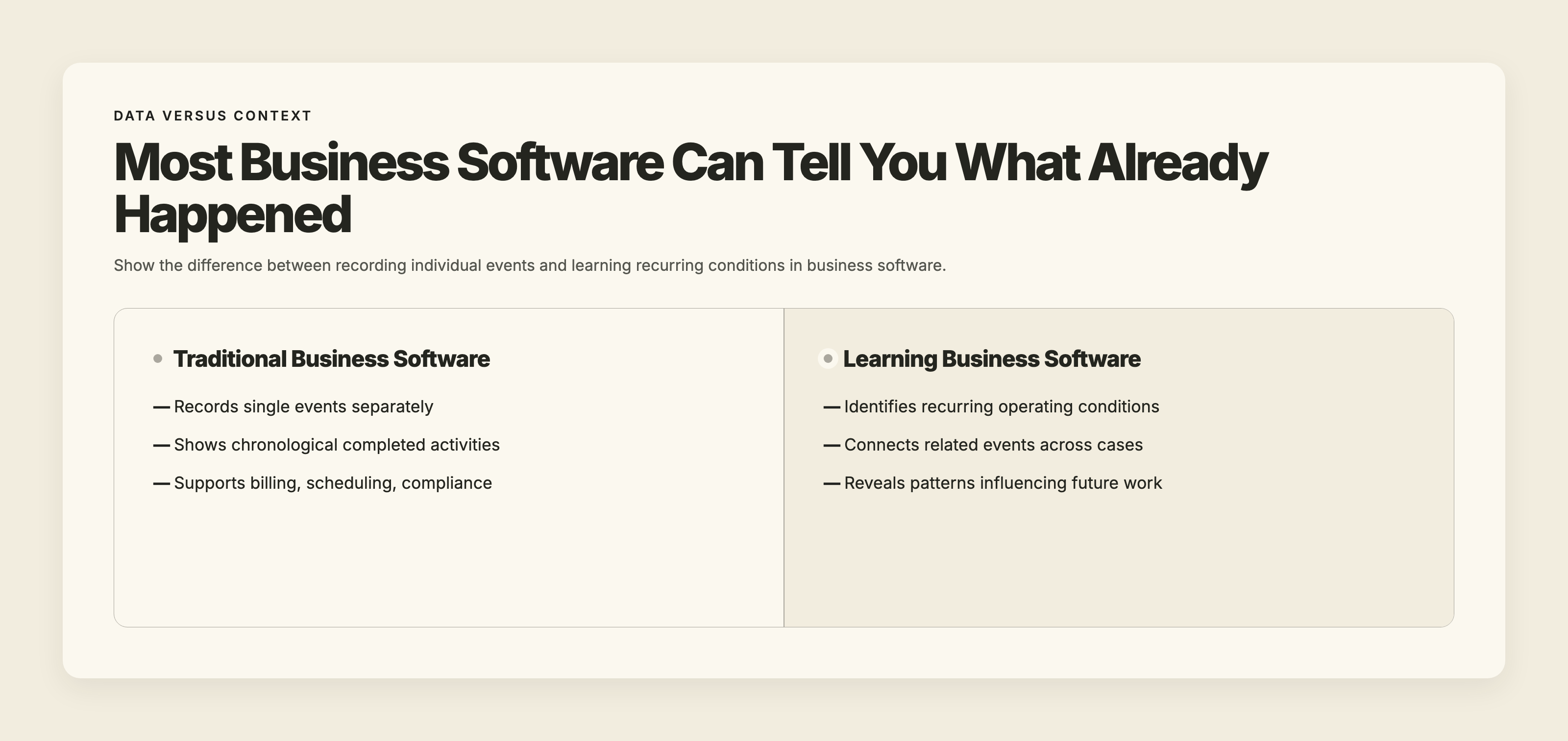
The difference between documentation and learning appears when software can connect those ordinary events. Rather than displaying twenty separate appointment changes, it helps the team see that twelve involved the same practical requirement. Rather than presenting five revised quotes as unrelated files, it helps show that four changed at the same buying stage.
A business can therefore have excellent records and still learn very little from them. Accurate documentation supports billing, scheduling, compliance, and customer service. Learning begins when the activity around those records reveals a recurring condition that could influence how future work is handled.
Customers Do Not Experience Work as a Series of Neat Records
Customers move between channels according to convenience, not according to the categories inside a company’s software. Someone may begin with a website form, call from the car, approve a quote by email, and send an appointment change by text. To the customer, this is one buying process. Inside the company, it may appear as four separate activities.
Consider a small commercial sign service. On Monday morning, a facilities manager submits a request for an exterior sign repair. She includes the address and a photograph but does not mention that the sign is mounted above a locked loading area. The office coordinator creates the job and places the photo in the service system.
Later that day, the customer calls to ask whether the technician will need access to the electrical room. A receptionist answers, writes a note, and tells the customer someone will confirm. The service manager sees the original job but not the receptionist’s note, which sits in the phone system. He assumes the site details have already been checked because the appointment is on the schedule.
The next morning, the technician arrives and discovers that the loading area requires security clearance and that the electrical room contact will not be available until the afternoon. The visit cannot proceed. When the technician calls the office, the coordinator says, “I thought you handled it,” while the receptionist believed the service manager had followed up.
No single record is necessarily wrong. The form was saved. The call occurred. The appointment was created. The technician was dispatched. What broke was the connection between those actions and the practical condition affecting the job.
The customer does not see separate systems or internal assumptions. She sees a company that asked for information, received additional information, and still arrived unprepared. When the rescheduled date is not confirmed by the end of the day, she quietly requests availability from another sign company. She does not complain or announce that the account is at risk. She simply gives herself another option.
A delay that appears administrative inside the business creates doubt outside it. After the failed visit, even a few hours of silence can feel less like an internal handoff and more like confirmation that nobody owns the request. Customers often reveal process failure through comparison, delay, and reduced responsiveness long before they express dissatisfaction directly.
The Point Where Recorded Activity Becomes a Useful Lesson
One failed sign-service visit does not establish a general rule. The site may have had unusual security requirements, or an employee may simply have missed a note. Changing the entire intake process after one incident could create unnecessary work for every other customer.
The lesson becomes more useful when comparable jobs show the same condition. Suppose the owner reviews exterior sign repairs from the previous eight weeks and finds that seven required an additional contact before the visit. Five involved restricted access, and four of those were at multi-tenant commercial properties.
At that point, the business has more than an anecdote. It has evidence that a particular job type and property type often require an access check before dispatch. The practical response may be modest: ask for a site contact and access window when scheduling exterior work at multi-tenant locations.
This is where learning software differs from a filing cabinet. It helps associate the appointment change, technician note, customer call, property type, and incomplete visit. The owner can then examine the recurring condition while the coordinator still remembers the call, the technician still remembers the site, and the service manager can explain why the original schedule looked complete.
That timing matters. Operational lessons often disappear because the work eventually gets finished. Once the return visit succeeds and the invoice is sent, the earlier confusion is reduced to a closed job with more labor in it than anyone planned.
Similar outcomes can also have different causes. A postponed visit could result from weather, missing parts, customer availability, site access, or an earlier job running long. Grouping every postponement together would produce a misleading conclusion.
Useful learning depends on comparing activity that is genuinely comparable. The software may indicate that restricted-access jobs behave differently from standard residential visits, but the service manager still understands whether the distinction makes operational sense. Experience remains essential because the same data can reflect seasonality, unusual accounts, temporary staffing, or a change in local requirements.
A record says the visit was moved. A useful lesson says that a specific condition tends to affect this kind of visit, at this stage, for a practical reason the company can examine.
A Practical Way to Separate Recording from Learning
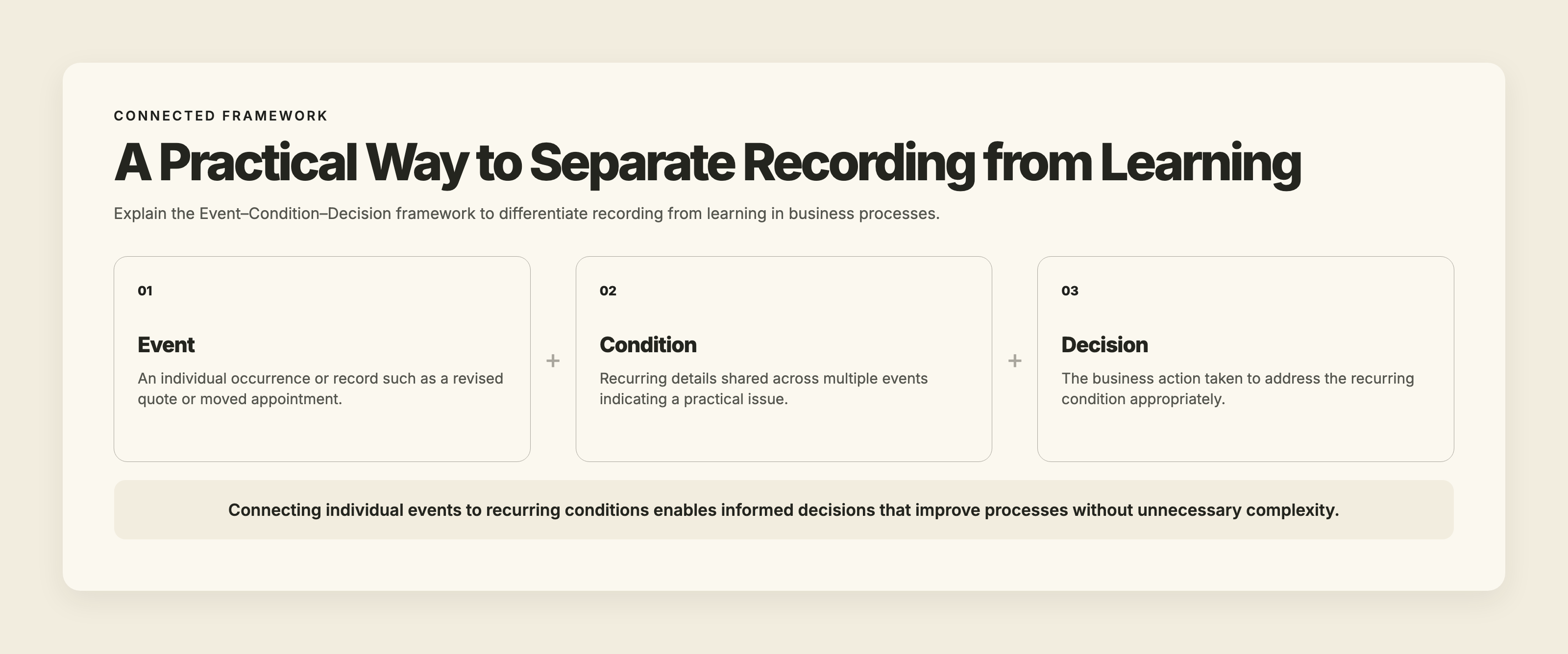
A useful shorthand for examining this difference is Event–Condition–Decision. The terms sound formal, but the distinction appears in ordinary work whenever employees say, “This happened again,” and begin comparing notes.
The event is the occurrence in front of one employee: a quote was revised, an order changed, a customer called, or an appointment moved. Event records establish what happened in that case. Problems at this level are familiar. A date is missing. The receptionist’s note is stored in the phone system instead of the job. Two employees create separate entries for the same request. A technician records the result but not the reason.
When the event record is incomplete, the next employee often fills the gap with an assumption. The quote probably changed because of price. The visit probably moved because the customer was unavailable. The order probably changed because the buyer made a mistake. Those explanations may be reasonable, but they are not evidence.
The condition appears when comparable events carry the same practical detail. One product family produces repeated late specification changes. Appointments for a particular service keep requiring an additional access confirmation. Several buyers pause after the same internal approval handoff.
Employees usually encounter the condition before the company names it. A salesperson starts including an extra image. A coordinator keeps a private reminder. A warehouse employee checks one product configuration twice because the submitted orders are often incomplete. The work continues, but recurrence is being absorbed by individual effort rather than recognized by the operation.
The decision is the response the business makes after the recurrence becomes clear. When AI helps shape that response, give it the right business context by explaining the recurring pattern, not just listing the individual events that led to the decision.
It may be as small as moving one question earlier, placing a compatibility note beside an option, or adding an access detail to a certain type of job. The decision remains grounded when employees can explain which cases it applies to and what problem it is meant to prevent.
The opposite reactions are easy to recognize. In one business, everyone acknowledges that the same issue keeps returning, yet nothing changes because each case is eventually rescued. In another, one difficult week leads to six new mandatory fields for every customer. The first response leaves employees carrying the gap. The second makes unrelated work harder.
Imagine a safety-equipment supplier whose customers frequently change glove sizes after purchase orders are drafted. The event record shows each revised order. The recurring condition becomes visible when the team notices that most revisions involve mixed crews and happen after supervisors circulate the final order internally.
The account representative may already know what is happening. A purchasing contact estimates the size mix, sends the draft through two departments, and then returns with corrections from supervisors who know the crews. The warehouse sees only another revised order. The sales coordinator sees another changed document. Neither view alone explains the pattern.
A proportionate decision may be to provide a simple size-confirmation sheet before the draft order is prepared. Adding six mandatory fields to every account would not necessarily help. Nor would automatically rejecting late changes. More entry can burden customers who already know their quantities, while rigid handling can turn a manageable purchasing habit into an avoidable dispute.
Event–Condition–Decision is useful only if it stays attached to those visible actions. The event is what someone had to handle. The condition is what employees keep compensating for. The decision is the limited change that reduces that repeated effort without creating a larger burden elsewhere. The framework loses its value when unlike events are grouped together merely because their outcomes look similar.
What One Recurring Condition Can Cost Across a Normal Month
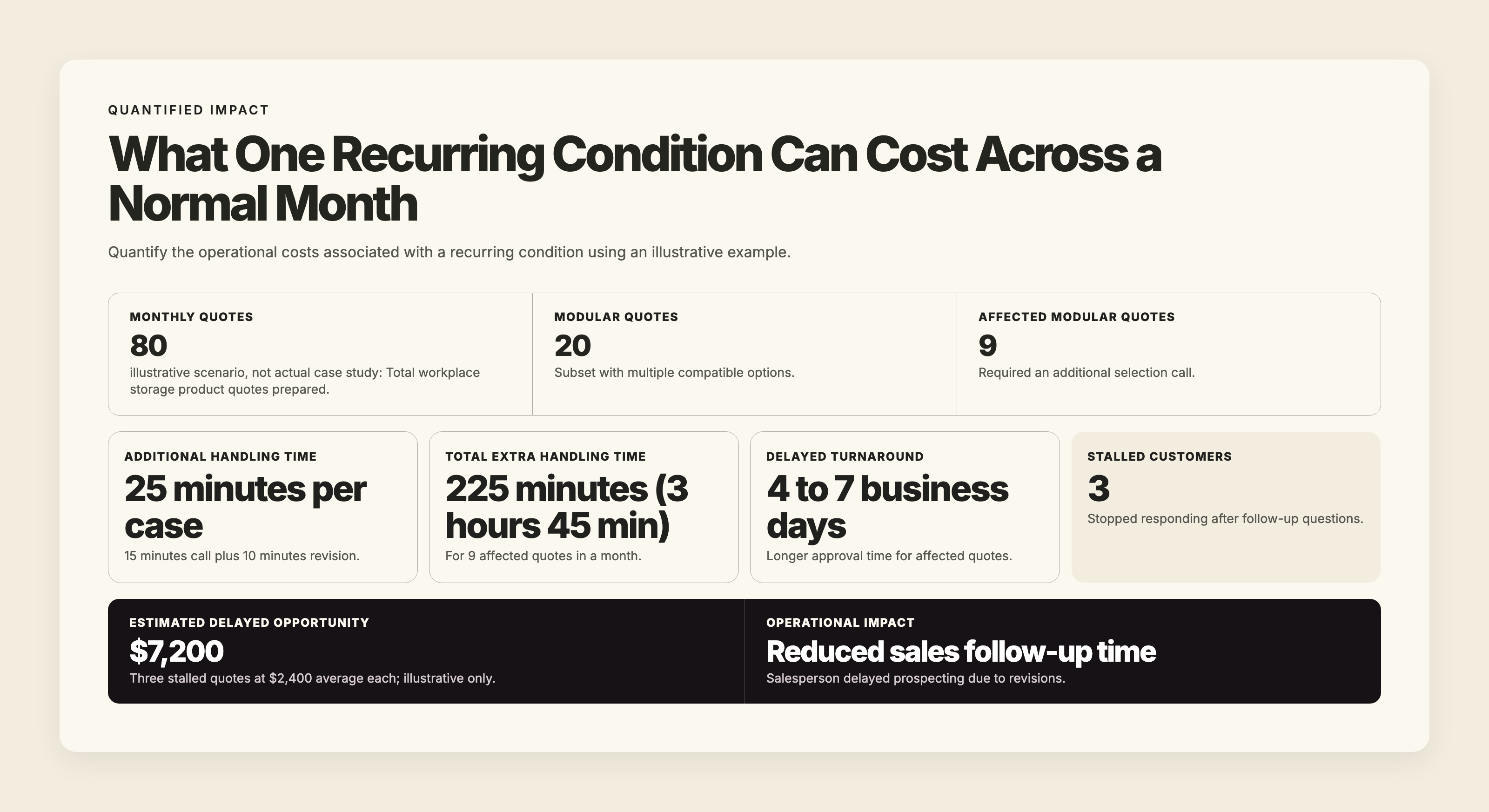
The cumulative effect of a recurring condition is often easier to see through ordinary monthly numbers than through dramatic projections. The following is an illustrative operating scenario, not a reported case study. Its figures show the kind of calculation a supplier could make from its own quote history without treating the result as proof of cause.
Consider a regional supplier that prepares 80 quotes in a month for workplace storage products. Twenty of those quotes involve modular configurations with several compatible door and lock options.
During a routine review, the sales team notices that nine of the twenty modular quotes required an additional selection call. Each call took about 15 minutes, followed by roughly 10 minutes to revise and resend the quote. That created 25 additional minutes of handling for each affected request.
Nine cases multiplied by 25 minutes equals 225 minutes, or three hours and 45 minutes of additional monthly effort. The labor cost is not ruinous. It is enough, however, to displace prospecting, account follow-up, or quote preparation during an already full week. The effect may be felt less as a cost line than as a salesperson finishing revisions late in the afternoon and postponing the calls that were meant to happen next.
The supplier could also compare turnaround within the same illustrative set of records. Suppose modular quotes without the extra selection round were usually approved in four business days, while those requiring another call averaged seven. Of the nine affected quotes, three customers stopped responding after receiving the follow-up questions.
One buyer opened a competing supplier’s quote while waiting because it presented compatible options more clearly. Another delayed the purchase until the next budget period. The third eventually replied, but only after the salesperson sent two reminders. None of these customers announced that the process had created doubt. They became slower, quieter, and more willing to compare.
If the average affected quote were worth $2,400, those three stalled requests would represent $7,200 in delayed or uncertain opportunity for that month. That figure would not establish that all $7,200 had been lost, or that every stalled quote would have closed with a different process. It would not separate option confusion from budget timing, internal approval, competitor pricing, or ordinary customer delay.
The defensible conclusion is narrower: within this illustrative month, a recurring selection condition appeared alongside slower turnaround and weaker completion. That is enough to justify a closer look, not enough to claim a proven revenue result.
The supplier might then present compatible lock choices before preparing the quote and compare the next two months with the prior two. The salesperson’s notes still matter. If customers continue pausing, the issue may sit elsewhere. If the extra calls decline but incorrect selections rise, the adjustment solved one problem by creating another.
Useful software makes this examination easier by connecting quote type, revision reason, response time, and outcome. To measure SMS ROI, compare quote turnaround and follow-up effort with outcomes, then use recurring delays or revisions to identify where time is being consumed.
It gives the business a better view of its own activity without turning a modest operational signal into a manufactured success story.
Small Adjustments Matter More Than Autonomous Decisions
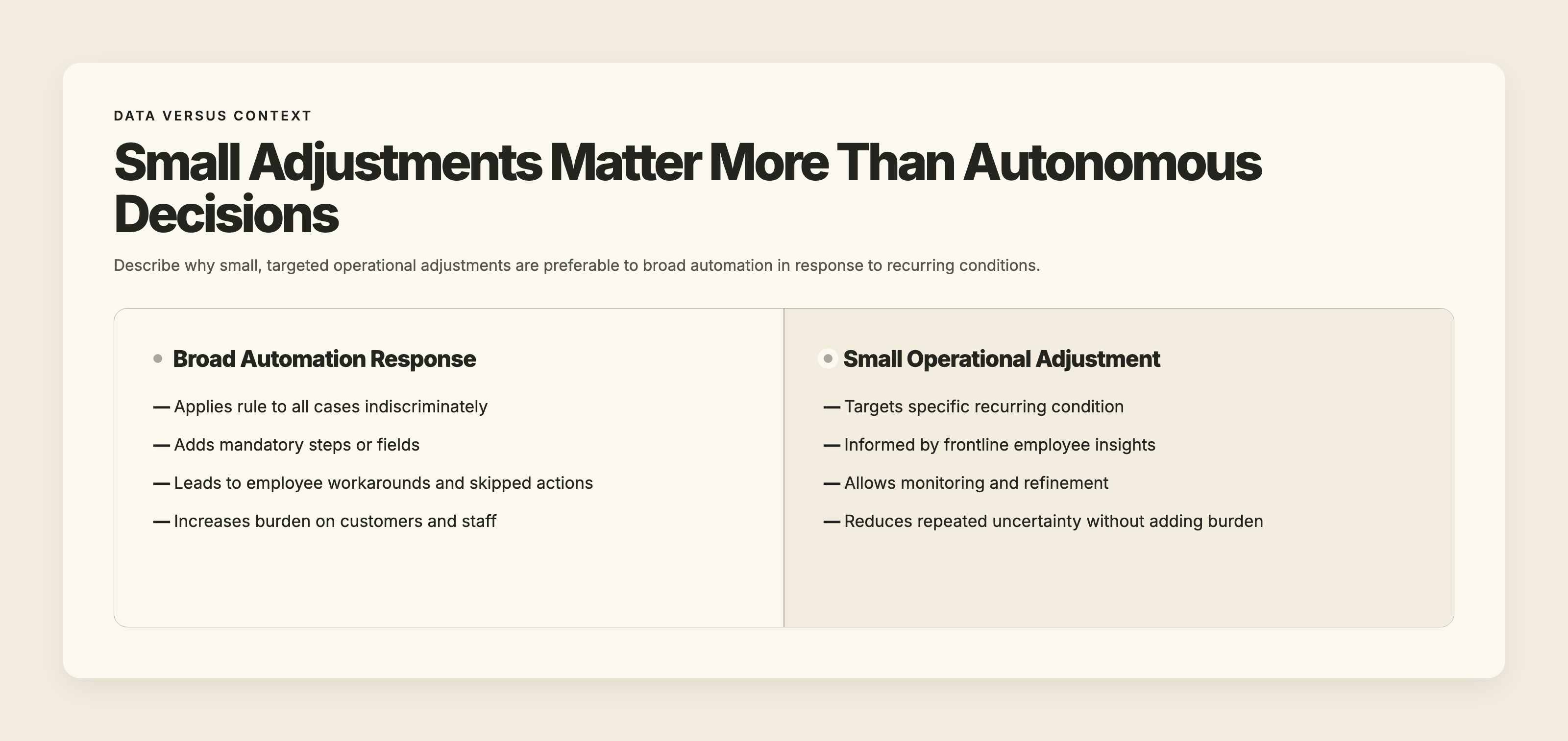
When software identifies recurrence, the tempting response is to automate immediately. If customers regularly ask the same question, send an automatic answer. If appointments change under certain conditions, insert another mandatory step. If a quote stalls, trigger more follow-up.
That response can create a second problem: the system begins treating every case as if it contains the same condition. Customers who already supplied the information are asked for it again. Straightforward jobs acquire extra fields. Salespeople receive automated reminders for quotes they know are waiting on a scheduled committee meeting.
The result is usually visible first in employee behavior. Staff skip fields, type placeholders, dismiss alerts without reading them, or create workarounds outside the system. A rule intended to improve consistency becomes another thing experienced employees learn to navigate around.
For the sign-service company, a more useful adjustment might be a pre-visit access confirmation for a specific class of commercial property. It would not need to apply to every repair. A coordinator could see why the question appears, and the technician could distinguish loading-area access from roof access or electrical-room entry.
After six weeks, the service manager could compare incomplete visits among jobs with and without the confirmation. The review would not only ask whether failed visits declined. It would also show whether customers could answer the question, whether coordinators spent more time chasing unavailable contacts, and whether technicians received information specific enough to change preparation.
Frontline knowledge determines whether a small change survives contact with the work. A technician may explain that roof access and loading-area access require different equipment. The coordinator may know that certain property managers cannot confirm entry until the morning of service. A receptionist may notice that callers understand “site contact” but become confused by “access authority.”
These details are not exceptions to the process. They are the material from which a workable process is made.
A limited adjustment also leaves room for correction. If the new question adds little value, it can be narrowed or removed without disturbing the entire operation. If it consistently prevents failed visits, it can become part of the normal scheduling flow for the relevant jobs.
Automation works best once the repeated condition has recognizable boundaries. Before that point, it tends to turn an early assumption into a rule and spread it across cases that do not belong together.
The strongest operational changes are often unremarkable from the outside. A question appears earlier. A technician receives one additional detail. A product option is displayed beside its compatibility requirement. Customers do not see a company making a strategic transformation. They experience fewer moments in which they have to repeat information or wait while employees reconstruct what happened.
Learning from Quotes, Orders, Appointments, and Service Preparation
Useful operating lessons can emerge from nearly every stage of ordinary business activity. Quotes may show where buyers pause, request revisions, or change scope. Orders may reveal which specifications are commonly amended after internal approval. Appointments may expose timing conditions that repeatedly affect attendance or readiness.
Service preparation is especially revealing because employees often make small adjustments before the customer ever sees them. A technician swaps tools after recognizing a certain equipment model. A dispatcher assigns a longer time window to one property type. An office employee calls to confirm whether a gate code still works.
Individually, these actions may look like experienced staff doing their jobs well. Across dozens of cases, they can indicate that preparation relies on knowledge held by a few people rather than information consistently available when the job is created.
The system may show that the work is being completed on time while the employee is arriving early, checking another screen, calling a familiar contact, or carrying extra equipment to make that result possible. The record captures the successful outcome and misses the extra judgment that produced it.
The pattern often becomes obvious only when the experienced employee is absent and newer staff have to work from the visible record alone. What looked like a dependable process turns out to have been a dependable person protecting an incomplete one.
Consider an irrigation service that repairs residential and small commercial systems. Its senior dispatcher knows that older developments on the east side often have controllers inside locked garages. She calls those customers before morning routes and confirms access. The calls are so habitual that she may not record each one as a special action.
When she is away, newer staff schedule from the service record alone. The appointments look complete: address, service type, arrival window, and customer number. Nothing on the screen indicates that the technician may be unable to reach the controller.
Technicians then arrive at several properties where no one is available to open the garage. One waits ten minutes while the office calls the customer. Another completes an outdoor inspection but has to return to test the controller. A third marks the visit incomplete and moves on because the remaining route is already tight.
The software correctly shows booked appointments and incomplete visits. Learning requires connecting the development, controller location, access result, and dispatcher’s usual pre-visit action. It also requires noticing that the dispatcher’s calls were not incidental courtesy. They were an undocumented preparation step holding the route together.
The same principle applies to spoken interactions. A customer may mention during a phone call that the controller is indoors, the delivery dock closes at three, or the purchase requires a second approval. If that detail ends when the call ends, it cannot contribute much to later preparation.
As spoken systems evolve, their useful role will be to connect relevant details from calls with appointments, quotes, orders, and service work. Calls are one source among several. A customer’s statement gains operational meaning when it can be checked against the scheduled job, the employee’s notes, and what happened during the visit.
The deeper lesson is not that every experienced habit belongs in software. Some judgments depend on context that is difficult to standardize. The opportunity is to identify which recurring preparations keep preventing the same avoidable failure, especially when only one or two employees know to perform them.
Where TMMN Fits In: Connecting Customer Communication to Everyday Work
TMMN approaches customer communication as part of the broader way a business operates. In practice, SMS automation should follow the work: confirmations, reminders, and follow-ups need to reflect what is actually happening in the business.
A phone call is rarely just a call. It may change the scope of a quote, affect the time required for an appointment, alter an order, or determine what a technician needs before arriving.
That connection is easy to miss when each channel has its own record. A form contains the original request. A call adds a constraint. A text changes the date. An email approves the revised amount. Employees can remain busy in every channel while the practical meaning of the activity stays scattered.
Fragmentation rarely announces itself as failure. It usually looks like several people doing reasonable things in separate places. The receptionist records the call where calls are recorded. The coordinator updates the schedule. The salesperson revises the amount. The technician opens the job record. Each person may complete the expected task while still missing the detail held by someone else.
The customer may receive prompt replies from every employee and still experience a process that does not seem joined up. Repetition is often the first clue. The customer explains the access restriction on the phone, repeats it when the appointment is confirmed, and explains it again when the technician arrives.
A systems-oriented approach examines whether information from customer interactions can contribute to the work those interactions affect. If a caller mentions restricted access, that detail has consequences for service preparation. If several prospects pause at the same quote decision, their questions may expose a recurring point of uncertainty that individual quote records do not make obvious.
TMMN’s place in this shift is centered on that connection between customer communication and everyday operations. The role is not autonomous management. It is helping relevant communication remain attached to the quote, appointment, order, or service activity that gives it practical meaning.
Spoken Touch, as a TMMN concept for handling spoken customer interactions, points toward the same future. Spoken exchanges contain details that may matter beyond the moment of the call, but those details need context. “The gate closes at three” affects a scheduled visit differently from a general inquiry. “My supervisor needs to approve this” may explain a quote delay without indicating lost interest.
A statement made by a customer is evidence, not an unquestionable instruction. Employees still need to resolve ambiguity, recognize exceptions, and decide what belongs in the work. The software contribution is continuity: reducing the chance that a useful detail disappears merely because it arrived through a different channel.
The practical test is visible in the next handoff. Does the coordinator know what changed? Does the salesperson understand why the quote paused? Does the technician arrive with the information the customer already provided? Connected communication earns its value there, inside the ordinary movement of work.
Key Takeaways
Business software that learns connects recurring conditions across comparable events rather than merely preserving completed records.
Customers experience one continuous process even when their information is divided across calls, forms, texts, emails, and job records.
The records may exist, but customer context is lost across systems, leaving employees to reconstruct the sequence before they can act.
Experienced employees often protect incomplete processes through private reminders, extra calls, and undocumented preparation.
Useful operational changes are usually narrow, bounded, and visible in the next handoff.
Automation becomes reliable only after the recurring condition and its exceptions are understood.
After a Normal Week, What Did the Business Learn?
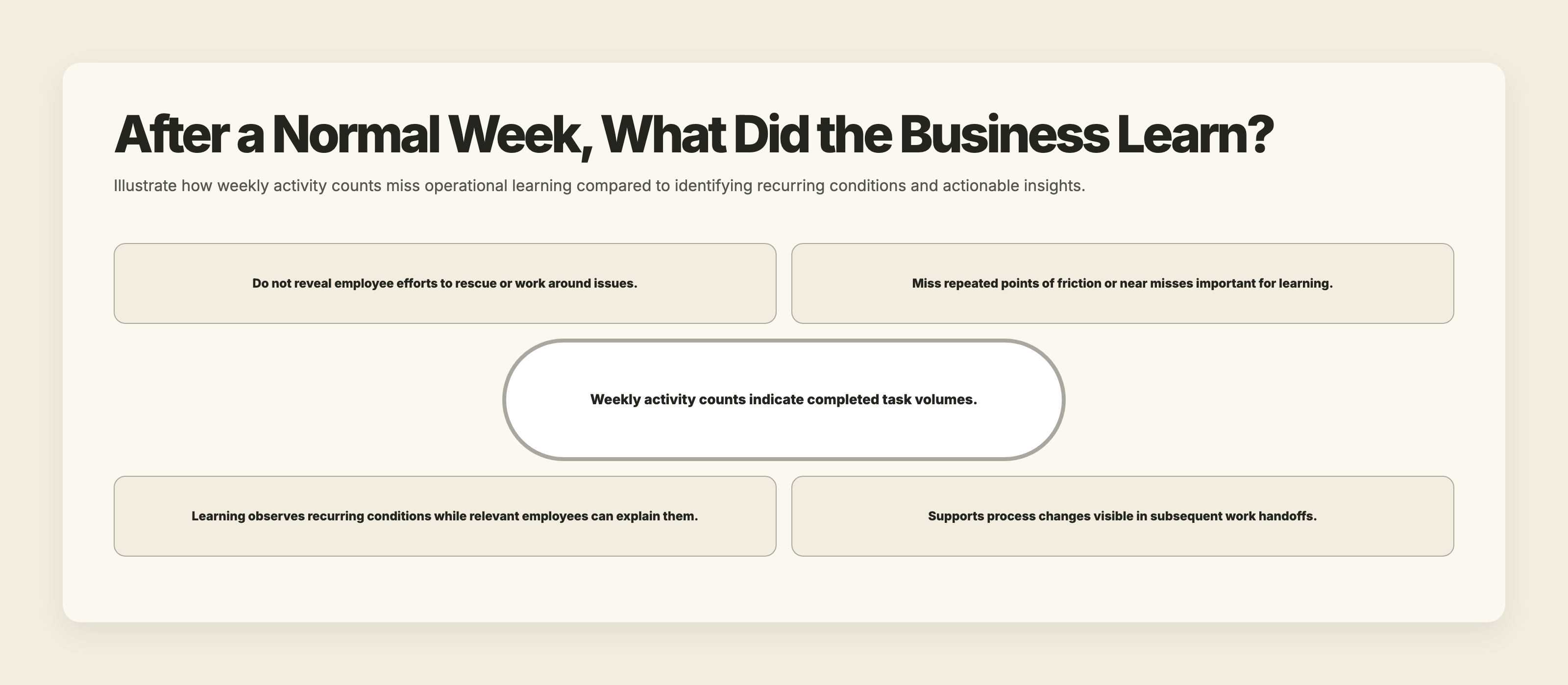
At the end of a normal week, most software can produce an activity count. It can show how many calls were answered, quotes were sent, orders were changed, appointments were moved, invoices were issued, and jobs were completed.
Those totals describe volume. They do not reveal what employees had to rescue, repeat, remember, or work around to produce the completed week.
A useful weekly observation might be that three installation quotes paused at the same compatibility choice. It might be that two technicians independently requested the same site-access detail. It might be that several order changes occurred after purchasing managers circulated drafts to department supervisors.
Another useful observation may come from a near miss rather than a failed outcome. A coordinator caught an address discrepancy before dispatch. A salesperson called because a familiar configuration looked wrong. A warehouse employee stopped an order after remembering that two components were not compatible. The customer saw a successful result, but the business depended on someone recognizing a condition that the visible record did not explain.
Those moments deserve attention because successful completion can hide operational weakness. If an experienced employee repeatedly saves the same type of job, the absence of failure does not mean the process is strong. It may mean the same person has become the process.
The weekly question is therefore larger than whether the totals improved. It is whether any repeated friction became visible while the people involved could still explain it. What did customers have to clarify twice? Which jobs required a call that was not part of the recorded preparation? Where did employees leave the system to find the information they trusted?
Some observations will disappear on examination. Three delayed quotes may have three unrelated causes. Two access problems may be coincidence. A temporary supplier issue may explain a cluster of order changes. Learning includes rejecting weak patterns rather than forcing every irregularity into a new rule.
Other observations will hold. The same choice will keep slowing the same quote type. The same property condition will keep changing technician preparation. The same internal customer handoff will keep producing late order revisions. At that point, the business has something more useful than a count: it has a recurring condition with an operational shape.
The following week may not look dramatically different. One question may be asked earlier. One note may reach the technician instead of remaining in the call record. One product option may appear beside the detail needed to select it. The change matters because it removes a repeated point of uncertainty from real work.
There will always be unusual customers, legitimate exceptions, seasonal disruptions, and incomplete information. Business software that learns does not eliminate that messiness. It helps preserve enough context for a team to tell the difference between an isolated event and a condition the business has been quietly absorbing.
Recording tells a company that the week is over. A 14-day free trial can help a team test whether clearer communication context improves the continuity of everyday customer work.
Learning shows where the next week does not have to repeat it.

.svg)

.png)