
Understanding What Happens Inside a Shared Inbox: Beyond the Tool
A shared inbox isn’t merely a repository where incoming messages accumulate. It serves as a complex communication environment where multiple people interact, interpret, and respond to customer inquiries. This space influences not only how quickly messages get answered but also how teams relate to one another and how the business presents itself to customers. To fully grasp what a shared inbox entails, one must look beyond viewing it simply as a tool for managing volume and task assignment. It is a setting where human behavior, emotions, and subtle interpersonal dynamics unfold—elements that directly shape communication quality.
Consider a small design studio receiving customer inquiries through a shared email address. Mary, the receptionist, checks the inbox first thing in the morning and notices a message from a prospective client asking about project rates. Unsure about replying immediately because pricing usually falls under James, the lead designer, she flags the email but doesn’t claim it, assuming James will respond later. Both Mary and James glance at the inbox during the day but never discuss who should reply first. Eventually, James sends a response—but it’s formal and technical, lacking the warmth Mary might have added. The customer perceives the change in tone and later reaches out to a competitor instead.
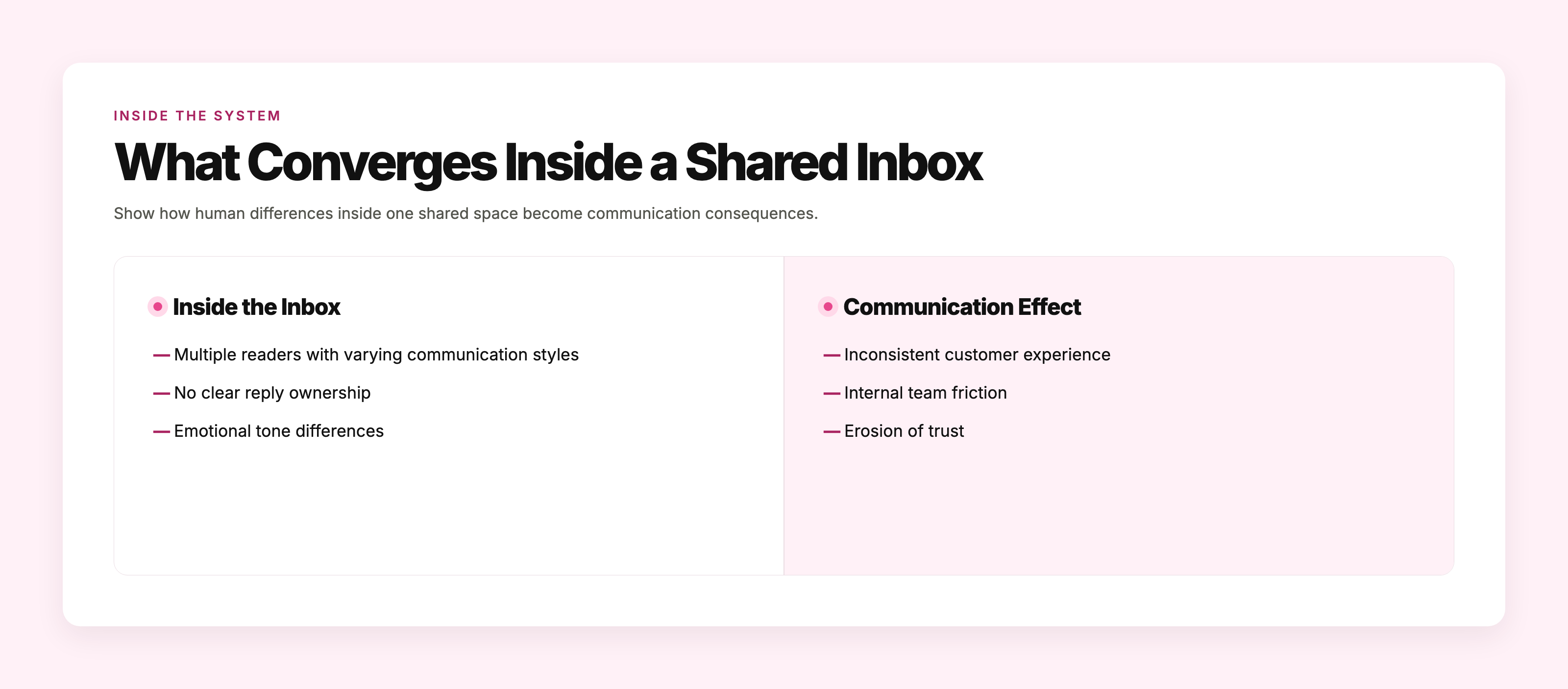
This everyday scenario reveals what actually happens inside a shared inbox: multiple readers with different communication styles engage the same message, often without clear responsibility or real-time coordination. The inbox becomes a stage where emotional registers play out—Mary’s approachable tone contrasts with James’s reserved style, and that inconsistency is immediately noticed by the customer. This scenario illustrates why learning how to build a shared inbox that actually works for your business is critical to fostering coordination and consistent communication.
Rather than streamlining replies, the shared inbox subtly reshapes relationships among team members and between the company and its customers.
Scenes like this occur in every organization using shared inboxes. The transparency of message streams—everyone seeing every response—creates unspoken tension as team members strive to balance collaboration with individual voice. Over time, this dynamic can erode operators’ confidence and mold team culture, especially if tone and reply habits go unmanaged. A shared inbox exposes how a team actually communicates; without clear guidelines, this transparency can lead to uneven customer experiences and internal friction.
How Shared Inbox Dynamics Shift Team Communication Behavior
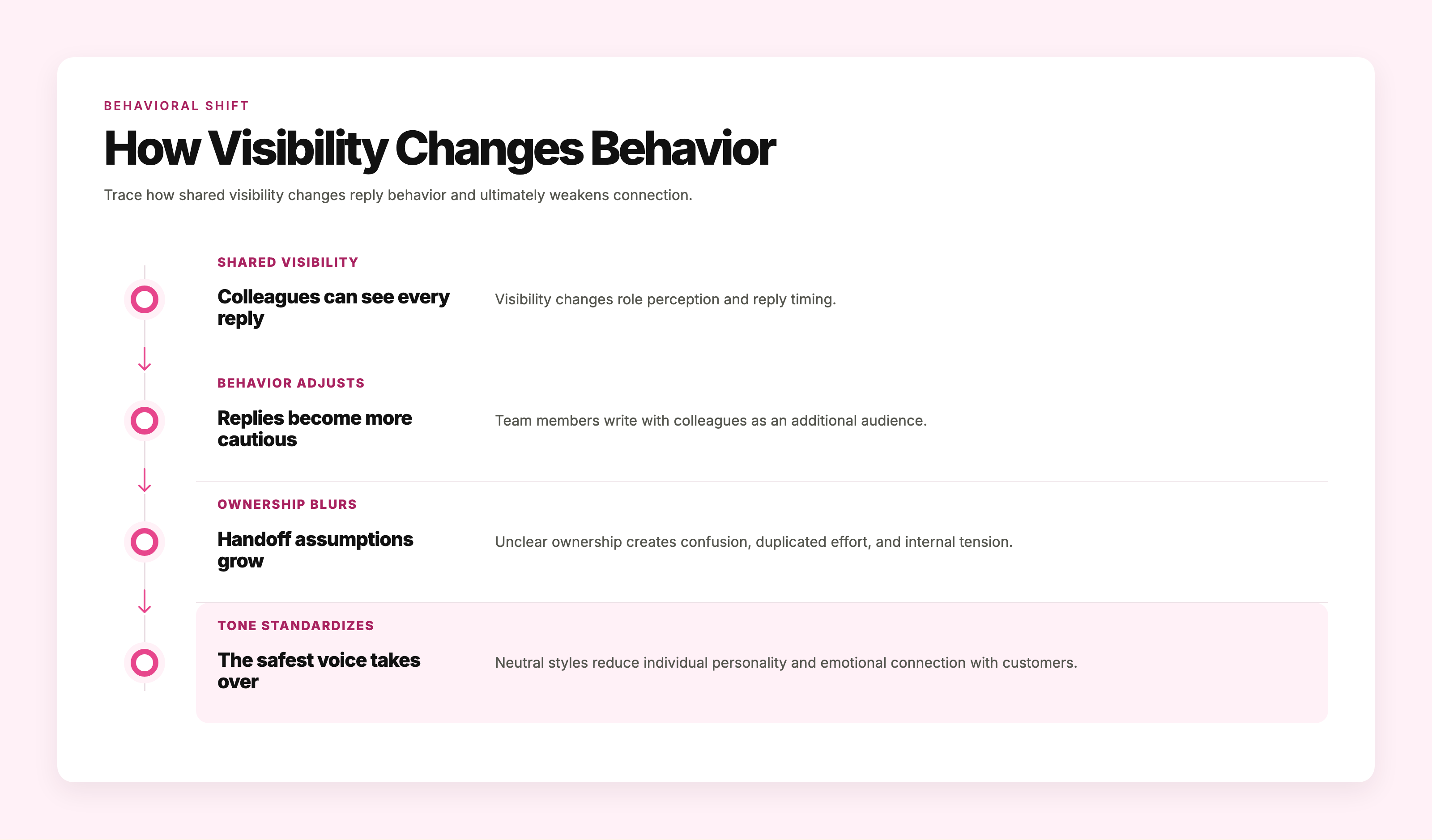
Within a shared inbox, communication patterns change distinctly from individual email accounts or direct messaging. Awareness that others can read and respond shapes each team member’s perception of their role. Operators realize their answers are visible to colleagues, often influencing their tone and timing. Some become cautious, concerned about reply overlap or correction. Others hold back, expecting someone else to respond first.
Unclear “ownership” of messages fosters subtle handoff confusion and duplicated effort. For example, a receptionist might assume a technical question requires an expert’s attention, while that expert waits for the receptionist to vet or prioritize it. These silent assumptions slow response times and create gaps customers interpret as neglect. Internally, staff experience tense “but I thought you had that” moments, where nobody explicitly confirms responsibility. These breakdowns don’t show on the inbox interface but generate friction throughout the day.
The team’s tone also adjusts inside shared inboxes. Understanding tone indicators is essential because they guide clear and effective business communication that prevents the kind of impersonal tone drift often found in shared inbox replies.
Operators typically mimic group norms or previous replies, leading to a loss of unique personality. Responses gravitate toward a neutral, “safe” voice to avoid standing out. Although this may appear superficially professional, it often drains the emotional connection customers rely upon to feel valued. When communication feels impersonal or inconsistent, customers begin doubting whether the business genuinely understands or cares about their needs.
This subtle behavioral shift in shared inboxes often goes unnoticed. Teams may fall into mechanical back-and-forths instead of sustaining warm, adaptive conversations. Shared visibility doesn’t guarantee better rapport; instead, it can segment conversations, make replies feel clipped, and prompt customer doubts. This nudges customers toward competitors who communicate more clearly and empathetically.
The Impact of Multiple Voices on Customer Experience: A Quantified Look
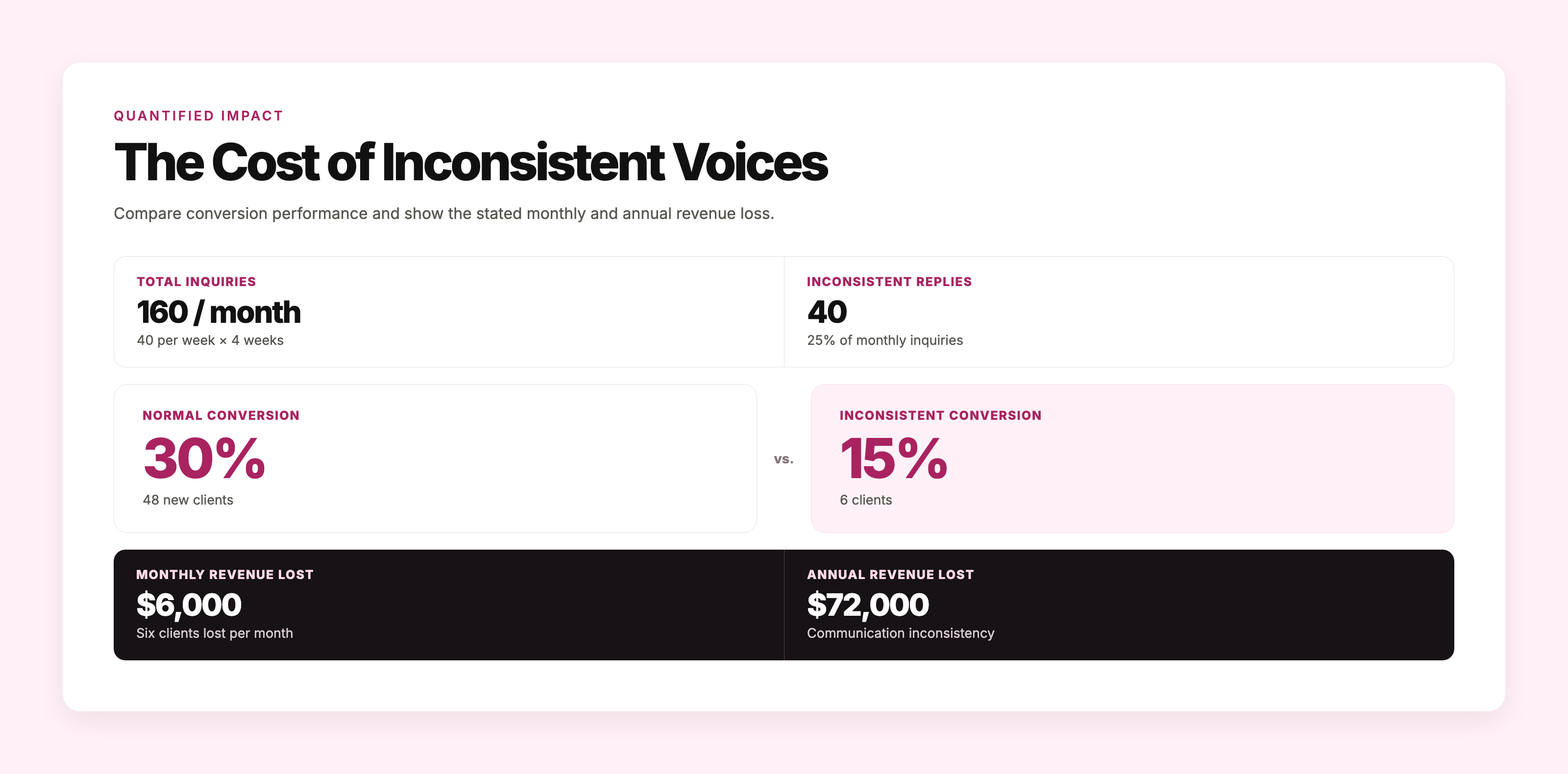
The operational cost of mixed voices within shared inboxes appears in measurable business results. Consider a consulting firm handling about 40 inbound inquiries weekly via a shared inbox used by three team members. Their typical conversion rate is around 30%, yielding 12 new clients weekly, each generating approximately $1,000 in initial revenue.
Within this flow, the company monitors follow-up patterns and finds that 25% of inquiries (40 out of 160 monthly) receive delayed or tone-shifting replies due to inconsistent communications. Different team members send answers varying in warmth and detail—some rushed or overly formal, others missing key information or delayed while waiting on peers.
Their internal review shows these 40 inquiries convert at only half the usual rate, about 15% instead of 30%. That translates to about 6 fewer clients monthly, resulting in roughly $6,000 lost revenue per month. Over a year, this amounts to $72,000 in revenue slipping away because of communication inconsistencies within the shared inbox.
Breaking down the numbers:
- Total inquiries per month: 160 (40 per week × 4 weeks)
- Normal conversion rate: 30% = 48 new clients
- Inquiries with inconsistent replies: 40 (25% of 160)
- Conversion on inconsistent replies: 15% ≈ 6 new clients
- Lost conversions vs. normal: 12 expected - 6 actual = 6 clients missed monthly in that segment
- Average client value: $1,000
- Monthly revenue lost = 6 × $1,000 = $6,000
- Annual revenue lost = $6,000 × 12 = $72,000
Even allowing for adjustment, the data highlights how fragmented communication in shared inboxes quietly erodes revenue. Customers hesitate or disengage because inconsistency undermines trust. Multiple voices managing one inbox also obscure where communication breaks down, allowing minor gaps to multiply into significant losses.
Without close attention to team behaviors and their emotional effects on customers, these issues pass unnoticed, stalling growth. This connects closely with why visibility in customer communication matters for small businesses, as it helps identify and remedy hidden breakdowns before they impact revenue.
This measurement underscores why businesses must look beyond technology to the human dynamics operating inside shared inboxes.
Diagnosing Communication Tone Drift Within Shared Messaging Systems
Tone drift—when communication warmth and style vary unevenly across responders or over time—is among the toughest challenges in shared inboxes. It develops gradually and subconsciously, yet its ripple effects are substantial.
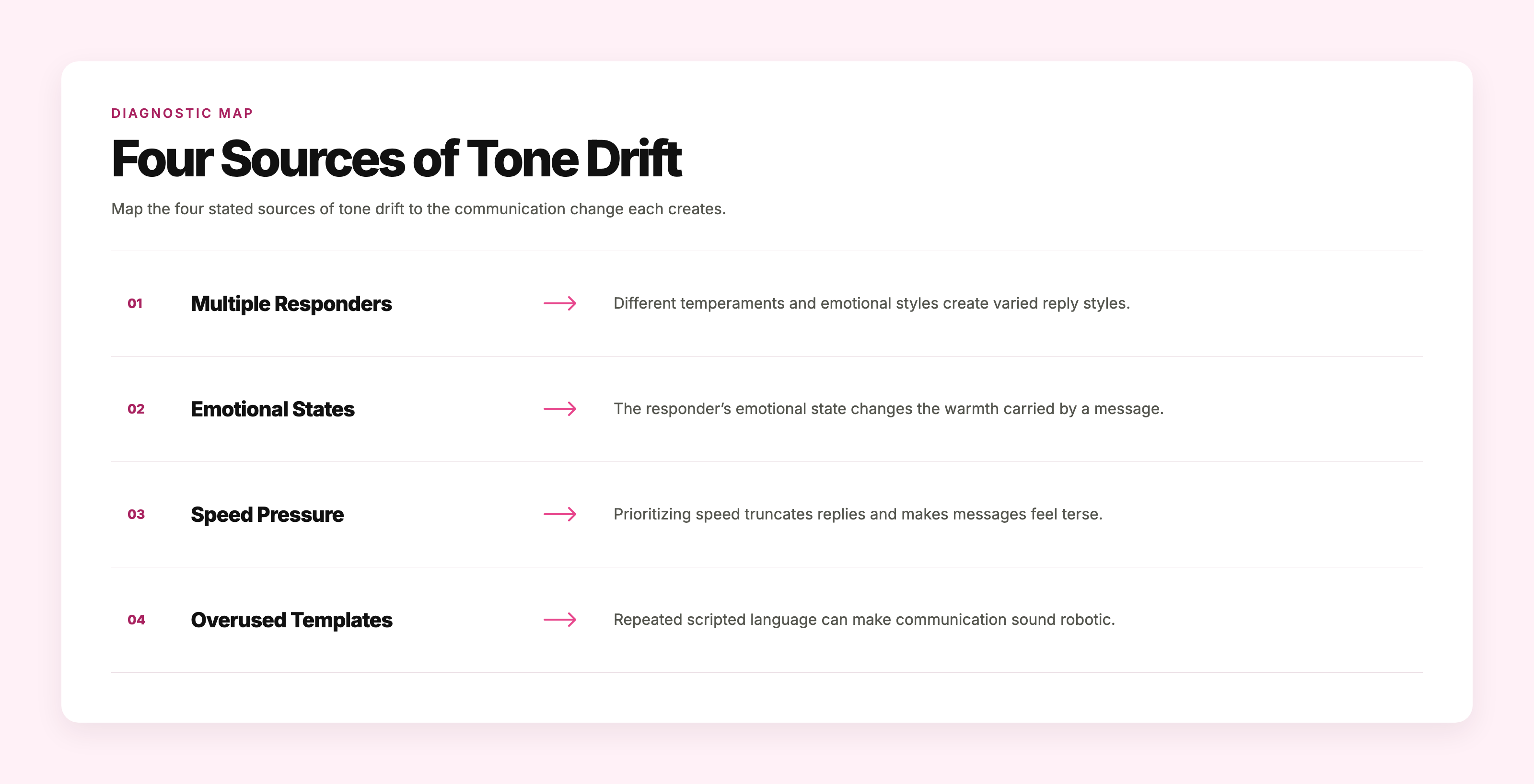
Several factors cause tone drift inside a shared inbox:
1. Multiple Responders: Different team members bring unique temperaments and writing styles. Without clear guidelines or regular calibration, messages can range from overly formal to excessively casual or lack emotional depth.
2. Emotional States of Operators: A stressed or distracted team member’s replies may be terse or curt. Another, feeling upbeat, might write friendlier responses. Customers sense these emotional undercurrents without understanding their origin.
3. Pressure to Expedite: When incoming volume surges, operators often prioritize speed, trimming messages to essentials. Customers receive replies that feel transactional and cold.
4. Overuse of Templates: Relying heavily on canned replies to maintain “consistency” can backfire, causing answers to sound robotic and insincere.
This drift alters how customers perceive the business relationship. For example, a customer receiving a warm, personalized first reply but later a brief, impersonal follow-up senses inconsistency. That raises doubts about the company’s sincerity or attentiveness. Confusion creeps in, causing the customer to hesitate before further engagement.
A real scenario: a midsize law firm uses a shared inbox. Initial inquiries go to a client intake specialist who sends detailed, empathetic replies. Later follow-ups come from paralegals relying heavily on template responses. One potential client notices the shift: “At first, I felt they understood my needs. But the last email was generic, like they were rushing me.” The client withholds signing and explores other options.
In another office, a sales team member known for warm style abruptly lowers reply warmth after a stressful day, sending terse, clipped answers. The next day, teammates notice customers’ slower responses and internal feedback about “losing the connection.” These subtle tone shifts, unnoticed by the sender, ripple into lost momentum.
Addressing tone drift means recognizing communication as relational, not merely transactional. Teams must align norms, monitor moods, and balance efficiency with empathy. Otherwise, shared inboxes gradually become patchworks of voices wearing down customer trust.
Framing Modern Customer Expectations for Consistent, Human Responses
Today’s customers expect more than rapid replies; they seek consistent treatment that makes them feel recognized across every interaction. Each message shapes ongoing impressions influencing trust and loyalty. Customers want to be seen as individuals—not just as another ticket.
Shared inboxes can fragment this ideal when multiple voices fail to coordinate warmth and tone. Customers detect even small shifts or delays and interpret them as signs of indifference, confusion, or chaos—regardless of how carefully the company manages requests behind the scenes.
This expectation arises from a natural desire for psychological safety in communication—predictability, understanding, and genuine attention. When any of these are missing, silence or uneven replies feel deliberate or careless, prompting customers to reconsider continuing the relationship.
Picture a customer emailing an online retailer about shipping delays via a shared inbox. The first reply is polite and empathetic. The next, from another agent, lacks apology and sounds brusque. The customer senses goodwill slipping away, reducing willingness to be patient. Others may receive conflicting messages that confuse them, leaving uncertainty if their shipment is on track.
Most customers have limited patience for mixed signals. They want a seamless emotional flow like speaking to a consistent, trustworthy person—even if multiple people manage communication behind the scenes. This reality requires business teams to view shared inboxes not only as tools for quick responses but as spaces for relational continuity.
Addressing this demands moving beyond channel management to cultivating a communication culture. Teams need to understand that their voices inside a shared inbox shape the brand’s emotional tone. Consistent, human voice requires agreed-upon tone norms, managing expectations, and nurturing empathy. It also involves attending to operators’ emotional readiness and recognizing the psychological dynamics in interactions among teammates and customers.
This subtle approach reduces customer hesitation and lowers the chance they will seek alternatives. The benefits extend beyond efficiency, supporting deeper satisfaction and repeat engagement.
Where TMMN Fits In: Supporting Emotional and Behavioral Communication Systems
While TMMN is often linked to organizational message structure and flow, its deeper value lies in fostering communication environments tuned to emotional and behavioral realities. A shared inbox is not just a message bucket—it can become a place where teams cultivate emotional awareness and relational responsiveness.
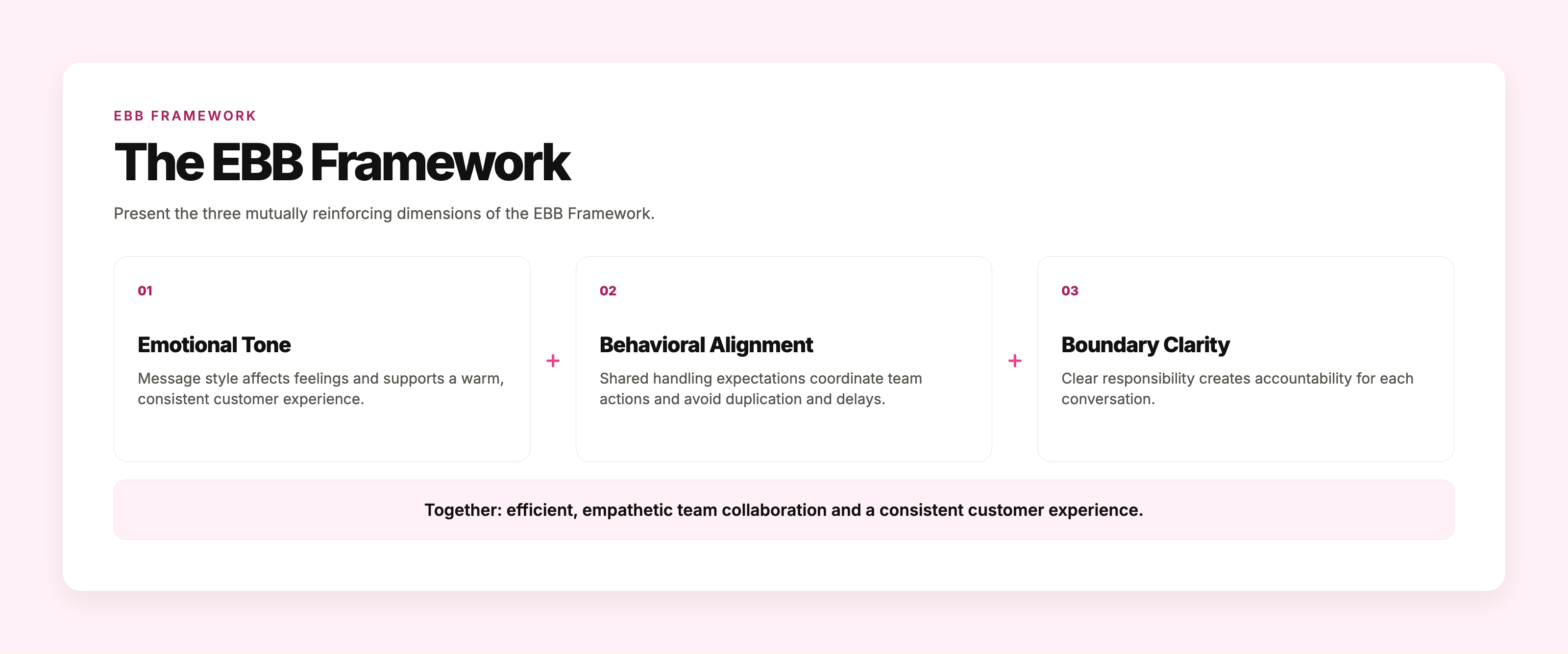
TMMN presents a framework we can call the EBB Framework, representing three key dimensions inside shared inboxes: Emotional Tone, Behavioral Alignment, and Boundary Clarity.
- Emotional Tone focuses on how message style, word choice, and timing affect customer feelings. When neglected, replies become robotic or inconsistent, eroding trust. Customers detect subtle signals indicating whether they feel genuinely attended to.
- Behavioral Alignment concerns shared expectations for how team members handle messages, including response speed, phrasing, and mutual support. Issues here manifest as duplicated effort, deferrals, or paralysis caused by uncertainty. These create bottlenecks, delays, and internal stress over “who’s responsible.”
- Boundary Clarity defines when and how conversations move among team members or across channels, making accountability explicit without sparking disputes. Breakdowns appear as “I thought someone else did it” situations, leaving customers waiting and the team confused.
This framework underscores that optimizing a shared inbox is not only a technical challenge; it requires shaping the people and relationships involved. With strong leadership and steady habits, teams strike a balance across these three dimensions, reducing friction and transforming the inbox into a collaborative space where interactions feel both personal and professional.
For operators, this means developing skills like empathy reading, tone control, and proactive coordination—all while managing shared inbox flow. For leaders, it means monitoring communication patterns, modeling desired behavior, and establishing rituals that foster connection and clarity.
When this alignment takes hold, shared inboxes become hubs of smooth collaboration, with near-seamless replies and steady, warm tone. Customers experience a consistent, personable flow that builds long-term trust. Without it, tension and drift persist regardless of how many messages get processed.
Thus, TMMN’s approach elevates shared inbox management beyond workflow mechanics to embracing the human psychology and emotional intelligence underpinning lasting customer relationships. This reframes shared inboxes as ecosystems where a business’s listening, responding, and relating come vividly to life.
Internal Team Moment: A Shared Inbox Handoff Breakdown
During a mid-morning update at a small nonprofit communications office, a revealing incident unfolded around their shared inbox. At 9:00 am, an urgent donor inquiry arrived about a matching gift deadline. Dana, the front desk coordinator, saw the message first and assumed Paula, the development manager, would reply because it contained detailed information. Meanwhile, Paula expected Dana to at least confirm receipt and provide basic info.
By mid-afternoon, no reply had gone out. Both Dana and Paula flagged the message without formally claiming it. The inbox showed the item untouched. When a senior director asked about the response, both staff members suddenly noticed the gap. They rushed to send a last-minute reply, but it came hours late.
This episode illustrates how shared inboxes can create invisible handoff confusion. No one ignored the inquiry; everyone mentally “touched” it without explicitly owning it. The message lingered unanswered, giving the donor an impression of disorganization and possibly devaluing their commitment. Internally, the team felt frustrated, sensing a lost opportunity.
This moment reveals the core tension in shared inbox collaboration: balancing transparency with clear ownership. Without firm conventions or swift in-message confirmations, urgent requests can quietly slip through. Encouraging operators to explicitly claim or assign messages upon arrival, along with acknowledgments, carries major consequences for donor relations and organizational reputation.
Customer Behavioral Moment: Hesitation and Quiet Disengagement
Customer behavior in shared inbox communications often produces subtle signals before lost business becomes evident. Rachel, a retail customer, contacted a specialty food company with questions about custom gift baskets. Both sales and support teams managed the shared inbox.
Rachel’s first reply came from Alice, a sales associate with strong product knowledge and a friendly tone. Two days later, Rachel sent a follow-up, expecting a similarly personal reply. Instead, Bob from support responded with a terse, generic answer that failed to address her concerns directly.
Rachel hesitated, sensing she wasn’t receiving full attention. She paused, comparing her experience to a competitor’s chat that felt more immediate and engaged. Without complaining or canceling outright, Rachel quietly disengaged, never completing the purchase.
Her contrasting experiences with different voices inside the shared inbox planted doubt about whether the company genuinely cared. Rachel’s silence was a quiet decision to explore alternatives rather than burn bridges.
This example highlights the psychological layer beneath inconsistent communication quality—its direct link to customer hesitation and eventual silent churn. Customer experiences aren’t black and white; tone shifts and reply delays accumulate doubt. Without a carefully managed shared inbox culture attentive to these relational cues, businesses risk losing customers with no clear feedback, making recovery difficult.
Key Takeaways
- Shared inboxes are dynamic environments where multiple team members’ communication styles intersect, shaping customer experience beyond just message handling.
- Unclear ownership and subtle coordination gaps inside shared inboxes often cause silent operational friction, resulting in slower responses and internal frustration.
- Tone drift is a pervasive issue that quietly undermines customer trust, as inconsistent warmth and style across responders sow doubt and hesitation.
- Customers expect relational consistency and psychological safety in communication; fragmented voices or conflicting messages prompt disengagement even when replies are timely.
- The EBB Framework (Emotional Tone, Behavioral Alignment, Boundary Clarity) reveals that optimizing shared inboxes requires attention to human behaviors and relationships, not just technological fixes.
Conclusion
Shared inboxes are not mere technical conveniences—they are vibrant intersections where team behaviors, emotions, and communication styles visibly merge. Effective management means observing how operators interact with each other and customers in ways that extend beyond message processing.
The emotional tone teams set, their behavioral alignment around ownership and response routines, and the clarity of conversational boundaries collectively shape the customer experience. Small misalignments quietly erode trust, breeding doubt and disengagement in ways that do not easily show up in reports but are profoundly felt.
The EBB Framework—Emotional Tone, Behavioral Alignment, and Boundary Clarity—provides a practical lens through which teams can reveal and improve their shared inbox culture. It calls for ongoing, hands-on attention to the human side of communication, transforming shared inboxes from mere tools into arenas of relational excellence.
For leaders and operators alike, recognizing that a shared inbox is where both customers and teammates experience genuine connection—or its absence—is crucial. These principles align with how to assign, track, and close customer conversations efficiently, ensuring accountability and smooth handoffs inside shared inboxes.
Cultivating emotional intelligence and establishing agreed-upon behavioral norms within this space is an investment in stronger customer relationships, elevated team morale, and sustainable growth.
By looking beyond speed or task assignments and embracing shared inboxes with a human-centered perspective, businesses deliver communication that is consistently empathetic and trustworthy—gaining a fundamental advantage rooted in real human interaction.
Starting with a 14-day free trial of tools designed to enhance shared inbox collaboration can help teams experience this advantage while building consistent communication habits.

.svg)