
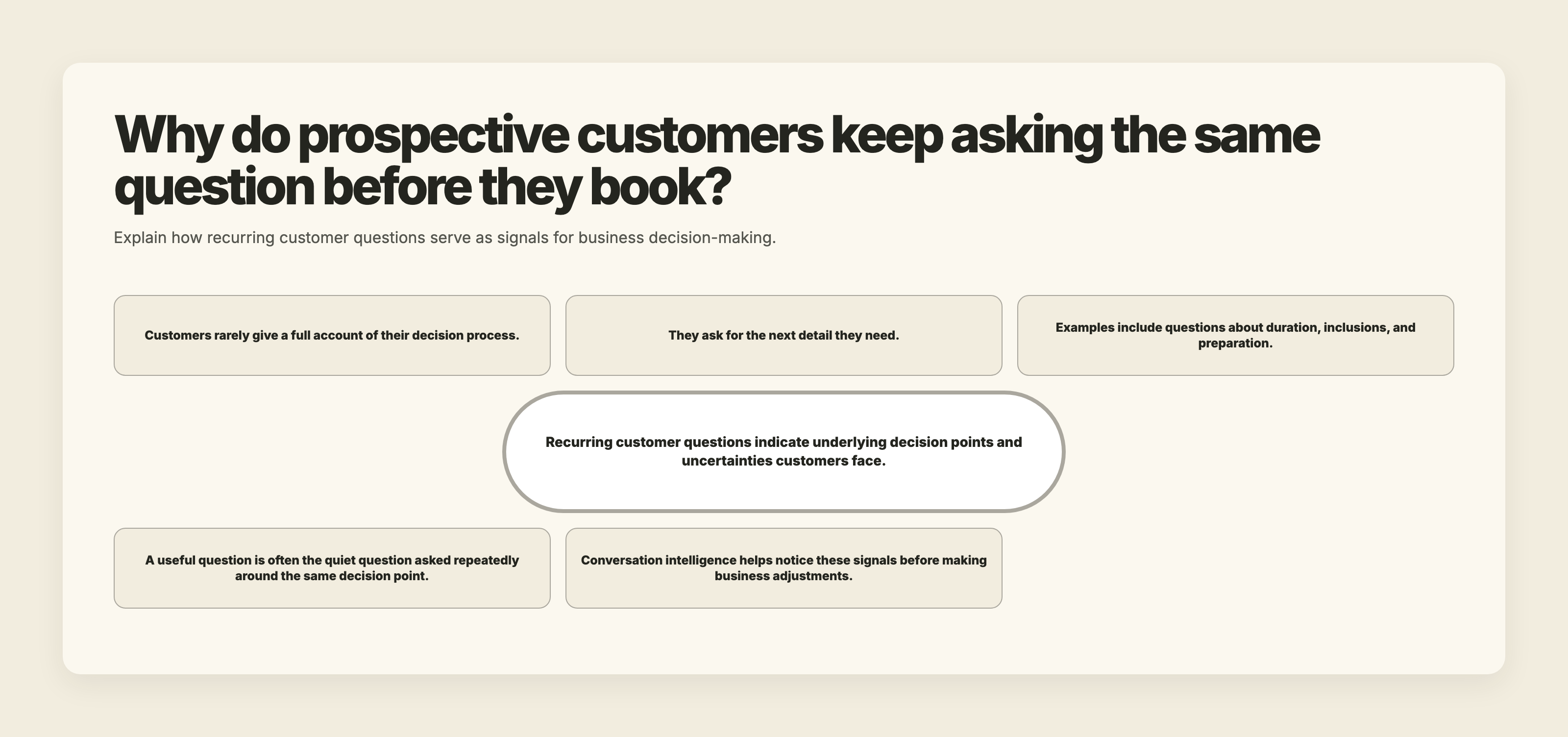
Why do prospective customers keep asking the same question before they book?
That question often comes up when an owner is considering a practical change. A pet groomer may be revising an online booking page after noticing how many first-time customers ask whether an appointment takes 45 minutes or half a day. A martial arts school may be deciding what parents need to know before a trial class. An independent bookkeeper may wonder why prospects keep asking whether monthly support includes payroll questions.
Each customer needs an answer in the moment. Staff provide it, the inquiry continues, and the day moves on. Yet when the same uncertainty appears week after week, it becomes more than a service task. It becomes useful information about how people understand the business while deciding whether to proceed.
Customers rarely give a full account of their decision process. They ask for the next detail they need. “How long should I allow?” may mean they need to arrange transportation. “Is that included?” may mean they cannot confidently compare two service options. “What should we bring?” may mean a parent is worried that a child will arrive unprepared.
Conversation intelligence helps an operator notice those signals before changing an explanation, estimate, appointment process, or service option. The aim is not to assign deep meaning to every question. It is to recognize when an ordinary point of uncertainty appears often enough to deserve attention.
A useful question is not always the loudest one. It is often the quiet question asked by many different people at roughly the same point in their decision. Once an owner sees that recurrence, a modest improvement becomes possible.
Conversation Intelligence, Defined for Everyday Business
Conversation intelligence is the practice of identifying recurring customer signals, interpreting what they reveal about a practical decision, making a focused adjustment, and observing what happens afterward.
Distinguishing conversation history from conversation intelligence helps operators separate a record of what was said from the recurring signals that can inform the next adjustment.
That definition matters because the term is often reduced to software. Recording tools, summaries, search functions, analytics, and AI can support the practice, but none of them can make the operating decision by itself. A report containing common words does not tell an owner
whether to revise a booking page. A call summary does not decide whether an estimate needs clearer boundaries. Those choices still require judgment from someone who understands the work.
In everyday use, conversation intelligence begins with a real question. Why are first-time grooming customers uncertain about appointment length? Why do bakery customers ask about pickup windows after placing an order? Why do parents hesitate when choosing between trial-class times? The business looks for relevant signals rather than reviewing communication with no clear purpose.
The result is practical. A clearer description may replace a paragraph that customers routinely misread. An order confirmation may state when a product will be ready rather than merely listing the date. Appointment instructions may distinguish what is required from what is optional. A service package may be renamed because customers consistently interpret its current name incorrectly.
This is why conversation intelligence is best understood as a business learning practice. It connects what customers say with choices about how a company explains, prepares, schedules, packages, and delivers its work.
It also has limits. Customers can reveal uncertainty, priorities, comparisons, and preparation needs, but they do not always know which change would solve the issue. An owner can listen carefully without turning every request into policy. The value comes from interpreting the signal in the context of the work and then checking whether the response actually helped.
What Customers Reveal Through Ordinary Questions
Ordinary questions often contain more information than their wording suggests. Questions about duration reveal planning needs. Questions about inclusions reveal uncertainty about value or scope. Questions about preparation show where customers are worried about arriving incorrectly. Requests for comparisons indicate that the available options are difficult to distinguish.
Consider a parent contacting a martial arts school about a trial class. The parent asks whether a uniform is required, whether a child can watch before participating, and whether parents stay in the room. None of those questions directly says, “My child is nervous, and I need to know whether this first visit will feel manageable.” Still, the sequence makes that concern visible.
If several parents ask similar questions, the school can improve its first-visit information. It might explain that comfortable clothing is fine, observation is welcome, and an instructor will greet the child before class begins. A parent reading that information can picture the visit more easily. That adjustment does not require a new program. It simply answers the questions influencing whether the first visit feels possible.
Customer behavior becomes especially informative around pauses. A bookkeeping prospect may read a monthly service description, ask whether routine payroll questions are included, and receive a vague answer several hours later. The prospect then visits two other providers’ websites and stops replying. The delay alone did not determine the outcome, but uncertainty remained during the comparison period.
Silence in that moment can feel intentional to the customer even when it results from an ordinary workload. The customer does not see the staff meeting, deadline, or internal discussion behind the delay. They see that a straightforward question did not produce a straightforward answer. Doubt develops quietly, often before anyone inside the business would describe the inquiry as lost.
The internal version of the event can sound harmless. One employee thought the owner needed to answer. The owner assumed the employee had already handled it. Someone left the message unread because another person had opened it. By the time the team recognizes the missed handoff, the prospect has already made a decision elsewhere.
Experienced operators pay attention to those decision moments. The question itself matters, but so do its timing, the clarification that follows, and whether the customer can proceed confidently after receiving an answer. A customer who asks one question, gets a plain answer, and books is different from a customer who asks the same question twice in slightly different ways.
From a Business Question to a Practical Adjustment
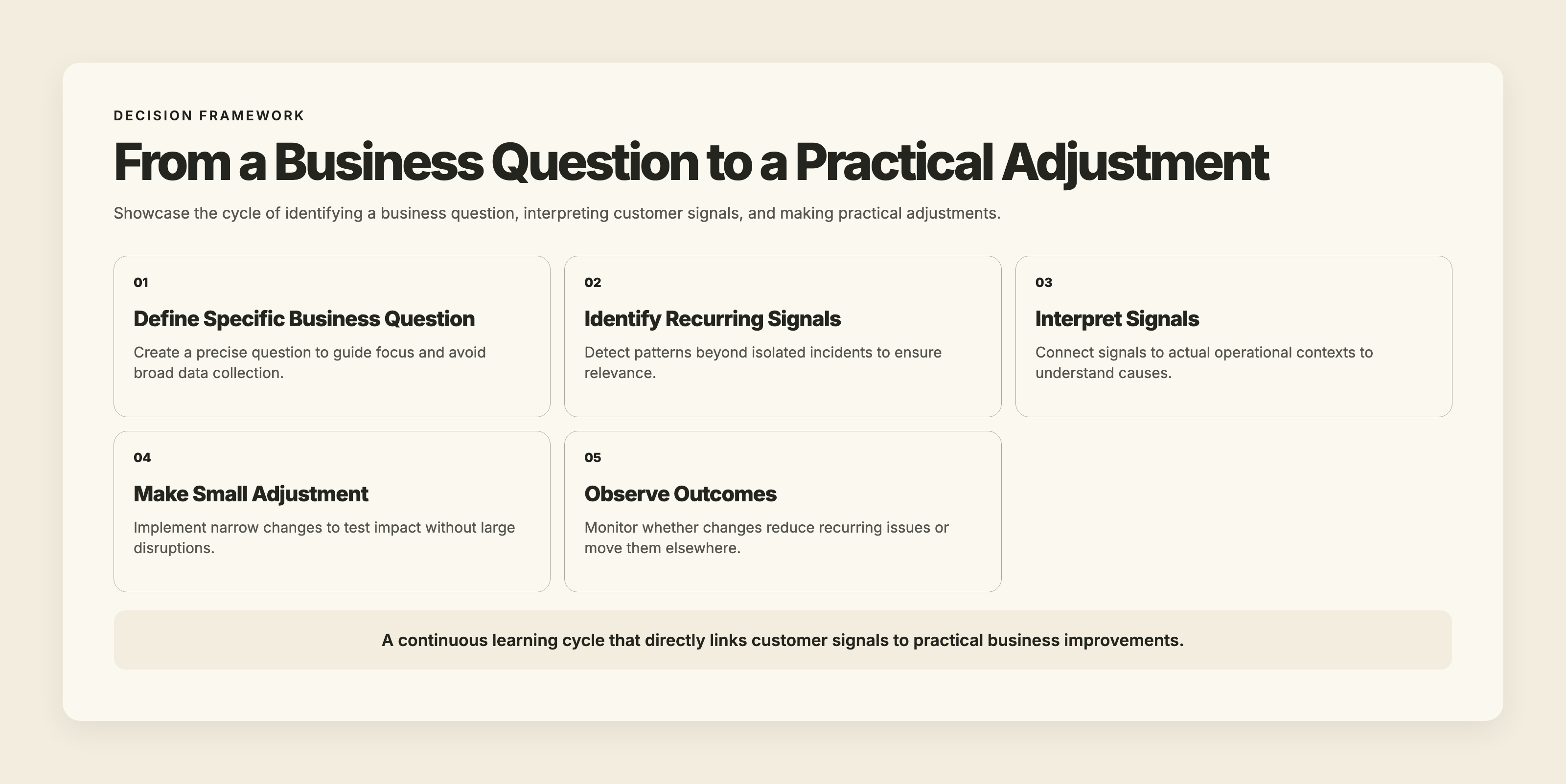
A useful way to apply conversation intelligence is through a Practical Learning Loop: begin with a business question, identify recurring signals, form a practical interpretation, make a small adjustment, and observe what follows.
The first job of the loop is to create a boundary. “Why do customers ask questions?” is too broad. “Why do first-time customers ask about grooming duration before selecting an appointment?” is specific enough to guide attention. Without that boundary, staff may collect a large amount of material while remaining unsure what decision it should inform.
Recurring signals show whether the issue extends beyond one memorable encounter. Failure at this stage often looks like an owner reacting to an unusually forceful complaint or a staff member recalling the most difficult customer of the week. A caller who was upset may stay in everyone’s mind long after ten quieter customers have asked a more useful question. Recurrence keeps one vivid incident from taking over the operating agenda.
Interpretation then connects the signal to the actual work. If grooming customers ask about duration, the issue may be transportation, separation anxiety, coat condition, or an assumption that all appointments take the same amount of time. Those possibilities do not justify guessing at a customer’s motives. They help the groomer identify which part of the existing explanation may be incomplete.
The operating details usually settle the question. If customers mainly ask after selecting a service, the service description may be unclear. If they ask immediately after drop-off, the handoff may not have set expectations. If they call an hour into every appointment, staff may be giving a time estimate that sounds more definite than it is. The same words can point to different weak points depending on when they appear.
The adjustment needs to be narrow enough to evaluate. The groomer might add a typical time range to the booking explanation and note that coat condition can affect completion. The front-desk employee may then have a consistent sentence to use when customers call. Rewriting every customer message, retraining the entire staff, and changing the schedule simultaneously would make it difficult to know what helped.
Observation is where an internally sensible idea meets the workday. Duration questions may decrease, yet customers may still arrive expecting an exact completion time. Staff may spend less time explaining ranges but receive more calls asking about same-day updates. Those reactions show whether the wording addressed the original uncertainty or merely moved it to another point in the process.
In practice, the loop is more likely to lose value by drifting away from the original business question than by lacking more data. A focused question keeps the evidence connected to a decision the business can actually examine.
The loop is useful because it keeps attention tied to a defined operating question. It prevents a customer comment from becoming an oversized project and prevents a polished internal explanation from being mistaken for customer clarity.
Why the Same Uncertainty Keeps Taking Staff Time
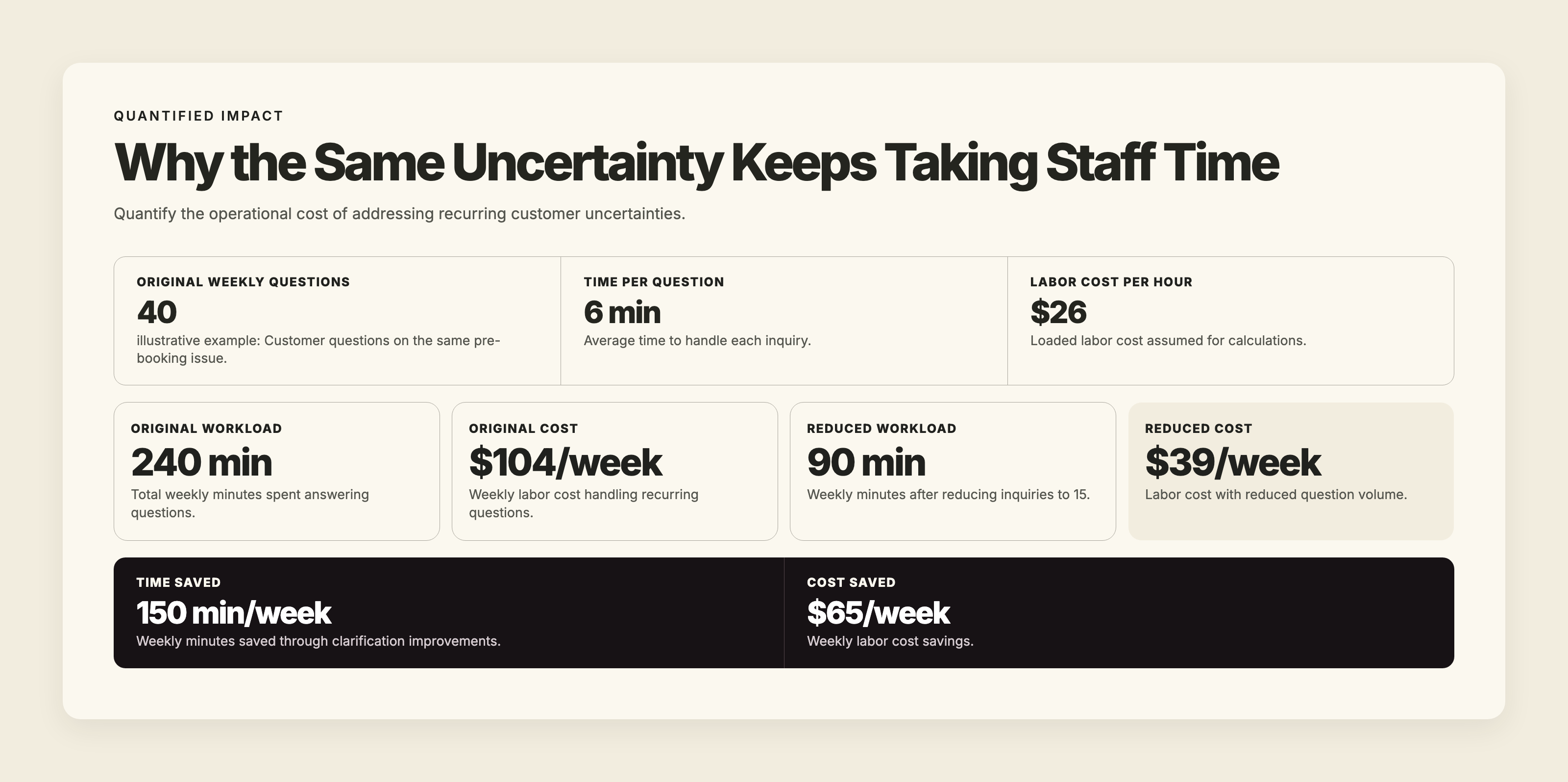
Recurring clarification has a measurable cost even when every inquiry is handled well. Suppose a small business receives 40 questions each week about the same pre-booking issue. If an employee spends an average of six minutes reading, answering, and documenting each one, that uncertainty requires 240 minutes of work.
That is four staff hours per week. At a loaded labor cost of $26 per hour, the business spends about $104 weekly, or roughly $450 in an average month, answering one preventable question. The amount is not catastrophic. It is still enough to affect how an owner thinks about the clarity of the booking process.
Those six-minute interactions also interrupt other work. An employee may stop confirming appointments to reply to a message, look up a service detail, send an answer, and make a note. None of that feels significant on its own. By late afternoon, though, the same clarification has appeared between check-ins, while someone is trying to finish a schedule, or just as the front counter becomes busy.
The visible reply is only part of the cost. Sometimes the employee asks a coworker, waits for confirmation, reopens the message, and then returns to the task that was interrupted. If ownership is unclear, two people may both investigate the same question. In other cases, each employee gives a slightly different answer, creating another clarification later.
Assume the business revises its service page and confirmation language, reducing those inquiries from 40 to 15 per week. At six minutes each, the change saves 150 minutes weekly. That is 2.5 hours, worth about $65 per week or $282 per month at the same labor rate. More importantly, employees can use that time for work that genuinely requires individual attention.
There may also be a conversion effect. If 100 monthly inquiries previously produced 52 bookings, the owner can compare that result with the period after the explanation changes. If 61 of the next 100 inquiries book, the improvement deserves attention, although seasonality, pricing, and demand also need to be considered. Conversation intelligence creates a better basis for comparison; it does not justify claiming one cause too quickly.
The same approach can measure appointment readiness. A martial arts school might track how many trial families arrive without the required waiver before and after revising its welcome information. A bakery might count pickup-time questions before and after adding a clear collection window to confirmations. A bookkeeping firm might compare how often prospects ask what is included in monthly support after it separates routine questions, payroll assistance, and scheduled reviews in plain language.
Staff effort is easiest to underestimate when it arrives in six-minute pieces. The calendar never shows a four-hour block labeled “explain the same uncertainty again,” but the time is still used. Repeated clarification is often hidden labor created by information the business has already had several chances to make clear.
Which Customer Signals Deserve an Operational Response
Not every recurring comment should produce a business change. A useful signal usually has several qualities: it appears with enough regularity to matter, affects a real customer decision, concerns something the business can influence, and points to a recognizable point of friction in the work.
Recurrence protects against the memorable-comment problem. A custom cake bakery may receive one request for pickup at 5 a.m. That request is vivid but not necessarily useful for setting regular hours. If customers repeatedly ask whether Saturday cakes can be collected before noon, however, the bakery may need to explain pickup windows earlier in the ordering process.
Decision relevance is equally important. Some comments express preferences without affecting action. Others appear just before a customer selects an option, submits a deposit, or prepares for an appointment. Signals close to those moments usually deserve more attention because they shape what the customer does next.
Timing often reveals more than intensity. A mildly worded question that appears just before several customers abandon a form may matter more than a strongly worded complaint made after a successful appointment. The complaint may still deserve a response, but it is not automatically the stronger operating signal.
The business also needs some control over the response. A groomer cannot eliminate uncertainty about how a nervous dog will behave, but it can explain why appointment times vary. A bookkeeper cannot make every service easy to compare, but it can state whether monthly support includes routine questions, account reconciliation, and scheduled reviews. A school cannot guarantee that every child will feel comfortable immediately, but it can make the first visit easier to understand.
Some signals expose an ownership problem rather than a wording problem. Customers may receive a clear answer when they reach the right employee but wait too long because nobody knows who owns the inquiry. In that situation, rewriting the website may have little effect. The more relevant issue is the handoff: who responds, where the answer is recorded, and what happens when approval is needed.
Experienced operators learn to separate interesting comments from actionable signals. The distinction is not whether a customer speaks strongly. It is whether the signal exposes a decision, handoff, explanation, or preparation point the business can improve. The customer’s words are evidence. The operating context determines what they mean.
A Small Change Should Produce an Observable Result
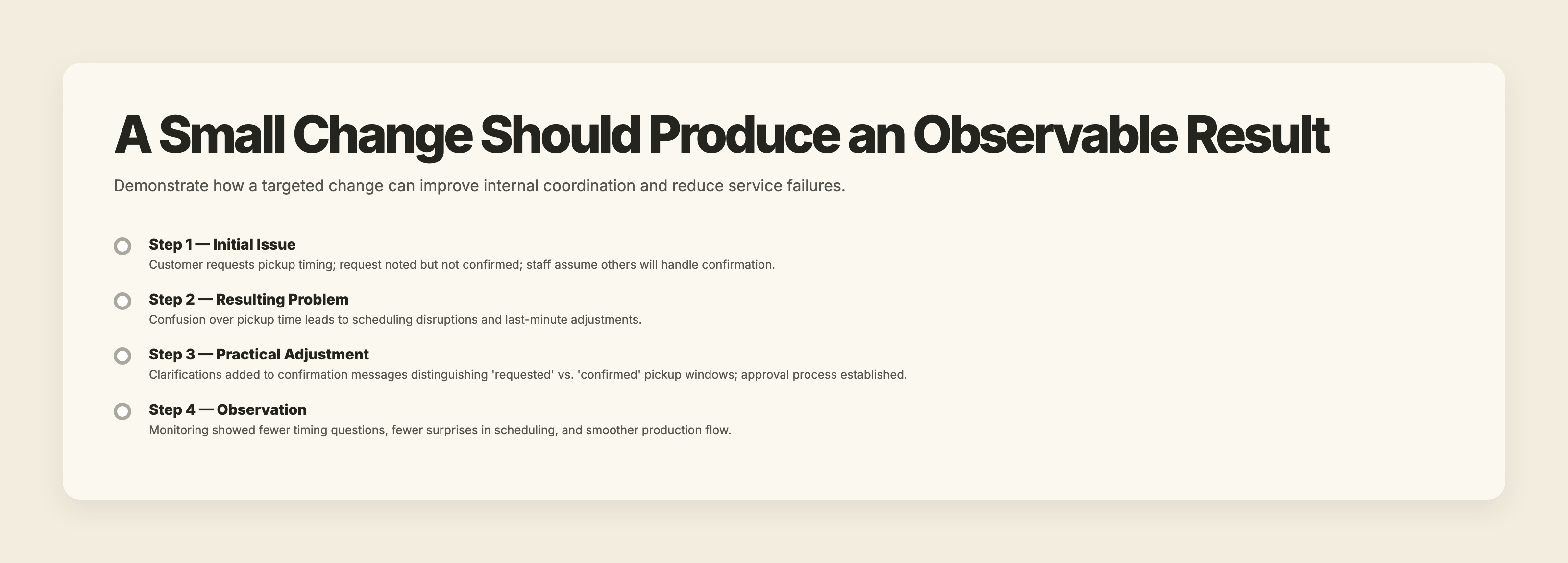
The following bakery case is an anonymized composite built from recurring situations seen in order-based businesses. The names and identifying details are omitted, but the failure pattern is grounded in ordinary operations: a customer request is recorded, nobody confirms its status, and each employee assumes someone else owns the next action.
At a custom cake bakery, pickup timing had become a regular question. Customers received an order confirmation showing the date, but the message did not state a collection window. Staff answered timing questions individually and assumed the front counter would coordinate the final details.
One Monday morning, a customer ordered a birthday cake for Saturday and asked the order coordinator whether pickup at 10 a.m. would be possible. The coordinator wrote “morning pickup requested” in a free-text note. Later that day, the decorator reviewed the production schedule but did not see a confirmed time. She planned to finish the cake shortly before noon.
Nothing in the system forced a decision. The requested time was visible if someone opened the note, but it did not appear as a production deadline. There was no field showing whether the request had been approved, declined, or was still waiting. The coordinator had captured the customer’s words without creating clear ownership for the answer.
On Friday afternoon, the customer called the counter and said she had arranged a family lunch around the 10 a.m. collection. The employee answering the phone believed the coordinator had confirmed it. The coordinator believed the decorator would respond if the timing could not be met. The decorator had treated the note as a preference because no approved time appeared on the schedule.
The owner heard the discussion and asked the team to finish the cake first on Saturday. The cake was ready, but the decorator had to reorder the morning’s work. Another employee prepared packaging earlier than planned, and the owner spent time checking details that should have been clear at the point of order.
The immediate issue was resolved. The customer collected the cake on time and may never have known how close the morning had come to disruption. Inside the bakery, however, the recovery was real. Other work started later, several people revisited the same order, and the team relied on goodwill and rushing to preserve an expectation nobody had formally confirmed.
This is how many service failures remain invisible. The customer receives what was expected, so the event is recorded as a success. The schedule disruption, repeated checking, and employee stress disappear from the record even though the process nearly failed.
The more valuable lesson was that several customers had asked the same timing question during the previous month. The Saturday incident did not create the problem. It exposed a gap that routine staff effort had been covering.
The bakery changed one element: confirmations now showed an agreed pickup window, and staff no longer treated a requested time as confirmed until production had approved it. The wording separated “requested” from “confirmed,” removing room for assumption at the counter. The approved window also appeared where decorators planned the work, rather than remaining inside a free-text customer note.
Over the next six weeks, the owner tracked timing-related contacts, arrivals outside collection windows, and last-minute production changes. The review did not require an elaborate dashboard. The owner needed to know whether customers still called for the same clarification and whether staff still discovered timing expectations after the production sequence had been set.
That evidence mattered. A revised message is not successful because the team prefers its wording. It is successful when customers understand the next step more easily and the workday becomes more predictable. In this case, fewer timing calls would show improved customer clarity. Fewer last-minute schedule changes would show that the internal handoff had improved as well.
Conversation Intelligence as a Regular Management Habit
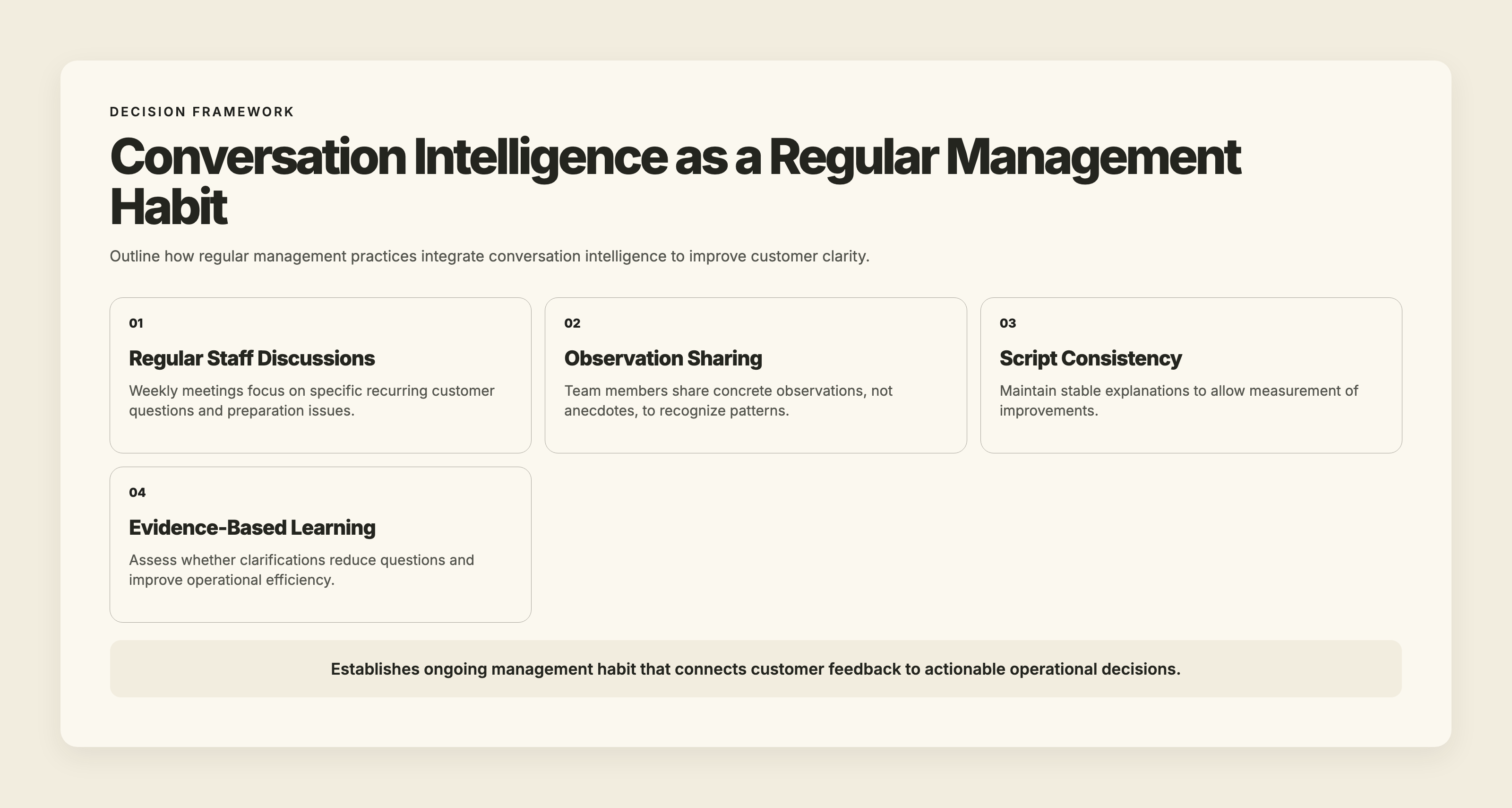
Small and mid-sized businesses do not need an elaborate research department to begin using conversation intelligence. They need a regular way to connect customer signals with decisions already being considered.
A weekly staff discussion can start with one narrow question. What did prospective customers need clarified before booking? Which preparation question appeared several times? Where did customers have difficulty distinguishing two options? The purpose is not to recount every interaction. It is to bring forward observations connected to a practical choice.
The discussion may take place during an ordinary staff meeting, with someone noting a few repeated questions from calls, messages, forms, or counter conversations. A team does not need a polished report to say, “Three parents this week asked whether they stay during the trial class,” or “People keep asking whether the quoted price includes collection.” What matters is that the observation is specific enough for others to recognize or challenge.
That last part matters. One employee may say customers are confused about price when another notices that the actual question concerns timing. A front-counter employee may hear preparation questions that never appear in email. The person updating the website may believe an answer is prominent because they know where to look, while a new customer passes over it entirely.
Informal recollection needs to be treated carefully. A receptionist may remember an impatient caller because the exchange was difficult. A sales employee may recall the most recent objection because it happened that morning. A shared workflow for assigning, tracking, and closing customer conversations makes recurring patterns visible instead of leaving them to individual memory.
Another staff member may have answered the same quiet question eight times without considering it notable. Bringing observations together reduces the influence of whichever incident is easiest to remember.
Consistency matters more than intensity. Changing scripts after every new comment creates variation without learning. One employee uses the old explanation, another improvises a new one, and the owner cannot tell which version customers understood. Even worse, the customer may receive one answer by phone and another in the confirmation message.
A stable explanation gives the business something real to observe. Staff can hear whether customers continue to ask the same follow-up question. The owner can see whether forms arrive more complete. The schedule can reveal whether preparation failures or timing surprises continue. The evidence appears in the work, not just in opinions about the new wording.
This practice also changes how staff experience routine inquiries. Repetition stops feeling like mere interruption and starts functioning as feedback about how the business is being understood. That does not mean employees need to analyze every sentence while serving a customer. Their first responsibility remains helping the person in front of them, answering the question clearly, and keeping the interaction moving.
Management creates the learning habit afterward. The strongest operators are often not those who hear something remarkable. They are the ones who recognize that an ordinary question has become too consistent to ignore.
Where TMMN Fits In
As interaction volume grows, useful signals become harder to notice through memory alone. One employee hears questions about timing, another handles package comparisons, and an owner sees only a portion of both. A message may sit in an inbox, a phone conversation may end without a note, and a front-counter question may never reach the person revising the website.
The practical limitation is fragmentation. A recurring issue can be spread across voicemail, email, text messages, booking notes, and conversations that were never recorded. Even when the information exists, it may be stored in places that different employees review at different times. The owner often sees the escalations while missing the quieter questions staff resolve every day.
TMMN fits into that working loop by helping bring relevant interactions into view around a defined operating question. Its role is not to announce a definitive explanation of customer intent or prescribe a universal response. It can help surface recurring themes, locate the conversations behind them, and reduce the manual work involved in reviewing scattered material.
That boundary is important. If several messages contain the word “pickup,” the system can help an operator find them. It cannot know, without context, whether customers are asking about hours, parking, order readiness, identification, or transporting a cake safely. Someone still needs to read enough of the surrounding exchange to understand which part of the workflow is involved.
The handoff also remains human. Teams can lose track of customer conversations when channel fragmentation is compounded by unclear ownership and weak handoffs.
A pattern may be visible in customer communication, but the person reviewing it may not own the affected process. Questions about collection windows could belong to order entry, production scheduling, or the front counter. Unless someone decides who will review the issue and who can change the process, the finding becomes another item people have seen but nobody owns.
The same restraint applies to Spoken Touch as it evolves. The useful future of spoken and written customer touchpoints is not simply storing more material. It is making it easier to find the moments that matter without forcing an owner to replay every call or search every inbox separately.
In practice, that may mean locating repeated preparation questions before a team meeting, comparing customer language before and after a confirmation changes, or checking whether the same package comparison continues to appear across calls and messages. The system assists detection and review. The operator determines whether the pattern is meaningful, what operating constraint surrounds it, and whether any change is warranted.
A well-aligned system reduces review work without pretending that interpretation is automatic. It can make missed patterns easier to see, especially when no single employee hears enough conversations to recognize recurrence. It cannot repair unclear ownership, approve a pickup request, or decide which promise the production schedule can safely support.
Technology is most useful here when it stays in its proper place. It helps people find the evidence. It does not remove the need for someone to understand the work, make the decision, and remain accountable for what changes.
Key Takeaways
- Repeated customer questions often mark unresolved decision friction, not isolated service tasks.
- Timing, pauses, and follow-up behavior can matter as much as the wording of a question.
- Small, observable changes create better evidence than broad simultaneous fixes.
- Clarification and recovery work remain operating costs even when the customer experience appears smooth.
- Technology can surface patterns; interpretation and accountability remain with the operator.
The Future Is Better Everyday Decisions, Not More Analysis
Conversation intelligence will become more capable as tools improve at identifying themes, summarizing interactions, and locating relevant moments. That capability can be valuable, especially for businesses whose owners can no longer personally hear a representative share of customer questions.
The risk is mistaking analytical volume for useful learning. A bakery does not benefit from knowing that pickup timing appeared in 73 interactions unless someone can connect that fact to confirmations, production planning, or collection windows. A martial arts school does not need a complex sentiment score to notice that parents want a clearer picture of the first class.
The best applications remain close to everyday work. They help a business explain what is included, prepare customers for an appointment, set realistic timing expectations, distinguish service options, and see where a handoff leaves a question unanswered. They help staff avoid answering the same preventable question from scratch when the answer could have been available before the customer had to ask.
They also preserve appropriate caution. A question asked several times may deserve attention without dictating the answer. A decline in clarification requests may indicate better information, but the owner still needs to check whether inquiries declined overall. A higher booking rate may support the change, though pricing, season, availability, and staffing still matter.
The deeper value of conversation intelligence is not that every exchange becomes data. It is that routine customer contact stops disappearing into the day. Questions, pauses, repeated comparisons, and uncertain handoffs become visible enough to inform the decisions operators are already making.
Customers regularly show businesses where explanations are unclear, preparation feels difficult, ownership is missing, or options are hard to compare. Staff regularly show where the process depends on memory, assumption, and quiet recovery work. Both forms of evidence matter.
A business often looks smooth from the customer’s side because employees absorb the confusion behind the scenes. For example, smarter SMS marketing can automate routine follow-ups so fewer customer requests depend on an employee remembering to respond.
Conversation intelligence makes that hidden work easier to see before it becomes a missed booking, a rushed order, or a preventable service failure.
A 14-day free trial can help a team test whether clearer communication context improves the continuity of everyday customer work.
The advantage belongs to the operator who notices those moments, understands where they touch the work, and responds without overreacting.

.svg)