
An intelligent coworker is a bounded software collaborator that applies approved business context to a defined job. It can use relevant memory, reason about the work, communicate, help with scheduling, and take authorized actions. People remain responsible for business decisions and consequential outcomes.
Every part of that definition matters.
“Software collaborator” means the system contributes to work rather than merely returning a generic answer. “Approved business context” limits what it treats as reliable company knowledge. A “defined job” gives it an operating role instead of an open-ended mandate. “Authorized actions” separate the ability to recommend something from permission to do it.
Most importantly, “bounded” is not a disclaimer added after the useful capabilities. It is what makes those capabilities usable in a business.
Without boundaries, the phrase can collapse into a vague promise that AI will somehow know the company, understand every situation, and act like an employee. That promise skips the operational questions that determine whether the role is coherent: What information may the system use? What must it remember? What can it do? When must it ask? How will anyone know whether the work actually happened?
A practical definition must answer those questions before it assigns the title.
A practical definition starts with the job
The easiest way to misunderstand an intelligent coworker is to begin with the model rather than the work.
A general-purpose AI system may be able to write, summarize, classify, or recommend. Those abilities can be useful, but they do not establish a business role. A role begins when a company specifies a job and connects that job to operating context, permissions, communication expectations, and accountability.
Consider the difference between these two instructions:
Help with customer communication.
And:
Review approved customer and business information, prepare a follow-up draft for a specific type of inquiry, recommend an appropriate next step, and request approval before any consequential external action.
The first instruction names a broad area. The second begins to define a role. It identifies what the system reviews, what it produces, and where its authority stops.
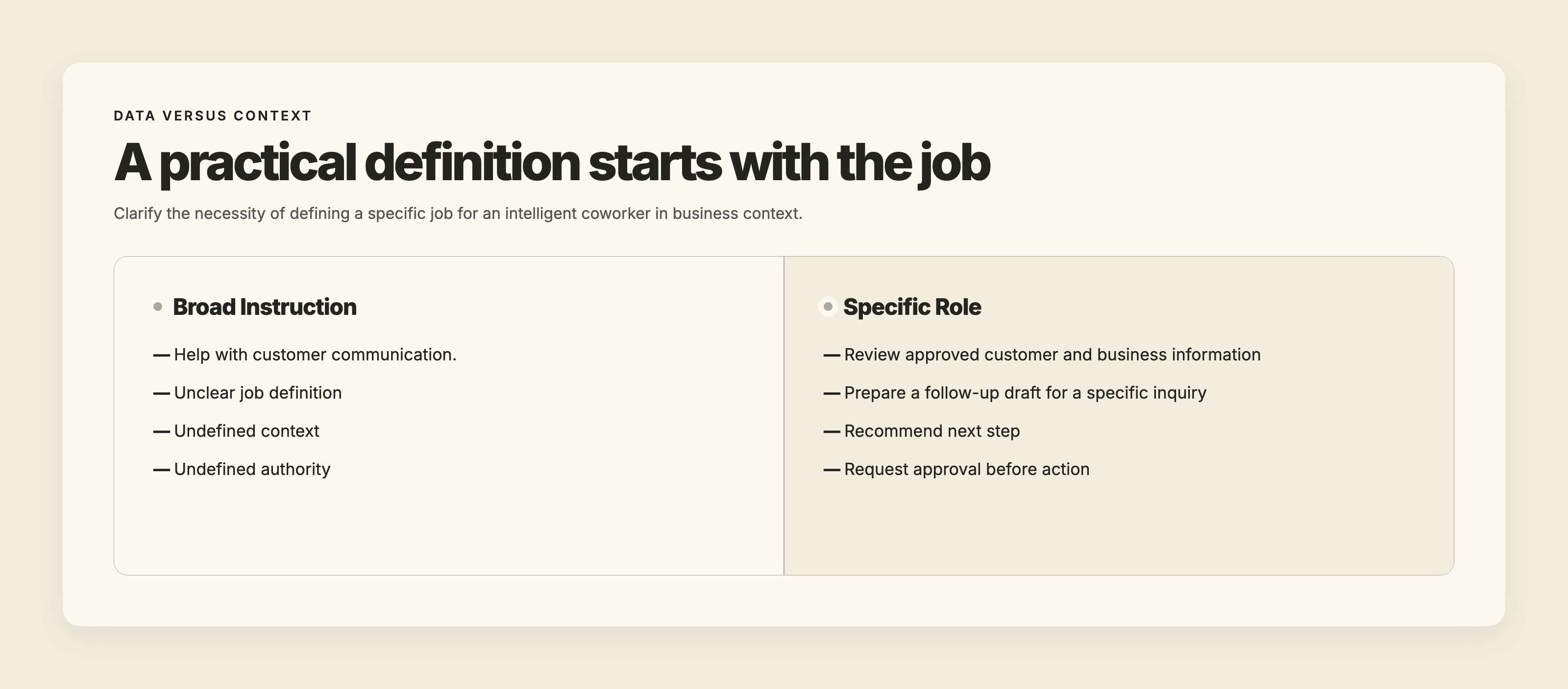
That distinction has consequences. If the job is unclear, the business cannot determine what context is relevant. If the context is undefined, the system may rely on information that is stale, incomplete, contradictory, or not approved for the task. If authority is unspecified, a reasonable recommendation can be mistaken for permission to act.
An intelligent coworker is therefore not defined by how human its language sounds. It is defined by whether its contribution is attached to a controlled business function.
The capabilities have to work together
No single capability creates an intelligent coworker. In practice, conversation intelligence becomes useful when insight moves through the systems and workflows that shape action. The role emerges from several connected ingredients.
First is approved business knowledge. The system needs more than general information about how businesses usually operate. It needs the policies, service details, operating conditions, and other company-specific context that the business has accepted for the job.
Approval matters because scattered information is not automatically business truth. A note in a conversation, an old document, a current policy, and an employee’s recollection may not carry the same authority. Giving software access to more material does not resolve those differences. The business still has to decide what the system may treat as dependable context.
Second is relevant operating memory. Some work requires continuity: what was requested, what has already been prepared, which decision is pending, or which commitment has been verified. Memory supports that continuity, but it must remain connected to the role. Retaining everything simply because it might be useful later does not make the role more intelligent.
Third is reasoning. The system must be able to apply context to the situation in front of it. Supplying relevant business context helps the system weigh goals, constraints, and operating details before deciding how to respond. That may mean identifying missing information, comparing a request with a policy, proposing a next step, or recognizing that the available evidence does not support a confident answer.
Fourth is communication. The work often has to move between software and people. The intelligent coworker may need to prepare a message, explain a recommendation, ask for a decision, or report the status of an action. Clear communication is part of the handoff, not a decorative interface around the reasoning.
Fifth is scheduling and authorized action. A useful role may extend beyond producing text. It may help organize when work should happen or carry out permitted steps. But any action must remain inside the authority assigned to that role.
These ingredients are interdependent. Memory without approved knowledge can preserve the wrong thing. Reasoning without permissions can produce an unsafe leap from recommendation to execution. Action without traceability can leave employees unsure whether anything happened. Communication without status clarity can make a proposal look like a completed task.
The operating value lies in the connection among the capabilities, not in any one capability viewed alone.
Boundaries are part of the definition
Businesses already know that a person’s role includes limits. Access, approvals, responsibilities, and escalation paths are not evidence that an employee is incapable. They are how coordinated work remains accountable.
The same principle applies here.
An intelligent coworker needs an identifiable role rather than anonymous access to whatever systems happen to be available. Its permissions should follow least-privilege logic: enough access to perform the defined job, but not broad authority unrelated to that job.
Approval should also reflect consequence. Requiring approval for every minor step can reduce the role to a cumbersome drafting tool. Allowing every plausible action without approval creates a different problem: the system may cross a meaningful business boundary simply because it can formulate a reasonable next step.
That boundary-setting must also extend to memory governance, because retained business context can shape what the system does next.
The practical question is not, “Should a human approve everything?” It is, “Which consequences require a person to decide?”
That question may have different answers for preparing a draft, recommending a time, changing a customer commitment, or sending an external message. The boundary belongs at the point where the consequence justifies it.
Traceability completes the picture. A business should be able to distinguish among work that was:
- Proposed: the system recommended or prepared something.
- Authorized: the required person or rule permitted the action.
- Attempted: the system initiated the permitted step.
- Completed: the action finished without an indicated failure.
- Verified: the business has evidence that the intended result occurred.
Those statuses are not interchangeable. A prepared follow-up is not an authorized follow-up. Authorization is not proof of sending. A sending attempt is not proof that the intended operational outcome occurred.
When a system blurs these states, people have to reconstruct reality from messages and assumptions. A bounded role preserves the distinctions so the next person knows where the work actually stands.
Reasoning does not create authority
A capable system may interpret a situation correctly. It may identify the most likely next step and explain that recommendation clearly. None of that grants permission.
This is one of the most important lines in the definition of an intelligent coworker: reasoning can support a decision, but it cannot manufacture authority.
Authority comes from the business. It is expressed through permissions, policies, approval rules, and the responsibilities assigned to people. The quality of a recommendation does not override those controls.
Suppose a system concludes that a customer should receive a specific commitment. Its reasoning could be well supported by the context available to it. But if that commitment requires human approval, the next valid step is to request approval—not to treat confidence as authorization.
This separation also protects the usefulness of reasoning. The system can still prepare work, expose missing information, and make a recommendation before reaching the boundary. Employees do not have to choose between “AI does nothing” and “AI acts independently.” They can define a role in which software advances the work while consequential decisions remain with the responsible person.
Human responsibility therefore does not disappear when the system becomes more capable. The handoff may change, but the business still owns its policies, permissions, decisions, and outcomes.
A hypothetical customer follow-up
Consider a hypothetical small business using an intelligent coworker to prepare a customer follow-up. This is an illustrative operating model, not a description of a deployed product.
The defined job is narrow: prepare follow-up material after a qualifying customer conversation and recommend when the follow-up should occur.
The intelligent coworker begins with approved information relevant to that job. It may review the customer’s request, the documented status of the conversation, and the business rules that apply to the follow-up. It should not quietly turn every available note into authoritative context. If required information is missing or conflicting, that limitation belongs in the handoff.
Using the approved context, it prepares a draft. It may also recommend a follow-up time based on the conditions the business has established. At this point, the work is proposed. A polished message and a plausible time do not mean anything has been scheduled or sent.
Assume the business requires approval before an external message of this type can be delivered. The intelligent coworker presents the draft, its scheduling recommendation, and any unresolved issue to the responsible person. That person may approve it, revise it, reject it, or provide missing information.
If approved, the status changes to authorized. Only then may the system attempt the action, and only if that action falls within its assigned permissions.
An attempt should be recorded as an attempt. If the permitted operation completes, the status can reflect completion. Verification remains a separate question: what evidence confirms that the intended result occurred?
The strength of this workflow is not that software replaces the responsible employee. It is that each participant can see the handoff. The system advances a defined job; the person controls the consequential boundary; and the status of the work remains legible.
How to evaluate a proposed intelligent coworker role
When a vendor, internal team, or planning document uses the term, do not start by asking how advanced the AI is. Start by asking whether the proposed role survives basic operating questions.
What is the job?
Name the recurring responsibility in concrete terms. “Help the business” is not a job. The definition should make clear what starts the work, what the system contributes, and where the task ends.
What context is approved for that job?
Identify the company knowledge the system may use and how the business distinguishes current, accepted information from conversation history, outdated material, or unsupported assumptions.
What should it remember?
Specify the continuity the job requires. Relevant memory may include prior status, pending decisions, or information needed for the next handoff. The answer should be role-specific rather than an unlimited instruction to retain everything.
What may it recommend, and what may it do?
Before assigning either role, use an AI readiness checklist to define human review, clear ownership, and explicit limits on action. Separate reasoning from authority. A system might be permitted to prepare a draft but not send it, recommend a schedule but not make a commitment, or initiate an approved action but not change the underlying policy.
Where does approval belong?
Place approval at consequential boundaries. The purpose is not to attach a human click to every software operation. It is to keep meaningful business decisions with the person or rule authorized to make them.
How does it communicate uncertainty and status?
The system should not present missing context as certainty or proposed work as completed work. Employees need to know what it used, what remains unresolved, and what stage the work has reached.
How will the outcome be evaluated?
Fluent output is not the same as a successful business result. Evaluation should connect to the real job and distinguish preparation, authorization, execution, completion, and verification.
If these questions produce vague answers, the proposed role is still vague. Adding more integrations or more conversational language will not repair that operating gap.
What the definition does—and does not—promise
“Intelligent coworker” is a practical way to describe a bounded software role. It combines approved business context, relevant memory, reasoning, communication, scheduling support, and authorized action under continuing human responsibility.
It is not a promise of general autonomy. It does not mean software possesses unrestricted company knowledge, authority equal to an employee, or permission to turn every recommendation into action. It also does not establish that any particular capability is deployed, production-ready, customer-facing, or commercially available. Architecture, source code, plans, and roadmaps can indicate different levels of intention or technical foundation; they should not be treated as proof of current operation.
That qualification sharpens the definition rather than weakening it. Operators need to evaluate what a system can actually do, what it is allowed to do, and what evidence marks the difference.
Before accepting the label, run one concrete test: choose a consequential step in the proposed job and ask who has authority at that moment, what status will be recorded, and how the outcome will be verified. If the answer is clear, you may have a bounded software collaborator. A 14-day free trial can help you evaluate how these ideas fit your workflow. If the answer depends on the system simply “knowing what to do,” the role is not yet defined.