The Point Where Communication Stops Being Manageable
Most team communication problems don’t show up when a business is small. In the beginning, communication inside a business feels simple. Messages come in, someone sees them, and someone replies. There’s no formal structure, but nothing feels broken. A missed message is rare, and if something slips, it’s easy to recover. Visibility is high because everything runs through a small number of people.
That simplicity creates a false sense of stability. It works not because it is well-designed, but because the volume is low enough to hide structural gaps. One or two people can hold everything in their head—who they spoke to, what was promised, what still needs a follow-up. There is no system, but there also doesn’t appear to be a problem.
Then the team grows. And with that growth comes a quiet shift that most businesses don’t recognize right away. It doesn’t feel like a breaking point. It feels like progress, and that’s what makes it easy to miss.
More people start answering messages. More channels get introduced. A second phone, a shared inbox, someone answering texts while someone else handles calls. The volume increases, but more importantly, the coordination complexity increases. What used to be visible to one person now depends on alignment across several.
This is where communication stops being manageable—not because of how much is coming in, but because awareness and ownership begin to drift apart. The business is still active, but it is no longer synchronized.
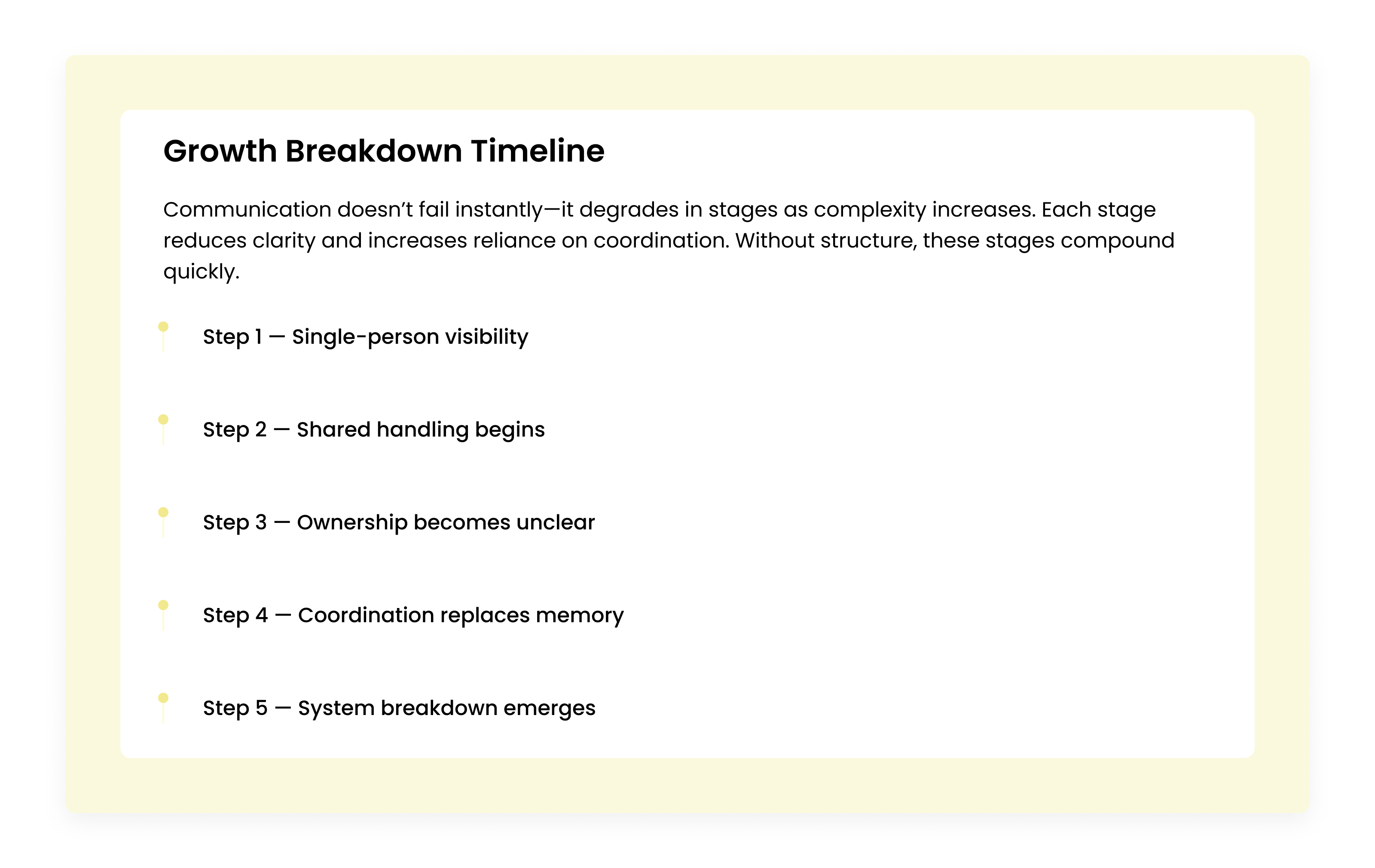
A small home services company might go from handling 8–10 messages a day to 40–50 within a few months. Nothing changes structurally, but the margin for error disappears. What used to be recoverable with memory becomes dependent on coordination, and missed responses start showing up not as obvious failures, but as jobs that simply never get booked.
Fragmentation rarely looks like failure. This is the same pattern outlined in Why Businesses Lose Track of Customer Conversations, where activity continues but structure quietly breaks underneath it.It looks like movement without coordination.
At this stage, nothing appears broken on the surface. It reflects the same dynamic described in Why Visibility in Customer Communication Matters, where visibility alone creates the illusion of control without real structure.Messages are still being answered. Customers are still being served. But underneath that activity, structure is weakening. No one has full visibility anymore. Conversations are being handled in pieces. And slowly, the business loses control over what it actually knows.
When More People Create Less Clarity
It seems logical that adding more people should improve responsiveness. More staff should mean faster replies, better coverage, fewer missed opportunities. That assumption is what drives most early scaling decisions.
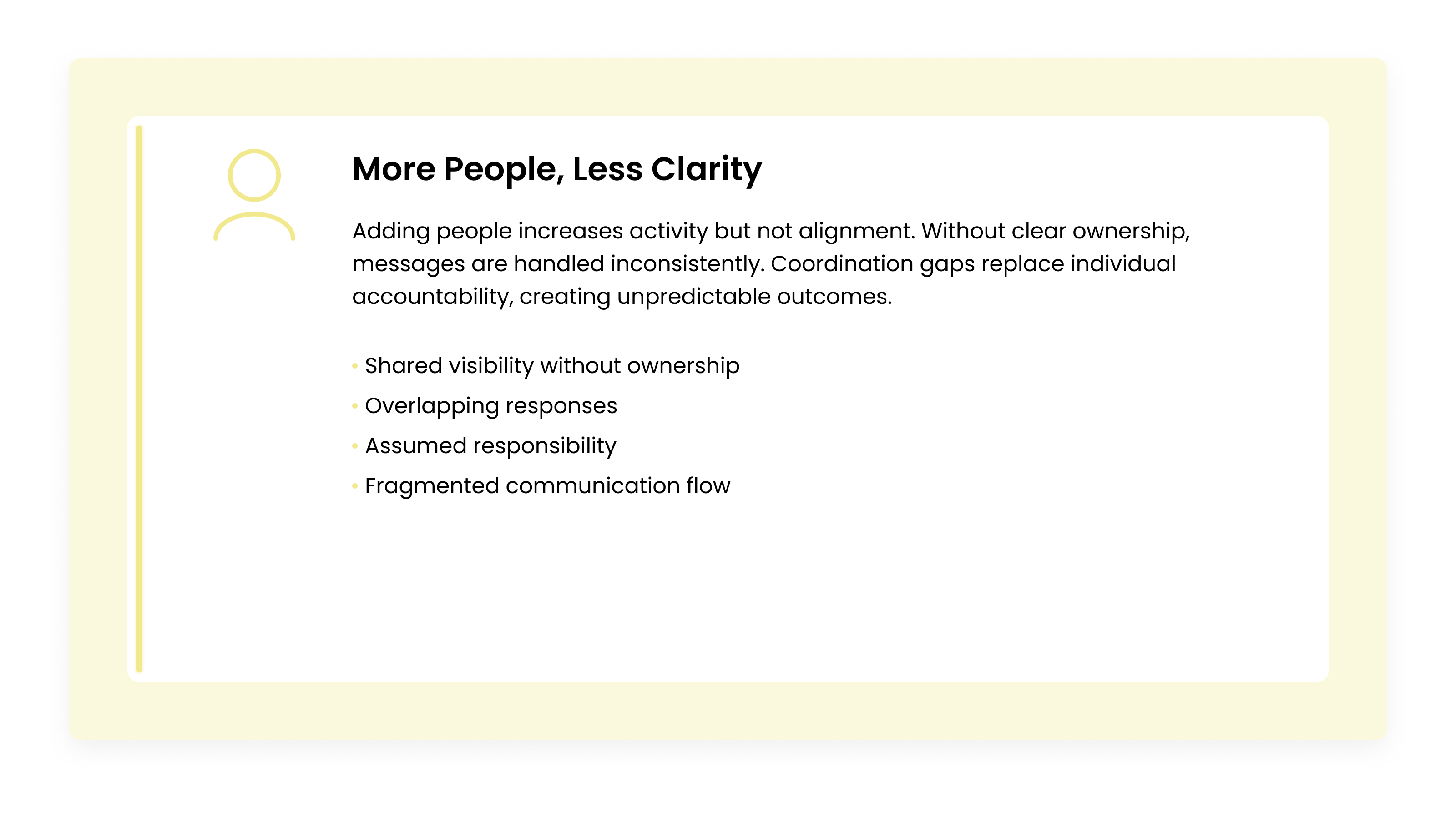
In reality, it often introduces inconsistency instead of speed. The problem is not the number of people—it’s the lack of coordination between them.
When multiple people can see the same message but no one is clearly responsible for it, response becomes unpredictable. One person assumes someone else will handle it. Another replies without full context. A third follows up later, unaware the conversation has already moved forward.
The issue isn’t effort. It’s alignment. This is exactly the gap explored in How Teams Actually Handle Customer Conversations, where effort exists but coordination determines outcomes.Everyone is working, but not necessarily working together.
Consider a small service business that has grown from one person handling communication to a team of five. Messages come in through text, calls, and email. Each team member touches at least one channel, but there is no shared structure tying them together.
At 9:15 AM, a customer sends a message asking about availability. One team member sees it but gets pulled into a call. At 9:30 AM, another replies with partial information. At 10:05 AM, the first team member returns and sends a different answer based on memory.
By 10:30 AM, the customer has two responses that don’t fully align. Nothing catastrophic happened. But something important was lost—confidence.
Later that day, the internal conversation sounds familiar: “Did you respond to that?” “I thought you did.” No one is ignoring the customer. The problem is that responsibility was never clear in the first place.
In some teams, this shows up within weeks. A medical office adding a second receptionist might double inbound calls, but without clear ownership, callbacks slip. Missing just 4–5 callbacks per day can quietly translate into 20–25 missed appointments per week, most of which never get traced back to communication.
Internally, this changes how the team operates. People start checking more often, not because they’re organized, but because they’re unsure. They ask each other what was handled. They revisit conversations. They rely on memory instead of structure.
Activity goes up. Clarity goes down. Over time, that gap becomes structural, not temporary.
How Customer Conversations Start Falling Through the Cracks
The breakdown doesn’t happen all at once. It builds quietly, in stages that are easy to miss if you’re focused on day-to-day activity.
At first, it shows up as small delays. A message sits unanswered longer than expected. Someone eventually replies, but the timing feels off. The customer stays engaged, but the experience is slightly less smooth.
Then it turns into overlap. Multiple responses. Slightly different answers. Repeated questions. The customer starts to feel like they’re talking to separate people instead of one business.
Eventually, it becomes absence. And this is where the real loss begins.
A message is seen but not answered. Or it’s never seen by the person who should have handled it. The conversation stalls—not because the business chose not to respond, but because no one realized they owned the next step.
This is where things begin to fall through the cracks.
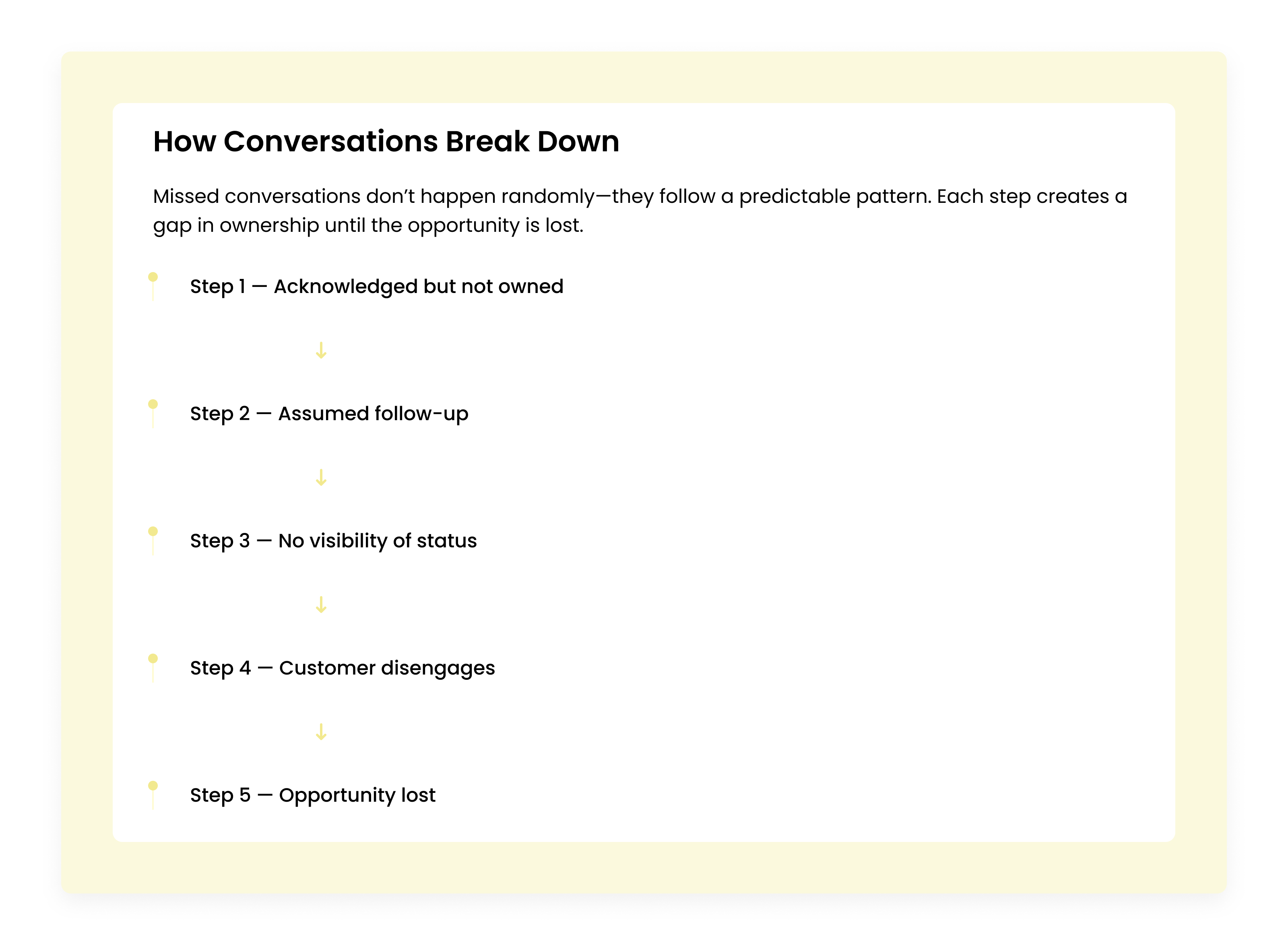
Morning: A customer asks for a quote. A receptionist acknowledges it and says someone will follow up.
Midday: The technician who should handle it is in the field and never sees the message. The receptionist assumes it’s being handled.
Afternoon: The owner checks messages, sees the thread, and assumes it has progressed.
Next day: The customer hasn’t received anything. They follow up once, then go silent.
Three days later, someone scrolling through messages notices the thread again. It’s already cold. The customer has likely moved on, and there’s no clean way to recover the conversation.
A few days later, the business realizes the opportunity was lost—not because of pricing or competition, but because the conversation lost continuity.
In a small legal practice, this might mean a potential client who reached out after hours never receives a timely follow-up the next morning. By midday, they’ve already contacted another firm. By the time the message is revisited internally, the decision has already been made elsewhere.
This doesn’t feel dramatic when it happens. That’s why it repeats. It blends into normal operations until it becomes a pattern.
The Hidden Cost of Missed and Duplicated Responses
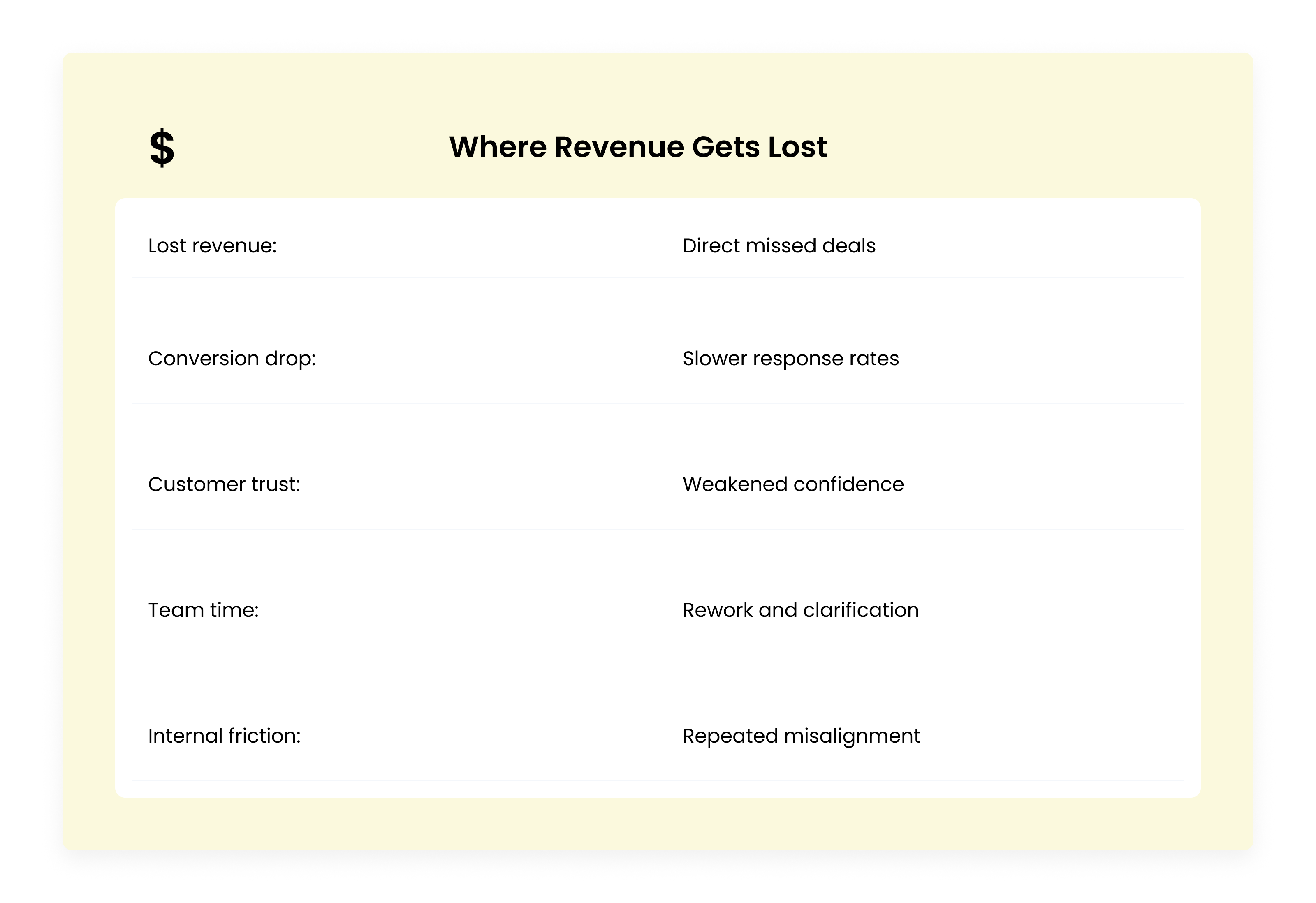
The cost of communication breakdown is rarely tracked directly. It doesn’t appear in a report, but it shows up in outcomes and missed growth.
Take a business receiving 30 inbound leads per day. If just 10% of those leads experience delays or missed responses, that’s 3 lost opportunities daily.
If the average deal value is $200, that’s $600 per day—roughly $18,000 per month. That’s not a theoretical number. It’s the accumulation of small missed moments.
In a different model, the numbers shift but the pattern stays the same. A lower-ticket business closing $75 jobs at higher volume might lose 5–6 opportunities per day instead of 3. The dollar amount changes, but the leakage remains consistent relative to volume.
Even small timing shifts matter. If response time moves from 5 minutes to 45 minutes during busy periods, conversion might drop from roughly 50% to closer to 30–35%. That difference doesn’t show up as a system failure—it shows up as fewer jobs booked at the end of the week.
And that’s only the visible layer. There are quieter costs that are harder to measure but just as real.
There’s the cost of confusion. When multiple team members respond with slightly different information, trust starts to weaken. The customer may still move forward, but with hesitation—or they may begin comparing alternatives more seriously.
There’s the cost of time. Team members revisiting conversations, clarifying what was said, fixing misalignment. Time spent not advancing work, but correcting it.
There’s the cost of internal friction. Small moments—“I thought you handled that,” “Did anyone follow up?”—that compound over time and slow the team down.
None of this looks like failure in isolation. It looks like minor inefficiencies. At scale, those inefficiencies become structural leakage.
Why Visibility Without Ownership Fails
A communication system is not just about seeing messages. It’s about defining what happens next and who is responsible for it.
Without that, visibility creates false confidence. Teams assume that because something is visible, it is being handled, even when there is no follow-through.
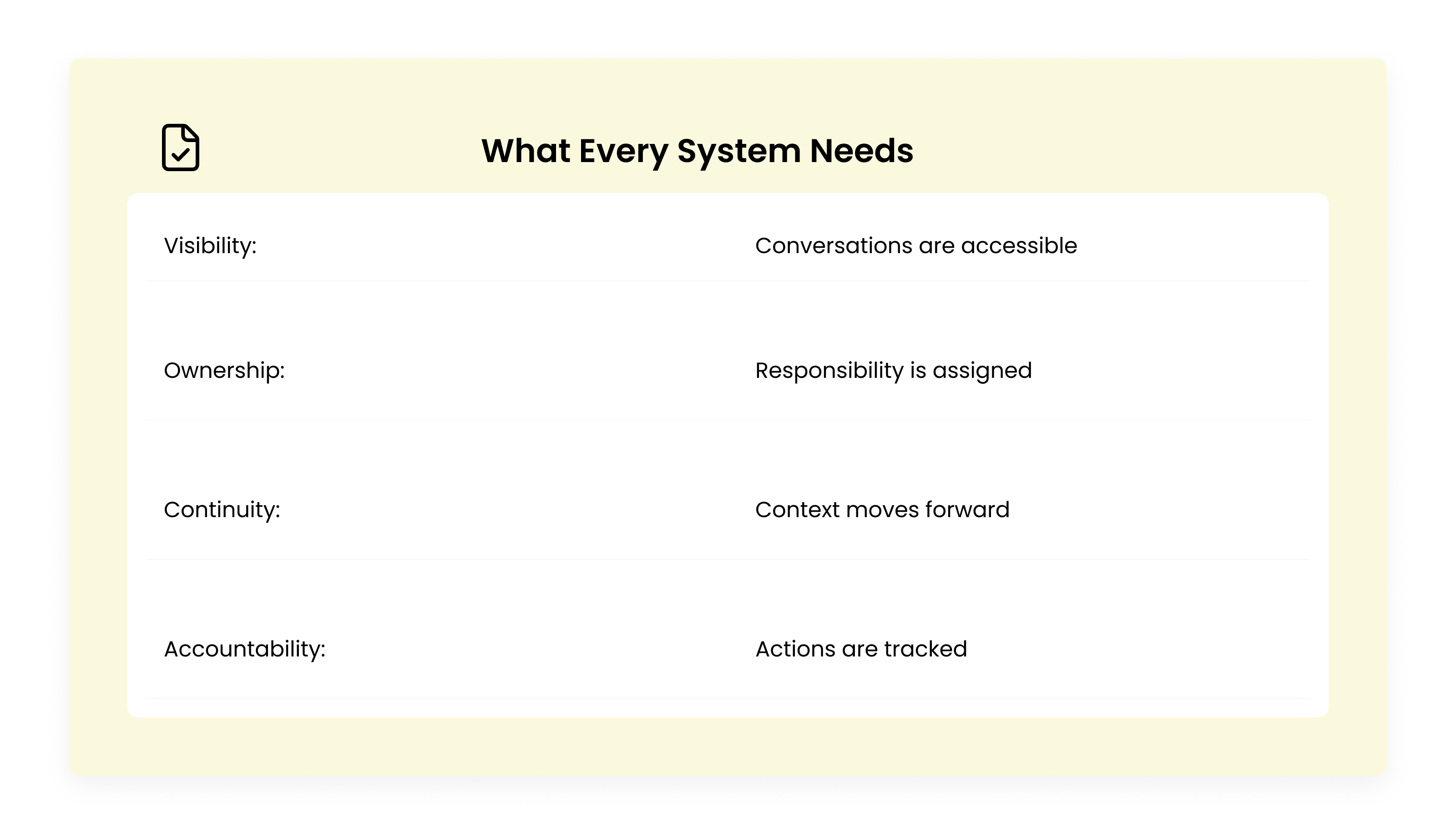
A practical way to understand this is through four layers that must exist together:
Visibility — Conversations are accessible across the team. Without it, messages are scattered and unmanaged, often living inside personal devices or isolated tools. A message may exist, but if it’s not seen by the right person at the right time, it may as well not exist.
Ownership — Every conversation has a clear responsible party. Without it, messages exist but progress stalls because responsibility is assumed, not assigned. This is where “I thought you handled it” becomes a recurring pattern.
Continuity — Conversations carry context forward. Without it, customers repeat themselves and responses feel disconnected, even if the team is trying to help. Each reply resets the conversation instead of advancing it.
Accountability — There is a way to track what was completed, missed, or delayed. Without it, problems repeat quietly because nothing is measured. A system without accountability simply makes disorganization visible.
Behind the scenes, this often looks like a shared inbox where dozens of messages are marked as “read,” but no one is actively responsible for them. Some are partially answered, some are waiting on follow-up, and some are simply overlooked because they no longer feel urgent in the moment.
In many teams, visibility exists in some form—a shared inbox, a message log, a dashboard—but accountability does not. Messages can be seen, but there is no clear signal of what still needs attention.
Most growing teams operate with partial visibility but lack the rest. They can see messages, but they don’t know who owns them.
They can respond, but they can’t ensure continuity. They stay busy, but they can’t track what was missed.
Activity is easy to see. Ownership is where things usually disappear.
What Customers Expect vs. How Teams Actually Respond
From the customer’s perspective, the business is one entity. They do not see departments, roles, or internal processes.
They expect consistency. They expect memory. They expect follow-through.
They expect responses to connect to previous messages. They expect the business to remember what was said. They expect that when someone says “we’ll follow up,” it actually happens.
When those expectations aren’t met, the reaction is rarely dramatic. It’s quiet and gradual.
A delayed response introduces doubt. Conflicting answers create hesitation. A missed follow-up signals lack of priority.
At that point, the customer doesn’t complain. They compare. They open another tab, check another provider, and send the same message elsewhere.
If that second business responds faster or more clearly, the decision is made there. The first business is left with a silent drop-off and no clear reason why.

For many customers, the decision isn’t made on price—it’s made on responsiveness. Reliability is often inferred from speed, not promises.
Then they move on—not out of frustration, but uncertainty. That distinction matters because it means the business often never knows why the opportunity was lost.
Many businesses assume lost leads come down to pricing or competition. In many cases, they’re lost in silence before those factors even come into play.
Where Communication Systems Start to Matter
A communication system becomes necessary when coordination can no longer be managed informally. That threshold comes earlier than most businesses expect.
This isn’t about adding tools. It’s about introducing structure where memory and assumptions used to carry the load.
At a certain point, every conversation needs an owner. Every message needs shared visibility. Every follow-up needs to be trackable.
Without that, growth introduces risk. With it, growth becomes manageable and predictable.
Before structure, teams operate reactively. Messages are answered based on who sees them. Follow-ups depend on memory. Outcomes depend on luck more than consistency.
After structure, something shifts. Conversations are still happening at the same volume, but they are no longer dependent on individuals remembering. The system holds context. The team works from the same view. Missed follow-ups become visible instead of invisible.
Inside the business, this often means fewer “check everything just in case” moments. Instead of scanning multiple inboxes or asking around, team members can see what is pending, what is assigned, and what is complete in a single place. This shift is central to What Unified Communications Means for Small Businesses, where communication moves from scattered tools into a coordinated system.
This is the shift from channel-based communication to system-based coordination, where conversations are not just handled—they are managed.
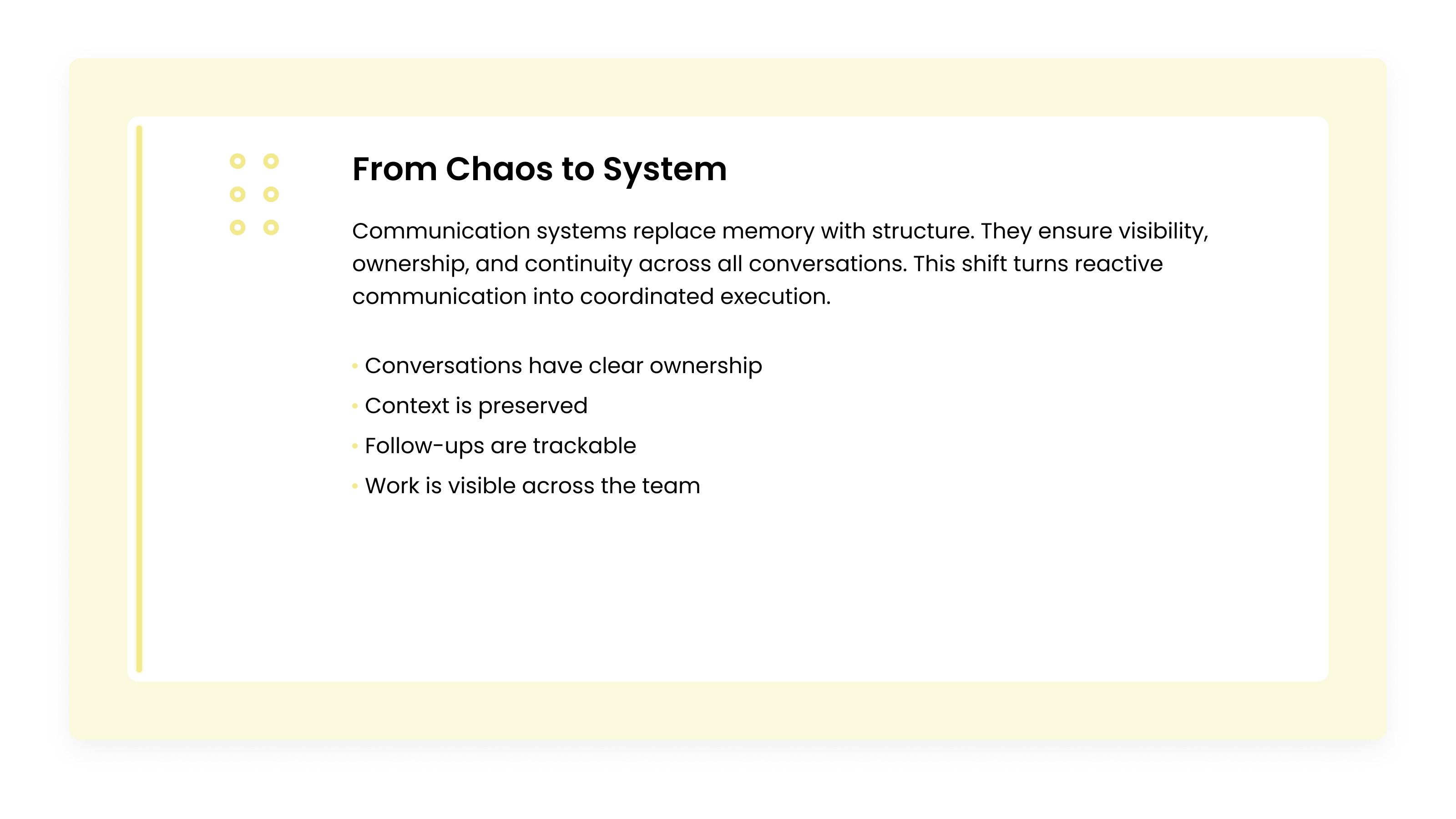
The goal is not to increase activity. It is to align activity with awareness so the business always knows what is happening and what still needs to happen.
Key Takeaways
- Growth exposes communication gaps that were previously hidden by low volume.
- Visibility without ownership creates activity, not progress.
- Missed responses rarely look like failures—they show up as silent lost revenue.
- Customers decide based on responsiveness long before pricing becomes relevant.
- Structure doesn’t change the work—it makes the work visible, trackable, and complete.
Teams that want to move from reactive communication to structured coordination can start with a 14-day free trial and see how visibility, ownership, and continuity come together in practice.
Where TMMN Fits Into Structured Team Communication
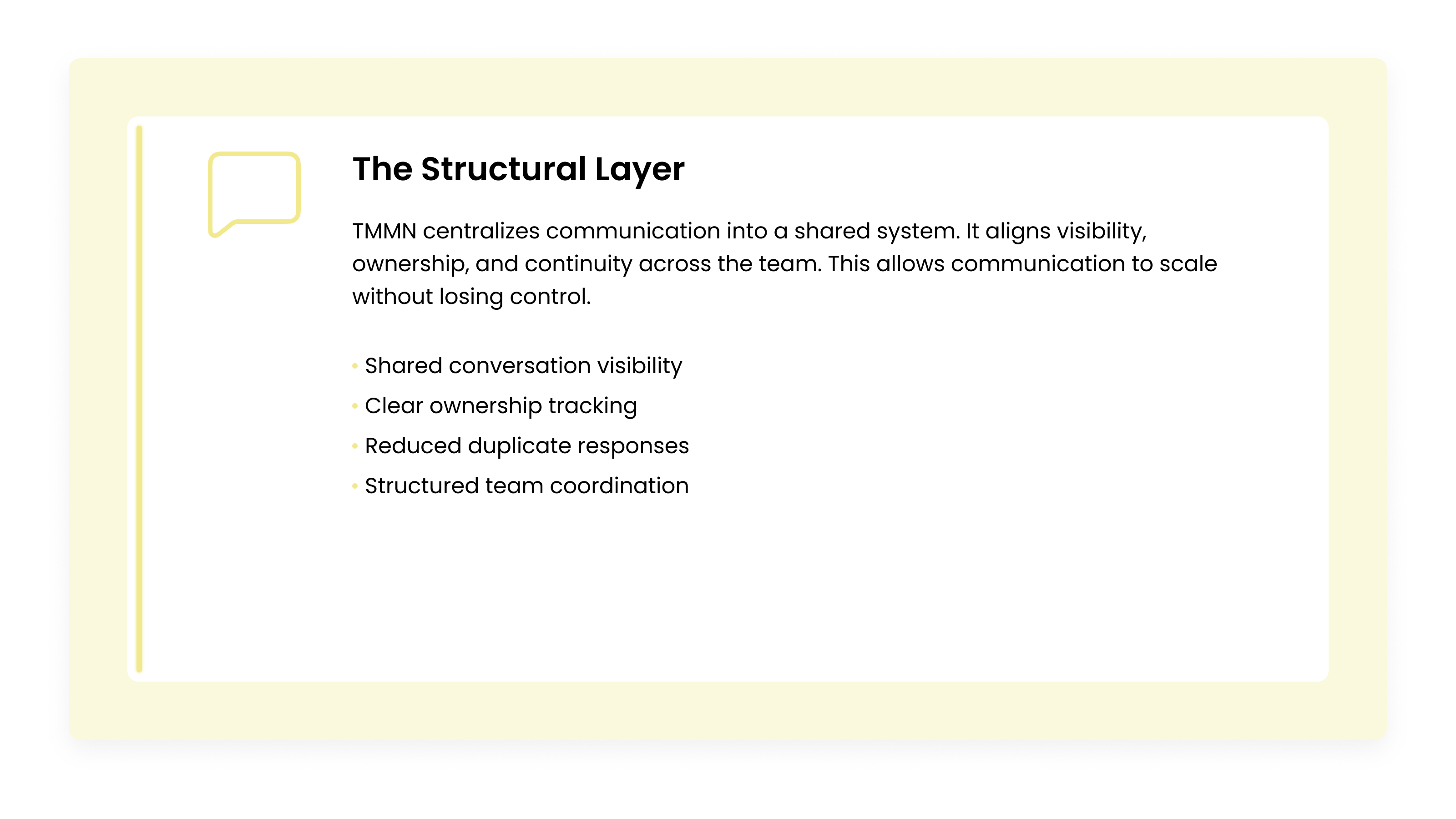
TMMN fits into this shift as a structural layer, not just another channel added to the mix.
It brings conversations into a shared environment, making visibility consistent across the team instead of scattered across devices and tools.
More importantly, it supports ownership and continuity—ensuring conversations don’t live inside individual memory or get lost during handoffs.
The effect is subtle but noticeable. Duplicate replies decrease. Handoffs become clearer. Conversations move forward instead of restarting.
Its role is not to replace communication, but to organize it in a way that scales with the team.
As businesses continue to grow, the next step is not just managing communication, but unifying it across channels and workflows so the team operates as one system instead of disconnected parts.
Growth doesn’t break communication because of volume. It breaks when there is no system behind it.

.svg)