


The Moment Communication Stops Being Individual
At the beginning, customer communication feels simple. One person answers the phone, replies to texts, follows up on emails, and keeps track of what’s happening. Everything lives in one head. Even if it’s messy, it works—because continuity is naturally maintained.
That changes quietly.
The moment a second person gets involved, communication stops being an individual activity and becomes a shared responsibility. A receptionist takes the first inquiry. A sales rep follows up. An owner steps in later. Maybe a technician closes the loop. Each interaction still happens—but the continuity between them begins to weaken.
It doesn’t break all at once. It slips.
A customer reaches out in the morning, gets a quick response, and is told someone will follow up. By late afternoon, no one has. The next day, a reply finally comes—but the context has cooled. Nothing “failed,” but the timing is off just enough to reduce urgency.
Messages are still being sent. Calls are still being answered. The team feels busy. From the inside, it looks like things are working. But what’s actually happening is that conversations are being split across people, time, and tools. Each person is handling their part, but no one is responsible for the full experience.
It doesn’t feel broken internally. It feels like a normal day—messages coming in, replies going out, phones ringing. Somewhere in that flow, one lead stops responding. No one notices right away, because everything else is still moving.
What looks like productivity on the surface is often disconnected effort underneath. That’s the same operational problem explored in How Small Businesses Manage Customer Conversations Without Dropping Leads, where the issue is not a lack of replies but the loss of continuity between them.
At this stage, most teams try to fix the symptoms. They push for faster responses. They remind staff to stay on top of leads. They add another tool or inbox. But the real shift has already happened. Communication is no longer about replying—it’s about structuring how conversations move across a team without losing continuity.

That’s the difference between handling messages and building a team communication system.
Why Customers Expect Continuity Even When Teams Are Involved
From the customer’s perspective, there is no team.
There is just one business.
A customer doesn’t think in roles or departments. They assume the business knows what already happened. They expect the conversation to pick up exactly where it left off, regardless of who responds next.
That expectation isn’t stated. It’s assumed.
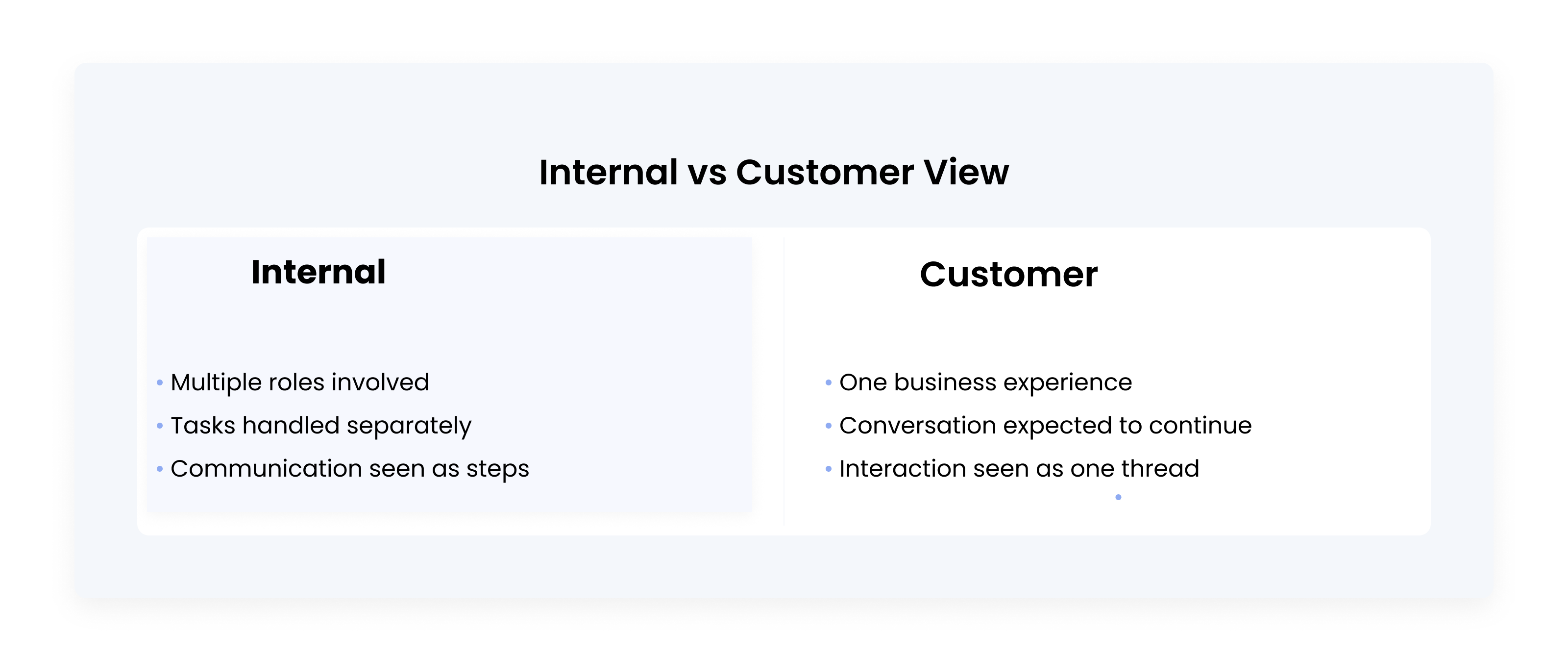
A customer might send a message in the morning asking about pricing. Someone responds with basic information. Later that day, they follow up with a specific question. A different team member replies—but asks something that was already answered earlier or ignores part of the context.
That moment is small, but it carries weight.
It signals that the conversation isn’t connected. That the business isn’t tracking the interaction as a whole. And even if the response is technically correct, something feels off.
Customers rarely call this out directly. They adjust instead.
They slow down. They respond later. They become less engaged. In some cases, they quietly open another tab, reach out to a competitor, and move forward with the one that feels easier to deal with.
The difference is rarely dramatic. It’s subtle alignment.
Customers are evaluating the experience of interacting with the business, not just the answers they receive. When that experience feels inconsistent or repetitive, friction builds.
Delays create doubt. Silence feels intentional. Repetition feels careless.
Most customers won’t tell you they’re losing confidence. They’ll just stop replying.
Many businesses assume communication is complete once a message is sent. But customers evaluate the entire sequence of interactions across time. That expectation is exactly what sits underneath What Customers Expect When Contacting a Business — Modern Communication Standards, because customers are judging whether the business feels coherent from one touchpoint to the next.
Continuity is what they’re actually buying into. That’s why companies that structure around the full customer journey—not isolated touchpoints—tend to create stronger, more consistent experiences across every interaction.
Where Team Communication Breaks Down (And Why It’s Not Obvious)
Breakdowns don’t happen in one obvious place. They happen in the space between actions.
A customer reaches out at 9:15 AM asking about a service. The receptionist replies quickly, collects details, and says someone will follow up. That part works.
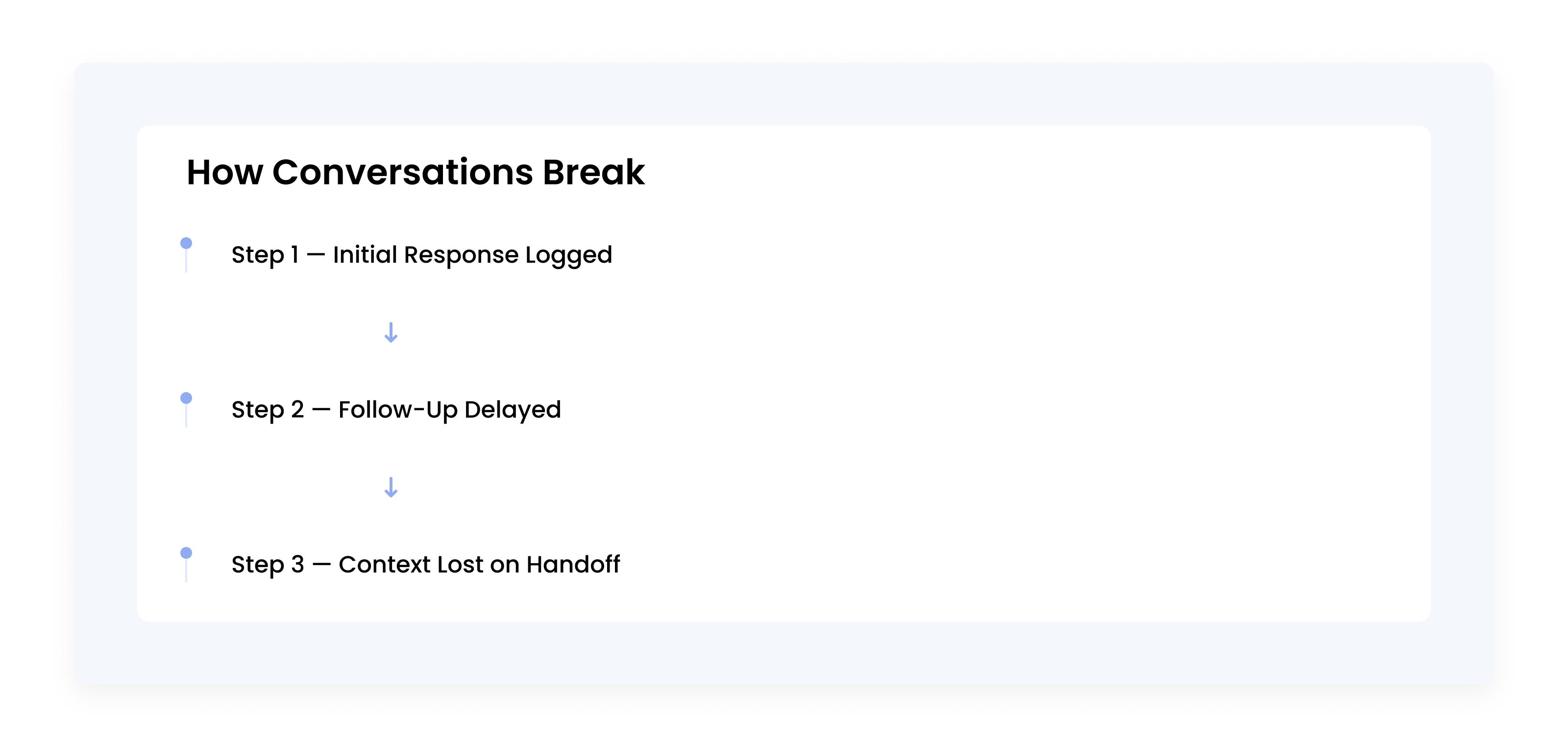
At 11:30 AM, the sales rep sees the message but is in the middle of something else. They plan to respond later. No one formally owns the conversation at that moment—it’s just sitting there.
At 2:45 PM, the sales rep finally replies. The customer responds within minutes with a follow-up question. But now the sales rep is unavailable. The message sits again.
The next morning, the owner jumps in to help. But without full context, they ask a question the customer already answered.
The customer replies—but slower this time.
Nothing looks broken. But momentum is gone.
Internally, the team feels like they’re doing their part. From a system perspective, the conversation has no clear ownership, no continuity, and no structured progression.
Then comes the moment every team has experienced:
“I thought you handled that.”
After that, things stall. Someone checks the thread, assumes it’s being handled, and moves on. Hours pass. The customer waits. The conversation sits in a gray zone where no one is actively responsible.
That’s where things actually break.
It’s not about effort. It’s not about responsiveness. It’s about the gap between activity and awareness. Messages are moving, but ownership isn’t.
When communication isn’t explicitly owned and tracked, it defaults to assumption.
And assumption is where conversations disappear.
The Hidden Cost of Unstructured Communication Across a Team
The impact becomes clearer when you look at real numbers.
Imagine a small business receiving 50 inbound leads per week. Around 60% of those require more than one interaction—follow-ups, clarification, scheduling.
That’s 30 leads per week needing multi-step communication.
Now assume that 25% of those experience friction due to delays, missed handoffs, or inconsistent responses.
That’s roughly 7 to 8 leads affected each week.
If the average deal is $300 and even half of those leads fail to convert because of that friction:
4 lost deals × $300 = $1,200 per week
Over a month, that’s about $4,800 in lost revenue.
Over a year, that’s roughly $57,600—not from lack of demand, but from breakdown in continuity.
And that’s conservative.

What makes this difficult is that there’s no clear failure point. The system doesn’t crash. Messages don’t stop.
Everything looks active.
But the sequence is inconsistent.
Some leads move forward. Some stall. Some disappear.
Activity is visible. Loss is quiet.
Without structure, revenue doesn’t drop all at once. It leaks—one missed follow-up, one delayed response, one disconnected interaction at a time.
A Simple Way to Think About Communication as a System
To move out of this pattern, communication has to be treated as a system—not a series of responses.
A practical way to think about this is through three components:
Continuity
Ownership
Visibility
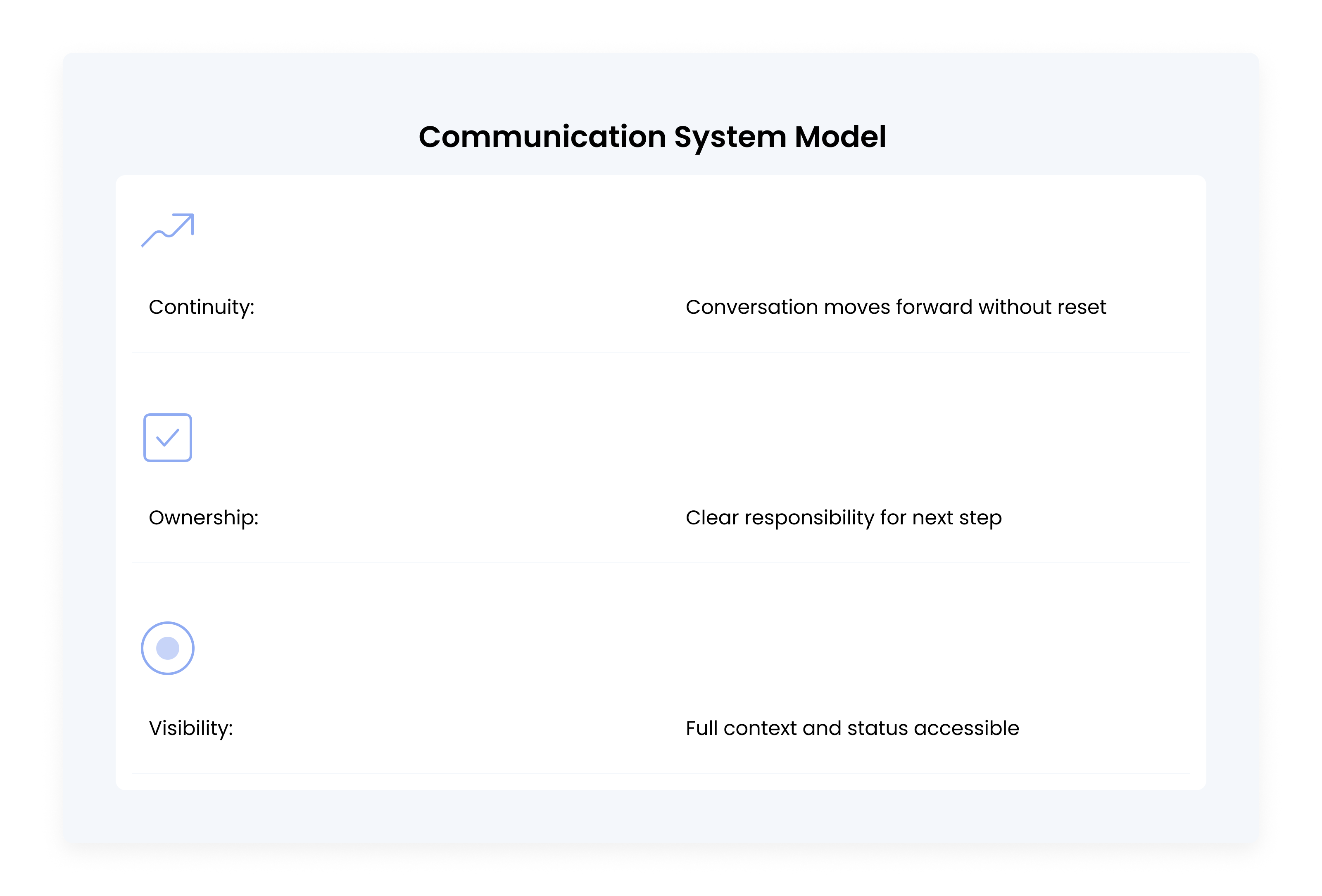
Continuity means the conversation carries forward without friction. Each interaction builds on the last. When continuity breaks, customers repeat themselves or feel like they’re starting over. When it works, the conversation feels remembered, even across different people.
Ownership means someone is responsible for the next step—not just the last reply. When ownership is unclear, conversations stall or overlap. When it’s clear, the interaction moves forward without hesitation.
Visibility means the full state of the conversation is clear to the team. Not just history, but status. Where it stands. What’s next. Without visibility, people react without context. With it, they step in with awareness.
Visibility is what turns activity into coordination. That’s why Why Visibility in Customer Communication Matters for Small Businesses belongs here: once teams can actually see status, ownership, and next steps, communication stops depending on memory alone.
Each piece matters on its own. But the real value comes from alignment.
Without continuity, customers feel the gaps.
Without ownership, conversations lose momentum.
Without visibility, teams operate in fragments.
Most setups cover one or two of these. Very few align all three.
What a Structured Team Communication System Actually Looks Like
A structured system isn’t complicated. It’s clear.
Conversations are treated as shared threads that move forward—not isolated messages that get answered.
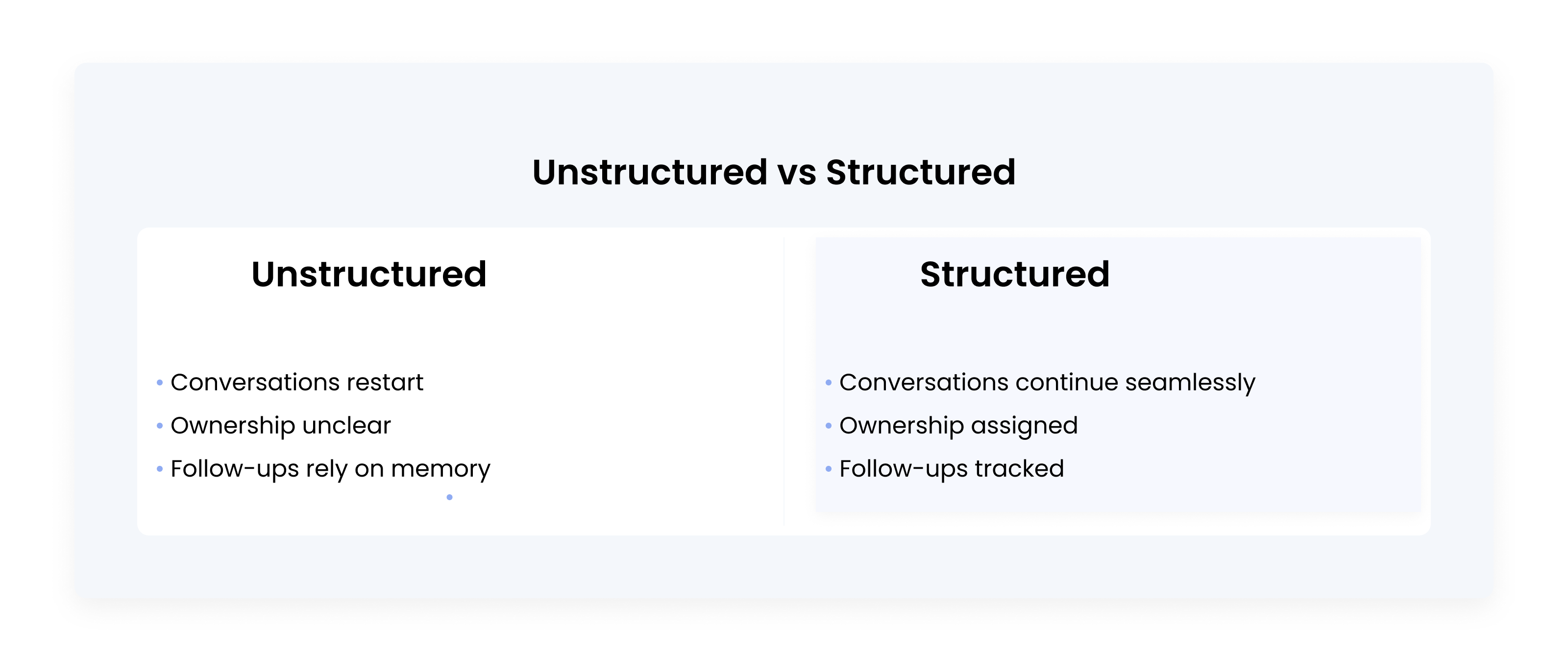
When a new inquiry comes in, it’s not just replied to—it’s assigned. Someone owns it until it reaches a defined outcome.
When a handoff happens, context moves with it. The next person continues the conversation instead of restarting it.
When follow-up is needed, it’s tracked—not remembered.
Without structure, the same scenario repeats with small delays and missed context. With structure, the same conversation moves smoothly across roles without the customer noticing the handoff.
This reduces dependence on memory and makes communication consistent across the team.
You also start to see patterns. Where delays happen. Where conversations stall. Where handoffs break.
That visibility allows the system to improve over time.
From the customer’s perspective, the experience feels steady. Not perfect—but reliable.
Why Tools Alone Don’t Fix Communication Problems
Most businesses respond to communication issues by adding tools.
A shared inbox. A CRM. Messaging apps. Phone systems.
Each one solves part of the problem. But when they’re disconnected, they reinforce fragmentation.
For example, a customer texts in one system, calls in another, and emails later. Each interaction is stored somewhere different. The team sees pieces—but not the full thread.
The result is more complexity, not less. That tradeoff sits at the center of The Hidden Cost of Too Many Communication Tools in Growing Businesses, because every added system creates another place where context can split.
Teams end up managing tools instead of managing conversations.
That’s why businesses can have all the right tools and still struggle. The issue isn’t the tools—it’s the lack of structure connecting them.
The goal isn’t more tools.
It’s alignment.
Where TMMN Fits Into Structured Communication
At a structural level, TMMN’s role is not to replace communication—it’s to organize it at the system level, not just the message level.
When conversations live in one place, teams don’t have to reconstruct context or guess what happened before. A receptionist can start a conversation, a rep can continue it, and an owner can step in without resetting the thread.
That reduction in friction shows up immediately inside the team, not just in the customer experience.
This aligns with a broader shift toward unified communication—where messaging, calling, and follow-ups exist within the same operational layer. That broader shift is exactly what What Unified Communications Means for Small Businesses in 2026 (And Why It Matters) is really about: reducing fragmentation by keeping more of the customer journey inside one connected operating layer.
The direction isn’t about adding more features. It’s about reducing fragmentation.
Key Takeaways
- Continuity breaks quietly, but customers feel it immediately
- Ownership is where conversations either move forward or stall
- Visibility determines whether teams coordinate or collide
- Most revenue loss in communication is gradual, not obvious
- Structure—not speed—is what holds conversations together
The Real Shift
- Customer communication doesn’t break because teams aren’t responding.
- It breaks because continuity isn’t maintained across people and time.
- Once communication becomes shared, structure becomes necessary. Without it, even active teams create fragmented experiences that lead to quiet drop-off and missed opportunities.
- A team communication system isn’t about sending more messages.
- It’s about making sure every conversation moves forward without losing its thread.
It’s about making sure every conversation moves forward without losing its thread—and if you want to see what that looks like in practice, start with a 14-day free trial.

.svg)
_thumbnail.png)
