

Understanding the Lead Capture Challenge in Everyday Operations
For many small and mid-sized businesses, capturing every prospective customer inquiry often feels more like an art than a science. Business owners and small teams frequently rely on a patchwork of habits — making mental notes during calls, jotting things down on sticky notes, or assuming a text message got passed on to someone who will follow up. These informal tactics can seem sufficient when contact volume is low, but as inquiries multiply and come through different channels, keeping track of every lead becomes increasingly tricky.
Consider a typical morning at a small subscription-based fitness studio. The receptionist answers a phone call from a potential new member asking about membership options and class schedules. While the receptionist briefly notes the caller’s name, the request doesn’t get entered into any shared system. Later that day, someone else texts the studio, asking about trial classes. The receptionist responds quickly but treats that conversation separately, without linking it or passing the lead to management for follow-up. By afternoon, a third inquiry arrives through social media direct messages, which gets replied to but isn’t assigned to anyone to convert.
That evening, the manager realizes several inquiries were handled informally without any plan for consistent follow-up. A week later, only one lead returns to sign up while the others quietly disappear. In an internal chat, the receptionist assumes the manager followed up with all leads, and the manager believes the receptionist shared them. Neither actually owns the next step, leaving prospects unattended.
This scenario is common and highlights a fundamental challenge many small teams face: it’s not about laziness or neglect, but the absence of deliberate, transparent processes that capture and track leads from the moment interest is shown. Relying on memory, scattered notes, or juggling multiple communication channels sets the stage for leads to slip through unnoticed. Each missed lead might seem minor in isolation, but over time they add up to significant lost opportunities — often unseen until it’s too late.
Another wrinkle is that customers now naturally use multiple touchpoints. Businesses that recognize this shift typically build systems around Why Modern Customer Communication Isn’t One Channel Anymore (2026 Guide), treating every interaction as part of one continuous customer conversation rather than isolated exchanges. A prospect may call, then text, then submit a web form or send a social message, starting separate threads disconnected from earlier contacts. Without a unified system, teams lose the conversation’s continuity, making timely, personalized follow-up difficult or inconsistent. This doesn’t just hurt conversion rates — it quietly shapes customer impressions, where unanswered or delayed responses foster hesitation or disengagement.
How Customers Reach Out and Why Leads Get Missed
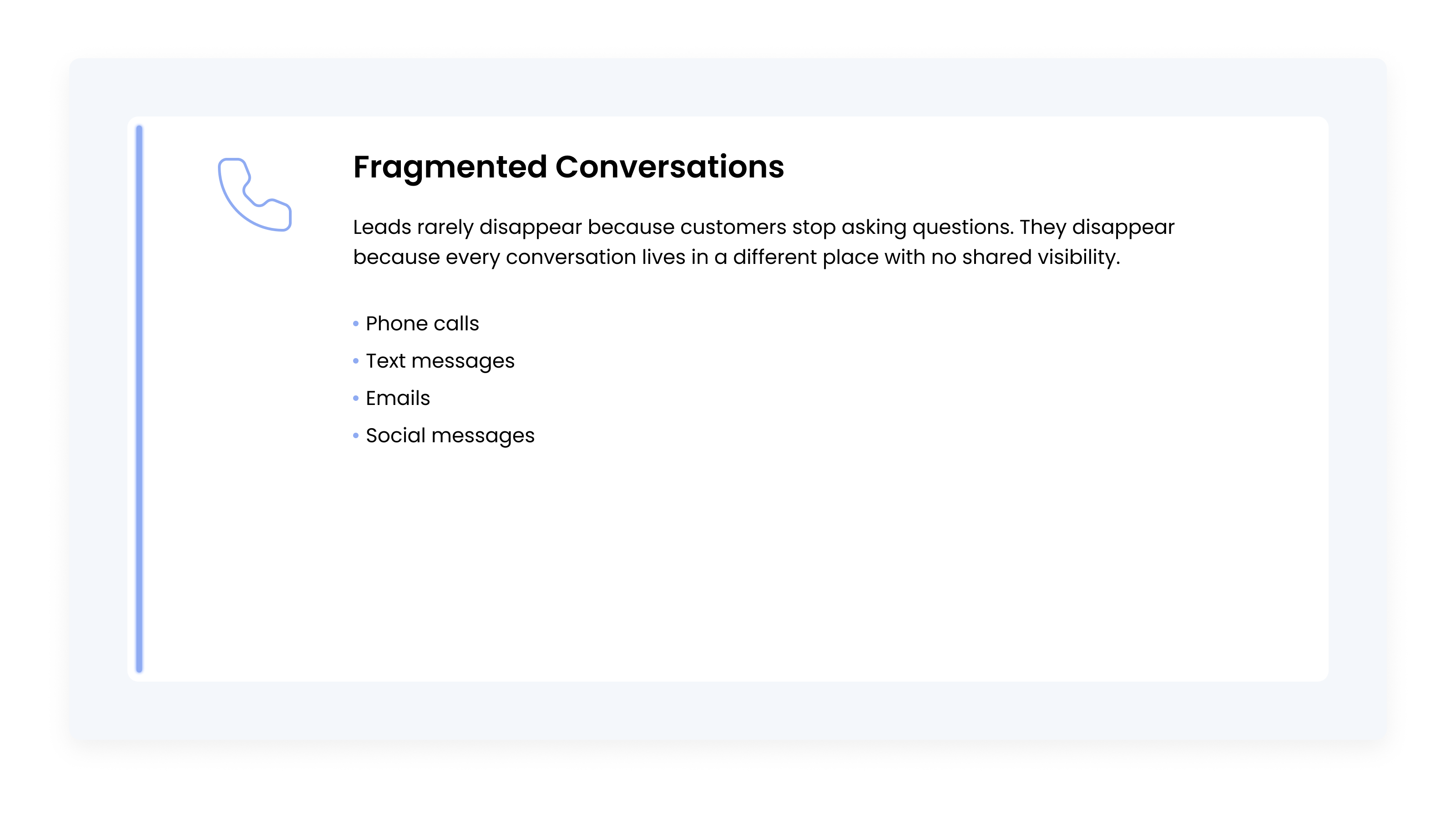
Looking at how customers initiate contact reveals common reasons leads fall through cracks. Small businesses see inquiries arrive by phone calls, text messages, emails, social media, or web forms. Each channel demands different response speeds and styles, which complicates daily operations for teams juggling multiple roles.
Picture a local software-as-a-service (SaaS) company providing personalized onboarding help. One prospect sends an inquiry through the website chat, asking about pricing and integrations. Another calls the main office requesting a demo. Meanwhile, a referral email arrives asking for additional product documentation. Each request comes from a different source but works toward the same goal: engage and move the prospect toward trial or purchase.
The problem arises when these inquiries aren’t connected. Disconnected conversations are often the first warning sign described in Why Businesses Lose Track of Customer Conversations (And How to Fix It), where visibility breaks down long before teams realize opportunities are slipping away. The chat message might be answered quickly by support, but sales isn’t informed. The call reaches an admin assistant who notes it on a spreadsheet but doesn’t follow up promptly. The email lands in a busy manager’s inbox and goes unnoticed for two days. Under this setup, some leads move forward, but others quietly fade as prospects turn to competitors who respond faster and more reliably.
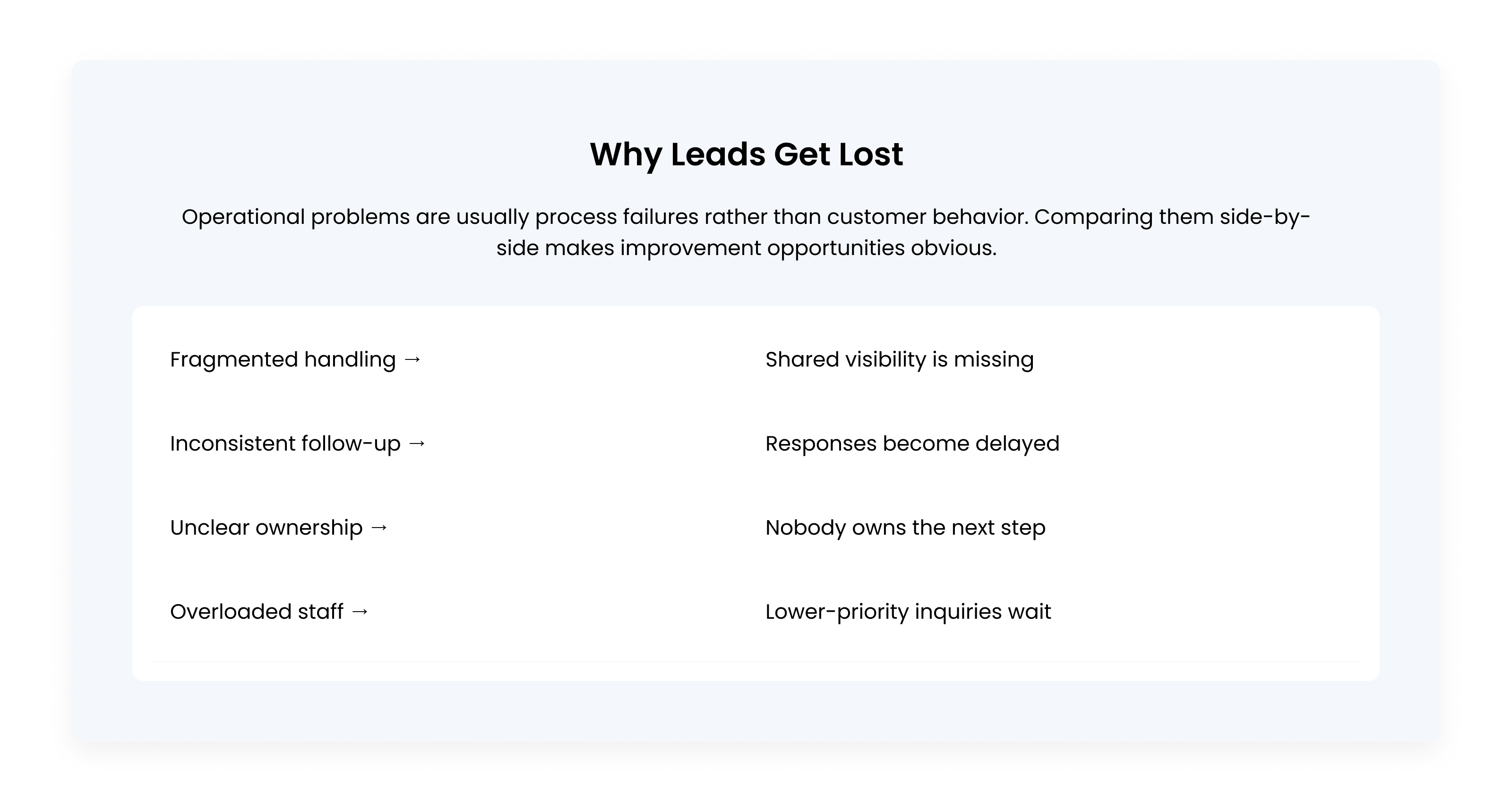
Several factors fuel these missed chances:
- Fragmented handling: Team members respond through separate channels with little shared visibility.
- Inconsistent follow-up timing: Delays or no replies make prospects doubt the business’s interest.
- Unclear ownership: Without a single person responsible, requests slip through.
- Overloaded staff: Wearing many hats, small teams unintentionally deprioritize some inquiries.
From the customer’s point of view, sending a message and not getting a reply within a few hours often feels like being ignored. The silence sparks questions: “Are they available? Do they care about new customers?” This doubt pushes prospects to shop around or switch to faster responders. Missing timely replies doesn’t just delay communication — it erodes trust before the relationship even starts.
Diagnosing Your Current Lead Management System: A Practical Framework
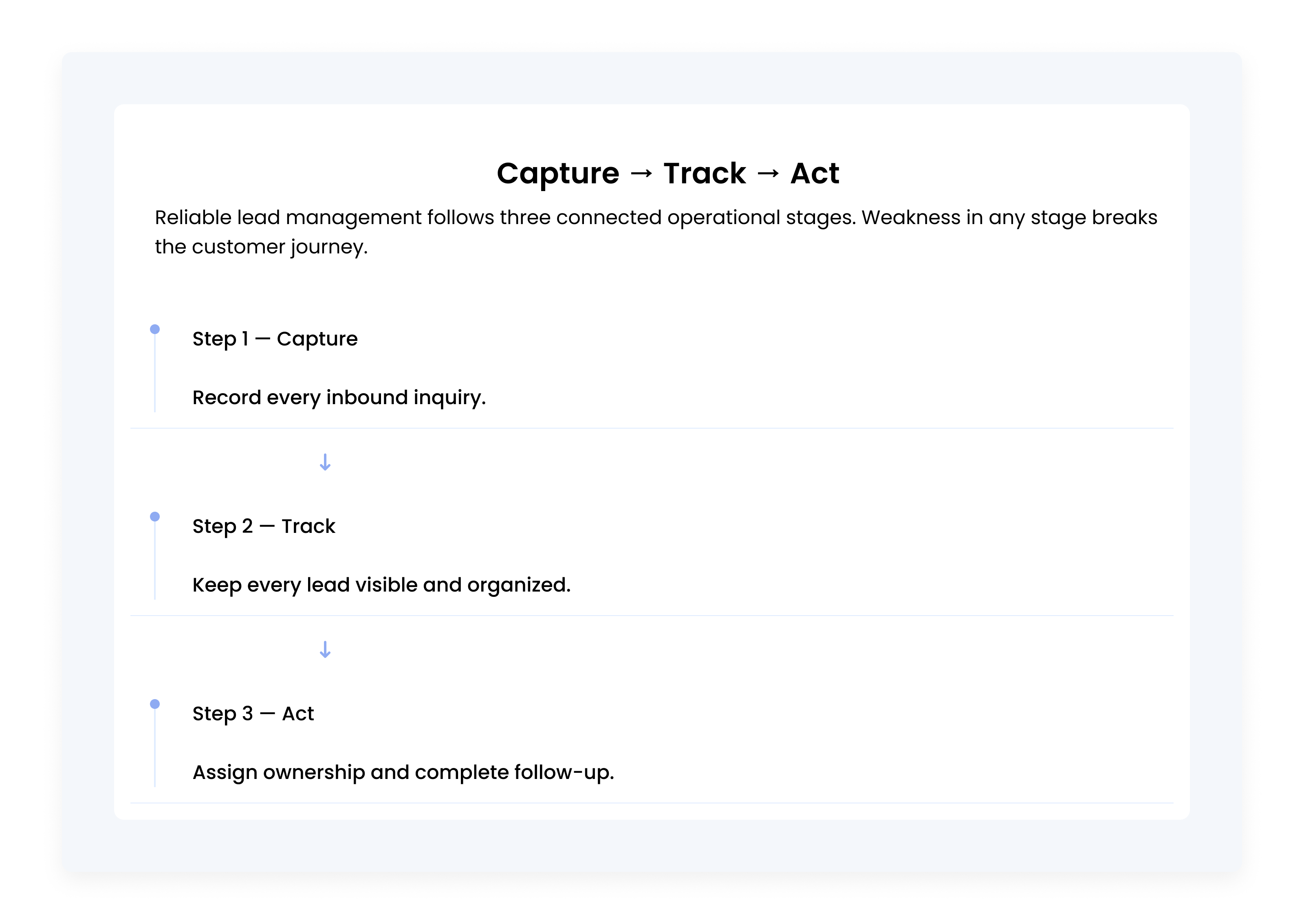
To understand how leads flow (or don’t) within your business, a straightforward framework helps pinpoint where breakdowns occur. One effective approach divides lead handling into three phases: Capture, Track, and Act — known here as the CTA Framework. Each phase requires specific operational habits, and recognizing these distinctions makes it easier to identify problems and plan fixes.
Capture means reliably logging every inbound inquiry, no matter the source. Missing leads happens when inquiries are unheard, unrecorded, or lost in overlooked inboxes. For instance, a technician might take a call and trust their memory instead of noting details, risking lost leads if interrupted.
Track involves organizing, prioritizing, and keeping all open leads visible for follow-up. Problems arise when tracking relies on scattered notes, spreadsheets, or personal devices with no shared access. When leads blend into general busy work, nobody systematically pushes them forward.
Act is executing thoughtful, timely follow-up—someone must be explicitly responsible. Without clear ownership, you get delays, duplicated follow-up efforts, or assumptions like “I thought you reached out.” Accountability ensures each lead progresses.
Applying this looks like a snack box subscription business experiencing slow sales cycles. Their review shows:
- Capture gaps: Website forms sometimes go to spam, unseen by sales.
- Tracking breakdowns: Phone call leads scribbled on sticky notes vanish.
- Acting failures: Follow-up emails drag days behind or wait for owner reminders.
Each point ties to clear operational causes, showing that separating Capture, Track, and Act reveals exactly where the process falters. Teams can then focus on fixing those steps, avoiding overwhelm from trying to change everything at once.
Adding to this, a scenario emerged in a small landscaping company where two sales reps independently called the same lead due to lack of ownership clarity. The client expressed frustration over multiple calls without resolution, leading to lost trust and a dropped sale. Internally, the reps blamed each other, highlighting how miscommunication can escalate and disrupt workflow, reinforcing the importance of clear lead ownership.
Simple Steps to Build Your Reliable Lead Capture Setup
Once you understand the problem, creating a lead capture system that works day-to-day should be practical, straightforward, and fit within your existing workflow. Overcomplicated systems or tech-heavy tools often fail because busy teams don’t adopt them.
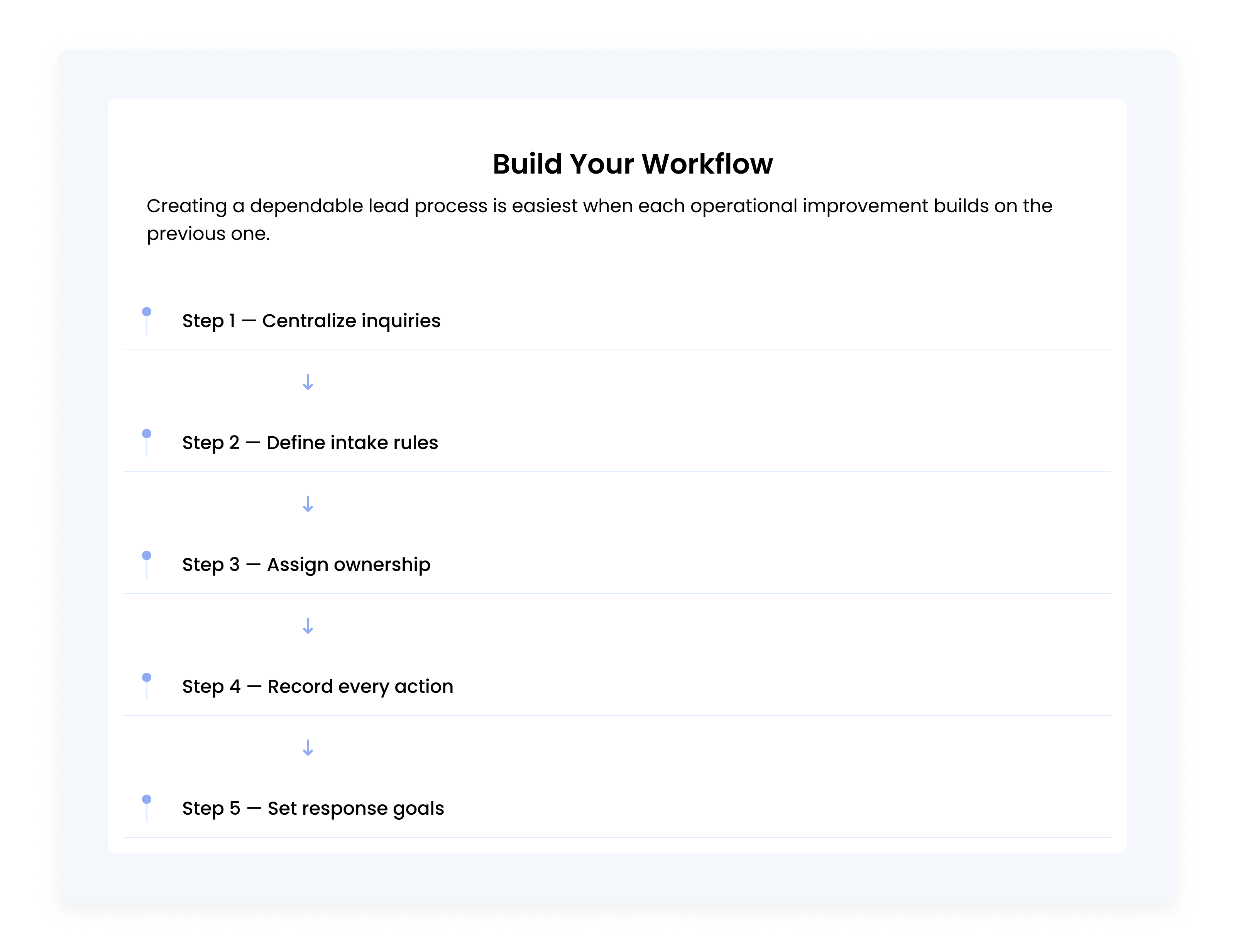
Step one is to centralize inbound inquiries—not by forcing all channels into one but by collecting messages into a single accessible place. For many small businesses, that means a shared inbox consolidating emails, texts, and chats, or a CRM-lite tool capturing contact info and inquiry times.
Step two sets clear intake rules. Not every message deserves the same urgency or handling. For example, mark urgent demo requests for immediate follow-up while scheduling informative questions within the day. The team agrees on categories, ensuring consistent treatment instead of random handling.
Step three is assigning ownership. Clear ownership becomes much easier when businesses apply the principles discussed in How to Assign, Track, and Close Customer Conversations Efficiently, ensuring every conversation has an accountable next step. Each lead should have a designated point person responsible for contacting the prospect. This might be a rotating role or based on position (sales agent or customer success rep). Avoid “everyone and no one” confusion by confirming responsibility explicitly in your system.
Step four means recording actions with the lead. Notes from conversations, follow-up emails, and next steps belong alongside the lead’s data in one place. This prevents repeating questions, losing context over shifts, or missing details during staff changes.
Finally, set response goals. A practical target—such as replying within four hours on business days—creates a clear, manageable standard. The goal is consistent predictability rather than speed alone.
For example, a remote-first SaaS support team started with a shared dashboard pulling emails and chats. They tagged urgent “new subscription” leads for prioritization and established weekly rotations of ownership. Following these steps visibly boosted reply reliability, increased prospect confidence, and reduced internal confusion—as everyone could see lead status, cutting duplicated outreach.
Quantifying the Impact: What Lost Leads Cost Your Business
Lost leads quietly drain a business’s revenue potential. Let’s break down a realistic scenario for clarity.

Imagine a B2B software provider receives about 100 inbound leads monthly from various sources. Their timely follow-up conversion rate sits around 20%, with average deals worth $1,000. That’s roughly 20 new customers each month, generating $20,000 revenue.
If their current system only promptly captures and responds to 80% of leads, 20 leads—equivalent to $20,000 potential revenue—go cold monthly. Suppose 5% of the missed leads eventually return; 15 leads remain lost.
Improving to 100% capture and response means those extra 15 leads convert at 20%, adding 3 new customers monthly. That adds $3,000 revenue every month or $36,000 annually without increasing marketing spend.
Over one quarter, that’s $9,000 in missed opportunity—money slipping through operational cracks, unseen. Bigger deal sizes or longer sales cycles only increase this loss.
Taking this further, a seasonal retail boutique noticed that during peak periods lead inquiries doubled, but response times stretched due to staff overload. They estimated that even a 10% dropout during these spikes translated into thousands in lost sales weekly. Addressing their lead follow-up backlog with a dedicated rota noticeably stabilized revenue and reduced customer friction.
This simple math shows how small operational shortfalls steadily eat growth. Viewing lead capture as a revenue lever shifts focus from a nuisance task to a predictable gain by closing visibility and accountability gaps. The same operational improvements also reduce the hidden losses explained in Missed Calls and Texts: The Hidden Revenue Leak in Small Businesses, where overlooked customer inquiries gradually erode growth.
Common Lead Capture Mistakes and Why They Don’t Work
Awareness of repeated pitfalls helps avoid adopting flawed systems. Small teams often fall into these traps:
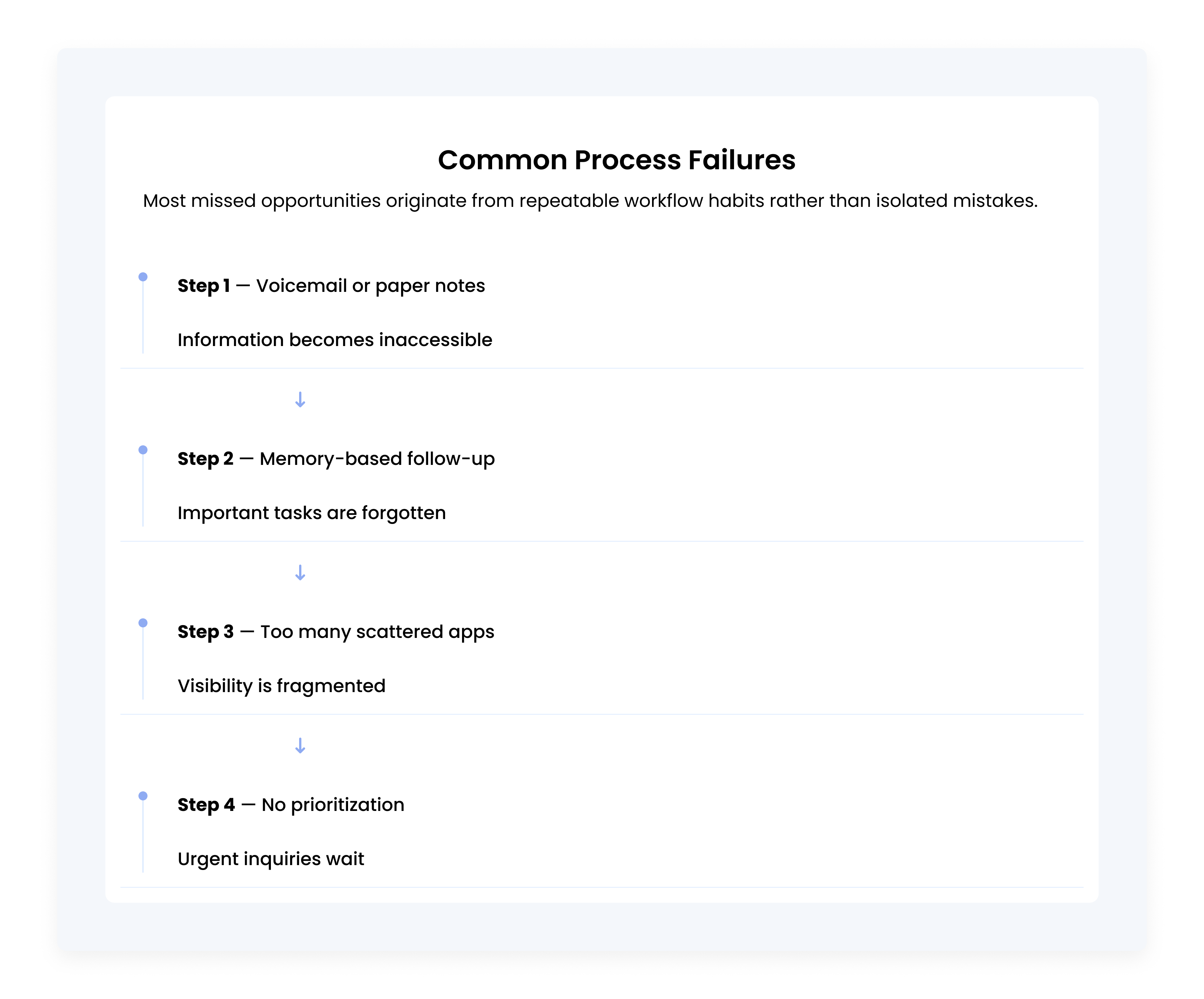
Relying solely on voicemail or paper notes. Voicemails, if unchecked or forgotten, strand leads. Paper notes get lost, inaccessible to others, and prevent shared awareness.
Counting on memory for follow-up. Staff might intend to reply “later” but get interrupted or distracted. When multiple people handle leads, duplicate efforts and missed follow-ups multiply.
Juggling too many scattered apps. Email, texting apps, social media messengers, plus several CRM tools without integration causes mixed priorities and lost messages.
Treating every inquiry the same. Without prioritization, urgent demo requests or quick questions might wait, letting prospects explore other options.
Each mistake reflects ignoring operational realities and overcomplicating or scattering tasks. The best solutions simplify lead capture and organize workload in ways that fit existing rhythms without adding new burdens.
For instance, a small consulting firm once depended on individual email inboxes. One lead inquiry was responded to by a project manager who lacked budget authority, causing delayed proposals. Meanwhile, another team member, unaware of the inquiry, started redundant conversations. This confusion left the potential client frustrated, again highlighting how fragmented processes undermine conversions.
Where TMMN Fits In: Building Systematic Lead Follow-Up
The Technology-Managed Messaging Network (TMMN) serves as a practical foundation—an enabler of organized, repeatable behaviors rather than just a product. It aligns lead capture and conversational management with day-to-day workflows, helping teams achieve reliable follow-up that respects actual staff structures and constraints.
For example, a remote-first subscription service reworked its intake process with TMMN principles. They unified chat, email, and phone messages into one interface and established assignment processes. This clarity allowed the team to focus on consistent lead handling instead of juggling scattered messages or assumptions.
Seen through the Spoken Touch approach, this foundational setup forms the backbone of lead management, reducing risk in conversation handling before more personalized engagements occur. It helps customers feel continually attended to from first contact, creating space for deeper relationships later rather than forcing improvisation amid chaos.
This incremental path respects operator workloads by making leads visible, actionable, and trackable without disrupting daily flow or requiring costly new roles.
Operational Insights to Carry Forward
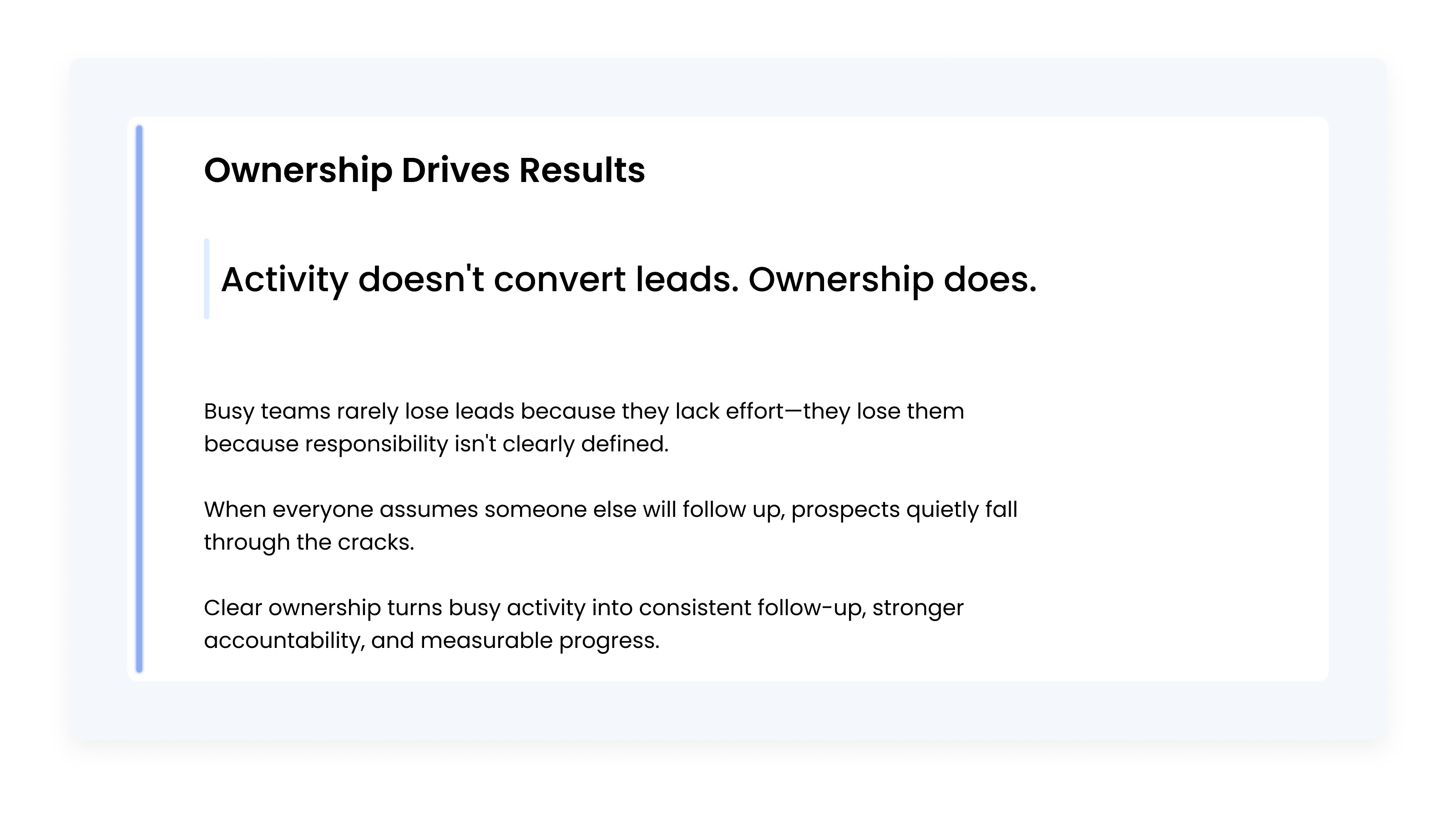
One thing observed in countless small businesses: busy teams often lose leads not from lack of activity but from missing ownership. Everyone may be answering calls or messages, yet without shared responsibility for the next step, leads quietly drift.
Contact fragmentation rarely looks like dramatic failure. Instead, it feels like everyone is busy, but no one sees the full picture. This “busy without progress” dynamic frustrates operators who work hard but struggle to push leads forward.
A telling example came from a tech startup where the sales lead was out one day. Multiple team members responded to different channels, but since no one was assigned responsibility, a high-potential client received mixed messages and no consistent follow-up. The startup lost the deal and learned that assigning ownership—even temporarily—was vital.
Finally, from the customer perspective, silence or delays breed doubt. An unanswered message signals low priority. Customers start exploring alternatives, often disappearing without explanation. Recognizing this behavioral pattern reveals why consistent, predictable replies matter hugely in maintaining engagement.
Key Takeaways
- Leads slip away less from inactivity than from unclear ownership and fractured communication.
- Unified visibility and explicit responsibility transform follow-up from random chance to reliable progression.
- Prioritization and categorized intake align response efforts with prospect urgency and boost conversion chances.
- Incremental operational improvements build momentum without overwhelming busy teams.
- Silence or delay early on erodes trust and drives prospects toward faster, clearer responders.
Conclusion: A Foundation for Intentional Lead Management
Shifting from accidental lead handling to an intentional system requires stepping back from fragmented habits and unclear ownership. Embracing a practical framework—Capture, Track, Act—that fits real team size and workflows sets the stage for consistent lead conversion.
Failing to adopt structured lead management doesn’t cause immediate crisis but quietly accumulates lost revenue and missed growth. Closing these operational gaps delivers measurable results with no need for complex technology or sprawling processes—just a clear, reliable setup focused on managing every lead with deliberate attention.
Businesses adopting this structure evolve from scattered inquiry responses to confident, organized lead handling that supports steady growth. This approach builds a foundation where customer engagement is reliable and systematic, not left to chance. As teams refine these processes over time, even something as simple as starting with a 14-day free trial can help validate whether a structured communication workflow fits naturally into their daily operations.
Starting with the mindset that no lead should ever be uncertain or unattended, operators reclaim control over sales conversations and their outcomes, shaping customer loyalty and business identity with clear purpose and steady action.

.svg)