


Understanding How Customers Use Texting and Calling Differently
When customers reach out to a business, their choice between texting and calling typically reflects their immediate needs: the issue's complexity, available time, and expected interaction style. Texting and calling are common communication channels but serve distinct roles that shape the overall customer experience. Recognizing how customers naturally engage with each helps businesses tailor communication approaches that align with customer expectations and keep interactions straightforward.
Texting suits customers seeking quick updates, simple confirmations, or convenience without the need for real-time dialogue. It supports asynchronous communication—customers send a message and wait for a reply when convenient for the business. This fits those juggling busy schedules who favor brief, controlled exchanges over setting aside blocks of time for a call. For example, confirming an appointment or checking an order status fits texting perfectly. Customers appreciate that texting doesn't demand immediate attention and is less disruptive than a call.
Conversely, calling is preferable when real-time conversation is essential, explanations become complex, or emotional nuance matters. Customers facing uncertainty often want the reassurance that comes from hearing a voice and engaging in live exchange. That immediacy clarifies questions faster and minimizes misunderstandings. Handling technical issues or discussing contract terms usually benefits from phone conversations. In these cases, the opportunity for tone and immediate back-and-forth outweighs texting’s convenience.
These differences emerge in everyday interactions. After a store visit, a customer might text a quick product question or follow-up. But when problems affect satisfaction, they tend to call. Modern communication habits balance convenience with responsiveness, so businesses that use texting for straightforward information and reserve calls for more involved discussions often reduce friction. Businesses that consistently balance channels this way often discover the same operational patterns discussed in When to Use SMS vs Phone vs Email in Customer Communication. One customer texting at 10 a.m. to confirm an appointment might receive a reply in 30 minutes, while a billing question later prompts a call where an agent reviews charges thoroughly. The text offers quick reassurance; the call provides depth and closure. Such patterns show that understanding each channel’s fit goes beyond convenience to impact customer satisfaction.

Recognizing When Each Channel Fits the Customer’s Need
Effective communication goes beyond providing all channels—it hinges on matching the channel to the customer's current needs and expectations. Problems emerge when businesses rely on one channel out of habit or simplicity rather than appropriateness. Many of those challenges become more visible as organizations grow beyond a single communication channel, a pattern examined in Why Texting Alone Isn’t Enough as Your Business Grows. That mismatch wastes time, creates friction, and sometimes erodes customer goodwill.
Texting excels when simplicity and timing flexibility matter. Appointment reminders, order updates, brief confirmations, and quick instructions fit well with texts. Here, customers prioritize information over dialogue and prefer receiving it on their schedule. When delivery windows or receipts are texted, it fits the customer's rhythm and reduces hassle. Staff handle many simple texts efficiently by batching replies or using templates, preserving professionalism without added burden.
However, texting stumbles when conversations demand nuance or dynamic exchange. If messages lack clarity, customers often hesitate to continue texting for fear of misunderstanding. Resolving disputed charges or rescheduling services usually requires a more fluid interaction than texting can provide. Extended text exchanges risk confusion on both sides.
Calling makes sense when immediate dialogue speeds resolution or fosters trust. Customers seeking live reassurance find comfort talking to a real person. Calls convey tone, empathy, and inflection—qualities text can’t fully capture. Calls consume more staff time and require one-to-one availability, which challenges small teams and creates bottlenecks during busy times. Calls may also inconvenience customers who want more control over timing or pace.
Balancing this is tricky. An owner calling every question may spend hours on interactions texting could handle faster. Overusing text for complex issues risks drawn-out conversations and frustrated customers. Matching channel to intent matters: routine updates go to text; complicated or sensitive topics warrant calls.

For example, a flooring company texts a welcome message asking if a call is preferred. Some customers reply “yes, please call,” while others pursue follow-ups by text. This respects preferences, cuts unnecessary calls, and minimizes repeated contacts, leading to higher customer satisfaction. This example encapsulates how tuning channel use to customer need reduces operational friction and improves clarity.
Diagnosing Channel Mismatch: Practical Signs and Examples
Channel mismatch reveals itself through delays, repeated contacts, or subtle signs something is awry. Watching how customers react following messages or calls signals whether the chosen channel meets expectations.
A classic sign is back-and-forth “ping-pong” over text, where customers chase answers or are told repeatedly to call. This occurs when complex questions receive only partial text responses, stretching resolution over multiple messages. Every additional text risks misunderstanding and forces staff to reconnect context, especially when messages appear at intervals. Insisting on texting when a customer seeks live answers can backfire—the customer hesitates to switch channels or stops contacting altogether.
Overusing calls for simple messages fatigues staff and annoys customers who feel interrupted. Calling to confirm a non-urgent appointment without notice might lead customers to ignore or postpone answering. Missing a call after a text inquiry signals low priority and erodes trust.
An internal example illustrates this: a receptionist assumes a colleague handled a callback after a missed call, but a customer’s follow-up text goes unnoticed because it wasn’t logged properly. Days later, the frustrated customer calls again, considering leaving. Confusion over ownership and unclear follow-up weaken reliability. Clear ownership becomes much easier when every interaction remains connected, reinforcing the operational principles discussed in How Teams Actually Handle Customer Conversations Without Losing Context. These issues accumulate quietly.
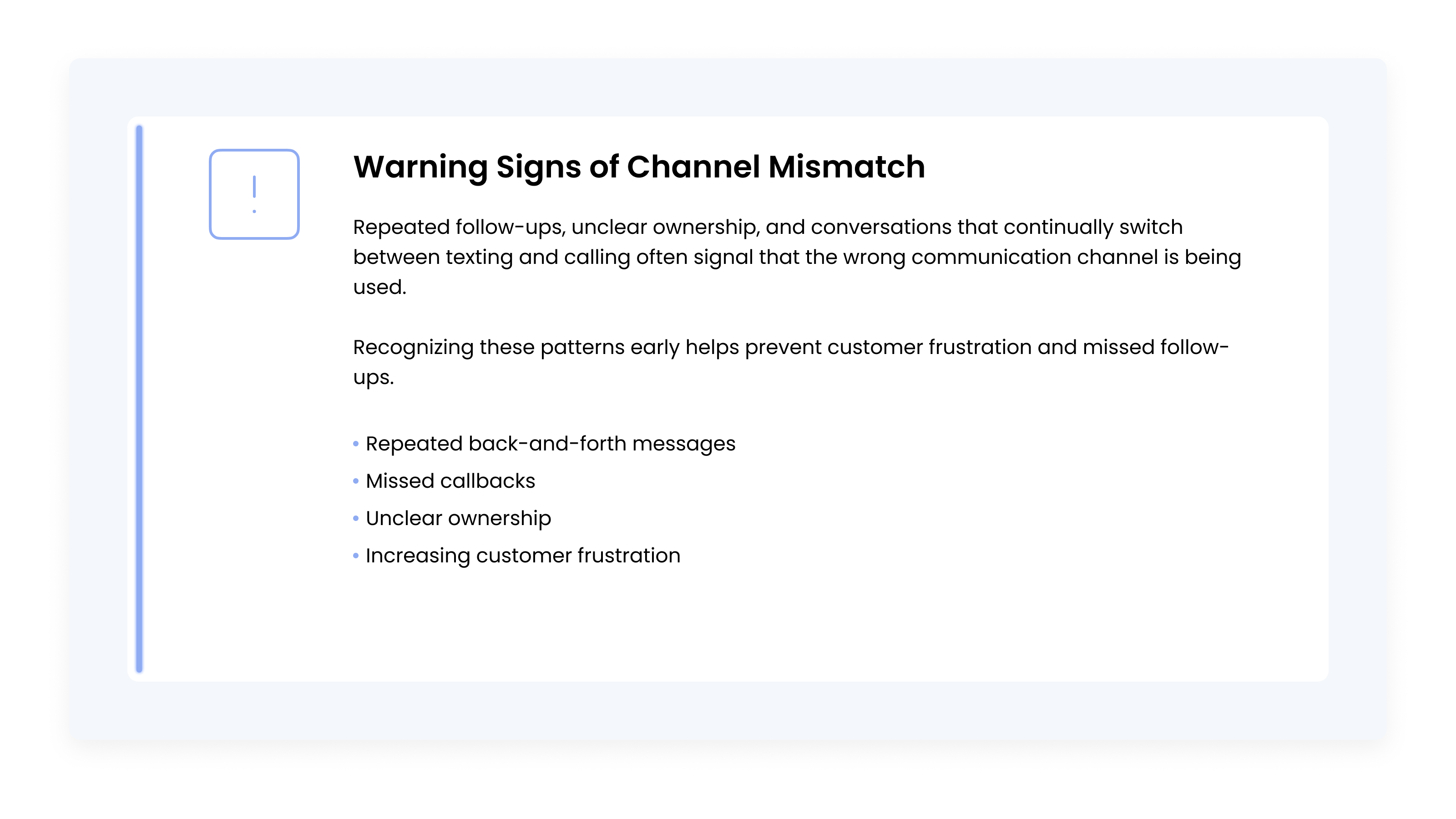
Customers seldom voice complaints loudly; instead, they hesitate or withdraw, gradually losing trust. They wonder, “If they can’t return one call or message, how dependable will they be later?” These unspoken doubts damage reputation. Businesses noticing these red flags early and adjusting channel use avoid this slow erosion.
Quantifying the Impact: Time and Effort Wasted on Wrong Channel Use
Communication efficiency is measurable through labor and cost. Using the wrong channel inflates handling time and follow-up volume, compounding delays across days and teams. Minor inefficiencies escalate significantly.
Take a busy repair shop handling 100 weekly inquiries, with no clear channel policy, split evenly between calls and texts. Calls average 6 to 8 minutes including hold and wrap-up; texts take 2 to 3 minutes per message but typically require several exchanges—about three messages per issue—totaling 6 to 9 minutes per text interaction. Calls usually resolve issues in one go.
In this random mix, 50 texts consume about 375 minutes (50 × 7.5 minutes average) and 50 calls 350 minutes (50 × 7 minutes), totaling roughly 12 hours weekly on communication. At $20 hourly staff cost, this equals $240 per week.
A more strategic approach: 70% of messages handled by text with one or two quick replies averaging 3.5 minutes each, 30% requiring calls averaging 7 minutes.
- Text: 70 × 3.5 minutes = 245 minutes (~4 hours)
- Calls: 30 × 7 minutes = 210 minutes (3.5 hours)
Total: 7.5 hours or $150 weekly—saving 4.5 hours and $90 per week compared to the random approach.

Besides time savings, proper channel matching cuts repeat contacts and customer frustration. Customers receiving quick, clear answers on preferred channels are less prone to follow up or escalate, conserving more time. Across a year, these gains mount to thousands of dollars saved, smoother workflows, and improved satisfaction.
Operational Tips for Balancing Text and Call in Small Teams
Small businesses face real challenges balancing texting and calling without overwhelming staff or confusing customers. Uniform, rigid policies risk driving customers away or generating unnecessary calls. Leaving channel choice too open causes inconsistency. A mindful yet flexible approach fits best.
First, categorize interactions by communication need. Routine notifications, confirmations, status updates, and general info align with texting. Sensitive issues, problem-solving, contract talks, or uncertain customers call for phone conversations. Defining these roles helps staff prioritize and standardize responses without scripting every interaction.
Second, train teams to pick up and respond to customer cues. When texts branch into lengthy exchanges, offering a call: “This sounds important—would you like me to call to discuss?” invites customers to choose their preferred mode, managing complexity smoothly.
Third, use tools that integrate texts and calls within single conversation threads. Systems displaying messages alongside call logs present full history, preventing repeated questions or ownership confusion. One office manager reported fewer missed follow-ups and smoother handoffs after adopting such tools.
Fourth, set clear expectations on response times per channel. Texts can have longer reply windows due to their asynchronous nature, which customers accept. Calls generally require quicker callbacks. Clarity here reduces customer anxiety.
Finally, accommodate staff and customer preferences. Some team members prefer calls for rapport; others use texts to focus during busy periods. Knowing individual strengths and customer habits supports operational balance.
For example, a salon owner mainly texts appointment reminders but found last-minute changes confusing when texts alone went unacknowledged. Adding a quick call if no reply arrives within a few hours for same-day appointments reduced no-shows. Their policy: text first, call if no response within three hours. This small adjustment fit their business and customer base well.
Where TMMN Fits: Supporting Smarter Channel Choice for Real Conversations
Choosing between texting and calling rests heavily on grasping customer needs and team capacity—technology eases execution. Platforms combining multiple channels provide small teams with context and tracking to prevent missed messages and unclear ownership.
Rather than a blanket fix, these tools respect natural conversation flow, minimize manual tracking, and maintain continuity whether communication occurs by text or call. When texts escalate to calls, message history appears alongside call notes, so whoever answers is fully up to speed. This eliminates repeated explanations and smooths handoff.

This points to a future where phone conversations and texts merge into one continuous customer dialogue, not isolated silos. Teams gain real-time visibility and clear ownership, focusing on connection quality—tone, clarity, empathy—without juggling channels.
Experienced operators observe, “Ownership is where things fall apart.” Technology that ties conversations into unified threads with firm responsibility reduces missed follow-ups and confusion, strengthening customer relationships. Unified conversation history also makes it easier for teams to maintain consistency as communication volumes increase, an operational challenge explored in How Businesses Handle 50+ Customer Conversations Per Day Without Chaos.
Key Takeaways
- Customers select texting or calling based on immediate needs for speed, complexity, and reassurance, showing natural preferences in everyday interactions.
- Mismatched channel use creates operational friction visible in repeated contacts, delays, and subtle trust erosion, often unnoticed until problems escalate.
- Strategic channel assignment reduces handling time and costs significantly by resolving routine matters via text and reserving calls for complex issues.
- Small teams benefit from flexible frameworks that classify communication by purpose, monitor customer cues, and employ integrated tools to maintain clarity and ownership.
- Technology that unifies texting and calling histories supports seamless handoffs and continuous dialogue, shifting communication from fragmented interactions toward relationship-building.
Conclusion
Deciding between texting or calling in business communication hinges less on features and more on attuning to customer context, needs, and habits. Texting serves convenience, brief updates, and asynchronous interactions well. Calling is superior when complexity, immediacy, or personal connection matters. Businesses, particularly smaller ones, that develop nuanced, practical channel approaches ease customer effort and staff workload alike, boosting satisfaction and efficiency.
This dynamic means avoiding reliance on a single channel that frustrates customers or exhausts teams. Businesses evaluating how these communication workflows fit their own operations can see them in practice with a 14-day free trial before deciding what approach works best. Instead, thoughtfully blending texting and calling—with attention to conversation type and customer signals—fosters smoother experiences for all. Friction dissolves when teams recognize when to text or call, read customer cues accurately, and maintain clear ownership supported by integrated technology.
As communication evolves, approaching it as a human relationship practice—not just transactions—builds trust, minimizes endless back-and-forth, and cultivates stronger bonds extending beyond singular exchanges. The key lies in recognizing that each customer moment demands the right medium, chosen deliberately and attentively. That approach lays the foundation for better conversations and better business.

.svg)

