
Understanding the Realities of Managing Multiple Conversations at Once
In small and mid-sized businesses, especially those handling customer care via phone or SMS, it’s common for staff to juggle several conversations simultaneously. Contrary to what some might expect, these conversations don’t unfold one by one in neat succession. Instead, they overlap and intertwine in unpredictable patterns throughout the day. For example, at a local appliance repair shop, the receptionist might be on a call with a new customer booking a service while also keeping an eye on incoming text messages from existing clients about scheduling and status updates.
This kind of multitasking demands careful attention to prevent losing track of details or unintentionally delaying important replies. The receptionist may start drafting a text response but pause mid-thought to answer a ringing phone, then return to the message thread moments later. Meanwhile, other conversations continue evolving rapidly on different channels, requiring constant mental context switching.
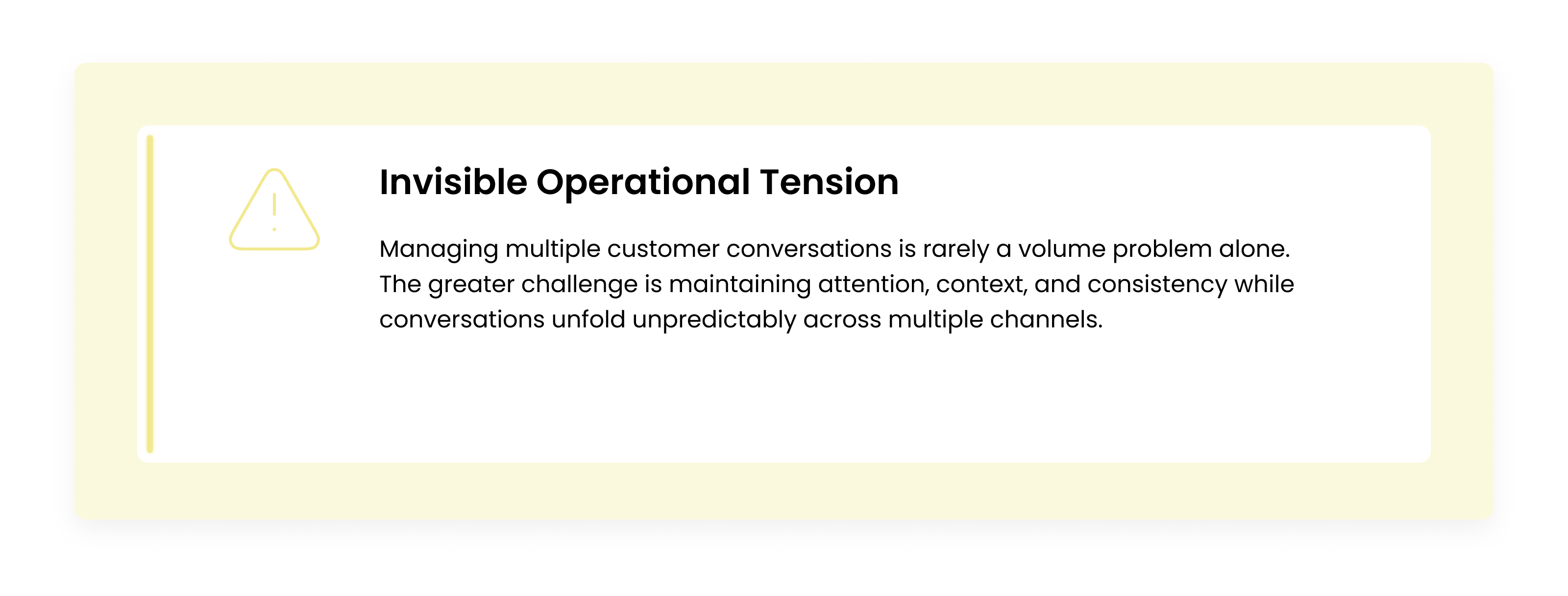
This environment creates a subtle but persistent operational tension. Staff want to be responsive and accurate but must cope with limited attentional and cognitive resources. When several threads demand focus at once, the risk of missing cues, forgetting follow-ups, or mixing up contact details rises. For instance, if a customer texts asking when a technician will arrive and that message gets overlooked or answered vaguely because the operator was distracted by a new incoming call, the customer’s trust in the business can suffer.
Often, the real challenge isn’t sheer volume but the unpredictable rhythm of these interactions. Customers don’t wait patiently or stick to scripted timings. Calls and messages pop in at irregular intervals and often require fast topic changes. Operators develop informal “mental triage” methods—prioritizing urgent or visible requests—but these shortcuts come at a cost. Businesses that create a consistent system for deciding what deserves attention first often avoid this problem, as explained in How Businesses Prioritize Customer Messages Without Missing What Matters. A customer who sent a question earlier may face delayed or incomplete answers because their conversation was pushed behind a higher-priority thread.
This dynamic shapes much of the experience when managing multiple conversations. The tension between being prompt and maintaining sustained attention affects not only immediate replies but also how customers perceive the business. If a customer senses confusion or hears conflicting information, their confidence erodes—even if no outright mistake occurs.
A small boutique catering company provides a typical example. On a busy day, the catering manager juggled orders coming through phone calls, texts about menu options, and an influx of social media inquiries. By late afternoon, a message from a wedding client about last-minute changes went unnoticed for hours, buried behind other conversations. The client started to hesitate and contacted a competitor for confirmation instead. This incident illustrates how complex multitasking quietly undermines customer relationships before any formal complaint or lost contract arises.
How Modern Customers Keep the Conversation Flow Moving
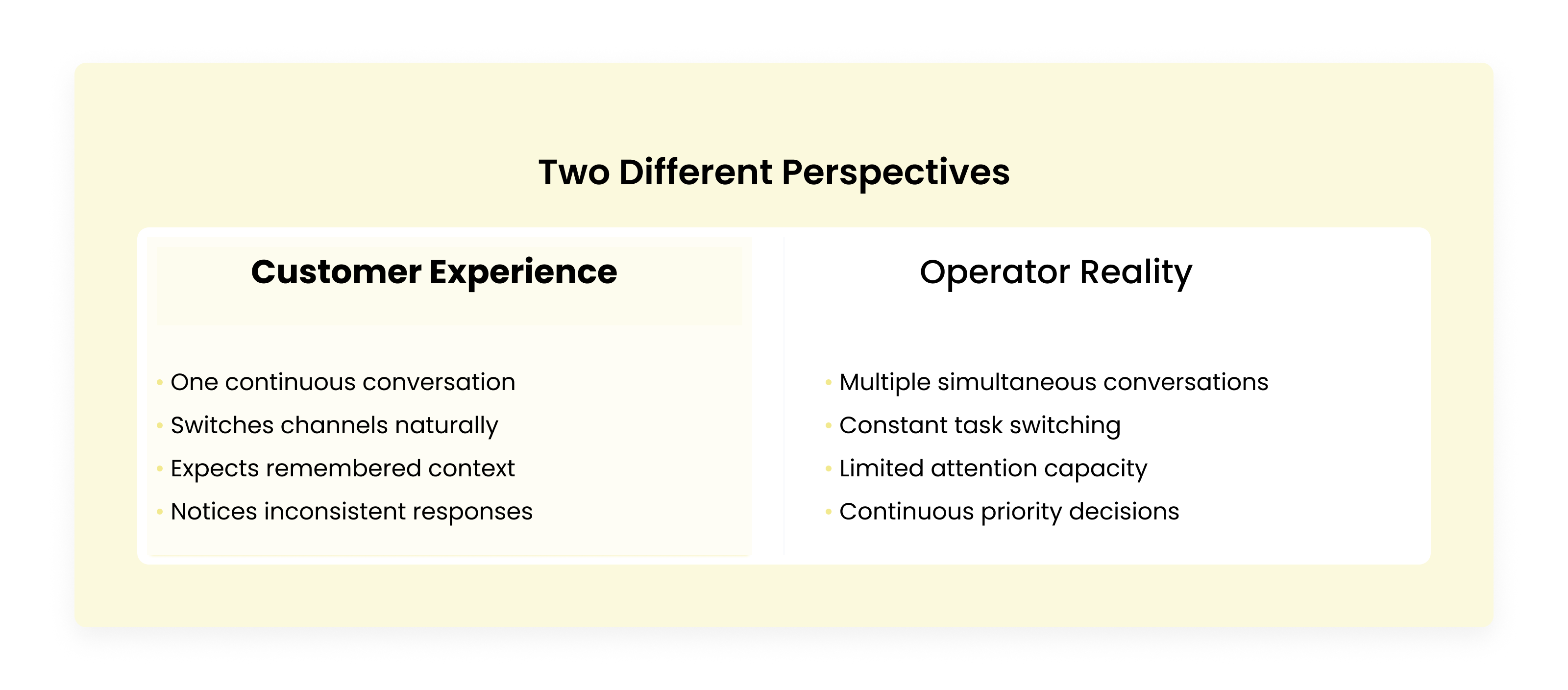
Customers today expect conversations to flow seamlessly across different channels and moments. They don’t limit themselves to one medium or wait patiently for replies in a fixed order. Whether texting a question during a commute, calling to clarify details mid-day, or sending an email with further requests overnight, customers create interaction patterns that may appear scattered externally but feel natural to them.
This poses a challenge for businesses managing multiple conversations: customers expect their needs to be remembered and addressed coherently, even as operators switch rapidly between dialogues. The customer’s experience is shaped by their own timing and habits—not by the business’s internal rhythms.
Consider a landscaping service receptionist answering morning calls while texting reminders for upcoming appointments. A client might first message about fertilization options, then call later to discuss scheduling conflicts, followed by an email requesting a quote. To the customer, this feels like ongoing engagement, but the receptionist is managing three separate threads with overlapping concerns. If these exchanges aren’t linked effectively, the customer encounters disjointed or inconsistent service. Maintaining continuity becomes much easier when every interaction is captured consistently, an approach explored in How to Track Every Customer Interaction Without Spreadsheets.
The subtle psychology here is that delays or missing replies interrupt the customer’s sense of continuity. Silence or generic responses create doubt about whether the operator understood or valued the inquiry. Most customers won’t voice dissatisfaction immediately but may quietly switch providers or reduce future engagement.
This hesitation rarely appears dramatic; it shows through longer response times, less urgency in follow-up messages, or a declining tone. In the landscaping example, the client waiting on a quote might pause before committing, search for alternatives, or stop making new requests—signs that the conversation lost momentum and relevance.
From the operator’s perspective, this drives informal multitasking shortcuts. To keep pace, staff tend to prioritize the most recent or visible alerts, sometimes sacrificing thread continuity for older but still active conversations. Mental triage here involves juggling customer moods, urgency signals, and topic complexity—a continual balancing act where small errors accumulate.
It’s important to recognize this pattern reflects how customers naturally want conversations to unfold, but it becomes operationally challenging for teams handling multiple dialogues. The key is reconciling these unpredictable conversational flows with limited human attention without compromising responsiveness or quality.
Diagnosing Where Operators Get Overwhelmed: A Practical Framework
To address this tension practically, consider a framework spotlighting four core factors that contribute to operator overload and conversation mishandling: Attention Fragmentation, Ownership Clarity, Context Continuity, and Response Timing. This approach comes from frontline observations and mirrors real work environments for communication teams.
1. Attention Fragmentation
What it is: Operators split their focus across several conversations happening simultaneously, often spanning SMS, calls, and email.
What failure looks like: Operators jump between topics too fast, lose track of ongoing replies, or respond with unclear or inaccurate information because attention is scattered. For example, a receptionist handling a quick call about an appointment might accidentally send a generic reply to a complex billing inquiry, confusing the customer.
Why it matters: Each shift risks dropping conversational threads and increases mistakes, causing delays and confusion that ripple through customer interactions. Cognitive overload here creates a constant friction point, particularly for lean teams lacking formal tracking tools. This fragmentation is the invisible chasm where operational breakdowns quietly multiply.
2. Ownership Clarity
What it is: Clear responsibility for each conversation or customer issue at any given moment.
What failure looks like: Multiple staff assume others are handling a message or task, resulting in duplicated efforts or missed responses. Internal assumption spreads without confirmation. For instance, two team members might both follow up independently on the same customer query, leading to conflicting information and wasted time.
Why it matters: Ownership gaps stall conversations or bounce them back internally, making the customer experience feel inconsistent and erratic. Many of these breakdowns become preventable when responsibility is clearly established from the beginning, a principle discussed in How to Assign, Track, and Close Customer Conversations Efficiently. Without clear ownership, progress grinds to a halt despite apparent “activity.”
3. Context Continuity
What it is: Maintaining understanding across multiple exchanges and channels—preserving relevant details and customer history.
What failure looks like: Operators forget past commitments, repeat questions unnecessarily, or contradict previous information. Customer data fragments across systems or personal memories. For example, a client might have to explain the same delivery issue several times because the notes weren’t passed along, causing frustration.
Why it matters: Losing context forces customers to re-explain issues, reduces professionalism, and erodes trust. Continuity builds productive, authentic conversations that create lasting rapport.
4. Response Timing
What it is: Managing prompt, relevant replies matching customers’ expectations and urgency.
What failure looks like: Delayed, overly generic, or poorly timed responses that don’t fit the customer’s inquiry rhythm. Handling many responses at once creates cascading delays. A customer waiting hours for a confirmation may try calling multiple team members, leading to confusion and impatience.
Why it matters: Slow or irrelevant replies break conversation momentum. Customers waiting in silence fill gaps with doubt, often exploring other options or disengaging quietly.
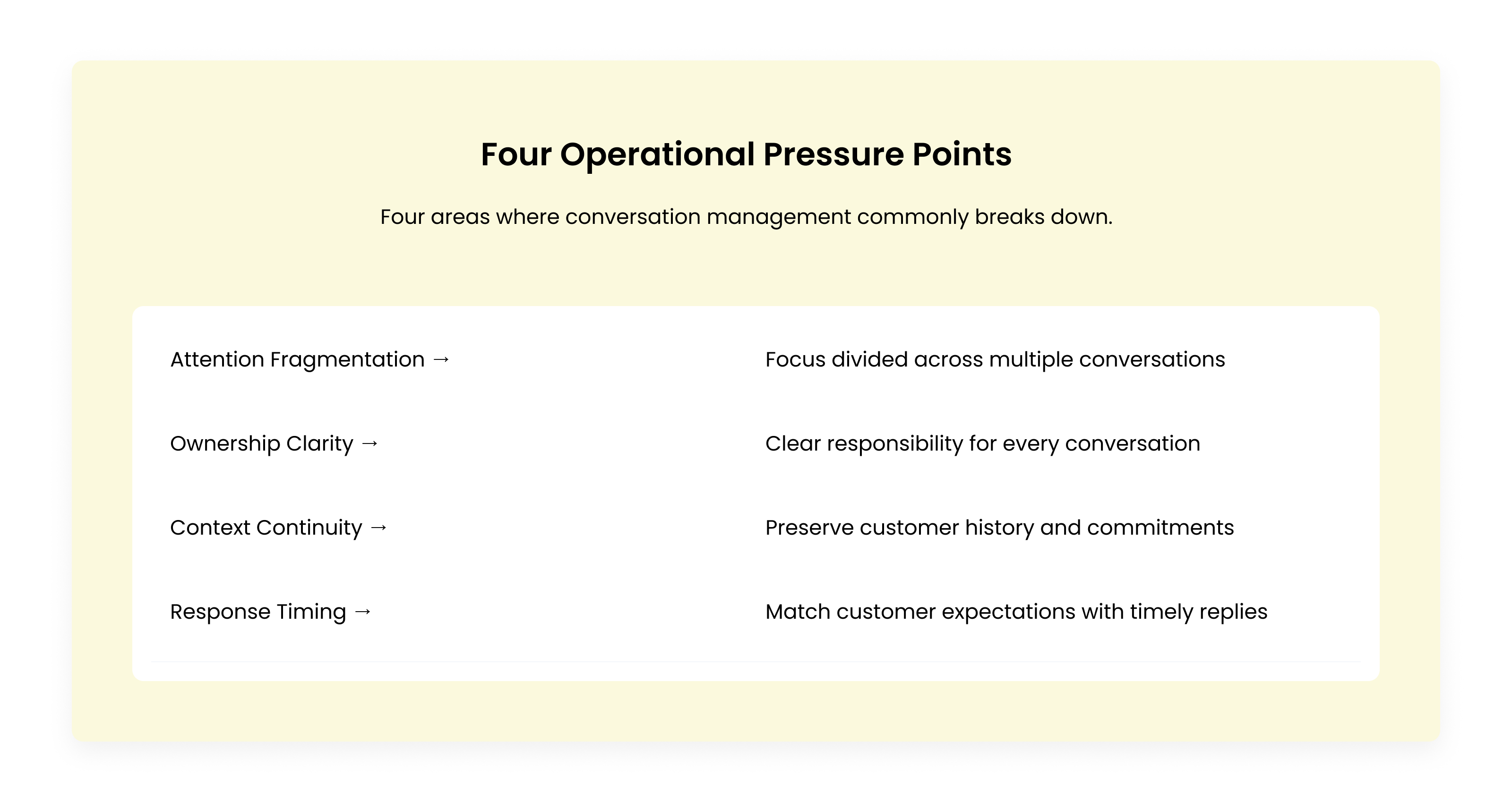
This framework pinpoints where multitasking conversations commonly falter. For example, a mid-sized cleaning company receptionist managing morning calls and texts might feel they’re keeping up. Yet, fragmented attention combined with unclear ownership leads to a message about a missed appointment slipping through unnoticed. Different staff give customers conflicting info about rescheduling. Miscommunication builds quietly, leading to complaints or lost clients.
Addressing these areas is not just about adding tools but about nurturing operational habits that reduce unseen slips. It also explains why simply multitasking harder or layering on automation can increase friction if ownership and context aren’t solid. One operator observation from seasoned communication teams is that failing to pin down ownership early often triggers a cascading failure where multiple threads fray simultaneously.
Quantifying the Impact: What Happens When Conversation Handling Breaks Down
Understanding the cost of mismanaging multiple conversations is crucial for wise resource allocation and process improvement. Consider this typical small business scenario to illustrate cumulative effects.
Imagine a small team of three frontline staff handling about 50 daily conversations across phone, SMS, and email. Each conversation demands roughly 10 minutes of interaction over one or two days. The team aims for replies within an hour, but multitasking leads to 15% of messages or calls receiving responses delayed over two hours.
In this setting, a 15% delay means 7 to 8 daily conversations suffer slower responses that quietly wear down customer patience. About half of these—4 conversations—trigger visible customer hesitation, like reduced follow-up or silent alternative searches.
If the business earns approximately $200 revenue per active conversation, a conservative 10% loss rate from disengagement amounts to roughly $800 daily in missed opportunities ($200 x 4 lost engagements). Over a 22-workday month, that totals nearly $17,600 slipping away quietly.
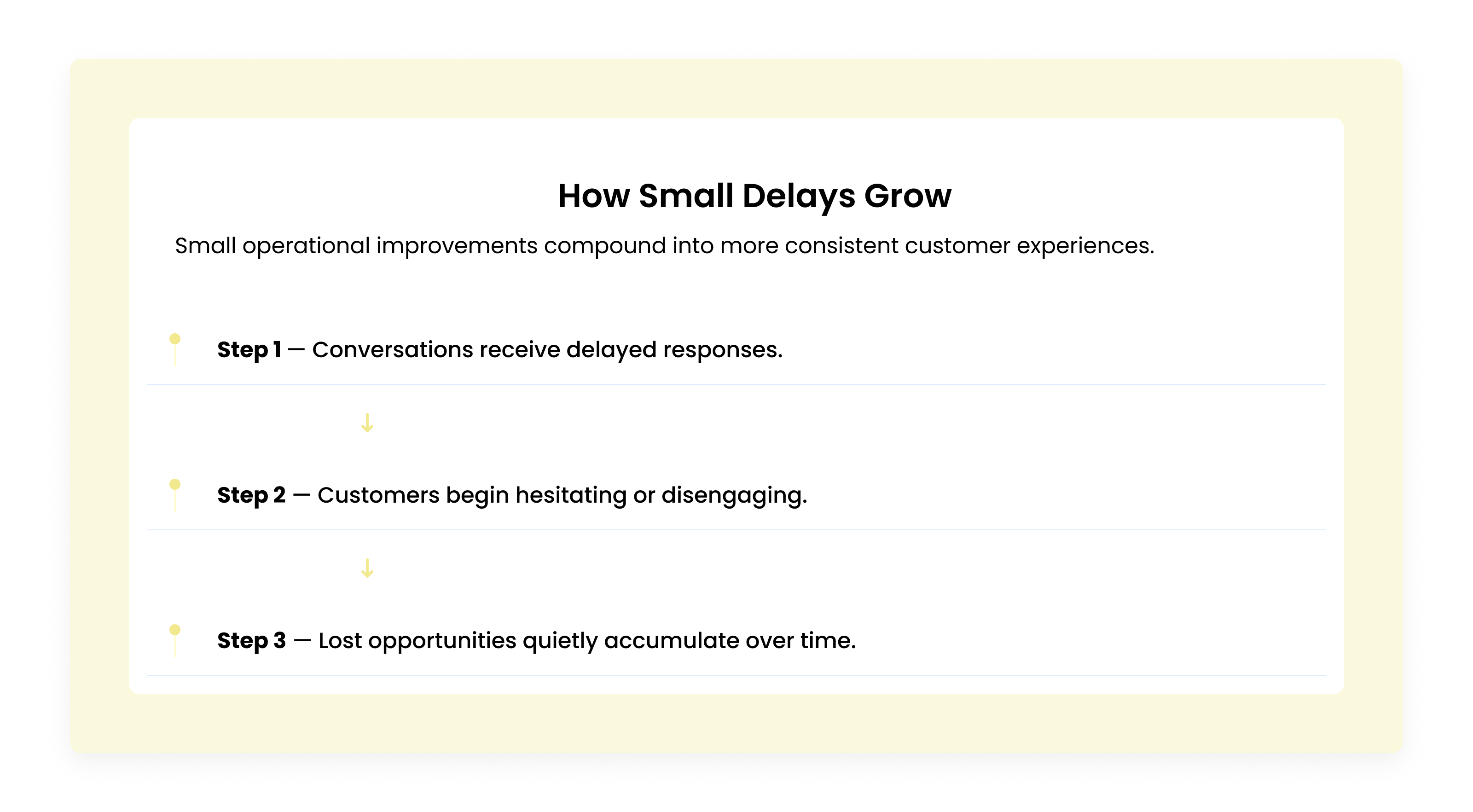
This simplified calculation highlights how delays and fuzzy communication not only inconvenience customers but directly impact revenue over time. Even small delays can quietly weaken customer confidence before the financial impact becomes obvious, as shown in The Hidden Cost of Slow Response Times in Small Businesses. Losses don’t come as dropped calls but as gradual decline in repeat business and referrals. Meanwhile, staff burnout from mental overload reduces efficiency, stretching conversation times and capping capacity—another indirect cost.
This model also clarifies why hiring more people without fixing operational clarity can feel expensive and ineffective. New hires may face the same fragmentation, confusion, and context gaps, perpetuating moderate losses. It shows that managing multitasking well is a layered skill and system alignment challenge, not just a volume problem.
Improving Operator Focus Without Relying on More Staff
When customer conversations increase, many small businesses think adding headcount is the answer. But without addressing core habits, more people can multiply communication breakdowns rather than reduce them.
Instead, operator focus improves by adopting deliberate practices that foster attention discipline and clarity at scale. Some effective approaches include:
- Explicit conversation marking: Operators tag conversations with simple status indicators like “in progress,” “awaiting customer reply,” or “needs escalation.” This visual tracking cuts mental juggling by showing where focus is pending. Even a whiteboard or shared spreadsheet can serve as a lightweight tracker. For example, a busy front desk team in a small hotel used these tags on a shared whiteboard, reducing missed requests by 30%.
- Defined ownership protocol: Assigning each conversation to one person until resolution avoids internal assumption gaps. For example, when a receptionist transfers a call to a technician, they confirm who will follow up and briefly document the handoff for team visibility. This reduces duplication and silences. One catering business saw fewer conflicting customer messages after clarifying ownership responsibilities.
- Chunked time allocation: Breaking work into focused blocks—like half-hour windows for uninterrupted message handling—lowers the cost of frequent task-switching. Operators report better recall and response quality when concentrating on fewer threads consciously.
- Context capture notes: Jotting quick internal notes or message snippets to track customer history within conversations supports continuity. This is essential when multiple team members handle a case over days. Basic CRM or note fields economically enable this practice. In one landscaping firm, quick notes reduced repeated customer explanations and raised satisfaction visibly.
- Customer expectation signaling: Informing customers about typical response times or preferred channels sets clearer interaction rhythms. Instead of chasing immediate replies across all channels, customers know when to expect answers, which relieves pressure on operators to multitask reactively.
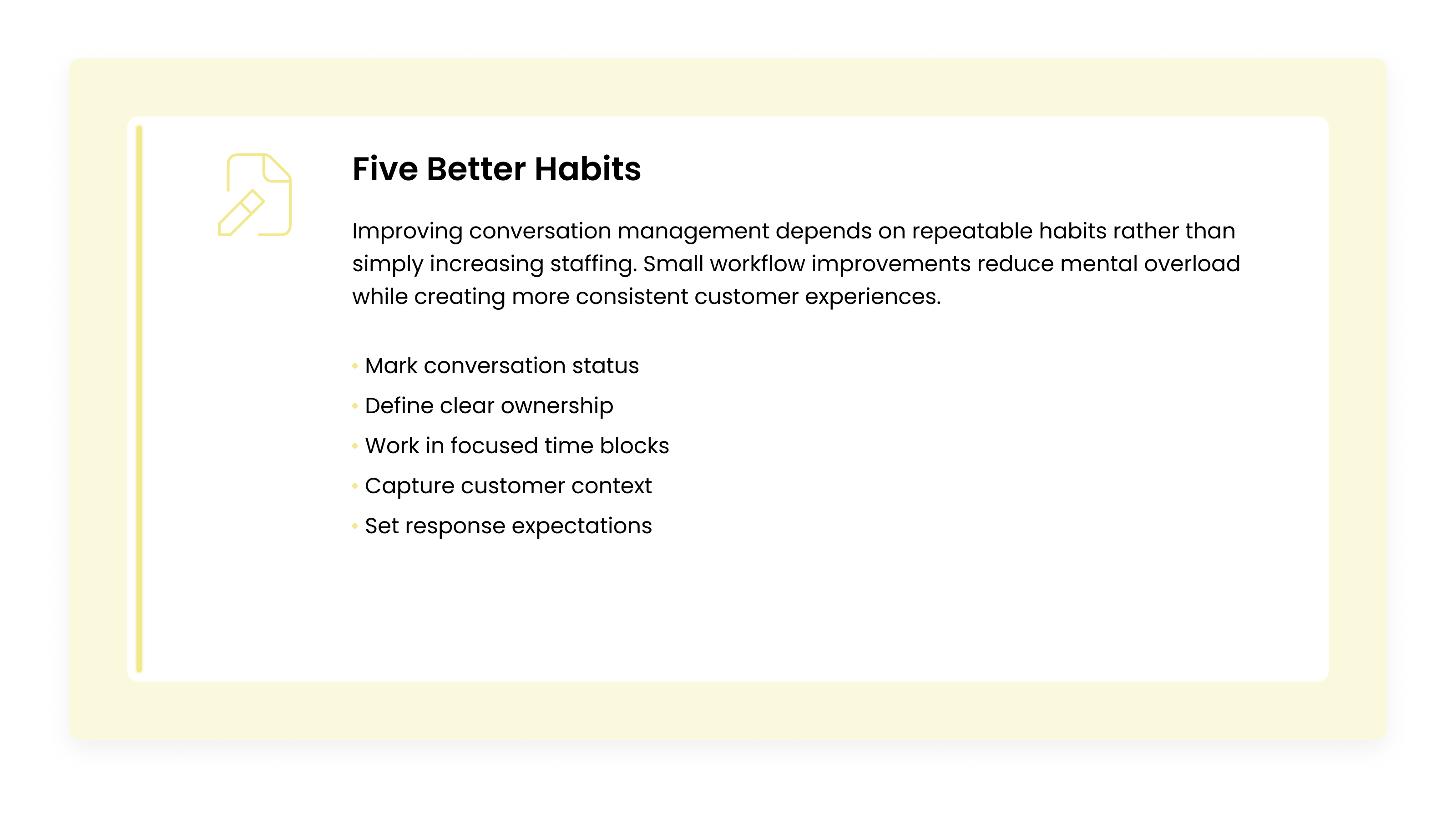
One restaurant group introduced these habits without new technology. The changes improved frontline cohesion and cut error rates significantly. Operators felt less scattered and more confident juggling multiple conversations. Customers noticed more consistent follow-up and fewer repeated questions.
These adjustments show multitasking is a skill to be consciously developed—not a chaotic race demanding endless mental effort. Improving operator focus aligns practical workflows with human limits rather than expecting impossible stretched attention spans.
Where TMMN Fits In: Structured Support for Scaling Conversations
As small businesses grow, informal conversation management becomes less reliable and increasingly fragile. This is where aligning with a system like TMMN can provide steady support while respecting human operator realities.
TMMN organizes multiple simultaneous conversations through clear visual cues, defined roles, and consistent context. Instead of replacing human judgment, it enhances operational habits by offering reminders, status tracking, and accessible customer history to prevent broken continuity.
For instance, TMMN reinforces ownership clarity by requiring team members to claim or assign each active conversation. It supports context continuity with integrated notes and conversation logs accessible across devices. Automated—but coachable—reminders help keep response timing on track without sidelining human choice.
This structure helps teams handle the tension between limited attention and conversation volume by making invisible work visible and easing cognitive friction. Operators can manage more dialogues with fewer mistakes and less stress.
TMMN also encourages viewing conversations as evolving interactions rather than isolated messages, matching customer expectations across channels and time. This raises operator awareness of interaction rhythms, allowing more mindful multitasking that values relevance and timing equally.
In practice, TMMN surfaces subtle but important signals—like conversations stalled too long or lacking clear ownership—that often go unnoticed until customers disengage. Addressing these early preserves customer connection and smooth operations.
By embedding these supports into everyday workflows instead of sudden mandates, TMMN fosters a culture where managing conversations becomes a collective operational strength. This stance helps small businesses keep attentive, personalized customer relationships—even while handling multiple concurrent conversations.
Key Takeaways
- Multitasking multiple conversations creates invisible tension where fragmented attention and unclear ownership quietly erode customer trust and operational reliability.
- Customer interaction rhythms defy neat schedules, pushing operators into informal triage that risks missing past commitments or delaying responses.
- Operational clarity around ownership and context continuity is often the difference between smooth workflows and cascading communication breakdowns.
- Delays and mixed signals from poor multitasking translate directly into gradual but measurable revenue loss and increased staff burnout.
- Conscious operator habits paired with structured supports like TMMN transform multitasking from a reactive scramble into a manageable operational capability.
Small and mid-sized businesses juggling many customer conversations at once face a complex environment that demands sharp attention, clear responsibility, and consistent context. Viewing this as a skill to cultivate rather than a flaw helps teams develop habits that tame multitasking complexity.
The framework focusing on Attention Fragmentation, Ownership Clarity, Context Continuity, and Response Timing offers a practical way to diagnose breakdowns and guide improvement. Quantifying the hidden costs clarifies why operational discipline really matters beyond just adding staff or reactive fixes.
Deliberate methods to sharpen operator focus paired with structural alignment—such as through TMMN—allow businesses to treat conversations not as competing interruptions but as interconnected, flowing exchanges. Businesses ready to put these practices into everyday workflows can begin with a 14-day free trial and see how greater visibility and organization improve conversation management over time. This shift empowers teams to maintain clarity and presence across multiple dialogues, strengthening customer connection and operational reliability.
Ultimately, this approach transforms multitasking from a barely managed scramble into a deliberate operational capability that supports business growth and customer trust over time. By framing conversation management as a dynamic cultural strength rather than a logistical headache, businesses open the door to richer, more resilient customer relationships.

.svg)