
How Customer Behavior Shapes Response Timing Expectations
The rhythm of customer interaction is often mistaken for a simple race to respond as quickly as possible. Yet beneath this surface, customers hold nuanced expectations about timing and engagement that stretch beyond mere “immediacy.” Grasping this complexity is essential for any business aiming to turn inquiries into loyal customers without rushing the conversation or missing key moments.
Consider a local artisan bakery that receives a message early in the morning from a regular customer wanting to pre-order a customized cake for later that week. The customer expects a reply within a few hours—enough time to feel acknowledged, but also enough to have a meaningful conversation about design options and lead time. If the bakery fires back an instant, curt confirmation, the customer might still feel uncertain about pricing or design details. But if the bakery takes several hours to send a thoughtful reply that clearly lays out different choices and invites further questions, it sparks deeper engagement.
This example reflects how modern customers approach communication. They want to feel their inquiry is genuinely valued and understood, not just checked off. A quick “got it” might work for a bot, but it falls short in creating emotional connection or reassurance. Customers also interpret silence differently depending on timing. A short pause can signal the company is reviewing details thoughtfully; hours of silence can come across as disinterest or forgetfulness. This expectation draws naturally from patterns of human interaction customers are used to offline, now carried into digital conversations.
At the same time, the type of inquiry shapes how tolerant customers are about waiting. A simple question about store hours or product availability demands a fast reply—often within minutes or an hour. But more complex requests, like custom quotes, consultations, or technical explanations, need space to provide detail and don’t benefit from rushed answers. Customers typically prefer clearer, richer responses even if it takes a few hours, rather than fragmented and immediate ones.
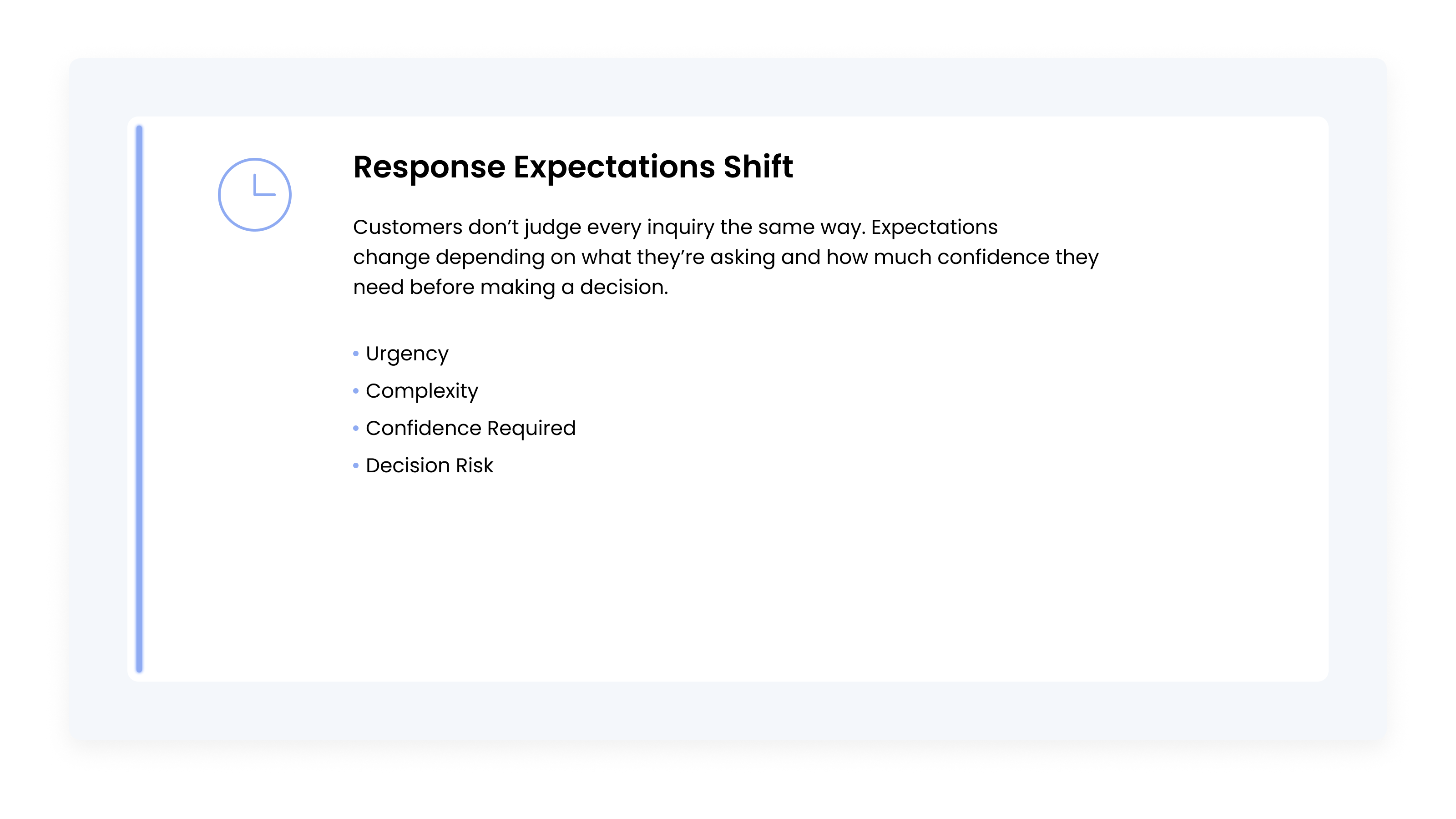
This shows that the simple rule of “faster is always better” doesn’t hold up. What matters is recognizing when customers are signaling a need for paced responsiveness that builds trust instead of just speed. Many growing businesses eventually discover that balancing responsiveness with consistency becomes far easier when they understand The Hidden Cost of Slow Response Times in Small Businesses across everyday customer interactions. Achieving this requires paying close attention not just to when customers expect an answer, but what kind of answer nudges them closer to a decision.
The Real Impact of Your Response Time on Conversion Rates (Quantified)
To see how response timing affects real business results, imagine a small consulting firm receiving 40 inquiries per week. Tracking these over a month reveals clear patterns tied to how quickly replies come.
These inquiries fall into three timing categories: - Immediate responses (under 5 minutes) - Moderate responses (5 to 30 minutes) - Slow responses (over 30 minutes)
Here’s what the data shows: - Immediate replies convert around 12% of inquiries into consultations. - Moderate replies convert about 18%. - Slow replies convert just 7%.
Putting numbers to this: if each converted client brings in $1,000 in contract value, then:
- Immediate replies: 40 × 12% = 4.8 clients → $4,800
- Moderate replies: 40 × 18% = 7.2 clients → $7,200
- Slow replies: 40 × 7% = 2.8 clients → $2,800
Switching from immediate to moderate response timing yields an extra $2,400—a 50% revenue boost—all by pacing responses thoughtfully rather than rushing them.
What causes this gap? Immediate replies tend to be brief and transactional, ticking the “replied” box but failing to spark a real conversation. Moderate replies have time to be tailored, explain details, and invite next steps, giving customers confidence to commit. Slow replies risk cooling interest altogether, giving prospects space to shop elsewhere.
This scenario proves that speed alone isn’t the deciding factor in closing sales. Quality interaction combined with timing that matches customer expectations unlocks better results. This means resources spent scrambling for immediate replies might generate busywork without converting well. Instead, making time for clear, meaningful answers within a reasonable window better suits customers and boosts revenue.
Diagnosing Your Current Response Timing and Its Effectiveness
Many businesses have a general feel for when they respond but lack concrete insight into how that timing actually affects outcomes. Getting a clear picture of current response habits is a crucial first step.
Take a mid-sized outdoor gear retailer managing inquiries via email, phone, and SMS. The customer service team juggles all channels without a unified system. Some questions get answered in minutes; others take hours or even days, depending on who’s available.
Looking over a recent week, the owner spots patterns: - Basic product questions get quick replies from sales reps. - Technical or rental inquiries often wait longer until specialized staff respond. - Customers sending multiple messages across different channels get fragmented or conflicting answers.
This inconsistency creates a patchy customer experience and leaves gaps where interest slips away unnoticed. These situations often develop gradually, echoing many of the operational challenges described in Why Businesses Lose Track of Customer Conversations (And How to Fix It). Inside the team, conversations devolve into “Did you handle that one?” and “I already replied to this but got no update,” with duplicate messages and unclear follow-up responsibilities.
One customer frustrated after repeated confusion said, “I’m tired of repeating myself every time I switch from texting to email.” Meanwhile, a support agent noted, “I didn’t know someone else was already looking into that question, so I sent a reply again.” These everyday moments highlight the operational noise that disrupts timely and coherent responses.
Simply noting response time inconsistencies without linking them to conversion misses the bigger picture. Layering in conversion data or customer feedback adds clarity. For example, slow technical replies correlate with lower rental bookings. Quick but shallow answers cause repeat calls and customer frustration. Staff hear customers saying, “I’m still considering my options,” pointing to doubts left unresolved by rushed or delayed replies.
To diagnose effectively, you need to combine operational observations with customer behavior insights. Ask: Are responses speedy enough to remain relevant? Are replies detailed enough to advance the conversation? Do internal processes support steady pacing or create confusion?
Pinpointing these pain points—whether staffing shortages, fragmented channels, or unclear ownership—sets the stage for targeted improvements.
Reading Your Inquiries: When Speed Helps and When It Hurts
Not all customer inquiries are the same, so their response timing shouldn’t be either. Recognizing this mix helps businesses prioritize and pace their communication strategically.
Experienced operators often size up the inquiry’s intent and complexity right away. A straightforward yes/no question or a scheduling request generally calls for an immediate answer, seizing the moment. Delaying these risks frustrating customers or missing the opportunity entirely.
On the other hand, more complex questions involving decisions, uncertainty, or comparisons benefit from slower, richer engagement. These customers seek reassurance, detailed options, and trust-building over time. Sending an instant but generic reply here can backfire, seeming dismissive or careless.
Imagine a freelance graphic designer handling three inquiries at once: a quick logo edit, a question about pricing packages for ongoing branding work, and a request for custom illustrations including sample reviews.
Responding instantly to the logo edit keeps that customer happy; the pricing question deserves a careful explanation; and the illustration request needs time to send samples and clarify style.
Rushing answers to the latter two risks confusion and hesitation, prompting prospects to stall or look elsewhere. Waiting too long risks losing their initial interest.
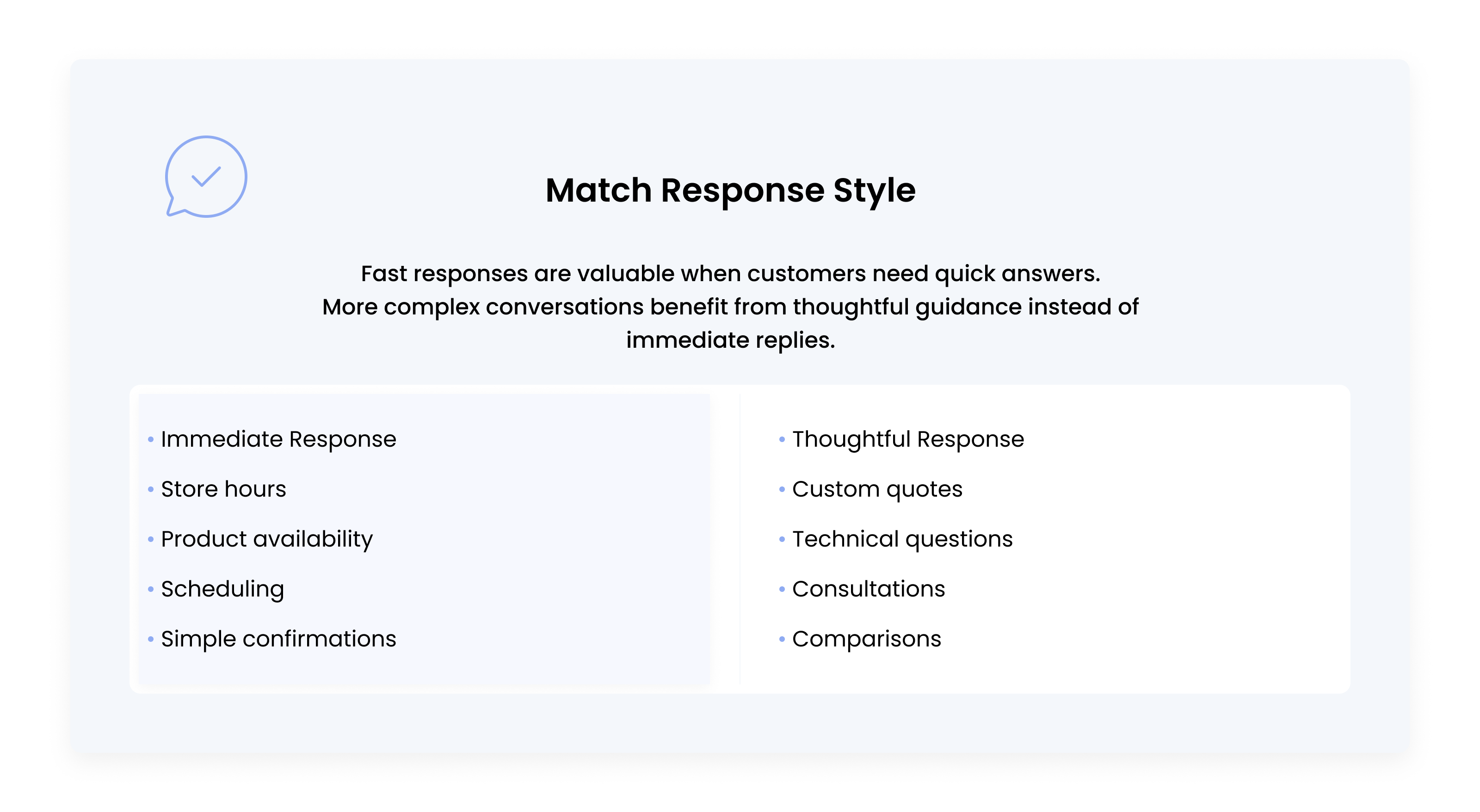
A practical approach is to sort incoming inquiries into tiers—simple, moderate, complex—and assign response windows accordingly. That kind of structured decision-making also supports the broader communication workflows discussed in How Businesses Handle 50+ Customer Conversations Per Day Without Chaos. This triage helps staff focus effort where it drives results.
Channel also affects timing expectations. SMS and phone messages demand quicker replies; emails tolerate longer waits. Ignoring these differences can frustrate customers or cause confusion.
One striking operator insight is that, “Customers rarely complain about waiting when they trust you’re working on their issue.” This trust, built through pacing and message quality, is fragile. Speed without substance can destroy it as quickly as silence.
Encountering a case where a reply came quickly but with incorrect details, one customer remarked, “It was fast, but now I’m more confused than when I asked.” Situations like this underline that timing alone doesn’t cut it—accuracy and relevance matter just as much.
Aligning Response Timing with Scaling Communication Practices
As businesses grow from solo operators to teams managing multiple communication channels, response timing needs to evolve alongside operations.
Consider a specialty medical supply company moving from owner-handled inquiries to a team covering phone, web chat, and email. Initially, the owner answered most questions personally and quickly, keeping things friendly and personal. But as volume increased, responsibility shifted to specialized teams.
Without clear handoff protocols, this change caused friction: patients calling after chats repeated questions, emails missed urgent phone flags, and no one owned the conversation from start to finish.
A nurse shared, “Sometimes I see a patient’s message waiting in email but their call comes through first—then I’m unsure if I’m supposed to prioritize the chat or the call.” This disconnect left emergency or high-priority inquiries waiting too long, while less urgent ones got fast but shallow replies—eroding patient confidence.
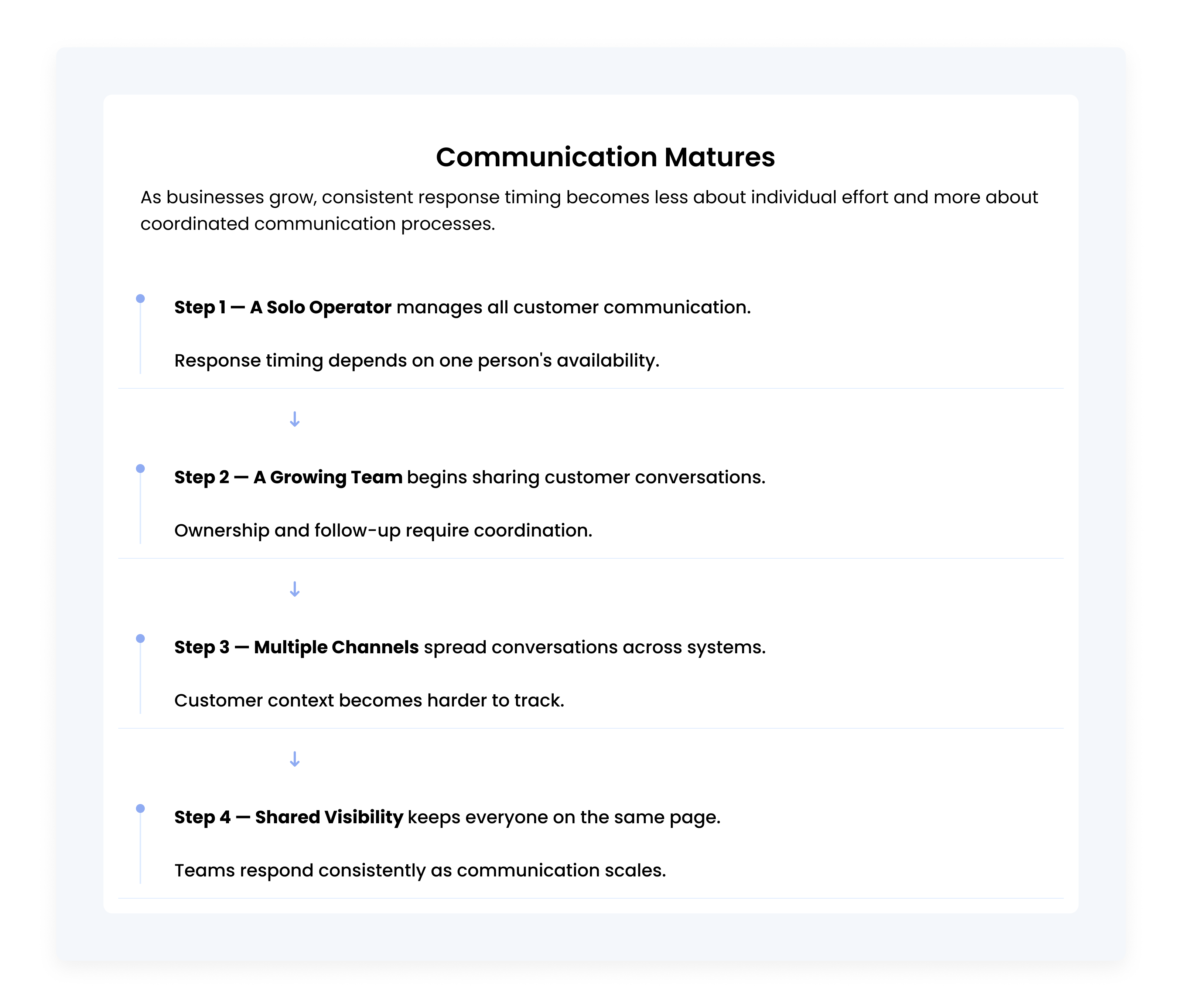
Scaling communication effectively means baking timing into team routines, not relying on individual effort alone. That means setting response standards for each channel and inquiry type, assigning ownership to avoid dropped threads, and ensuring visibility so no question goes unanswered.
A common complaint from team members during this transition was, “I spend half my day trying to figure out who’s on what, instead of actually responding.” This internal confusion leaks out to customers as delays and mixed messages.
Systems that bring clarity to inquiry status—who’s handling it, what’s been done—become vital. Building visibility into ownership naturally complements the practices outlined in How to Assign, Track, and Close Customer Conversations Efficiently. Equally important is coaching teams to treat timing as part of service quality, not just a speed metric.
Operators often say, “Activity is easy to see, but awareness turns it into progress.” Managing timing systematically brings that awareness to the whole team.
An operational observation worth noting here is how transparency in ownership directly influences response timing: when everyone knows who is accountable for each inquiry, the team avoids duplications and delays, maintaining smoother customer experiences even under growing workloads.
Where TMMN Fits In: Supporting Balanced, Effective Response Cadence
Technology alone doesn’t solve timing challenges, but TMMN lays a foundation for embedding thoughtful response cadence into daily operations.
TMMN’s platform unifies conversations from multiple channels into a single workspace, enabling teams to manage inquiries based on real-time status instead of scattered notifications. This clarity prevents questions from falling through the cracks and helps team members pace their replies to have the biggest impact.
It lets teams add notes and capture histories inside conversations, encouraging richer replies over quick, one-off messages. As businesses mature, TMMN shifts communication from simple texting toward full conversations where timing becomes strategic, not reactive.
For example, a staff member can acknowledge a customer promptly while holding back a full reply until more information is gathered or a colleague with more expertise can contribute. This measured pacing reassures the customer without rushing them.
Many teams using TMMN report fewer duplicated replies, clearer handoffs, and smoother follow-through—leading to better timing flow. Internal questions like “Who’s handling this?” almost disappear, reducing friction and missed chances.
Crucially, TMMN’s role is to create alignment in timing, not just speed up responses. It builds an environment where operators can make deliberate timing decisions confidently instead of guessing.
This kind of system support mirrors best practices any operator would seek—visibility, coordination, and pacing as tools to handle communication volume and complexity with consistency.
Key Takeaways
- Customers expect response timing to reflect the complexity of their inquiry; simple questions demand speed, complex ones reward thoughtful pacing.
- Immediate, transactional replies often neglect deeper engagement, while too slow responses risk losing interest entirely.
- Internal confusion over ownership and channel fragmentation frequently causes inconsistent timing and frustrated customers.
- Trust from customers hinges more on perceived effort and accuracy than on speed alone; rushed but shallow replies can backfire.
- Clear visibility and coordinated ownership among teams directly improve response timing and customer experience.
Conclusion
Finding the right pace for responding to customer inquiries is a practical, operational art. Customers want timely replies, but what they value more is meaningful engagement that recognizes their needs. Too-rapid but shallow answers can come off as indifferent, while delayed or scattered replies create doubt and let interest drift away.
As businesses grow and communication multiplies across channels and teams, maintaining this balance is tricky. Without clear coordination, response timing breaks down amid internal confusion and channel noise. But embedding thoughtful pacing into workflows and systems turns timing from a challenge into an asset.
Measured, deliberate response timing fits better with how customers think and behave than simply rushing to reply. Real-world examples and data show that well-timed, rich conversations convert far better than split-second, transactional messages.
Ultimately, treating response timing as a strategic capability means seeing communication as more than a task or cost—it’s a culture that shapes real connections, trust, and value. Designing systems and practices that evolve alongside your business helps keep communication sane and customer relationships strong. Seeing these communication practices in action during a 14-day free trial often highlights how consistent response management becomes easier as conversations stay organized over time.
TMMN’s structural approach supports this by bringing clarity and rhythm to conversations across channels and teams, fostering the paced, thoughtful engagement customers want and operators can sustain. The journey from quick contacts to rich conversations centers on mastering response timing as a key chapter.

.svg)
%20(1).png)