
Many businesses reach a point where customer communication starts to feel different.
At first, conversations are manageable. A few texts come in during the morning. A couple of phone calls happen throughout the day. Someone checks email between other responsibilities. Nothing feels particularly complicated because most interactions are happening inside the awareness of one or two people.
Then volume starts increasing.
Not overnight. Usually gradually.
A business that once handled 10 to 15 customer conversations per day begins handling 30. Then 40. Then 50 or more. The same processes that once felt efficient start creating subtle friction. Team members spend more time checking messages. Managers spend more time asking for updates. Customers begin waiting longer than expected for answers.
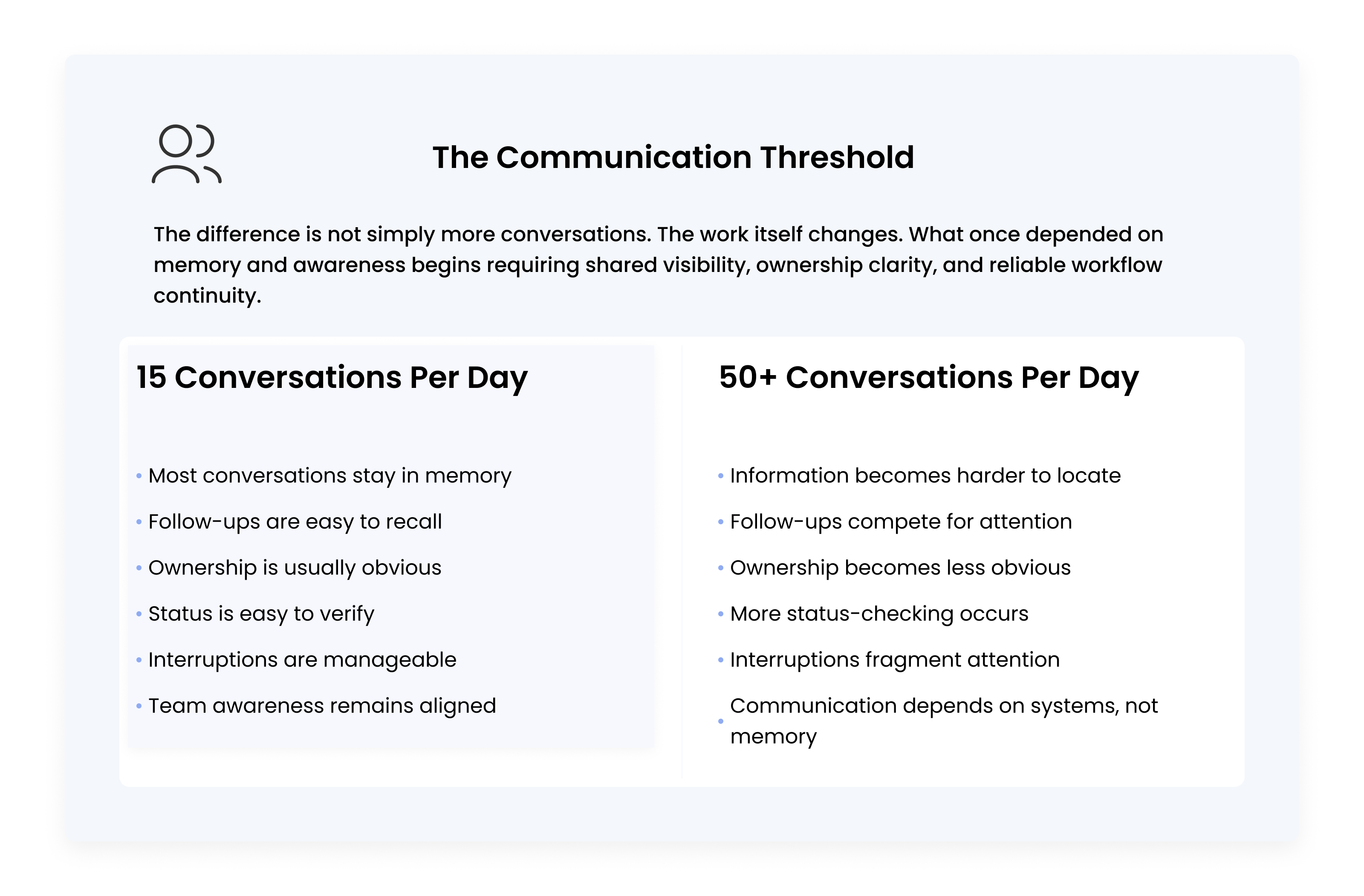
The difference between 15 conversations and 50 conversations is often difficult to appreciate until it happens.
At 15 conversations per day, a receptionist may remember which customer called earlier. A manager may remember promising a callback. A technician may remember that a quote is still outstanding. Most interactions remain inside the collective awareness of a small team.
At 50 conversations per day, the day looks very different. While one customer is requesting pricing, another is confirming an appointment. A third is asking for an update on work already scheduled. Several new inquiries arrive through a website form. Existing customers respond to messages sent earlier in the week. None of these interactions are unusual. The challenge is that they begin arriving simultaneously.
The challenge is not that communication suddenly becomes impossible.
The challenge is that communication stretches people’s ability to keep up.
Businesses that successfully handle high volume communication are rarely working harder than everyone else. In many cases, they are simply operating with systems that allow communication volume to increase without creating the same level of slowdowns and confusion.
When Conversation Volume Changes the Nature of Communication
There is an important threshold that many businesses never recognize until they are already experiencing the consequences.
At lower volumes, communication can be managed through awareness. People remember conversations. Team members know what happened earlier in the day. The owner can usually keep most customer interactions inside their head.
That works surprisingly well for a while.
The problem appears when communication volume grows faster than awareness can keep pace. Fifty conversations do not simply represent five times the work of ten conversations. They create a lot more moments when people are not sure who owns the next step or where the latest update lives.
A customer sends a text in the morning asking about availability. Another calls regarding pricing. Someone submits a website form. A previous customer follows up on a quote. A vendor sends an email requiring attention. Individually, none of these interactions are difficult.
Collectively, they create situations where no one is sure if someone else already handled part of the work. One reason this happens is that growing teams often lack a clear system for ownership and follow-through, which is why Why Businesses Lose Track of Customer Conversations (And How to Fix It) remains such a common operational challenge.
Consider a typical morning inside a growing business. A receptionist is speaking with a customer about scheduling while a text notification appears on screen. Before responding, an employee asks about an appointment status. A voicemail alert arrives. An email from a supplier requires attention. The receptionist returns to the original customer conversation only to realize part of the details are already slipping from memory.
Nothing dramatic happened.
No major failure occurred.
Yet several minutes of attention were pulled in multiple directions.
As communication volume rises, people stop managing conversations and start managing interruptions. The workday becomes fragmented into constant context switching. Messages pile up between responses. Follow-ups are left uncertain. Team members become increasingly reactive.
This is why many businesses feel busy long before they feel organized.
The issue is not effort. The issue is managing how much communication can fit into the day without slowing down progress.
Communication capacity is the ability to consistently move conversations forward even as more come in. Once a business reaches 50 or more daily interactions, keeping conversations moving becomes more important than just replying quickly.
A business can answer every message and still struggle to get things done. Conversations can be acknowledged without actually moving forward. Activity can increase while results stay the same.
That difference shows up in lost momentum more than ignored messages.
The Hidden Threshold Most Growing Businesses Eventually Reach
Consider a service company that receives approximately 55 customer conversations per day.
Some arrive through text. Others come through phone calls. A portion arrive through email. Several are existing customers requesting updates. Others are entirely new inquiries.
The company employs a receptionist, an office manager, and two field technicians.
At 8:30 AM a new customer texts asking for same-day service. The receptionist acknowledges the request and intends to coordinate with scheduling after handling several incoming calls.
By 11:00 AM the office manager has seen the message but assumes scheduling has already addressed it.
At 1:00 PM one technician becomes available unexpectedly due to a cancellation.
Nobody connects the available technician with the waiting customer.
The technician assumes the office manager has already reassigned the opening. The office manager assumes the receptionist already informed the customer. The receptionist believes scheduling is still being reviewed. This kind of breakdown rarely starts with bad intentions and more often reflects the same communication patterns discussed in What Happens When Teams Grow Without a Communication System.
Each assumption appears reasonable in isolation.
Together they stop the conversation from moving.
At 4:30 PM the customer sends another message asking if anyone is available.
The receptionist sees the follow-up and discovers that no appointment was ever scheduled.
By then, the customer has already contacted another provider.
Nobody ignored the customer intentionally.
Nobody made a major mistake.
The opportunity disappeared through accumulation.
Small assumptions stacked together until the conversation stopped moving.
A similar pattern often appears in quoting workflows.
A customer requests an estimate on Monday. Information is collected and passed internally. By Tuesday someone is waiting on pricing. By Wednesday another employee assumes the quote was already sent. By Thursday the customer follows up asking whether anyone had a chance to review the request.
The quote eventually goes out.
The customer has already selected another company.
Again, the issue was not effort.
The issue was momentum.
This type of situation happens over and over as communication volumes rise. What makes it tricky is that the business may still believe communication is working okay. Messages get answered. Phones get picked up. Emails get checked.
Yet important steps slip through cracks between moments of attention.
The hidden threshold shows up when communication no longer breaks because people aren’t available. It breaks because there is too much happening to keep track informally.
That threshold looks different for every business.
For some organizations it appears at 30 conversations per day. For others it appears closer to 80. The exact number matters less than recognizing when informal coordination stops working.

Why More Conversations Do Not Simply Mean More Work
Many owners assume communication scales linearly.
If ten conversations require one hour of attention, then fifty conversations should require five hours.
Real operations rarely behave that way.
Communication volume adds extra work that doesn’t come from direct handling.
Each conversation introduces more moments spent clarifying responsibility, checking status, tracking updates, and preserving context. As volume grows, coordination work often balloons faster than just replying to conversations one-by-one.
Imagine a business averaging six minutes of handling time per conversation.
At 15 conversations per day:
15 x 6 minutes = 90 minutes of communication activity.
At 50 conversations per day:
50 x 6 minutes = 300 minutes, or five hours.
At first glance, the increase seems manageable.
However, communication rarely consists only of direct response time.
Assume each conversation generates an additional three minutes of coordination work involving checking status, locating information, clarifying responsibility, reviewing previous interactions, or determining next actions.
Now the numbers change.
15 conversations:
135 total minutes.
50 conversations:
450 total minutes.
That equals 7.5 hours per day devoted to communication-related activity.
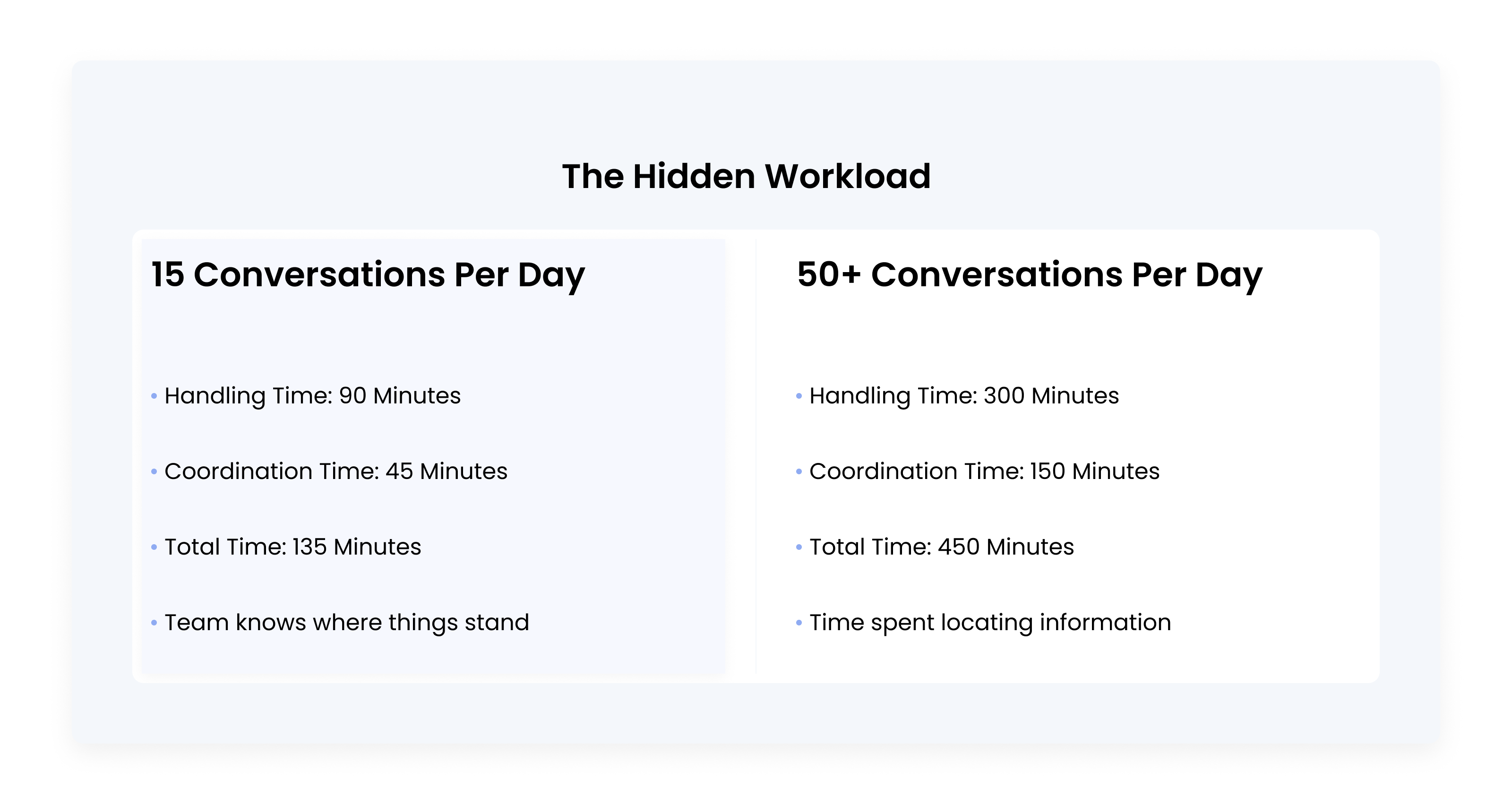
The increase is no longer proportional.
The business has not simply added conversations. It has added work managing how those conversations move.
The financial impact becomes clearer when including labor costs.
If communication-related work consumes 7.5 hours per day and average labor costs are approximately $25 per hour, that represents roughly $187 per day in communication handling and coordination activity.
Over a month, that approaches $4,000.
Over a year, it approaches $48,000.
Those figures don’t represent wasted money. They show how communication quietly takes up time meant for other work.
This is why many organizations feel overwhelmed even though staffing and customer expectations stay the same. Communication growth quietly eats into the time employees have available for other tasks.
The result is often slower sales cycles, more overtime, delays in decisions, and less ability to take on new customers.
The cost doesn’t always show up plainly in financial reports.
It shows up in missed chances.
It shows up in lost momentum.
It shows up in the extra hours it takes just to keep up.
What Modern Customers Expect From High-Volume Communication
Customer expectations have changed substantially during the past decade.
Most customers no longer separate communication into channels.
They do not think, "I sent a text message."
They think, "I contacted the company."
That distinction creates important implications.
Customers assume businesses remember prior interactions. They assume context carries forward. They assume information shared earlier remains available later.
When those assumptions are violated, trust begins eroding.
Often quietly.
Consider a customer researching several providers simultaneously.
They contact Company A and Company B within the same afternoon.
Company A responds quickly but asks the customer to repeat information already provided earlier in the day.
Company B responds later but demonstrates familiarity with the prior conversation.
Many customers interpret the second interaction as more organized and more trustworthy.
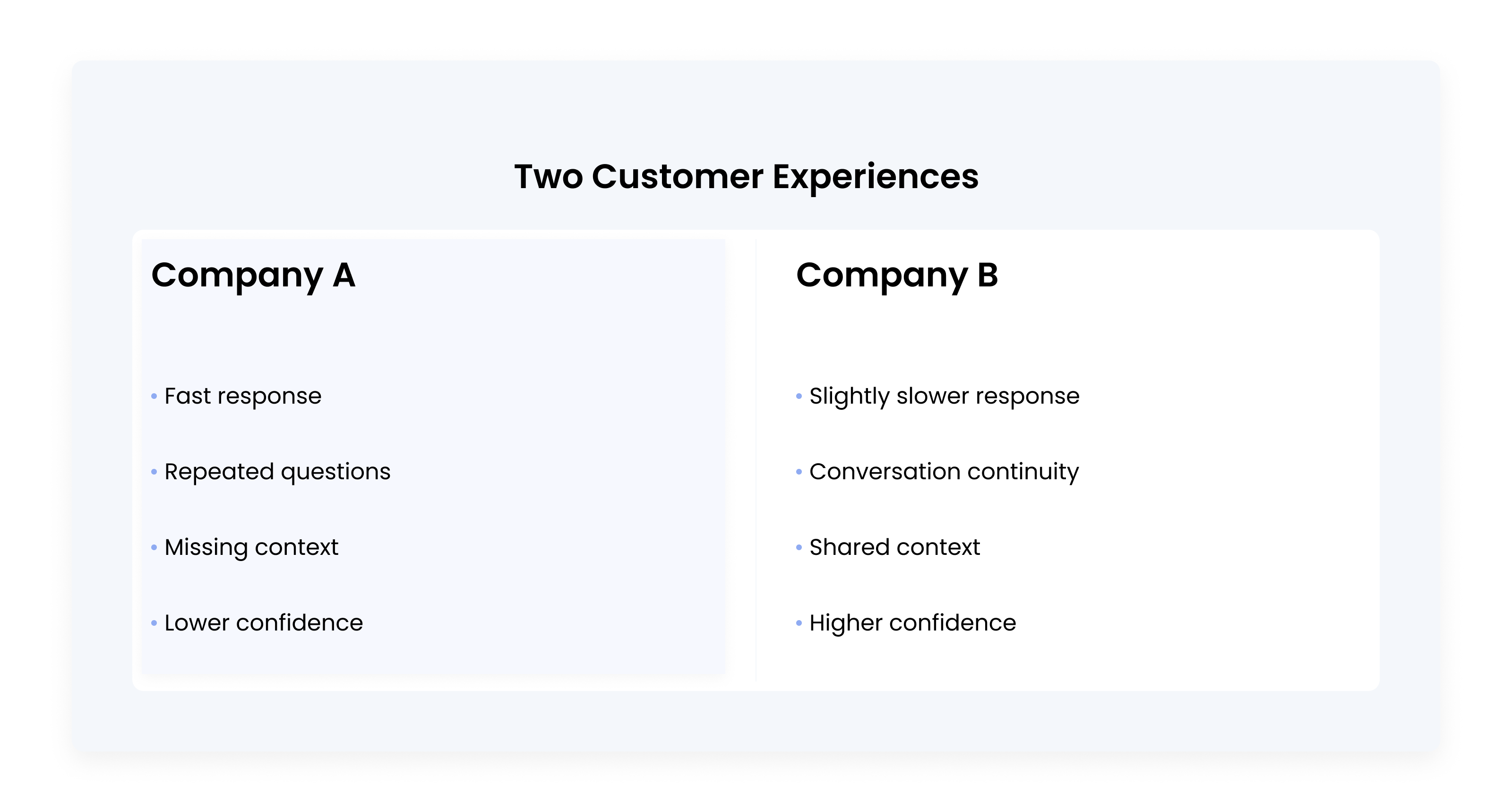
The difference is not necessarily speed.
The difference is confidence.
That comparison often continues across multiple interactions.
The customer requests a quote.
Company A responds promptly but loses track of previous details during follow-up discussions.
Company B responds slightly slower but references prior conversations accurately, understands the project history, and maintains continuity throughout the process.
By the time a purchasing decision is made, the customer may view Company B as the safer choice even if both companies offer similar pricing and service quality. Customers often judge reliability based on consistency rather than speed alone, which closely aligns with the expectations outlined in What Customers Expect When Contacting a Business — Modern Communication Standards.
Silence creates uncertainty.
Repeated questions create uncertainty.
Conflicting information creates uncertainty.
When uncertainty grows, customers naturally seek alternatives.
Rarely because they are angry.
Usually because they are attempting to reduce risk.
One of the most overlooked realities of customer behavior is that people often leave before a relationship feels broken. Doubt develops gradually. Small inconsistencies accumulate. Confidence weakens.
Then they stop responding.
From the business perspective, it can feel sudden.
From the customer's perspective, the decision often began much earlier.
The Capacity Equation Behind Communication Growth
Handling high volume communication effectively requires understanding capacity beyond staffing counts.
A business with five employees is not automatically more capable than a business with three.
Capacity depends on how communication moves.
Three questions matter:
Can conversations be found?
Can responsibility be identified?
Can progress be verified?
When those questions cannot be answered consistently, communication capacity becomes limited regardless of team size.
One useful way to evaluate communication readiness is through what can be called the Capacity Equation.
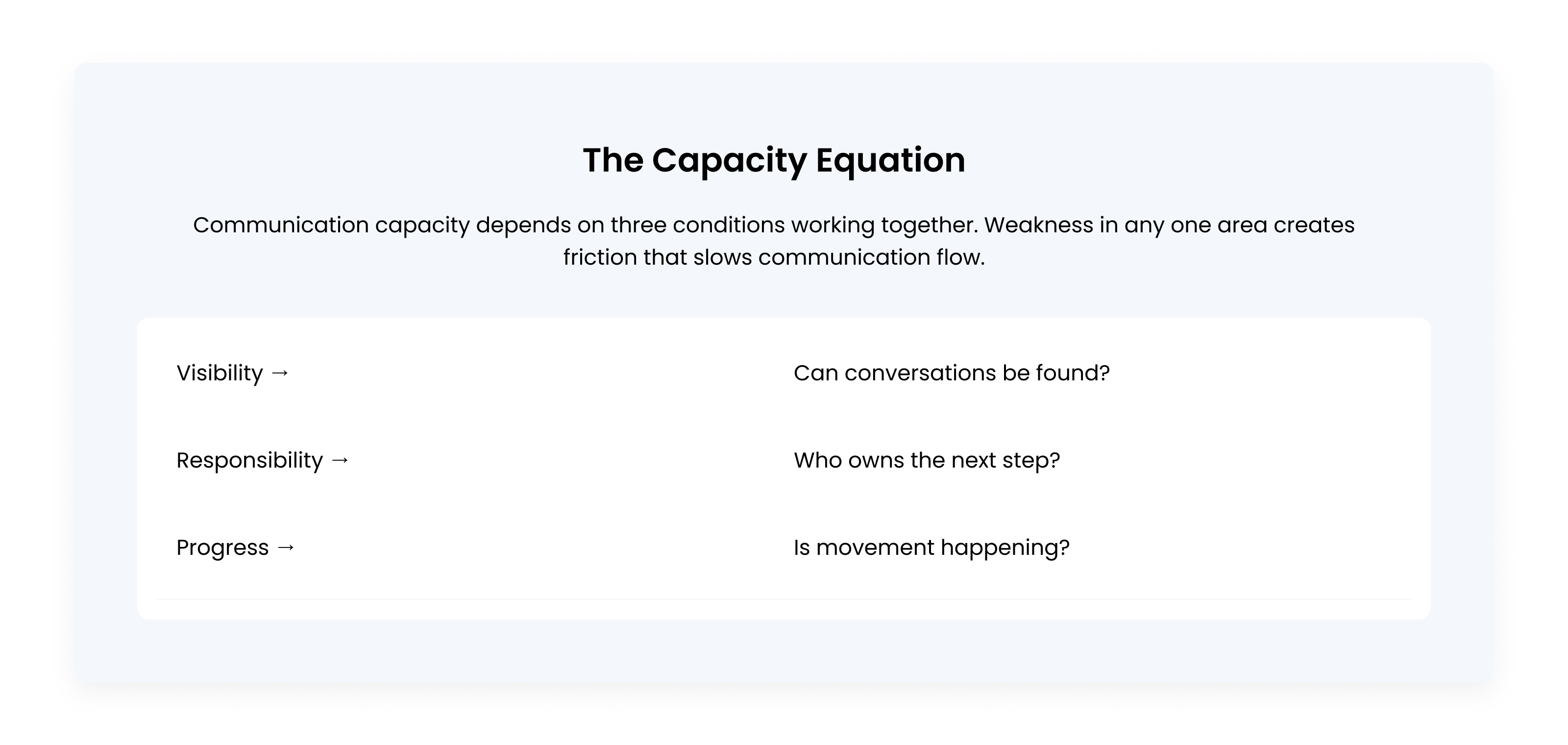
Visibility.
Responsibility.
Progress.
Visibility means conversations remain accessible when needed.
Failure looks like searching through text threads, email chains, notes, and memory.
In many organizations, visibility problems reveal themselves through delays. A customer calls asking about a previous discussion. Everyone knows the conversation happened. Nobody can immediately locate the details. Several minutes are spent searching before anyone can move forward.
Responsibility means someone understands what happens next.
Failure looks like multiple people assuming someone else is handling the situation.
Responsibility problems are often disguised as teamwork. Everyone is aware of the issue. Nobody owns the next action. Communication appears active while accountability becomes diluted.
Progress means movement can be verified.
Failure looks like conversations sitting idle while everyone believes work is advancing.
A quote can be acknowledged. A service request can be received. A follow-up can be promised. Yet none of those actions guarantee forward movement. Progress exists only when the conversation advances toward an outcome.
These elements sound simple.
Yet most communication blockages appear when one of them weakens.
Organizations often focus on answering messages while missing whether conversations actually move forward.
A response acknowledges a conversation.
Progress advances a conversation.
Those are not the same thing.
One experienced operator observation appears repeatedly across growing businesses:
Communication problems rarely begin with missing messages. They begin when nobody can confidently explain what should happen next. In practice, that uncertainty usually becomes visible first through missed ownership, unclear routing, and delayed follow-up, all of which are explored in How to Route Customer Messages So Nothing Gets Missed.
The businesses that handle larger communication volumes successfully tend to manage visibility, responsibility, and progress simultaneously.
That combination raises capacity without needing a lot more people.
Diagnosing Communication Capacity Before Problems Appear
Most communication problems become visible only after consequences emerge.
A customer leaves.
A follow-up is missed.
A quote goes unanswered.
An appointment slips.
By that point, the underlying issue has often existed for weeks or months.
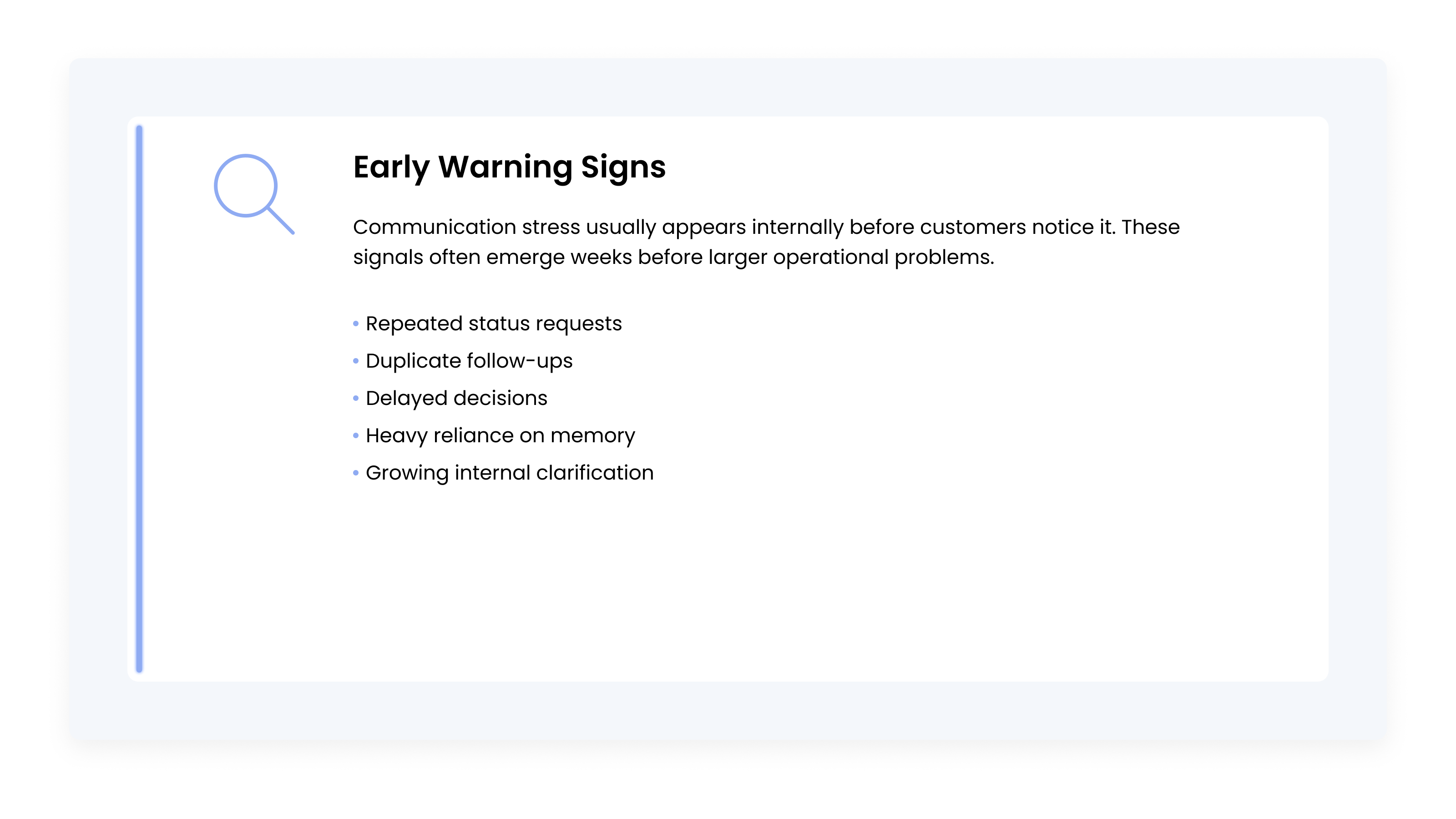
A more useful approach involves identifying early signals.
One signal is repeated status checking.
If team members constantly ask for updates, communication awareness may be scattered.
When several employees ask for status updates dozens of times per week, the organization is often covering for missing visibility.
Another signal is duplicate work.
When multiple people provide the same information or perform the same follow-up, coordination efficiency is declining.
A third signal involves delayed decision-making.
Conversations keep happening, but movement slows because nobody clearly owns the next step.
Perhaps the most important signal is growing reliance on individual memory.
When communication quality depends heavily on specific people remembering details, scalability becomes fragile.
A vacation, sick day, or staffing change can expose weaknesses immediately.
Communication systems are often tested during ordinary days, not extraordinary ones.
Businesses frequently prepare for spikes in volume while overlooking the steady buildup of normal growth.
One useful observation is that communication strain often becomes visible internally before customers notice it externally. Employees spend more time asking questions. Managers spend more time clarifying status. Follow-ups require more effort than they once did.
Those signals frequently appear weeks before customer-facing problems emerge.
The goal is not perfection.
The goal is creating enough operational stability that communication remains manageable even when volume increases unexpectedly.
Building Operational Readiness for Higher Conversation Volume
Operational readiness begins with accepting that communication growth means more handoffs and more opportunities for confusion.
The objective is not eliminating human judgment.
The objective is cutting down on how often people are not sure what to do next.
People should spend time solving customer problems rather than hunting for context.
That requires creating environments where communication stays visible, responsibility stays clear, and progress stays measurable.
This is where communication infrastructure becomes increasingly important.
Not because software automatically solves operational challenges.
It does not.
Technology highlights existing processes. Good processes get stronger. Weak processes become obvious.
Organizations that handle communication growth well think beyond individual conversations. They look at how conversations flow through the business over time.
They check how handoffs work.
They follow up on steps that span departments, shifts, or locations.
Many slowdowns happen during those handoffs.
The original conversation may be clear. The customer request may be understood. The problem shows up when responsibility moves from one person to another and details get lost along the way.
As volume grows, those handoff moments become deal breakers.
This process view is why many businesses move toward more unified communication environments. The goal is not just simplifying technology. The goal is cutting down the friction that comes with more volume.
Platforms such as TMMN can support that alignment when communication needs get more complicated, but the lesson is bigger than any tool.
Communication scalability starts with how work is designed.
Technology simply helps make that design easier to follow.
As communication ecosystems grow, including future unified approaches like those planned within Spoken Touch, the organizations that adapt best will be the ones that treat communication like a core business capability instead of a mix of separate tasks. Many growing organizations eventually discover that scaling communication requires more than adding channels, a theme explored further in Why Texting Alone Isn’t Enough as Your Business Grows (And What Works Instead).
Key Takeaways
- Communication volume eventually becomes a challenge about how much can fit into the day, not just how many messages come in.
- Small assumptions and unclear ownership often cause more breakdowns than lost messages.
- High-volume communication depends on conversations being easy to find, clear on who is responsible, and actively moving forward.
- Customers notice confidence and continuity as much as speed.
- Operational slowdowns usually show up inside the business before customers see a problem.
Conclusion
Businesses handling 50 or more conversations per day are not just dealing with a bigger version of lower volume challenges.
They face a different problem altogether.
Communication volume eventually stops being about how fast messages get answered and starts being about keeping all the moving pieces moving.
The organizations that succeed recognize that more conversations bring more handoffs, more missed details, and more moments when nobody knows who owns the next step.
One practical insight stands out.
Communication problems don’t happen suddenly. They build up over time.
Small delays.
Small assumptions.
Small moments when people aren’t sure what happens next.
Those moments pile up until the whole system slows down.
Another observation is clear across businesses that grow quickly.
Most communication failures aren’t from careless mistakes. They come from people trying to do their best in an environment overwhelmed by volume.
The businesses that keep working well as conversations multiply are usually the ones that spot these patterns early and put systems in place to keep conversations moving before things start to fall apart. For businesses evaluating ways to improve communication visibility, ownership, and follow-through, a 14-day free trial can provide a practical look at how structured communication workflows operate under real-world conditions.
Additionally, it’s common to see that by the end of the day, people are certain a conversation happened but not sure who was supposed to follow up. Sometimes, important emails disappear in a flood of other messages and are never answered, even though everyone thinks someone else took care of them. The risk isn’t just losing messages but losing track of what’s next.

.svg)