


A customer says an exception was approved. An employee describes a process that differs from written policy. A manager mentions that pricing will change next month. Each statement may matter. None should quietly rewrite how the business operates.
That is the boundary between conversation evidence vs business truth.
Conversation evidence records what someone said in a particular situation. It can reveal useful information, ambiguity, disagreement, or a possible change. Business truth is information the organization has reviewed, authorized, and accepted as current operating context.
Confusing the two creates an authority problem. A situational exception becomes a standing rule. A planned change is treated as already effective. An individual’s interpretation becomes the company’s approved position—even though nobody made that decision.
The answer is not to dismiss conversational information. It is to give that information a visible status, preserve where it came from, and place review between “someone said this” and “the business now treats this as true.”
Why conversation evidence and business truth are not the same
A conversation captures a statement, not an organizational decision.
For operators, Conversation History vs Conversation Intelligence: Understanding the Key Differences is an operational distinction: a stored exchange supports review, but it does not establish approval.
The speaker may be correct. They may also be describing an exception, repeating outdated information, proposing a future change, or speaking beyond their authority. The statement can still be worth preserving, but its value as evidence does not automatically make it an approved instruction.
Consider the difference between these records:
> “The customer said their account manager approved weekend delivery.”
> “Weekend delivery is approved for this account through December 31.”
The first reports a statement. The second presents current operating context. Moving from one to the other requires decisions: Was approval actually given? Did the account manager have authority? Does it apply to one delivery or the entire account? Is there an expiration date? Does it conflict with another operating condition?
Repeating the original statement cannot answer those questions.
This distinction matters whenever conversational information may influence later work. A person or system encountering the statement needs to know whether it is evidence to consider, a proposed change awaiting a decision, or approved context that can guide action.
Without a visible distinction, authority can become implied rather than assigned. The latest or most confidently expressed statement may appear authoritative even when it has never been reviewed.
An operator’s job is therefore not only to capture information. It is to control the transition between information and authority.
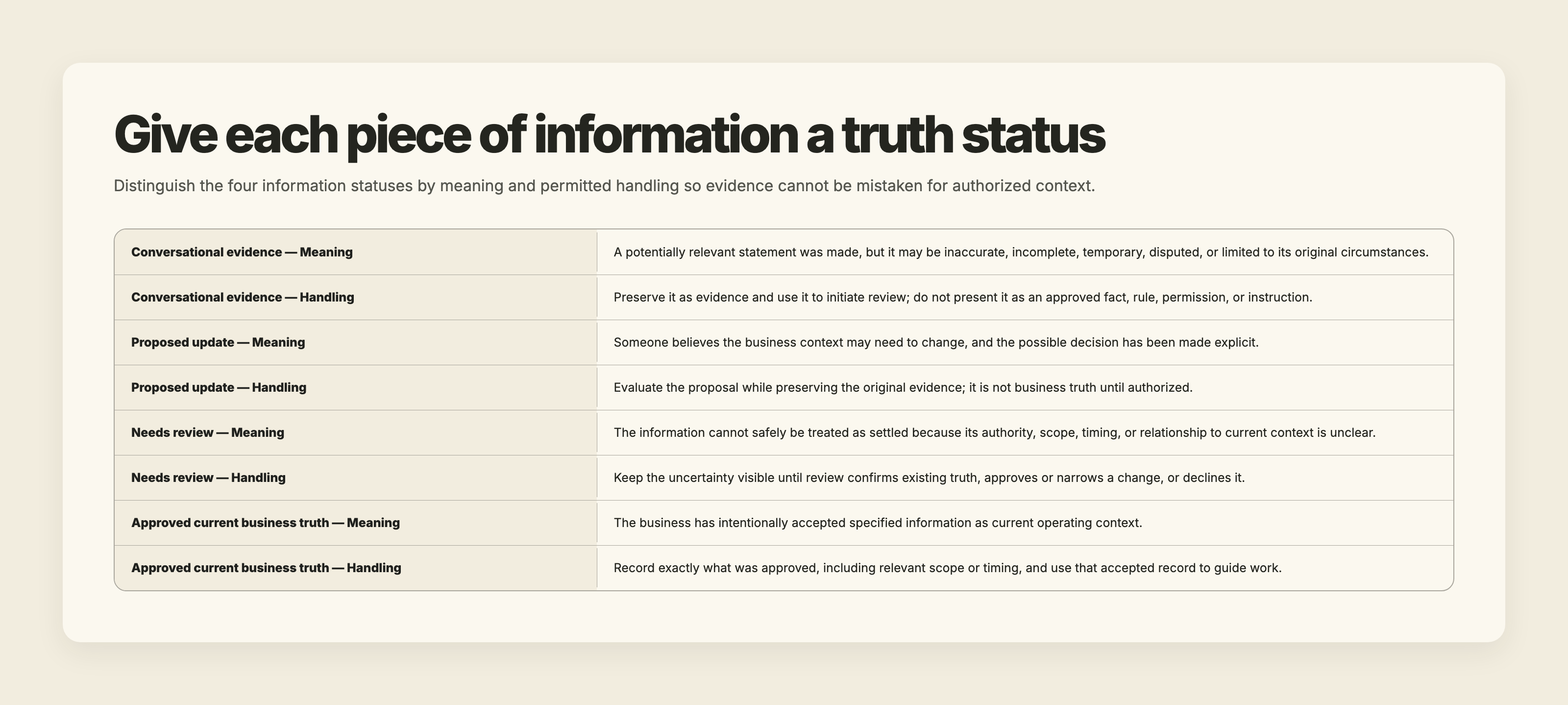
Give each piece of information a truth status
A practical status model can prevent conversational information from drifting into policy or knowledge by accident. The labels do not need to be elaborate, but they must make the information’s standing clear.
Conversational evidence
This status means: *This was said.*
It identifies a statement as potentially relevant without presenting it as an approved fact, rule, permission, or instruction. The evidence may be accurate, inaccurate, incomplete, temporary, disputed, or limited to its original circumstances.
Conversational evidence can initiate review. It should not silently govern later work.
Proposed update
This status means: *Someone believes the business context may need to change.*
A proposed update translates a statement into something an operator can evaluate. Instead of leaving “We make exceptions for nonprofit customers” buried in a conversation, the proposal might say: “Determine whether nonprofit customers qualify for a documented exception.”
That translation preserves the original evidence while making the possible decision explicit. A proposal is still not business truth because it has not been authorized.
Needs review
This status means: *The information cannot safely be treated as settled.*
Review may be necessary because the statement’s authority, scope, timing, or relationship to existing context is unclear. It may also conflict with information the business already treats as current.
This status should remain visible. Otherwise, uncertainty can disappear while the uncertain statement remains. Review may confirm the existing truth, approve a change, narrow the proposal, or decline it.
Approved current business truth
This status means: *The business has intentionally accepted this information as current operating context.*
Approval should identify exactly what has been accepted. A reviewer may approve one part of a statement while rejecting another. The resulting record should reflect the actual decision, including relevant scope or timing.
The essential separation is simple:
Evidence says what was reported. Approved business truth says what the organization currently stands behind.
Preserve provenance before treating a claim as usable context
A reviewer needs more than an isolated sentence. They need enough provenance to understand what they are being asked to assess.
Useful provenance answers questions such as:
- Where did the statement come from?
- Who said it, and when?
- What account, transaction, location, or situation was involved?
- Was the speaker describing an existing rule, requesting an exception, or proposing a future change?
- Is there related information that affects the statement’s meaning?
This is not about retaining detail for its own sake. It is about preserving the path back to the evidence.
Suppose an operator encounters the claim, “Returns are now accepted within 60 days.” By itself, that sentence looks like a settled policy. With its source attached, the operator may discover that it came from a customer asking for an extension on one delayed shipment.
The wording is similar, but the operational meaning is completely different.
Provenance allows a reviewer to inspect the original setting, compare the claim with approved context, and make an intentional decision. The source does not grant authority. It makes the claim assessable.
Use review to turn evidence into an intentional business decision
Review is the control point between a conversational signal and approved operating context.
It should not be reduced to a generic approval click. The reviewer must decide whether the proposed information is correct, current, appropriately scoped, and suitable for the business to authorize.
Four questions help structure that decision:
1. What exactly is being claimed?
Rewrite vague or situational language as a clear proposed update. If the claim cannot be stated clearly, it is not ready to become business truth.
2. Who has authority to decide?
The person who mentioned a change is not necessarily the person who can approve it. The reviewer needs authority over the affected policy, account, process, or operating condition.
3. Where and when does the claim apply?
Determine whether it is company-wide, location-specific, account-specific, temporary, transaction-specific, or prospective. Treat the governance question— What Should an AI Remember About Your Business? Governance Explained —as a scope-control decision before deciding what to retain.
A correct statement with the wrong scope becomes incorrect context.
4. What is the resulting business truth?
Record the decision directly. Future operators should not have to reconstruct it from comments, discussions, or the original conversation.
Review may end in approval, revision, or decline.
If approved, the proposal becomes current business truth within its accepted scope. If revised, only the revised wording receives that status. If declined, the original statement remains evidence that the claim was made—not a rule the business recognizes.
That prevents conversation-derived information from acquiring authority through repetition alone.
A hypothetical customer-requested exception
Consider this hypothetical example: a service business has a standard scheduling rule requiring 48 hours’ notice.
During a conversation, a customer says:
> “Your manager told me our account can book with 24 hours’ notice.”
The statement may identify a real account-level exception. It may refer to a one-time accommodation, reflect a misunderstanding, or lack authorization. At this point, the operator does not know.
The statement can therefore be preserved as conversational evidence, together with its source and context. It should not automatically replace the scheduling rule or create a new permission.
A proposed update might read:
> “Review whether this customer account has an approved 24-hour scheduling exception.”
The business now has a defined decision to make. An operator can compare the claim with the current rule, identify the manager involved, confirm whether that manager had authority, and determine the intended scope.
Several outcomes are possible.
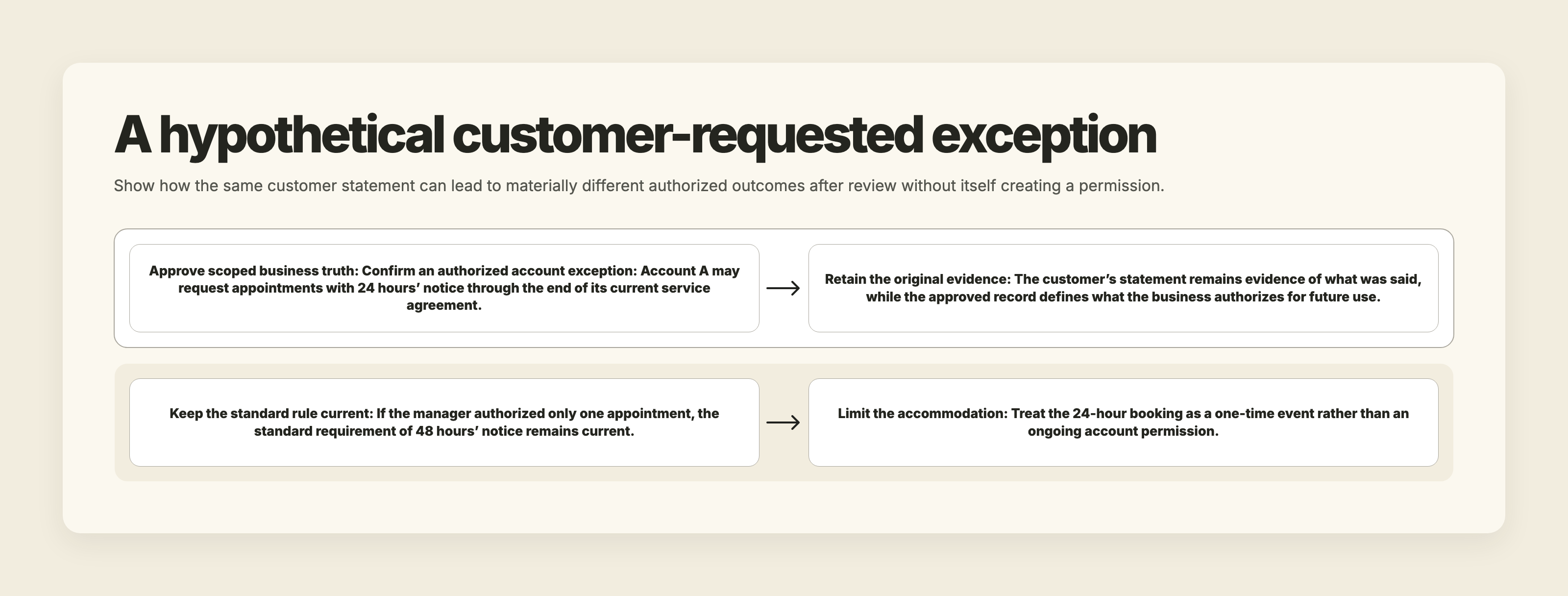
The operator might confirm a standing account exception and approve this scoped business truth:
> “Account A may request appointments with 24 hours’ notice through the end of its current service agreement.”
Alternatively, the manager may have authorized only one appointment. The 48-hour standard would remain current, while the accommodation would be treated as a one-time event rather than an ongoing rule.
The operator might also find no authorization and decline the proposed update.
In every outcome, the customer’s statement remains evidence of what was said. What changes is whether—and in what form—the business authorizes that information for future use.
This hypothetical does not assume that every conversation enters an automatic learning process. It describes what to do when a conversational statement is selected because it may affect operating context: preserve it, assign a status, and review it before granting authority.
Make correction possible by keeping evidence and approval distinct
Business information changes. A temporary exception expires. A decision is reversed. A policy takes effect later than expected. An approved statement proves too broad.
Correction becomes harder when source evidence and approved conclusions are blended together. If an operator cannot distinguish what was said, what was proposed, and what was authorized, updating the current record may obscure the decision history.
Keeping those layers distinct provides a clearer path. This distinction helps explain Why Businesses Lose Customer Context Despite CRM Records: preserving a statement does not necessarily preserve the context around it.
The evidence records the original statement. The proposal shows what change was considered. The approved truth shows what the organization accepted at that time.
A later review can revise current business truth without pretending the earlier conversation never occurred. Historical evidence may remain available while being visibly different from current operating context. Its continued existence does not restore its authority.
The objective is not to preserve every old statement forever. It is to make current truth deliberately correctable rather than silently overwritten.
An operator checklist for conversation-derived information
When information from a conversation may affect policy, knowledge, permissions, or operating decisions, use this test.
1. Identify the exact statement
Record the actual claim without broadening it.
“Sam approved free delivery for this order” is not the same as “Sam approves free delivery” or “Delivery is free.” Preserve the original scope.
2. Preserve its provenance
Attach enough context for another reviewer to understand where the claim came from and what situation it addressed. Include the speaker, timing, subject, and surrounding circumstances when available.
Do not separate a claim from the context needed to assess it.
3. Assign its current status
Mark the information as conversational evidence, a proposed update, needing review, or approved current business truth.
If its status is unclear, it needs review. Uncertainty should not default to approval.
4. Decide whether an operating decision is required
Not every statement needs to change business context. Some can remain evidence without further action.
If the claim could alter how the business answers, promises, permits, schedules, charges, or otherwise operates, state the proposed decision explicitly. Make clear what would change if approved.
5. Send it to an authorized reviewer
The reviewer should be able to determine whether the claim is correct, current, and appropriate within the proposed scope. Familiarity with the conversation is not a substitute for decision authority.
6. Record the decision separately
Do not make future operators infer the outcome from the original statement or review discussion. Record the approved wording, scope, and timing directly.
If the proposal is declined, preserve that outcome as well. A declined claim should not repeatedly return as though no decision was made.
7. Use only approved, current context as business truth
Evidence can inform review. Proposals can organize change. Neither should present itself as settled operating context.
Before conversation-derived information guides future work, ask:
Treat the distinction plainly— Customer Memory vs CRM: Understanding the Differences —because remembered context should not be treated as approval.
Can I point to the moment when the business intentionally approved this exact claim for this exact scope?
A 14-day free trial can help you evaluate how these ideas fit your workflow.
If the answer is no, treat it as evidence—not truth.

.svg)

