Where Customer Conversations Actually Break Down
At first, nothing looks broken.
Messages are getting answered. Phones are being picked up. Emails are going out. From the outside—and even internally—it feels like the team is handling communication. There’s activity everywhere. Notifications are firing. People are busy.
That’s exactly why the problem hides so well.
What’s actually happening underneath is different. Conversations aren’t being managed—they’re being reacted to. Each message gets treated like a standalone event instead of part of an ongoing thread. One person replies to a text. Another picks up a call. Someone else answers an email. No one sees the full picture, and no one is really expected to. That’s exactly the kind of breakdown behind Why Visibility in Customer Communication Matters for Small Businesses.
Fragmentation rarely looks like failure. It looks like busyness.
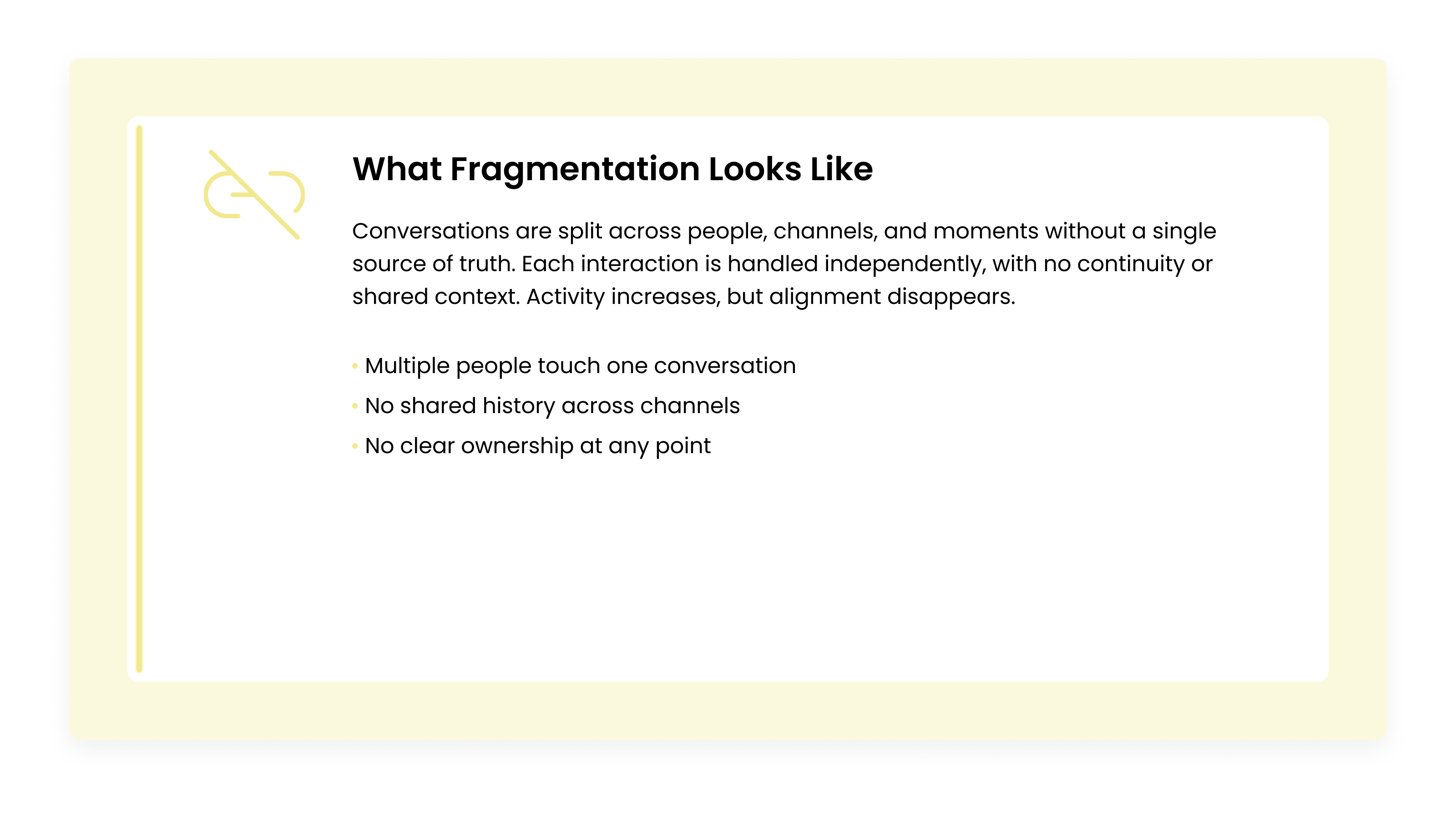
The breakdown usually starts small. A customer texts about a service. Someone replies quickly. Later that same customer calls to follow up. A different team member answers, scrolls through nothing, and asks, “Can you tell me what this is about?” The customer repeats everything. The call ends with “we’ll get back to you.” It gets written on a sticky note, or dropped in Slack, or mentioned out loud. No one follows up.
Now layer in time.
Morning: a new inquiry comes in. It gets a quick reply. Midday: the customer asks a follow-up question. It’s opened, skimmed, and left unread. Someone assumes someone else will handle it. End of day: the message is still sitting there, pushed down by newer notifications.
No alarms go off. No system flags it. The conversation simply fades.
There’s another version of this that happens internally. A receptionist flags a message for the office manager. The office manager assumes the technician will handle it. The technician assumes it’s already been scheduled. By the time anyone circles back, the thread has gone cold. No one ignored it. Everyone touched it. But no one owned what happened next.
Fragmentation doesn’t usually feel like failure. It feels like everyone did something, but nothing actually moved forward.
This is where most lost customer conversations actually happen—not in dramatic failures, but in quiet gaps between activity and awareness. And once more than one person is involved, those gaps stop being occasional. They become how the business runs.
The Hidden Cost of Lost Conversations
The cost of lost customer conversations almost never shows up clearly.
It doesn’t hit a dashboard. It doesn’t trigger a warning. Instead, it shows up in subtle ways—“we’re busy, but something feels off.” Leads feel inconsistent. Close rates fluctuate. The team works harder, but results don’t move the way they should.
To see it, you have to slow things down and put numbers to what’s happening.
Take a realistic small service business—an HVAC company handling around 120 inbound conversations per day across calls, texts, and web inquiries. Not all are new leads, but a meaningful portion are. Let’s say 40 of those are active opportunities.
Now assume a conservative breakdown rate: 10% of those conversations don’t get properly followed up.
That’s 4 missed opportunities per day.
If the average job value is $350, that’s $1,400 in potential daily revenue that quietly disappears. Over a five-day week, that becomes $7,000. Over a month, that’s $28,000.
Even small improvements here compound quickly. If that loss is cut in half, the business isn’t just improving operations—it’s recovering revenue that was already within reach. It’s the same pattern behind Why Small Businesses Lose Customers to Missed Messages (And How to Fix It)—not a dramatic failure, just enough missed follow-through to soften the pipeline and drag revenue down.
The math is there. The visibility isn’t.

Activity is easy to see. Ownership is where things usually disappear.
Zoom into one moment inside that same business. A customer texts asking about availability. The receptionist replies and says a technician will call shortly. The message gets passed verbally while someone is walking out the door. The technician gets pulled into another job, finishes late, and forgets. The call never happens.
The same pattern shows up in other environments. A small law office receives an inquiry about a consultation. An assistant logs it in a spreadsheet, then jumps to another task. The attorney assumes it’s already booked. The assistant assumes the attorney reached out. The lead refreshes their email once, then stops checking. Two days later, they’ve already signed with another firm.
The customer waits a few hours. Then a full day. Then they stop waiting.
By the time anyone realizes nothing happened, the opportunity is gone. Not because the business ignored the customer—but because the conversation had no structure holding it together.
Missed conversations don’t show up as losses. They show up as slower months, softer pipelines, and “we should have been busier.”
Why “Replying Faster” Doesn’t Fix the Problem
When businesses start to feel this breakdown, the first instinct is almost always speed.
Reply faster. Call back quicker. Reduce response time.
It sounds reasonable. But speed alone doesn’t resolve what’s underneath.
A business can respond instantly and still lose the conversation.
A customer asks for a quote. Someone replies within minutes. The customer sends more details. The message gets opened on a phone, partially read, then left for later. A new notification comes in. The thread drops down. No one goes back.
From the outside, the business looks responsive. Internally, it feels like communication is happening.
But the conversation is already drifting.

This is where most teams get stuck in surface-level fixes. They add more tools, thinking better technology will solve it. Now they have multiple inboxes, call logs, notifications, and platforms—all working separately. That’s the exact operational drag described in The Hidden Cost of Too Many Communication Tools in Growing Businesses. Instead of solving the problem, they create more places for conversations to stall.
They try to enforce discipline. “Make sure you follow up.” “Stay organized.” But in practice, that turns into mental checklists, sticky notes, or quick mentions that get lost within hours.
They assume everything is somewhere—email, text, notes. But when someone actually needs to act, they spend two minutes searching, don’t find what they need, and move on.
The real issue isn’t how fast a message is answered.
It’s whether the conversation has a clear owner, a visible history, and a defined next step.
Without those three things, conversations don’t break. They lose momentum one step at a time until they disappear.
How Modern Customers Expect Conversations to Work
Customers don’t think in channels.
They don’t separate their experience into text, call, or email. To them, it’s one continuous interaction with your business. They expect you to remember what they already said, regardless of how they reach you. That expectation sits at the center of What Customers Expect When Contacting a Business — Modern Communication Standards.
That expectation isn’t stated—it’s assumed.
If they text in the morning and call later, they expect continuity. If they spoke to someone yesterday, they expect today’s interaction to pick up where it left off.
When that doesn’t happen, something shifts.
They don’t usually complain. They don’t escalate. They don’t send angry messages.
They pause.
They open your message, read it, and don’t reply right away. They switch tabs. They search for another provider. They send a second inquiry somewhere else. They compare how each conversation feels.
In many cases, that shift happens the same day. A customer reaches out to two providers. One continues the conversation smoothly. The other resets or stalls. By the afternoon, the decision is already made—even if no one says it out loud.
“I already explained this.”
“Do they even know what’s going on?”
“I don’t want to deal with this again.”
And then they stop replying.
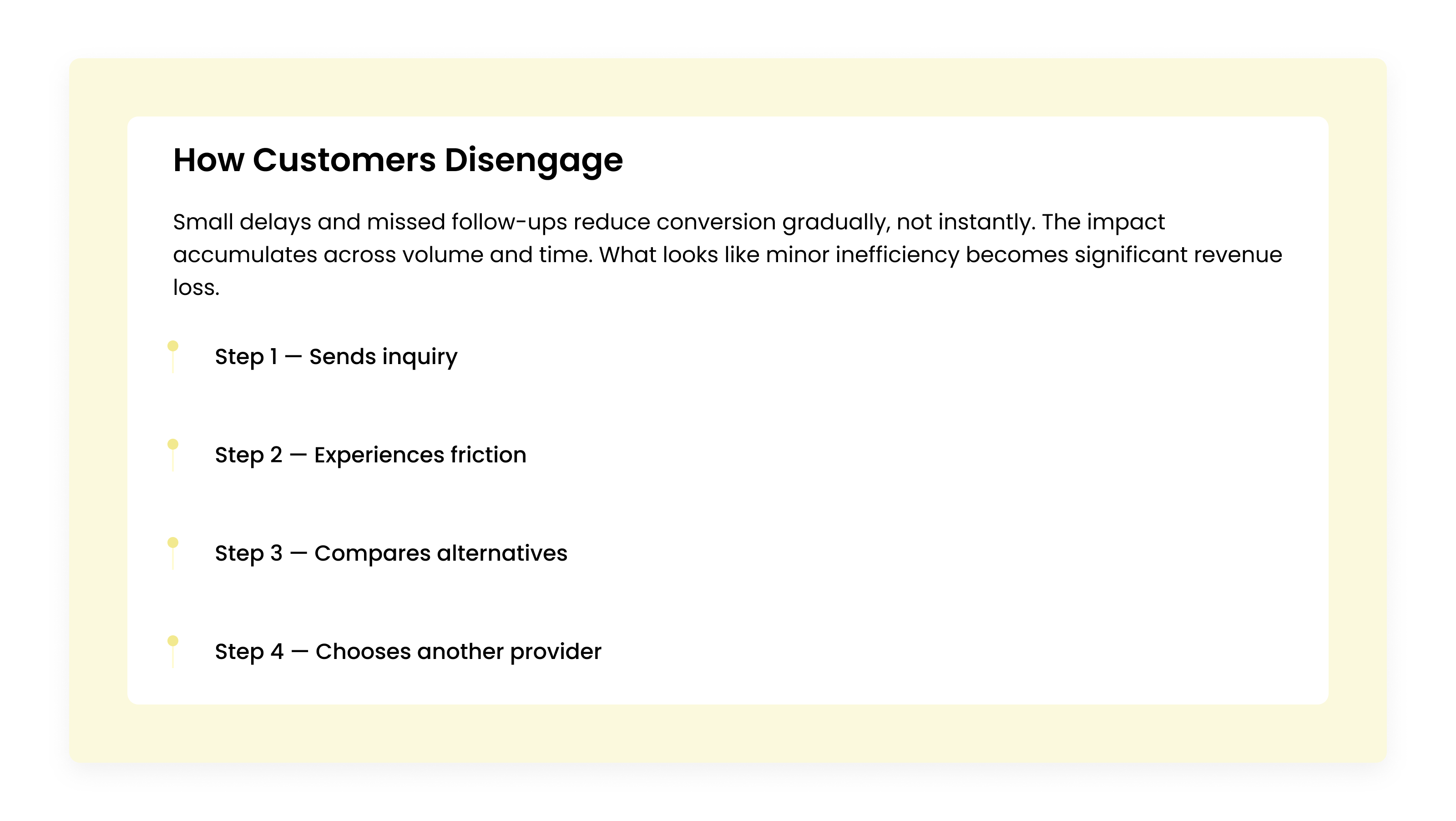
Silence from a customer is often read as disinterest. In reality, it’s usually a quiet decision made after friction.
That friction builds when the experience feels disjointed—when the customer has to repeat themselves, restart conversations, or wait without clarity. Trust doesn’t disappear all at once. It erodes one small interaction at a time.
The Shift from Messaging to Conversation Management
At some point, the issue stops being about communication and becomes about structure.
Businesses don’t need more ways to send messages. They need a way to manage conversations.
That shift changes how everything is handled.
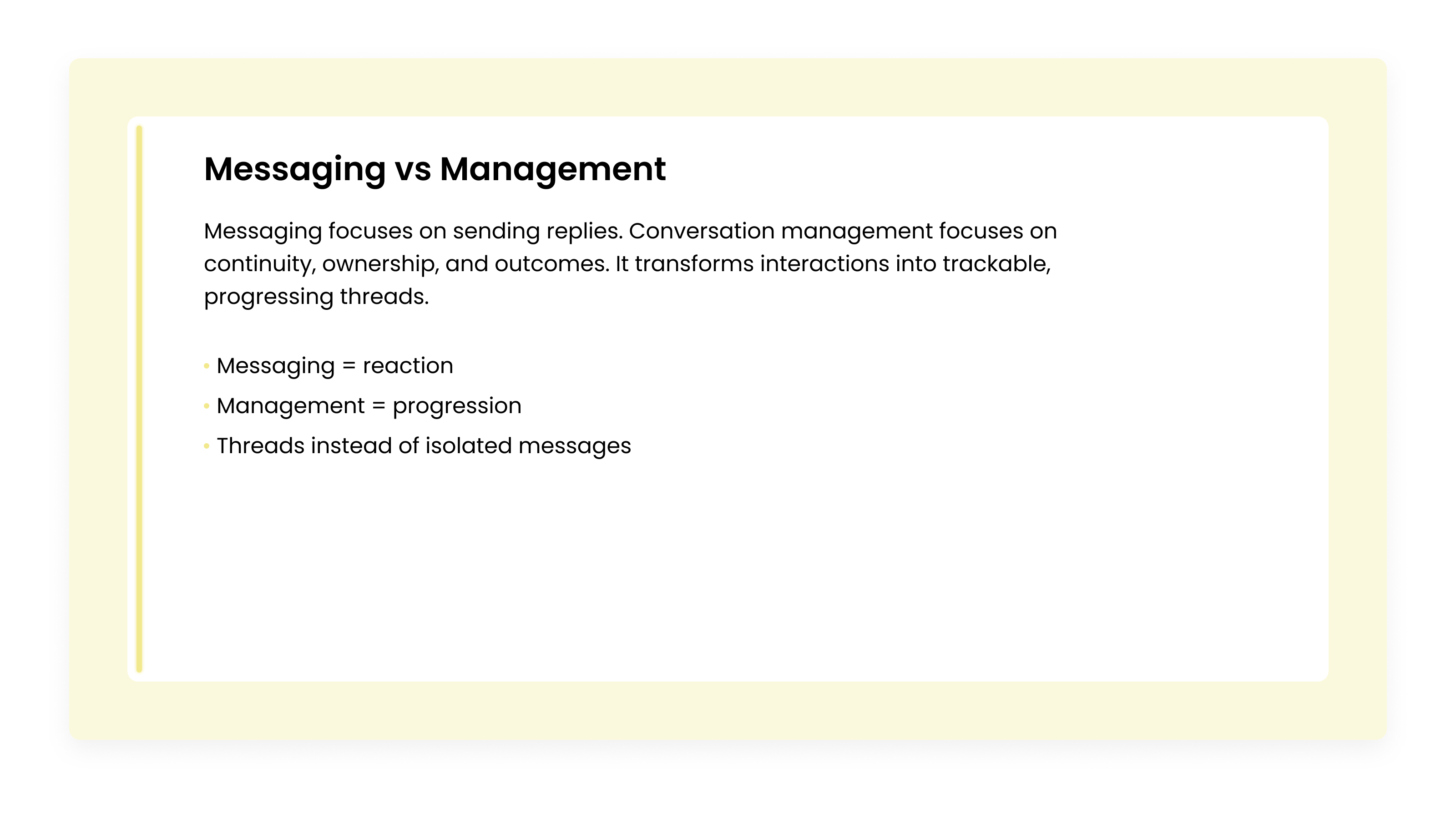
Instead of asking “did we reply?” the question becomes “where does this conversation live, and who is responsible for what happens next?”
Instead of messages being scattered across tools, they exist as a single thread. Instead of relying on memory, the system carries context forward. Instead of hoping someone follows up, there’s visibility into whether it actually happened.
In practice, this shift usually happens in stages. First, teams try to centralize visibility. Then they start noticing how often ownership is unclear. Only later do they begin to see consistent follow-through.
This is where the difference between activity and control becomes obvious.
A conversation management approach treats each interaction as something that progresses. It has context, ownership, and direction. It doesn’t disappear just because a message was sent.
Internally, this removes a specific kind of friction—the constant “I thought you had it” moments that happen dozens of times per day.
Externally, it changes how customers experience the business. They don’t have to repeat themselves. They don’t feel like they’re starting over. The interaction feels consistent—even across different people. In practice, that’s what How Teams Actually Handle Customer Conversations Without Losing Context is really about.
That consistency is what builds trust.
And it’s what prevents conversations from quietly slipping through the cracks.
A Simple Framework for Tracking Every Conversation
Fixing this doesn’t require complexity. It requires structure.
A practical framework is simple:
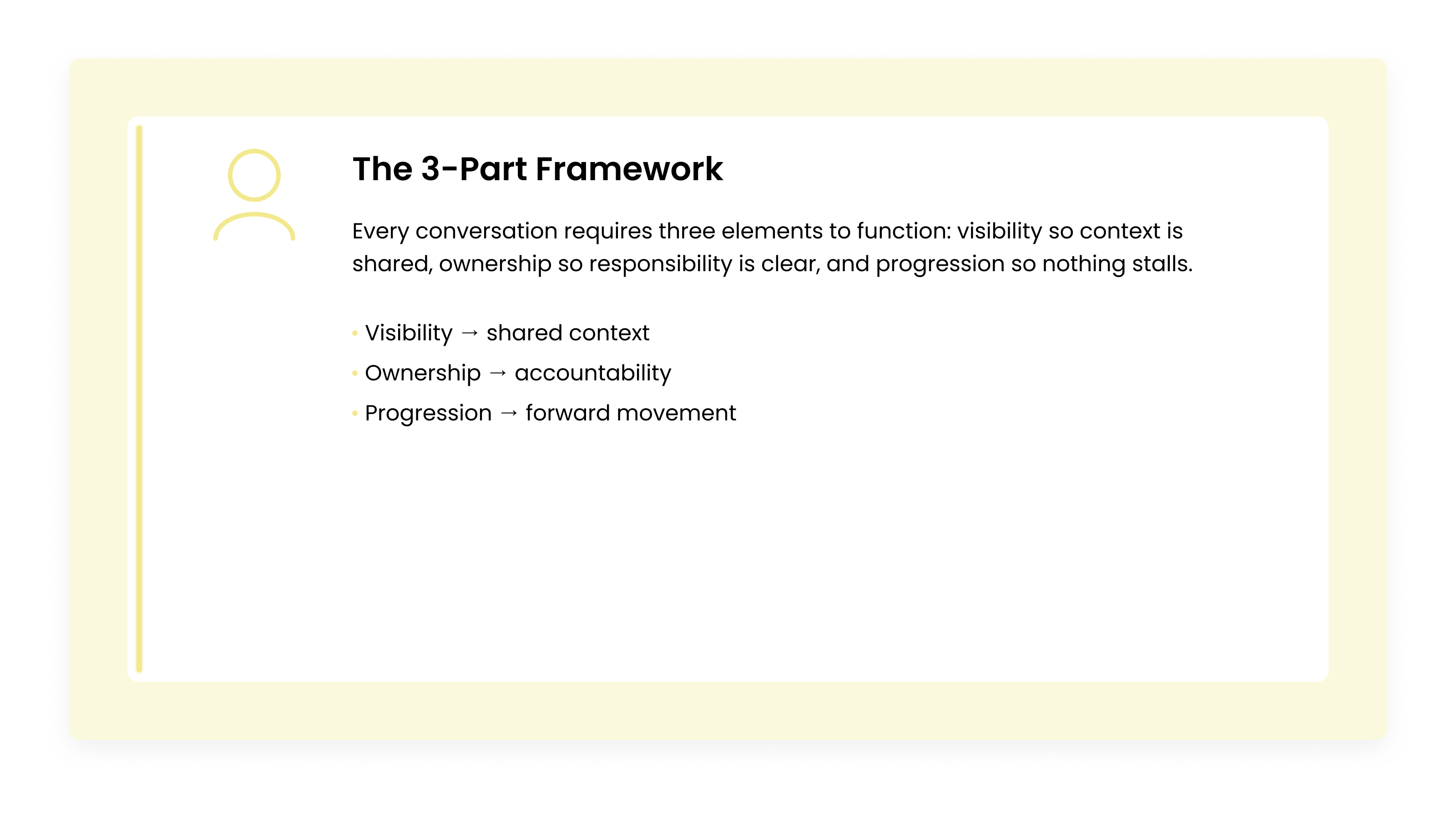
Every conversation must have visibility, ownership, and progression.
Visibilty
Visibility means the full conversation is accessible as a single thread. Not split across tools. Not dependent on who answered. Anyone stepping in can see exactly what was said, what was promised, and what hasn’t happened yet.
In practice, lack of visibility shows up when someone opens a message, spends a minute digging through different systems, doesn’t find the context, and either delays the response or gives a partial answer.
Ownership
Ownership means one person is responsible for the next step at any given time. Not multiple people. Not “the team.” A clear owner.
When ownership breaks down, conversations don’t stop—they drift. Messages get seen but not acted on. Two people assume the other is handling it. The customer sits in the gap between those assumptions.
Progression
Progression means every conversation moves forward. Not just replies, but defined next steps.
When progression is missing, conversations stall in polite language—“we’ll follow up”—that never actually turns into action.
Where most teams struggle is not understanding this framework—it’s maintaining it once volume increases and handoffs become constant.
Structure doesn’t fail all at once. It erodes under volume, handoffs, and assumptions.
These three elements—visibility, ownership, progression—create structure.
They remove ambiguity. They create accountability. And they turn conversations into something that moves, not something that sits.
What a Real Conversation System Looks Like in Practice
A real system doesn’t feel complicated. It feels clear.
Take the earlier scenario again—but this time with structure.
Morning: a customer sends a message about a repair. The conversation is logged as a single thread. It’s visible. One person is assigned ownership.
Midday: the customer follows up. The same thread continues. The owner sees it immediately—not as a new message, but as part of an ongoing conversation. They respond in context, not from scratch.
Afternoon: the owner schedules a technician and logs the next step. If responsibility needs to shift, it does so clearly—someone else now owns what happens next.
End of day: nothing is left hanging. Every conversation has either progressed or been completed.
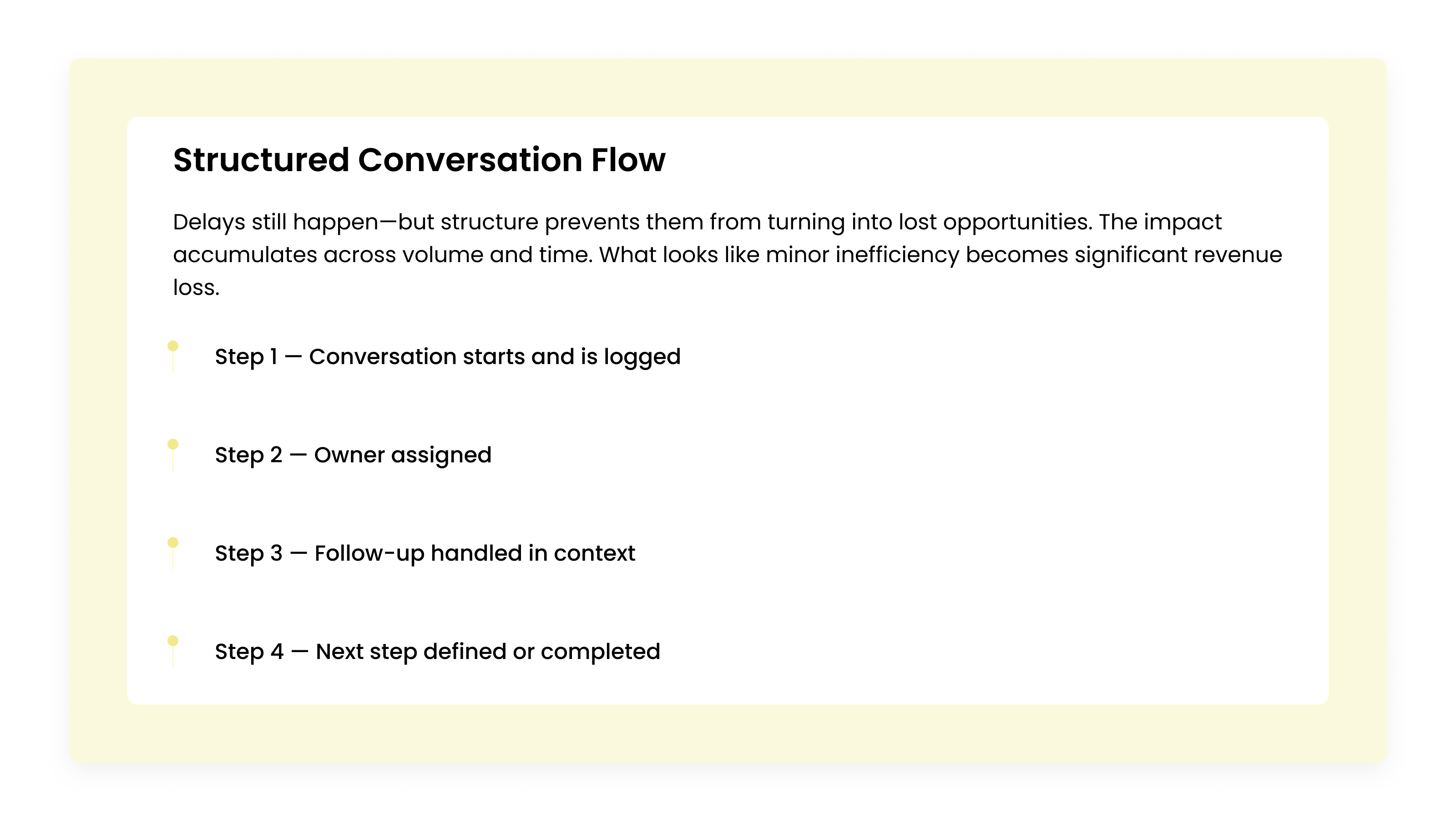
If even one of these elements is missing—if ownership isn’t clear, or the next step isn’t defined—the same breakdown pattern returns. The only difference is how quickly it shows up.
Internally, there’s no guessing. No one is asking, “Did anyone get back to them?” No one is opening three tools to piece together what happened.
Externally, the experience feels consistent. The customer doesn’t need to repeat themselves. They don’t feel ignored. The interaction feels intentional.
This is where systems like TMMN start to make sense—not as features, but as alignment with how conversations actually need to be handled. And as businesses continue to grow, the expectation moves toward unified environments where messaging, calling, and follow-up exist together.
That’s where things are going.
Not toward more communication—but toward conversations that actually move forward.
Key Takeaways
Conversations are rarely lost in a single moment—they fade through small gaps in ownership and follow-through.
Visibility without ownership creates awareness, but not movement.
Customers don’t notice systems—they notice when they have to repeat themselves.
Missed follow-ups don’t feel like failures internally, but they show up as inconsistent revenue externally.
Structure, not speed, determines whether conversations actually convert.
The Real Takeaway
- The problem isn’t that your team is missing messages.
- The problem is that your business doesn’t have a system designed to manage conversations as continuous, trackable assets.
- And until that changes, lost customer conversations won’t feel like failures.
- They’ll just feel like another busy day.
A 14-day free trial is often enough to show how much cleaner customer communication becomes when visibility, ownership, and follow-through live in one place.

.svg)