


A small business wants to use AI to handle a routine customer request. Clearly defining who can take responsibility for customer conversations is essential to successful delegation, as illustrated in How Small Businesses Manage Customer Conversations Without Dropping Leads.
The request sounds simple: “Can I reschedule my appointment without paying a fee?”
The answer depends on more than whether the business has an AI tool. It depends on which rescheduling policy is current, whether that policy applies to this customer, what the AI is allowed to access, whether it can change the appointment, and who handles an exception. Even a polished answer can be operationally wrong if it relies on an old document or exceeds the authority the business intended to grant.
That is the real AI readiness question.
A business is not ready merely because it has accumulated data, subscribed to software, or found a model that produces convincing responses. Readiness means creating the conditions under which work can be delegated within defined boundaries.
For a small business, those conditions do not need to cover every process. They do need to be clear for the first process placed in scope. That makes readiness less like a company-wide transformation and more like a disciplined operating decision: What work are we delegating, what does the AI need to know, what may it do, what does the workflow depend on, and where must a person remain responsible?
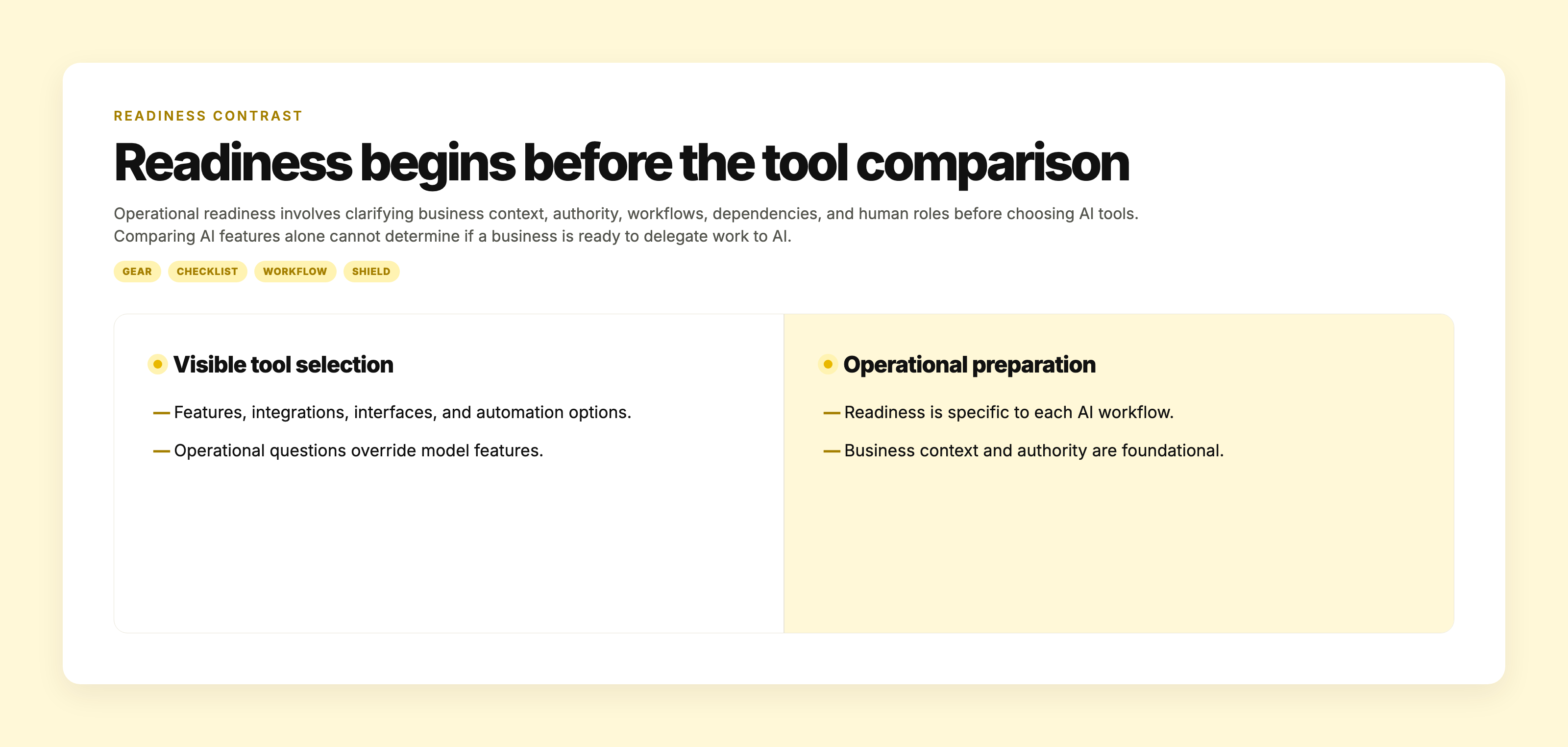
Readiness begins before the tool comparison
Tool selection is visible. Operating preparation is not.
It is easy to compare features such as integrations, interfaces, models, and automation options. Those comparisons matter eventually, but they cannot answer a more basic question: Is the business prepared to let an AI participate in this particular workflow?
Return to the appointment request. Before comparing systems, the owner needs to resolve several operational questions:
- Where is the approved rescheduling policy?
- Is it current?
- Does the AI have access to the customer’s appointment details?
- May it only explain the policy, or may it also change the booking?
- What happens if the customer reports an emergency?
- Who can review the exception?
- How will the business confirm that a requested change was actually completed?
These are not primarily model questions. They are questions about business context, authority, workflow design, dependencies, and human responsibility.
That distinction prevents a common planning error: defining readiness at the level of the whole company. A business can be ready for one narrow, supervised use case while being unready for another. This targeted readiness aligns with the principles discussed in How to Assign, Track, and Close Customer Conversations Efficiently to maintain clear operational boundaries.
Drafting a response from an approved policy requires different conditions than issuing a refund, updating a customer record, or committing the business to a new deadline.
The useful unit of readiness is therefore not “our business uses AI.” It is “this AI may perform this defined role under these operating conditions.”
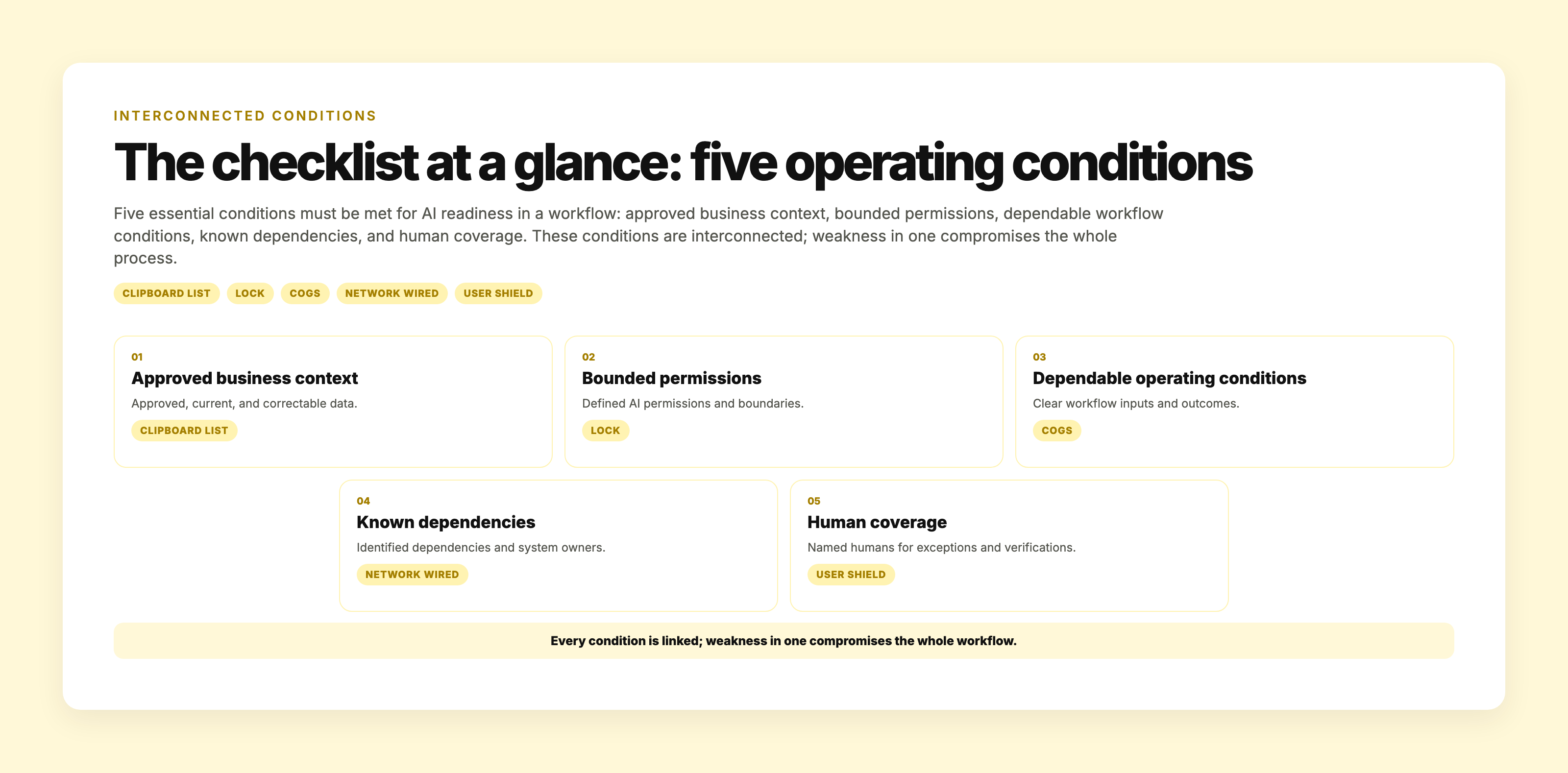
The checklist at a glance: five operating conditions
The checklist at a glance: five operating conditions
Use the following five conditions as a decision model, not as a certification or universal score:
1. Approved business context: The AI can use information that is identifiable, relevant, current, approved, and correctable.
2. Bounded permissions: The business has defined what the AI may retrieve, draft, update, send, or otherwise act on.
3. Dependable operating conditions: The workflow has a clear beginning, expected inputs, known exceptions, and observable outcomes.
4. Known dependencies: The people, systems, records, policies, and handoffs required by the workflow are available and understood.
5. Human coverage: A named person or role can handle consequential decisions, exceptions, corrections, and verification.
These conditions are connected. Current information does not grant authority. Permission does not make a broken workflow dependable. A reliable integration does not decide who owns an unusual case. Human review cannot compensate indefinitely for missing policies or unclear records.
The checklist works best when applied to one use case at a time. Instead of asking, “Are we AI-ready?” ask, “What is the first weak condition that would make this workflow unsafe, unreliable, or impossible to verify?”
That question produces work an operator can act on.
1. Can the AI use approved, current business context?
Small businesses often have plenty of information. That does not mean the information is ready to guide delegated work.
A policy may exist in an employee handbook, an old email, a shared document, and the owner’s memory—each with slightly different wording. A price list may be correct except for one recently changed service. A staff member may know how exceptions are handled even though the written instructions omit them.
For a defined AI use case, identify the information that actually governs the task. Then test it with five questions:
- Can we locate it?
- Is it current?
- Has someone with responsibility approved it?
- Is it specific enough to guide this task?
- Can we correct it when the business changes?
In the appointment hypothetical, suppose the AI finds a policy saying that changes made within 24 hours incur a fee. The current rule, however, uses a 48-hour window. The AI may produce a clear, grammatically correct answer that no longer reflects the business.
The operational failure began before the response was generated. The business supplied information without establishing which version represented current business truth.
Readiness does not require turning every file into a perfect knowledge system. It does require a controlled answer to a narrower question: What information is the AI allowed to rely on for this task?
Write that set down. Include the policy, the fields needed from the appointment record, and any instructions for cases the policy does not cover. Assign responsibility for correcting those sources. If no one can say which information is approved or who changes it, the use case is not ready to move beyond a tightly supervised test.
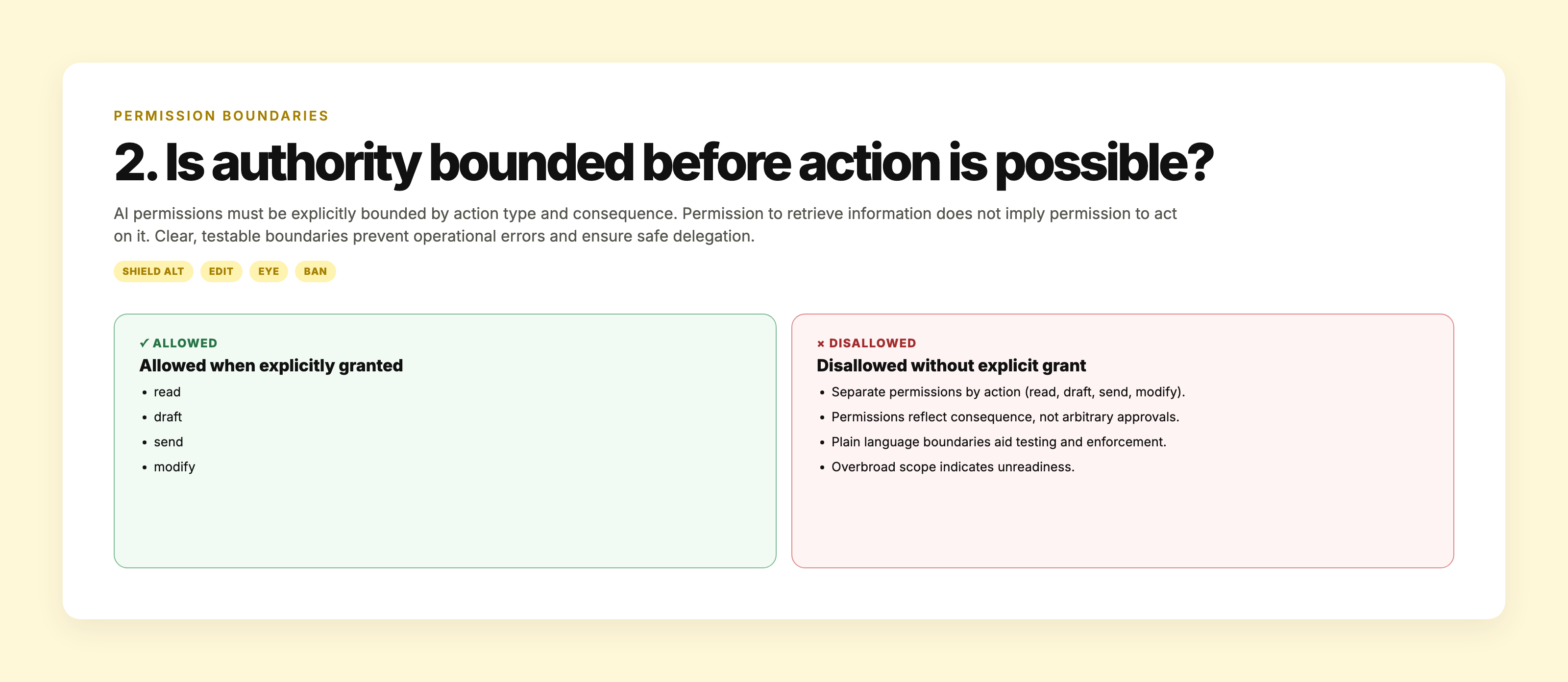
2. Is authority bounded before action is possible?
An AI’s ability to generate a recommendation does not give it permission to act for the business.
This boundary becomes important because several activities can appear to be one seamless interaction. An AI might retrieve a policy, interpret it, draft a response, send that response, modify an appointment, and record a note. Each step carries different consequences.
Define those permissions separately.
For the appointment workflow, the first version might allow the AI to:
- retrieve the approved scheduling policy;
- read the relevant appointment time;
- draft a response for an employee to review.
It might not be allowed to:
- waive a fee;
- change the appointment;
- promise availability;
- send the response without approval;
- access unrelated customer information.
This is not an argument that every action always needs approval. Approval should reflect consequence rather than being attached indiscriminately to every step. Retrieving an approved policy is not the same as issuing a refund. Drafting a proposed reply is not the same as sending it. Attempting an update is not the same as confirming that the update succeeded.
Use precise verbs when documenting authority. “Help with scheduling” is too vague to operate as a boundary. “Read appointment details and draft a response, but do not modify the booking or contact the customer” is testable.
If the permissions cannot be stated plainly, the scope is probably still too broad.
3. Are the workflow conditions and dependencies dependable?
A capable AI cannot repair every uncertainty surrounding a poorly defined process. Before delegation, follow the workflow from trigger to verified outcome.
What starts the work? Which inputs must be present? Which business rule applies? Which system contains the controlling record? What handoff follows the AI’s contribution? How does someone know the task is finished?
The appointment request, for example, may depend on:
- a message being associated with the correct customer;
- an accurate appointment record;
- the current rescheduling policy;
- access to the scheduling system;
- reliable visibility into available times;
- a handoff to an employee when an exception appears;
- confirmation that any approved change was completed.
Separate the normal path from exceptions. A routine request with a matching customer record and a clear policy may be suitable for a narrow test. A request involving conflicting records, special accommodations, missing details, or discretionary fee treatment should take another path.
Dependencies deserve their own inspection because a workflow may look ready while relying on an unstable link. The policy can be current, yet the appointment record may be incomplete. The AI can draft the correct next step, yet no employee may be assigned to complete it. A system can accept an update, yet the business may lack a dependable way to verify the result.
Map each dependency and its owner. Then ask what happens when that dependency is unavailable or ambiguous. The safe response may be to stop, request missing information, or route the case to a person. It should not be improvised after the workflow is already active.
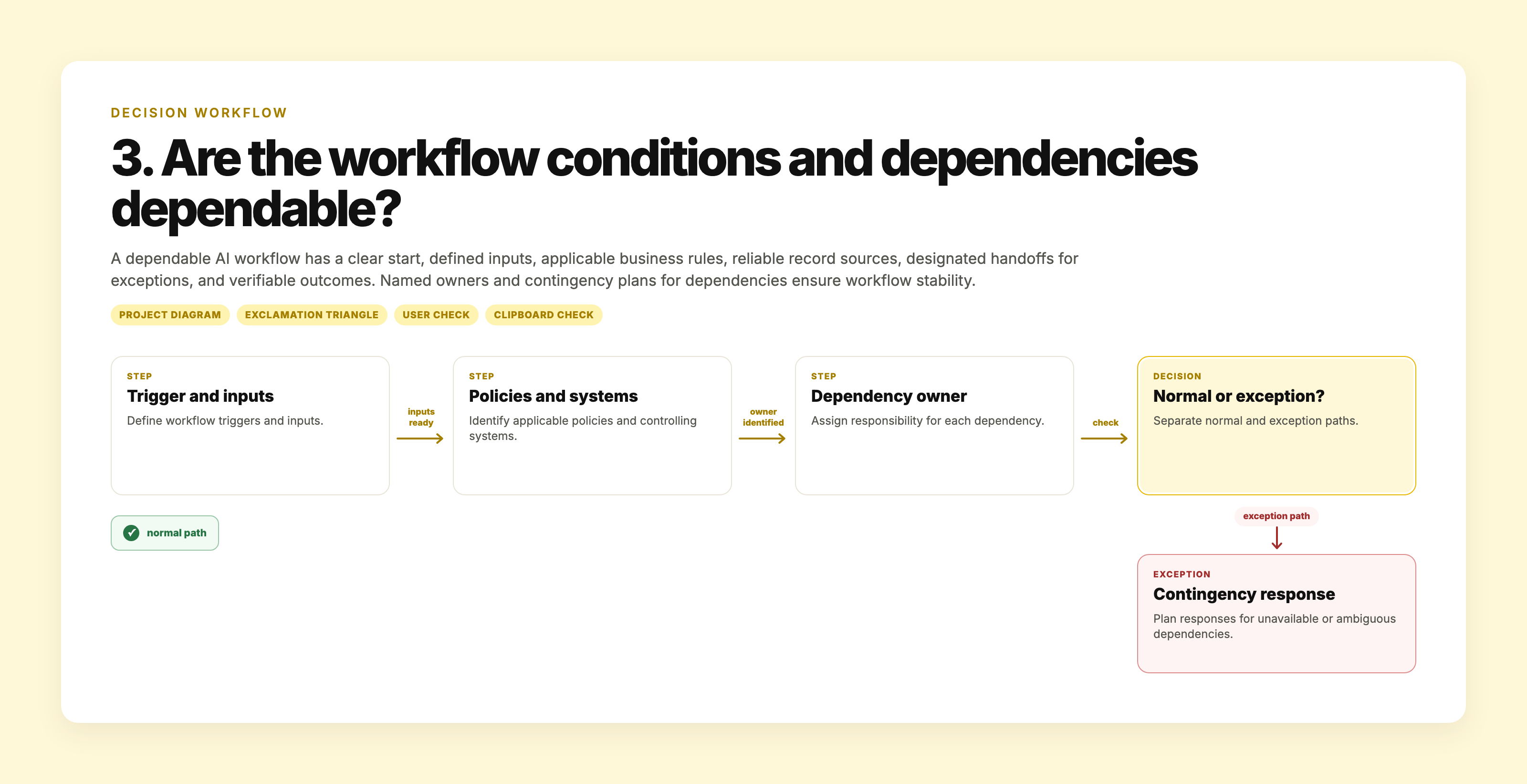
A narrow starting use case is valuable here because its dependencies can be named and its failures can be detected. “Handle customer scheduling” hides too many paths. “Draft responses to rescheduling questions when the customer and appointment are matched and the approved policy clearly applies” creates an observable operating boundary.
4. Is there human coverage at consequential boundaries?
“Human in the loop” is not complete operating guidance. A small business needs to know which human, at what point, with what responsibility.
Human coverage should concentrate on consequential actions, ambiguous cases, exceptions, corrections, and verification. Establishing consistent human oversight ensures communication reliability, as further explored in Why Businesses Lose Track of Customer Conversations (And How to Fix It).
Adding approval to every minor step can make a workflow cumbersome without resolving who is accountable when the situation changes.
For the appointment example, human coverage might be designed this way:
- An employee reviews the drafted customer response during the initial test.
- A manager decides whether a fee exception is allowed.
- The scheduling owner corrects the approved policy when rules change.
- A designated person handles requests the AI cannot match to a customer or appointment.
- The employee completing a booking change verifies that the system reflects it before the customer receives confirmation.
The final point matters. A proposed action, an authorized action, an attempted action, and a completed action are not interchangeable. If the workflow claims completion, there must be an appropriate way to determine whether the intended result occurred.
Human coverage also needs availability. Naming the owner is not enough if that person is routinely unavailable during the period when exceptions arrive. Decide whether unresolved work waits, moves to a backup, or stops with a clear message. Otherwise, the exception path exists only on paper.
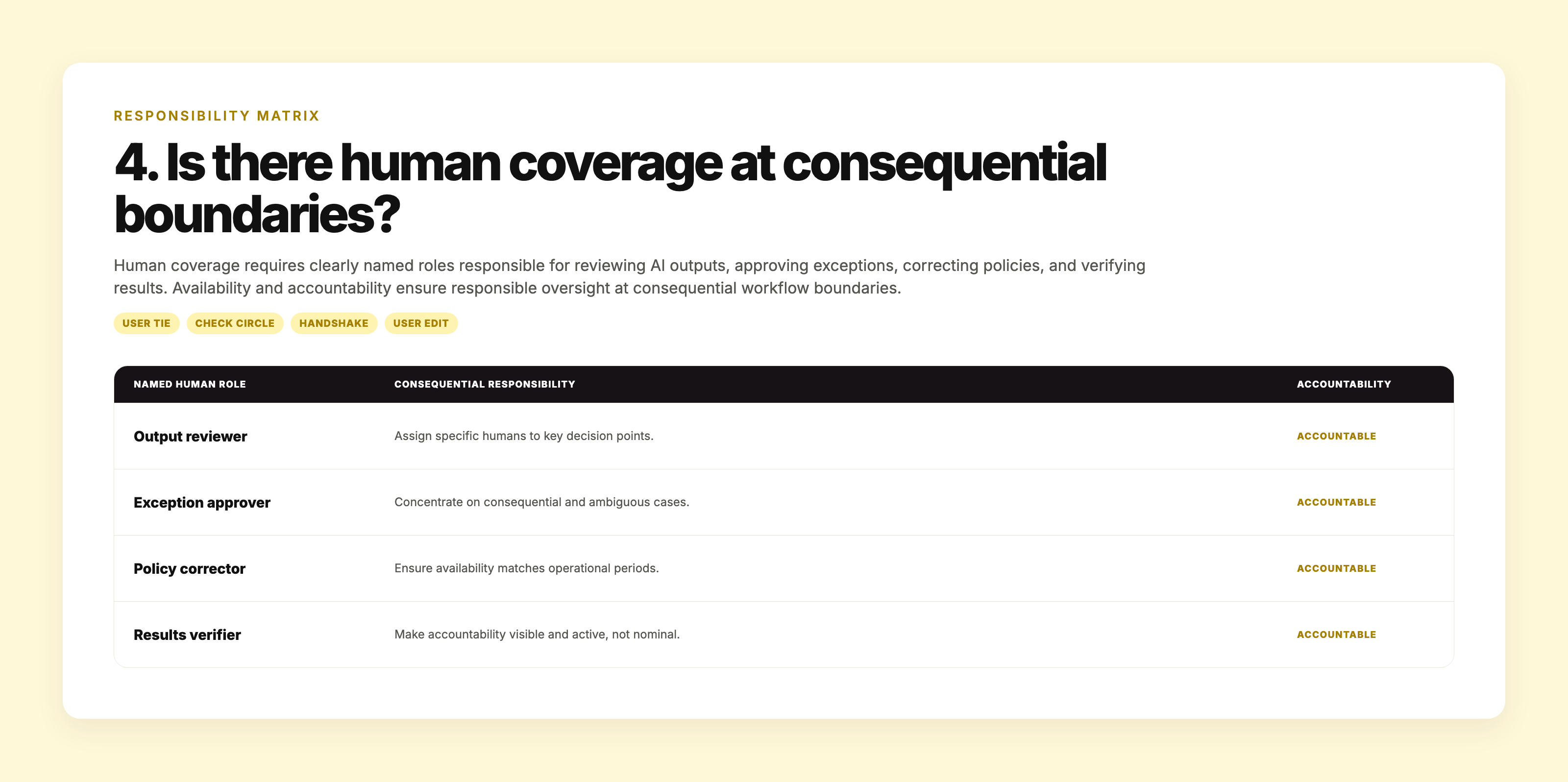
The goal is not to place a person beside every AI output forever. It is to ensure that responsibility remains visible where consequences require judgment or verification.
Turn the checklist into a first implementation decision
Do not finish this exercise by labeling the entire business ready or unready. Finish it by making a scoped decision.
Choose one routine use case. Describe its trigger and intended outcome in a sentence. Identify the approved information it requires. List what the AI may and may not do. Map the systems, records, rules, and handoffs it depends on. Assign the people responsible for approval, exceptions, corrections, and verification.
Then test the workflow under supervision before widening its scope. Such cautious implementation echoes strategies described in How to Handle Multiple Customer Conversations Without Losing Track, emphasizing controlled expansion to safeguard clarity.
Examine whether the information used was current, whether the permission boundary held, whether dependencies worked, whether exceptions reached the right person, and whether the outcome could be verified. A successful draft is not sufficient if the surrounding operation cannot be trusted.
If one condition is weak, fix that condition first. Do not compensate for unclear authority by buying another tool. Do not compensate for outdated policy with more automation. Do not expand the workflow while its exception owner remains undefined.
For the hypothetical business, the first implementation need not be autonomous appointment management. It can be much narrower: draft a response only when the correct customer and appointment are identified, the approved policy clearly applies, and an employee is available to review the result. Everything else routes to a person.
That is a concrete readiness test. Pick one real workflow this week and try to write its approved context, permissions, dependencies, and human coverage on a single page. A practical way to begin testing these operational conditions is by starting a 14-day free trial before committing to full-scale automation.
The first section you cannot complete is not paperwork to skip. It is the operating condition to fix before you delegate the work.

.svg)

.png)