
Understanding Why Prioritization Matters More Than Ever
In the daily flow of many small and mid-sized businesses, customer messages rarely arrive in neat, manageable batches. Instead, they come in a steady stream—varying in volume, timing, and urgency—each demanding different responses from teams juggling multiple roles. Prioritizing these incoming communications becomes essential—not to create red tape, but to bring focus and clarity within real-world limits.
Take a small healthcare practice as an example. The staff fields appointment requests, billing questions, prescription refill demands, and urgent symptom follow-ups, often all overlapping. Each message carries a different weight of urgency, yet without clear prioritization rules, staff might tackle messages based on arrival time or simply on whoever is available. Critical requests get delayed while routine questions soak up attention, sparking frustration and quietly eroding trust.
The challenge is practical: limited staff time meets a flood of undifferentiated messages, drowning out the truly urgent. It’s not just about volume—it’s recognizing that messages vary widely in importance and immediacy. When prioritization is ignored, customers face longer waits or uncertainty about whether their concern is being noticed—pushing them toward competitors or souring their view of the service.
For frontline operators, juggling this influx without structure often means flipping between inboxes, calls, and notes, all while trying to respond well. Without clear, customer-informed guidelines, energy gets spread thin with less and less to show for it. Prioritization here acts like operational triage, balancing responsiveness with workload through simple decision rules shaped by experience and business context.
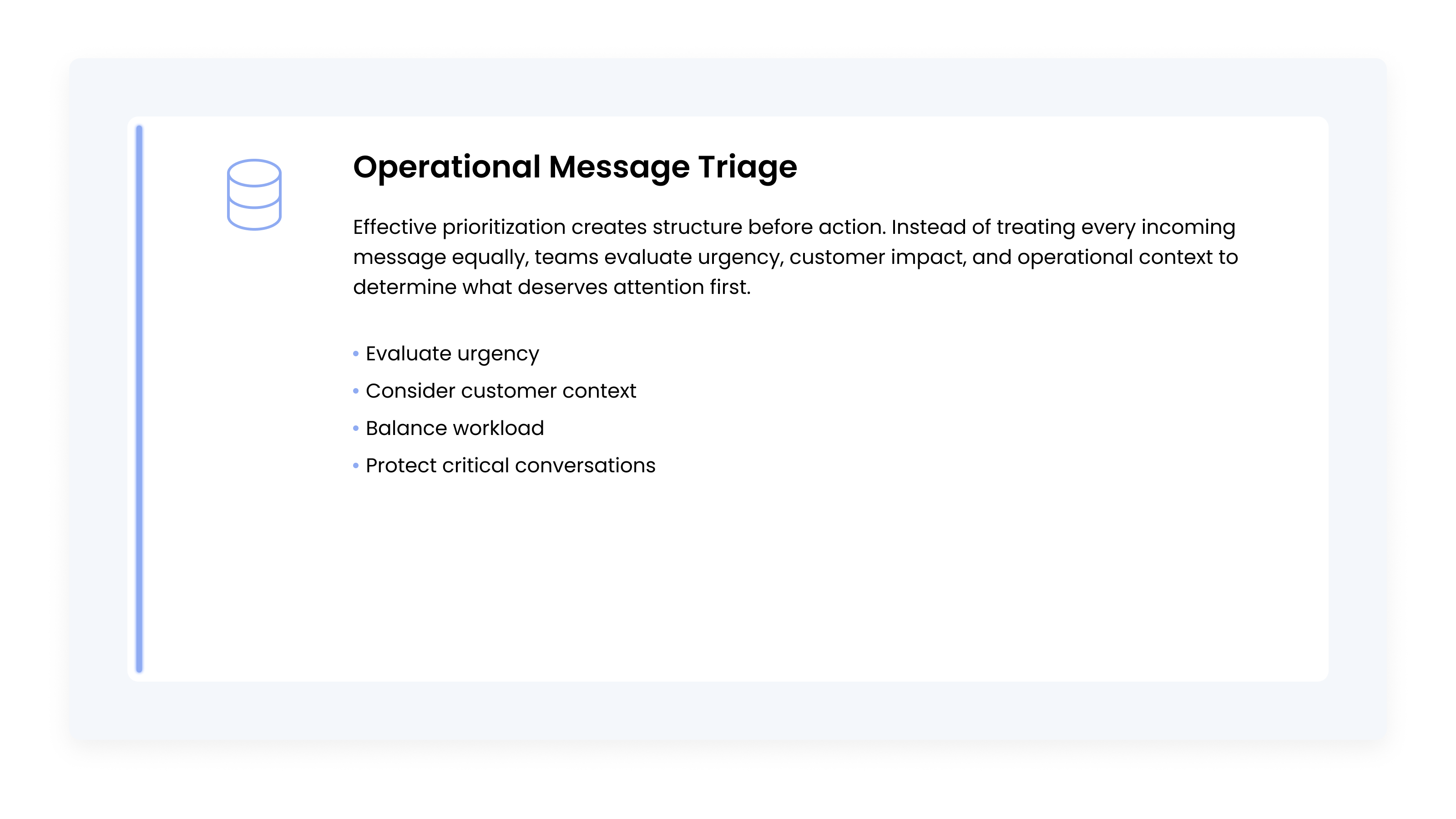
It’s not only about speed. How messages get prioritized also shapes which conversations happen at all and when. Prioritization signals respect for customer effort—urgent needs get timely attention, while less pressing questions receive clear, predictable replies later. Customers pick up on more than just being answered; they sense how their concerns are understood and valued.
Beyond the customer-facing side, prioritization brings order internally. Staff receive clearer signals on what to tackle first, cutting down overlaps, duplicate efforts, and dropped follow-ups. Organizations that consistently manage growing communication volume often rely on the same operational habits discussed in How Businesses Handle 50+ Customer Conversations Per Day Without Chaos. Over time, this builds a shared team rhythm anchored in real customer need rather than phone ringing or inbox count alone.
With communication volumes soaring, multiple contact channels multiplying, and customer expectations rising, prioritization’s role grows. This isn’t a call for complicated automated ticket systems or piles of new technology—often, those create noise instead of clarity. Instead, prioritization rooted in practical rules and behavioral insight adds value without weighty protocols or distractions.
In the end, prioritization is a critical hands-on skill at the heart of effective customer engagement. It helps teams handle a wide range of inquiries thoughtfully, ensuring the most important concerns get attention first and setting the stage for smoother interactions and steady customer trust.
How Modern Customer Behavior Changes Message Handling
Customer communication today looks very different from past decades. Customers want quick, relevant replies but also tend to pack multiple questions or concerns into one message. This means businesses must balance urgency with complexity—understanding that not every message demands equal immediacy, even when layered with different intents.
Consider a boutique B2B consultancy fielding client inquiries that vary from quick clarifications to strategic questions needing detailed responses. Some clients follow up multiple times per day on the same issue, others send occasional updates. Without a prioritization method, staff spread effort equally on all these, delaying answers that could seal sales or deepen trust.
Customers often expect fast acknowledgment or at least some nod to message relevance, not bland timestamp replies. Yet many businesses treat messages as identical units, responding in order received or first-come-first-served style, ignoring urgency or relationship status that signal true priorities.
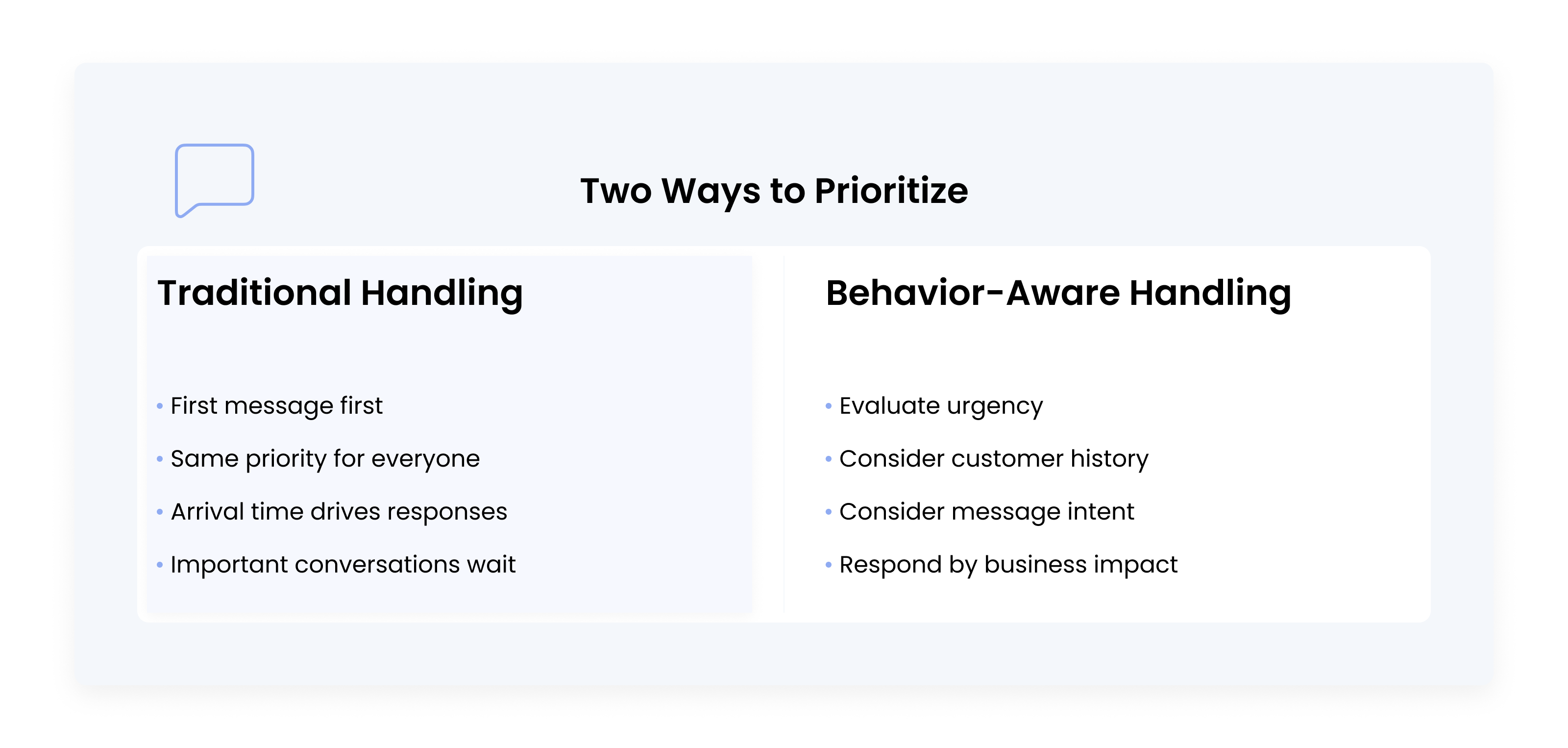
This mismatch breeds friction. Staff feel overwhelmed with a relentless flow and little clarity on which to handle first, relying on gut calls that vary widely. Some messages get rushed, others linger too long, creating service gaps and unhappy customers.
From the customer's view, uneven attention sparks doubts about reliability. Prospects waiting on exploratory replies hesitate, watching competitors that respond with steadier pacing. Existing customers might tolerate longer waits for routine questions but can interpret this as neglect or lesser importance.
Urgency isn’t always spelled out clearly. It often emerges through timing signals, message detail, or prior interactions. Good prioritization reads these cues, blending service history, inquiry type, and expressed need into flexible but consistent response ordering. It respects customer styles rather than forcing a fixed rhythm.
For the operation, this means moving beyond mechanical filtering to dynamic evaluation. Effective prioritization also depends on ensuring messages follow clear operational paths, a principle reflected in How to Route Customer Messages So Nothing Gets Missed. Teams benefit from guidance and tools that reflect message diversity: spotting which are simple info requests, which signal frustration needing fast recovery, and which open new business talks deserving priority.
Customer communication today pushes businesses to rethink priority strategies. Attention must focus where it counts, shaped by actual customer behavior and message meaning—not just volume or when messages arrived. This approach drives better satisfaction, closer engagement, and smarter staff time use—a multiplier for both productivity and relationships.
A Simple Diagnostic Framework to Assess Your Current Prioritization Approach
Before you can improve prioritization, you need to know how your team currently handles it. We offer a straightforward way to dissect existing practices into actionable parts—the PRACTICE framework. It breaks down prioritization into seven key areas: Pattern Recognition, Relevance Assessment, Attention Allocation, Communication Timing, Intra-team Clarity, Consistency, and Evaluation.
Pattern Recognition asks: Do staff notice recurring message types or customer behaviors that mark urgency or importance? Problems arise when every message is treated the same, pushing urgent ones behind by sheer volume. For example, in a family clinic, staff might overlook repeated calls about worsening symptoms from the same patient, delaying urgent help.
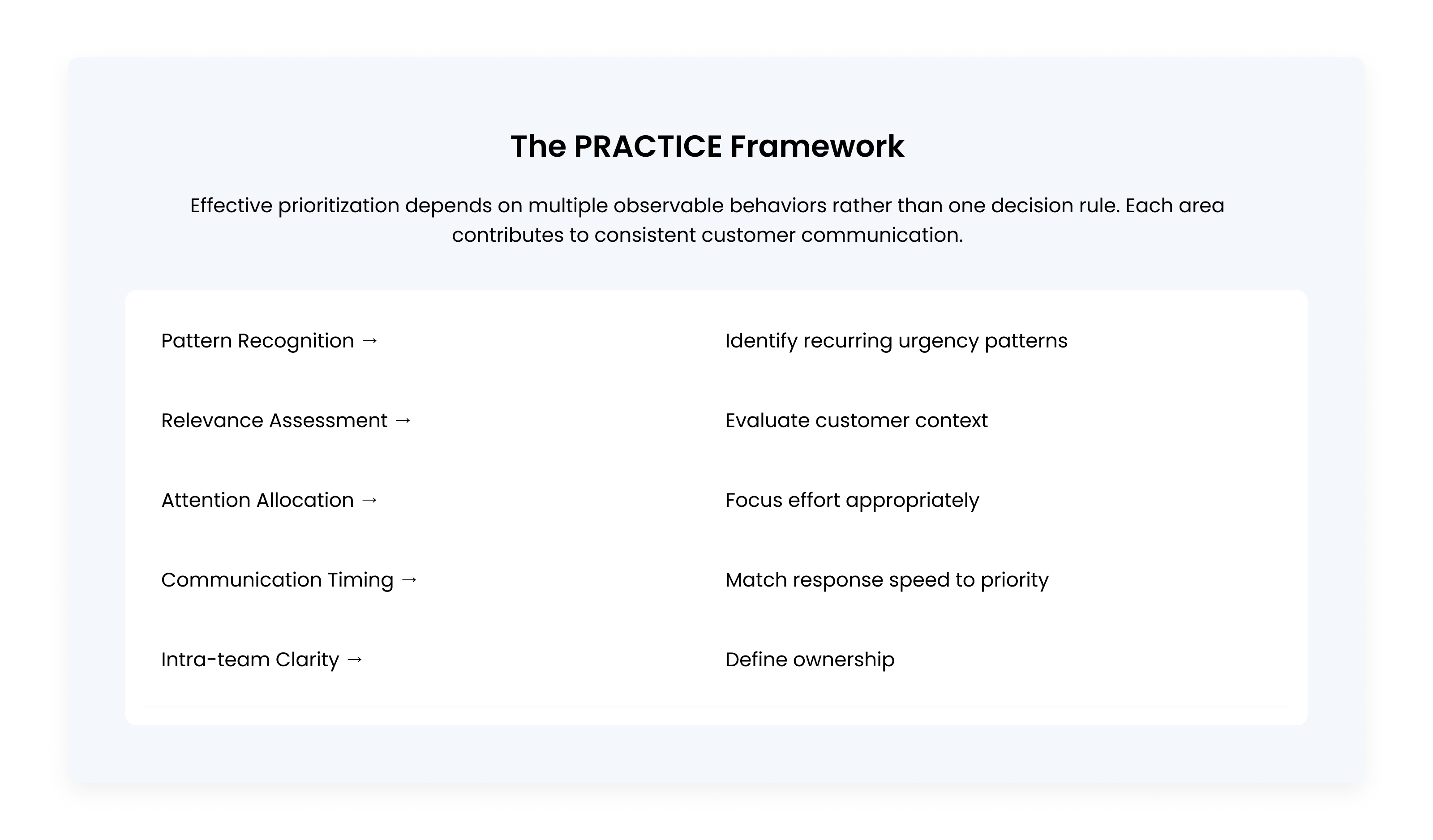
Relevance Assessment means filtering by customer context—distinguishing new questions, ongoing issues, or repeated contacts. Without this, trivial or duplicate messages get answered first, while overdue or strategic matters sit idle. A nonprofit’s donor office might find event RSVPs handled before urgent gift matching deadline inquiries due to lack of context awareness.
Attention Allocation focuses on directing effort to messages needing immediate action versus those that can wait. A common pitfall is equal effort across all messages, causing fatigue and response backlogs. One retail store found clerks wasted time responding with full replies to simple stock availability questions while urgent order delivery issues got delayed.
Communication Timing covers setting response windows according to priority—not a single deadline for all. Without this, messages get stuck in a timeless queue, frustrating customers who need faster replies. For instance, a regional venue initially had no stated response times, leaving event planners wondering when their contract inquiries would get addressed.
Intra-team Clarity involves a shared understanding of who handles what and when—stopping overlaps, missed tasks, or redundant responses. Shared ownership becomes much easier when teams maintain consistent conversation context, as described in How Teams Actually Handle Customer Conversations Without Losing Context. Gaps here create confusion and dropped balls. In a travel agency, an email inbox shared among agents led to duplicated replies because no one owned follow-up responsibility explicitly.
Consistency means applying prioritization rules reliably across shifts and team members. Without consistent habits, the same customer might receive wildly different treatment depending on who answers. For example, weekend staff might deprioritize urgent requests unknowingly due to absent guidance.
Evaluation calls for ongoing review using data and team feedback. Skipping this lets poor habits settle, letting problems persist unnoticed. A growing tech support team found that without periodic check-ins, response delays crept in unnoticed despite increased ticket volume.
Imagine a mid-sized nonprofit running donor communications. They find some inquiries—like matching gift deadlines or event registrations—demand urgent responses, while newsletter signups or resource asks can wait a day or two. Using the PRACTICE framework, staff sort messages accordingly, guiding daily workflow.
Pattern Recognition flags late gift matching queries. Relevance Assessment highlights renewals. Attention Allocation and Communication Timing put these top of the queue. Intra-team Clarity ensures assignments stick, not left to gut calls. Consistency gets checked weekly, with Evaluation noting donor satisfaction improvements.
When any framework part fails, operational noise grows. For example, one shift might overlook a renewal message (attention failure), risking revenue and donor confidence. Another might double-reply or lose handoff notes (clarity failure), frustrating donors.
PRACTICE is instantly actionable, relying on careful observation, simple rules tuned to specific business needs, and visible team communication. Crucially, it leans on operator judgment informed by shared knowledge—not heavy tech or inflexible rules that ignore daily realities.
Quantifying the Impact: What Better Prioritization Looks Like in Practice
Numbers help bring prioritization benefits to life, especially for staff weighing effort and time trade-offs. Picture a small urban medical clinic receiving about 80 patient messages daily—appointment requests, medical questions, billing, and follow-ups.
With two receptionists sharing message duties, realistically, they can fully handle about 50 inquiries a day during working hours. Without prioritization, they tackle messages in order, mixing urgent and routine.
Urgent medical follow-ups, roughly 20% of messages (16 daily), often wait around six hours for answers as they get lost among less urgent traffic. Even relatively small delays can compound into measurable business losses, reinforcing the operational concerns discussed in The Hidden Cost of Slow Response Times in Small Businesses. This delay causes about 10% of these patients—nearly two per day—to seek care elsewhere, resulting in roughly 1.6 lost visits worth $150 each, after visit conversion.
Applying prioritization flags urgent follow-ups first, trimming response delays down to two hours on average. Patient retention in this urgent group jumps to 95%. Other requests like appointment or billing get responses in 12–24 hours, with clear timing communicated.
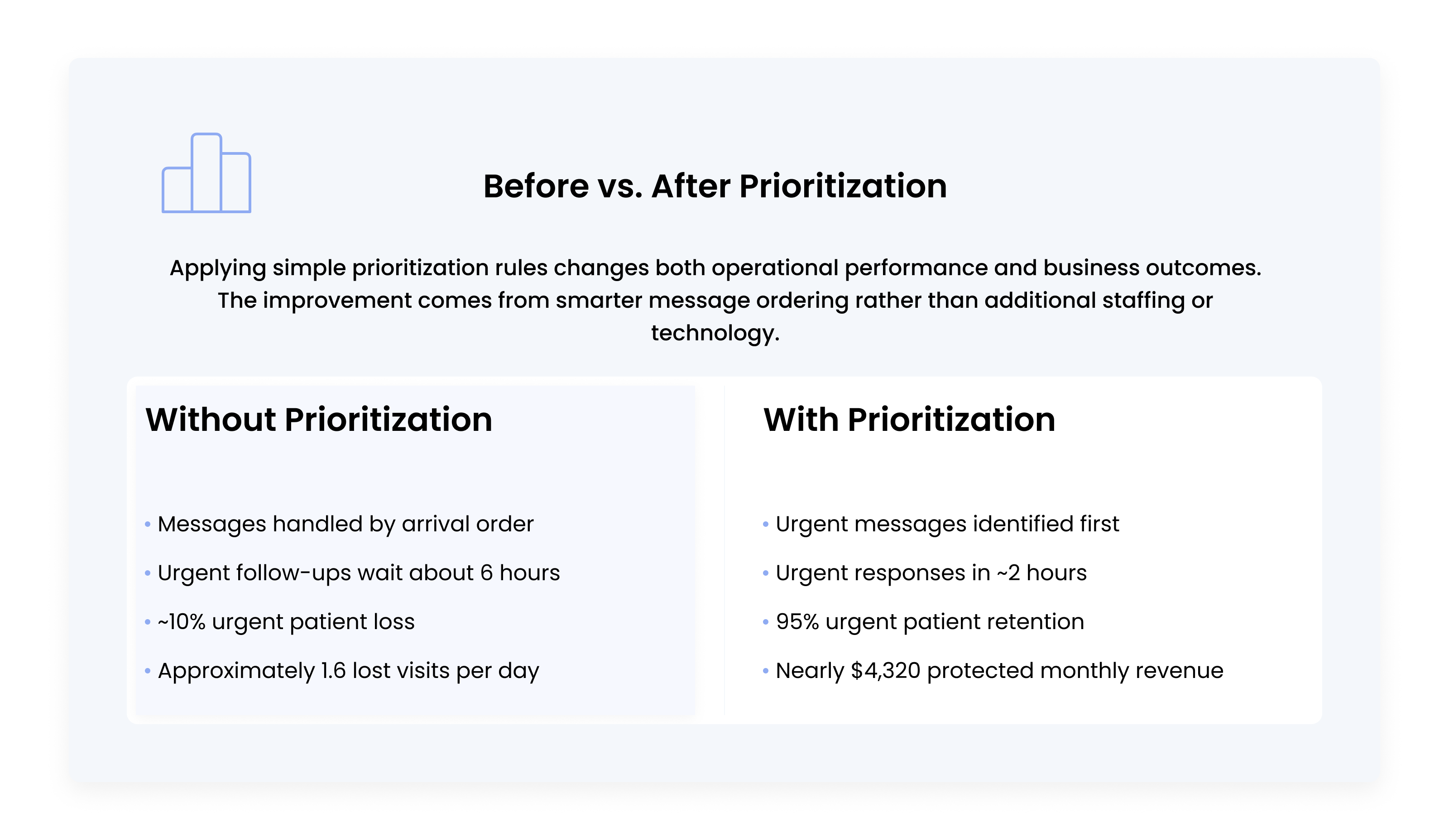
The difference? Prioritization reduces patient loss by about 1.44 visits per day (an improvement from roughly 10% loss to 5%), protecting close to $216 daily in revenue from more timely outreach. Over a 20-day work month, that’s nearly $4,320 saved—achieved mainly through smarter message ordering, not adding staff or expensive tech.
Staff also gain clarity, focusing on the most critical messages first without spreading attention evenly across all. The workday smooths out, stress dips, and urgent follow-ups stop slipping beneath routine clutter.
Beyond dollars, patient trust deepens. Timely responses make patients feel valued, cutting silent dropout where patients quietly disengage. These long-term relationships are vital in healthcare.
This quantified view anchors prioritization in real operational value, motivating teams beyond vague “best practice” talk. It proves that simple rules and shared judgement, not heavy investment, unlock meaningful gains.
Common Pitfalls and False Starts in Customer Message Prioritization
Despite widespread attempts, many businesses fall into traps that cost time and irritate staff without fixing core issues. Four common false starts keep coming up:
1. Treat all messages as equally urgent, responding by timestamp alone
This default approach misfires by offering no differentiation. Staff respond mechanically to volume, ignoring message content or customer context. It leads to burnout and delays on urgent requests. A receptionist juggling calls and emails might pick whatever's next without realizing a critical prescription refill has sat unanswered for hours.
2. Use complex automation or tagging without clear prioritization rules
Automation promises relief but often adds confusion if rules aren’t straightforward. Staff might miss filtered messages or disregard subtle cues crucial for good judgment. Important messages get lost or misassigned. For example, an automated tagging system routed certain inquiries directly to a “low priority” folder, burying urgent customer complaints because the tags were misapplied.
3. Depend only on individual intuition without shared guidelines
Some team members handle triage on gut feel, but without consistent documented rules, prioritization becomes patchy. Fast-tracking depends on personal whims, causing tension and service gaps as responsibilities blur. One customer support agent might rush a dissatisfied client, while another lets similar issues languish, confusing management metrics.
4. Ignore message source differences, treating new inquiries and follow-ups the same
Missing this distinction wastes effort on already-addressed matters while fresh questions wait. It’s a simple way to misallocate attention. A venue’s booking team might respond again to customers who already received contract details, overlooking fresh inquiries due to no system marking follow-ups separately.
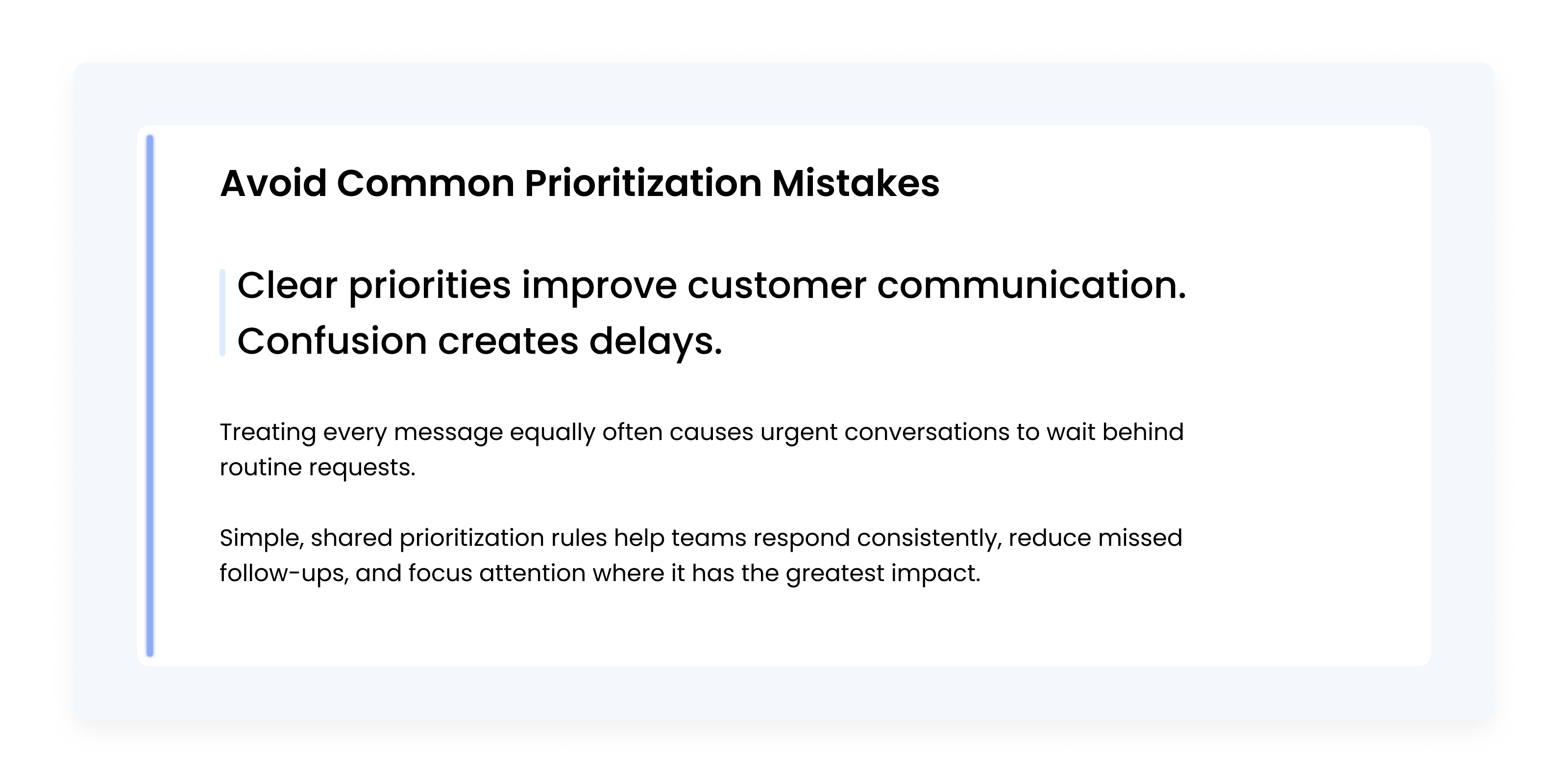
These pitfalls often fuel operational friction. For example, one receptionist might assume a co-worker is handling a follow-up message seen earlier, while no action occurs. Repeat assumptions cause days-long delays. Customers get silence and quietly look elsewhere.
Another friction point is juggling multiple channels—email, voicemail, SMS, social media. Treating each equally without prioritization means urgent requests left on lower-monitored platforms can wait unnoticed. Frustrated staff then dump complex messages on colleagues, adding confusion over ownership. A Saturday social media complaint might go unanswered because the team only monitors email during weekends.
These missteps highlight that prioritization must be practical, durable, and tied to observable message facts. It can’t be a theoretical overlay or a burdensome procedure. Instead, it should fit naturally into daily flow, with clear shared rules guiding attention without overpowering staff.
Where Thoughtful Prioritization Fits Into Your Overall Conversation Management System
Prioritization sits at the core of managing customer conversations. Within the broader communication setup, it shapes how messages get triaged, routed, timelines set, and accountability assigned. But it has to work seamlessly within team workflows—not sit apart like a separate project.
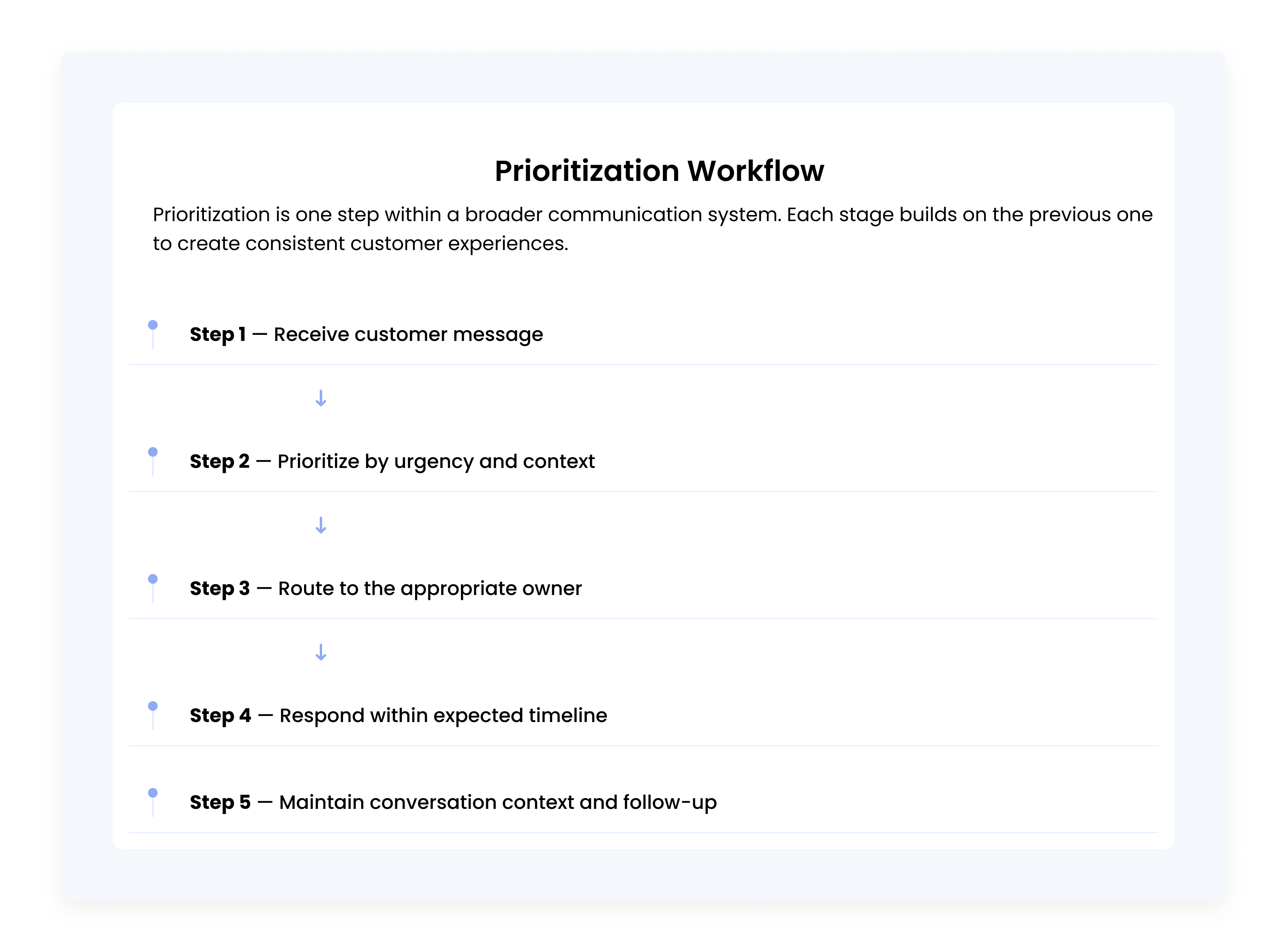
Good prioritization turns message volume from an enemy into a known quantity manageable with foresight. It guides daily planning by helping staff group tasks logically by urgency and customer context. This cuts down firefighting and arbitrary decisions.
It also sharpens internal clarity around ownership and follow-up. High-priority messages get assigned timelines, escalation cues, or reminders, averting confusion and duplicated work.
For customers, knowing urgent needs get fast attention and routine asks receive reasonable timelines improves perceived reliability. This often quiets chasing, as customers trust the provider’s triage choices.
As communication channels and message complexity grow, prioritization acts like a gatekeeper—not to block or delay, but to ensure resources focus on messages sustaining business health and relationships. It works alongside conversation management elements like centralized tracking, cross-team visibility, and context keeping.
In practice, prioritization can expose strained handoffs within an operation. For instance, a small regional event venue found that booking inquiries were treated the same as technical questions, delaying contracts by days. Introducing prioritization rules aligned to event booking stages let staff split queues—leading to faster contract replies and smoother progression from inquiry to closing.
This stopped the common experience of busy message activity with lagging outcomes. Prioritization established a steady rhythm, so staff knew instantly what to address and what to schedule. That fueled confident, consistent communication inside and out.
These clearer priorities helped reduce call-backs from customers frustrated by unanswered questions, improving the day-to-day morale of the booking team. Staff settled into reliable routines that avoided the chaos of juggling everything at once.
For teams considering or refining conversation management, prioritization offers an early, high-impact step. It balances workload, lifts customer satisfaction, and boosts revenue. It transforms daily communication flow from reactive scramble to intentional, practical effort.
Key Takeaways
- Prioritization is a practical skill that filters incoming customer messages by urgency and relevance, not merely by arrival time or volume.
- Misaligned prioritization commonly causes operational friction, with urgent requests delayed and staff burnout from unfocused workload.
- The PRACTICE framework breaks prioritization into observable behaviors—pattern recognition, relevance, attention allocation, timing, clarity, consistency, and evaluation—that guide effective handling.
- Data-driven insights reveal how prioritization reduces customer loss and strengthens trust by ensuring timely response to high-impact messages.
- Avoiding false starts like equal treatment of all messages, over-reliance on complex automation, or unsystematic intuition ensures prioritization integrates smoothly into daily workflows.
Conclusion
Prioritizing customer messages is a hands-on, essential task in managing effective customer communication. It’s not about quick replies by volume, but about focusing effort where it meaningfully supports the customer relationship and business goals. That requires practical skill grounded in understanding subtle customer behaviors and realistic team capacity.
By observing carefully and applying frameworks like PRACTICE, businesses can tune message sorting to reflect real urgency, relationship status, and content nuance—building workflows that ease team stress and deepen customer trust. When quantified, as with the medical clinic example, prioritization reveals its power to protect revenue and turn clearer operations into real financial gains.
Avoiding pitfalls like one-size-fits-all treatment, over-automation without context, or informal intuition without alignment helps move beyond busywork toward reliable, steady prioritization. Embedding this discipline within conversation management opens stronger, smoother engagement rhythms.
Ultimately, customer communication should be viewed not as a flood to fight but an asset to nurture. Thoughtful prioritization is a human-centered design choice that respects customer effort and operational limits, leading to flexible workflows that raise service quality without overwhelming staff.
Embracing prioritization as a daily operational habit invites ongoing experimentation and refinement. Applying these principles consistently is often easier when teams can evaluate their communication workflow firsthand through a 14-day free trial. It sets the stage for a communication culture where customers and teams alike experience clarity, confidence, and mutual respect—turning everyday messages into a foundation for deeper connections and sustainable growth.
For businesses facing growing complexity in customer interaction, this shift means not just better message handling but stepping into a chapter where responsiveness and clarity become clear advantages that help brands stand out and build lasting loyalty.

.svg)