

The Work That Happens Before the Visible Work
A customer meeting may occupy 30 minutes on the calendar, but the work surrounding it begins earlier. Someone reviews recent messages, checks the current order, finds the last pricing discussion, asks whether production confirmed a date, and writes down the points that cannot be forgotten. The meeting is the visible event. The preparation is scattered across the hour before it.
The same pattern appears in less formal moments. An owner opening the business in the morning wants to know which supplier question remains unresolved, whether yesterday’s large request received an answer, and which account needs attention before noon. A project lead preparing for a design review reads several notes to determine which decisions are still open. A nonprofit administrator turns departmental updates into a board recap. A field-service manager compares yesterday’s unfinished jobs with this morning’s schedule before the first technician leaves. None of this seems unusual enough to be treated as a distinct process.
Experienced employees often absorb these responsibilities without calling them work. They know which folders to open, whose notes tend to be incomplete, and which details deserve attention. When two people believe the other is preparing the update, however, the work becomes visible through its absence. The meeting begins with, “I thought you had the latest figures,” followed by several minutes of searching, half-finished explanations, and someone opening an old email thread.
This layer of preparation has traditionally lived in people’s heads because the individual tasks are small. Yet small does not mean inconsequential. The person making a decision frequently becomes the same person responsible for assembling everything needed to make it. That is the category of work a Digital Associate is designed to support: the routine gathering, condensing, and preparation that should happen before a conversation or decision begins.
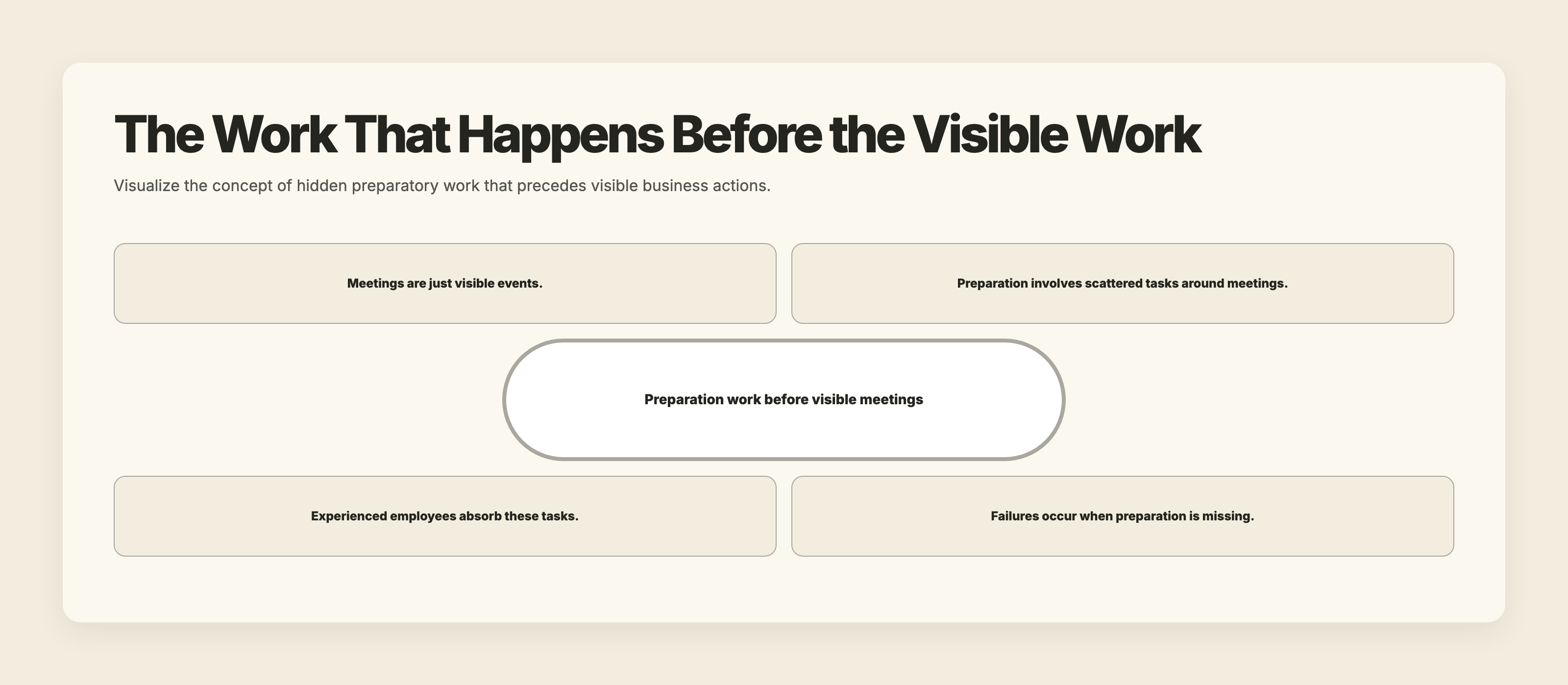
The eventual need is broader than any single meeting or software system. Every operating business creates a trail of requests, promises, changes, exceptions, and unfinished decisions. In a very small company, one person may still hold most of that trail in memory. As the company handles more customers, more channels, or more handoffs, memory stops being an efficient preparation system. The form of the need varies, but the underlying pressure does not: someone must turn recent activity into something usable before the next commitment is made.
What a Digital Associate Actually Is
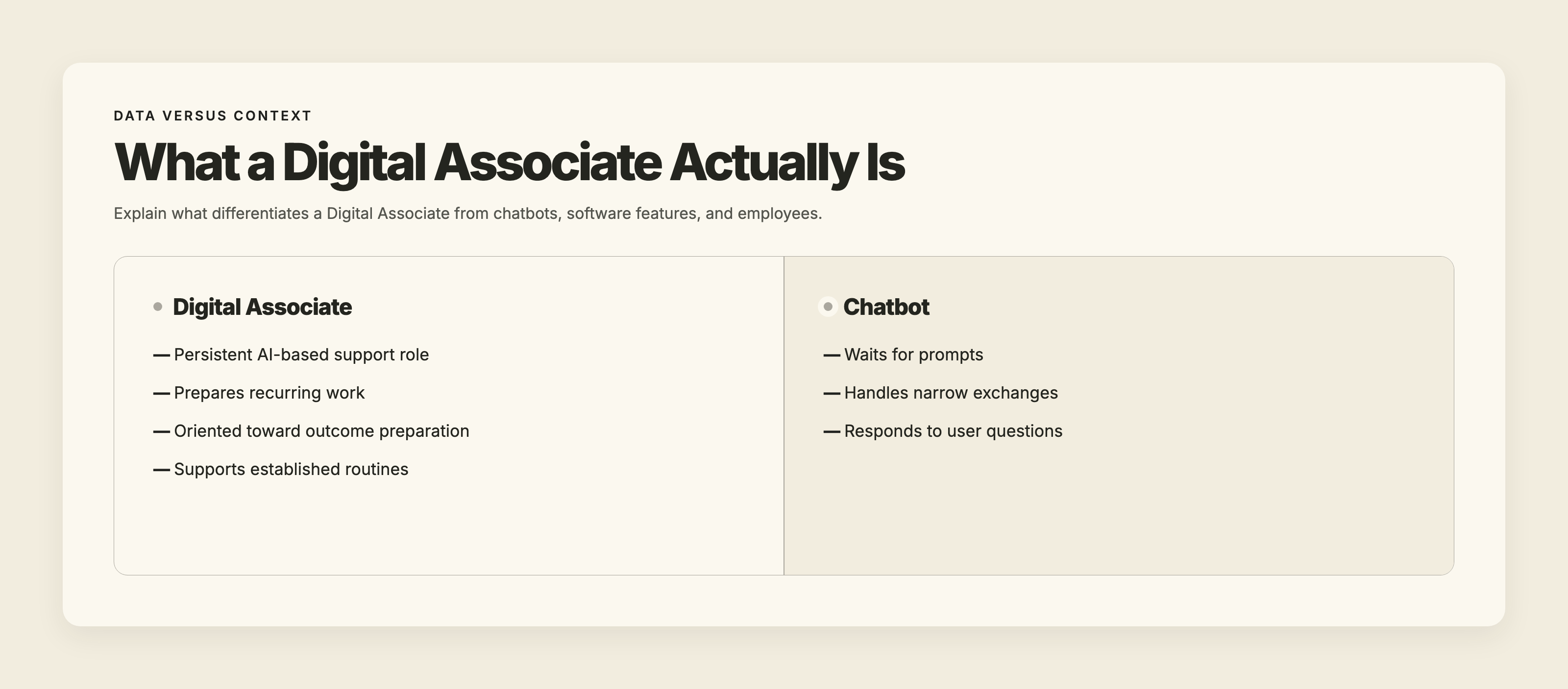
Digital associate AI is a persistent, AI-based support role that prepares recurring work from information a business already produces. Unlike a chatbot focused on answering the current prompt, a digital associate uses conversation intelligence, not just conversation history, to carry business context into recurring preparation before decisions are made.
It can assemble a morning briefing, collect open decisions before a project meeting, summarize changes affecting an account, or prepare the first version of an internal recap. Its purpose is not merely to provide an answer after someone asks a question. It helps make the next useful piece of work ready.
That makes a Digital Associate different from a chatbot. A chatbot usually waits for a prompt or handles a narrow exchange. A Digital Associate can support an established routine. If a distributor holds an account call every Thursday, the associate can prepare a concise brief covering current orders, unresolved pricing questions, recent requests, and promised updates before the call appears on the sales manager’s screen.
It also differs from a conventional software feature. A feature may filter records, send an alert, or produce a report. Those functions can be helpful, but they usually leave interpretation to the user. A Digital Associate is oriented toward an outcome such as “prepare me for this account review” rather than a function such as “show all activity from the last 14 days.”
Nor is it simply an employee represented in software. Employees carry judgment, relationships, craft knowledge, and responsibility. A Digital Associate provides a narrower form of support. It handles repeatable preparation so that a person can begin closer to the point where experience is most useful. Its value comes from dependable contribution, not from pretending it can occupy every role in the company.
The distinction matters because most companies do not suffer from a complete absence of information. They suffer from an uneven ability to make that information useful at the moment it matters. A record may exist, but it may not be connected to the next customer conversation, production choice, site visit, renewal, or internal decision. The role of the Digital Associate begins in that gap.
Why Available Information Is Not the Same as Prepared Work
Most companies can technically find the information they need. The supplier email is in an inbox. The revised quantity is in the ordering system. The account manager’s note is in the customer platform. A production comment may be in a team channel. Availability sounds sufficient until someone needs to combine all four items before a decision at 9:00 a.m.
Consider a small manufacturer preparing for its daily production meeting. At 8:10, the production planner sees that a material delivery has shifted. The sales coordinator has already received a customer question about the affected order, while the owner remembers a verbal promise made earlier in the week. Each person possesses part of the picture, but no one has a prepared account of what changed and which commitments may be affected.
At 8:45, the sales coordinator assumes the planner will raise the customer order during the meeting. The planner assumes sales has already adjusted expectations. The owner enters expecting a simple schedule review. Ten minutes later, the team discovers the dependency and pauses to retrieve messages. The meeting ends with an action item, but some confusion remains over who will confirm the revised sequence.
Nothing was technically missing. What broke was the movement from stored activity to shared awareness. By the next morning, two employees have drafted separate updates because each thought the action had remained with them. Information can be present while preparation is absent. A Digital Associate addresses that gap by assembling the relevant material around the work about to happen, rather than expecting a busy person to reconstruct it each time.
Operators recognize another version of the same failure: the record exists, but the team no longer trusts it. Someone sees an order note and asks whether it is current. A delivery date appears in one system, but an email sent later may have changed it. The search then expands from finding the record to proving that the record can still be believed. Once routine preparation includes that kind of checking, access alone provides less value than it appears to.
The practical problem is rarely “We have no information.” More often, it is “We do not know whether we have the complete, current picture.” That uncertainty is what sends experienced people back through message threads five minutes before a decision.
Modern Customers Create Work Across More Than One Moment
Customers rarely present a complete, orderly request in one interaction. A buyer may ask about availability in an email, mention a possible quantity change during a call, send a specification later, and wait for colleagues to approve the final number. Internally, those moments create pricing questions, inventory checks, supplier inquiries, and future commitments.
From the customer’s perspective, these fragments belong to one matter. The customer does not see the effort required to connect them. What they experience is whether the eventual response reflects the full request. If a distributor responds to the quantity question but overlooks the revised specification, the customer does not classify that as an internal coordination problem. The response simply feels incomplete.
Delay changes behavior quietly. After sending the final detail, a buyer may wait through the afternoon without checking in. The next morning, they open another supplier’s website, review an old quote, or ask a colleague for an alternative. They have not formally rejected the first company. They are reducing uncertainty. Silence feels intentional because the customer cannot see internal searching, competing priorities, or an unfinished draft sitting in someone’s inbox.
Trust often weakens before the opportunity visibly disappears. A slow or partial response introduces doubt about what fulfillment might be like later. The buyer starts comparing more closely, asks for firmer dates, or withholds the next question until the current one is resolved. A Digital Associate cannot create a good answer where none exists, but it can prepare the full set of customer details and internal questions sooner, allowing the team to respond with greater completeness.
The same behavior appears outside account sales. A homeowner waiting for a revised service date calls another contractor. A donor awaiting confirmation delays an internal introduction. A client who receives answers to only two of three project questions forwards the thread again with the missing item highlighted. These are not dramatic failures. They are small signs that the customer has started carrying coordination work the business was expected to handle.
As communication becomes easier, customers create more of these fragments, not fewer. They reply from phones, add details later, change channels, and expect the business to preserve continuity. The company may experience five separate interactions. The customer experiences one unresolved need.
How Small Preparation Tasks Accumulate Across a Year
Preparation work is easy to discount because each instance may take only 10 or 15 minutes. Consider a 20-person distributor preparing five recurring account briefs each week, one daily order-and-supply summary, and two internal commercial updates. If account briefs take 15 minutes each, the daily summary takes 20 minutes, and the commercial updates take 25 minutes each, the modeled weekly total reaches 225 minutes.
That is 3.75 hours every week. Across 48 operating weeks, the model produces about 180 hours spent preparing a relatively small set of recurring outputs. The assumptions are intentionally visible because the exact number will differ by company. A business with fewer recurring reviews may spend less. One with fragmented records or frequent late changes may spend considerably more. The estimate does not include searching for an attachment, clarifying an ambiguous note, or redoing a summary after a late update. It also excludes the mental restart required when a manager is interrupted halfway through assembling the material and returns later trying to remember what had already been checked.
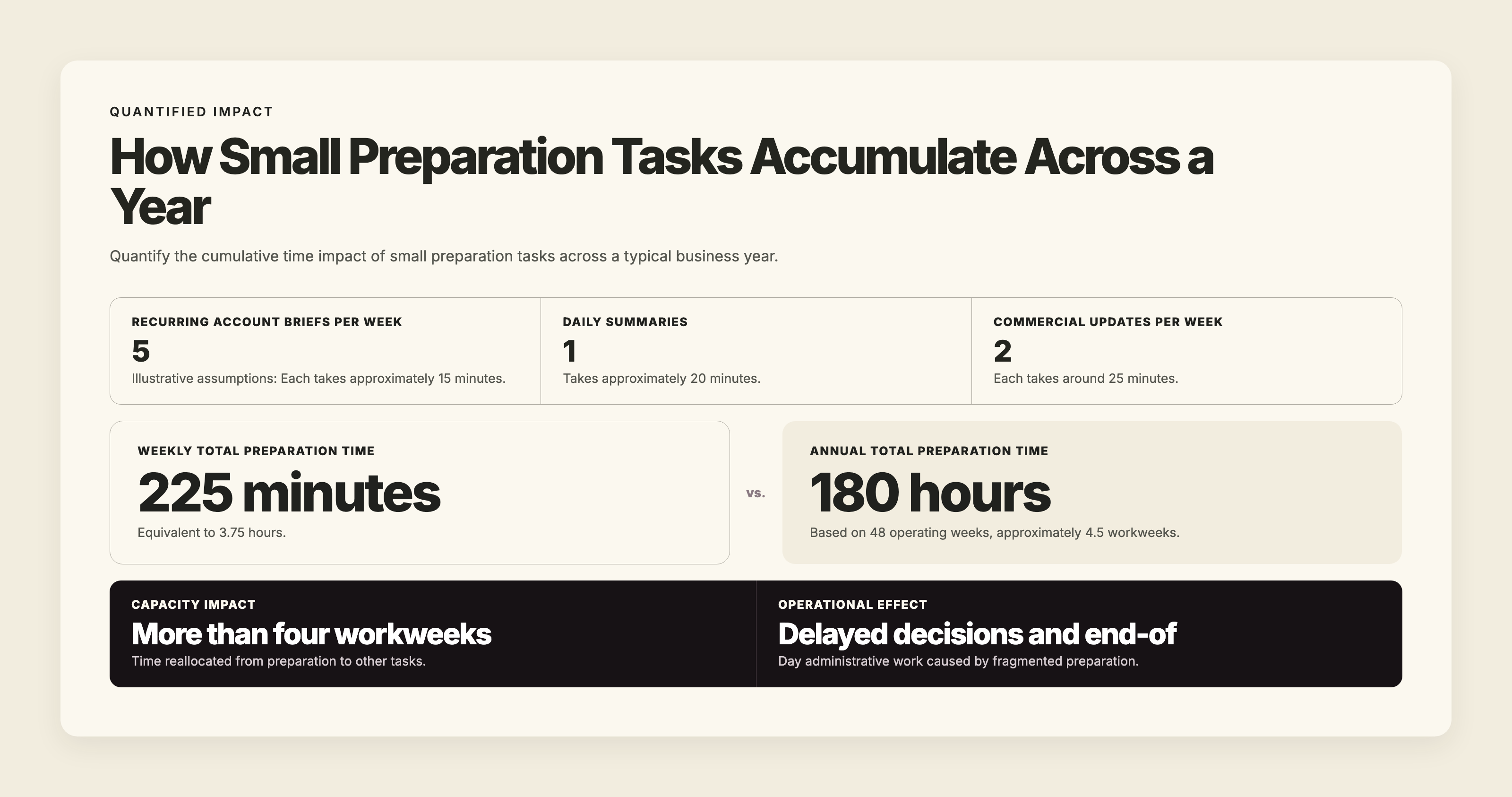
The labor cost matters, but capacity is the more useful lens. Those 180 hours equal more than four standard workweeks. If the preparation is divided among an owner, sales manager, and operations coordinator, it does not appear as a vacant month on anyone’s calendar. It appears as delayed quote reviews, shortened account conversations, end-of-day administrative work, and decisions pushed to tomorrow.
In service businesses, the same accumulation may appear in a different form. A dispatcher spends eight minutes reconstructing the status of an unfinished visit before calling the customer. A project manager spends 12 minutes comparing site notes with the latest schedule. An office administrator reads yesterday’s messages before identifying which appointments need confirmation. The outputs differ, but the pattern remains: brief acts of reconstruction repeat around the moments when the business has to speak or decide.
The commercial effect should not be exaggerated. Not every delayed brief loses an order. Still, if faster preparation allows the team to complete one additional account review each week, advance a handful of quotes sooner, or identify an order constraint before a customer asks, the reclaimed capacity has practical value. Quiet leakage often looks ordinary: paid people repeatedly recreating material the business needs in nearly the same form every week.
Finding the Work That Repeats Between Decisions
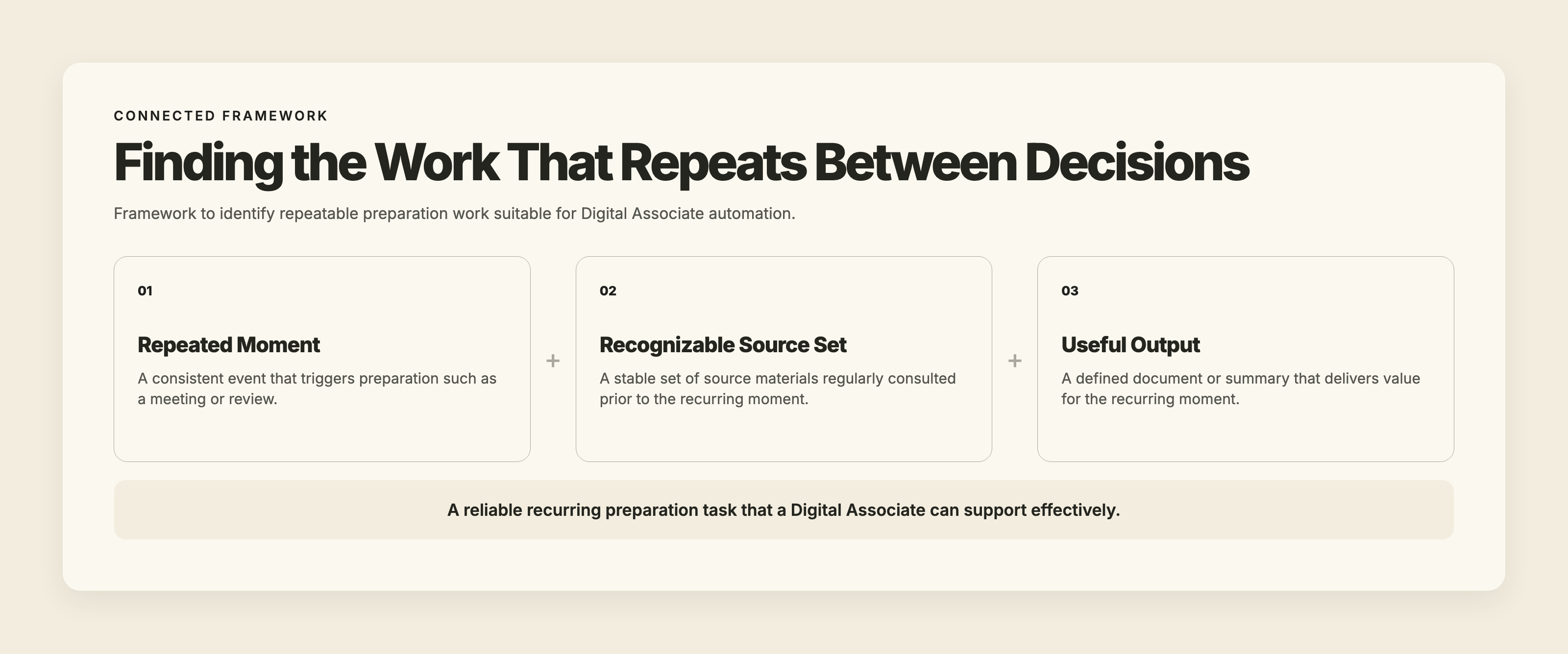
A useful starting point is the Prepared Work Test. It is not a technology assessment. It is a way to notice recurring preparation that already exists. The test has three parts: a repeated moment, a recognizable source set, and a useful output. All three need to be present before the work is a sensible responsibility for a Digital Associate. In practice, weak candidates usually fail at one boundary: the moment recurs, but the sources or expected output keep changing.
The repeated moment is the event that causes someone to prepare: a Monday planning meeting, a customer account review, a daily owner briefing, or a monthly board update. Failure here looks like choosing an unusual project with constantly changing needs. That creates more exceptions than consistency. Repetition matters because the associate can contribute more reliably when the destination is familiar.
Businesses often misidentify repetition by noticing that a task has the same name. Two items may both be called a “project update” while requiring entirely different judgment each time. One involves comparing documented milestones. Another depends on knowing that the client’s brief comment during a site visit changed the meaning of the entire plan. The label repeats, but the preparation does not. A recurring calendar entry is not enough if the work underneath it remains structurally different.
The recognizable source set is the material regularly consulted before that moment. An architecture firm might use project notes, recent client messages, drawing comments, and its decision log. Failure occurs when no one can say where the relevant material originates or when essential details exist only in undocumented conversations. The source set matters because dependable preparation requires a practical path from recent activity to the output.
A source set can also look stable on paper while failing in use. The official project record may exist, but half the team relies on a message channel and the senior lead keeps decisive notes in a private notebook. An order system may show the scheduled date while actual changes arrive by email and are entered a day later. In that environment, a polished output can make the underlying gaps more dangerous because it looks complete. The first sign is usually operator distrust: people read the summary, then reopen every source to check it.
The useful output is what a person should receive: five open decisions, a concise account brief, a list of changed assumptions, or a daily priority summary. Vague instructions such as “tell me everything important” usually produce clutter. A defined output gives the work shape. When operators can name the recurring moment, the usual inputs, and the document they wish had been ready, they have found a credible first responsibility.
Not every recurring output is valuable enough to preserve. Some reports continue because they have always been produced, even though recipients skim the first line and never act on the rest. Automating that report makes an ignored document arrive faster. Other outputs are abandoned because they create more checking work than they remove: long recaps with no distinction between background, changes, and unresolved items; summaries that repeat old facts; or priority lists that treat every item as urgent.
The strongest candidates tend to sit close to a real decision or commitment. Someone will call a customer, release work, adjust a schedule, approve a purchase, enter a meeting, or decide what needs attention first. The output has a visible use when it arrives. If no behavior changes when the preparation is missing, the work may not deserve a persistent role.
There is also a boundary around undocumented judgment. An experienced estimator may glance at three ordinary job details and recognize a risk because of something learned over 20 years. If that reasoning has never been recorded and the signal changes from job to job, the routine only appears repeatable from the outside. A Digital Associate can collect the job details and surface the unresolved question, but the experienced judgment remains the part that gives those details meaning.
The Prepared Work Test is therefore less polished in practice than its three parts suggest. Operators usually find a promising routine, discover that one source is unreliable, narrow the output, remove material nobody uses, and separate factual preparation from judgment that still belongs with a person. That friction is useful. It shows whether the recurring work is real or merely familiar.
What Businesses Should Reasonably Expect From a Digital Associate
A Digital Associate should first be judged on consistency. Does the morning summary arrive when it is useful? Does the project brief use the same recognizable format each week? Does it distinguish unresolved items from general background? Reliability in a narrow responsibility is more valuable than an impressive demonstration covering many unrelated tasks.
The output should also reduce preparation without creating a second editing job. A specialty retailer, for example, may want a daily owner briefing that combines low-stock questions, supplier changes, notable customer requests, and items needing a decision. If the owner still has to open six systems to validate the briefing every morning, the support has not yet become dependable enough.
That checking burden is where many promising outputs lose daily use. During the first few days, people may tolerate extra verification because the format is new. By the third or fourth week, an owner who repeatedly finds stale inventory notes or duplicated customer requests stops reading the briefing closely. The output may continue arriving, but it has ceased to be part of the operating routine. A prepared document has value only while the people receiving it trust that it reduces uncertainty.
Reasonable expectations include limitations. Before integrating a Digital Associate, businesses should use an operational readiness check to set realistic standards for consistent, trustworthy work without shifting excessive verification onto users.
Some details will remain ambiguous. A short internal note may not explain why a delivery date changed. A design comment may identify a question without showing who is expected to answer it. In those cases, useful behavior means identifying the uncertainty clearly and placing it beside the relevant material, not filling the gap with a confident assumption.
Over time, the business can expect the Digital Associate to fit more naturally into existing routines, but not to run the company independently. The early measure is whether people arrive better prepared. Does the production meeting begin with the changed orders already identified? Does the account manager know the promises that need confirmation? Does the owner spend less of the first hour reconstructing yesterday? Those are modest standards, but they produce durable usefulness.
The best early sign is often behavioral rather than technical. A manager stops keeping a separate scratch document. An administrator no longer sends a second recap because the first one already contains the open questions. A meeting begins with a decision instead of a search. When preparation is dependable, people stop building private insurance against its absence.
Why Dashboards, Chatbots, and Isolated Automations Fall Short
Adding another dashboard often feels like progress because the information becomes more visible. Yet visibility still requires a person to log in, choose filters, interpret changes, and translate them into the matter at hand. A sales manager preparing for a customer call does not need every account metric. They need the few changes, unresolved questions, and commitments relevant to that conversation.
A basic chatbot has a different limitation. It can answer “What was the latest order?” when prompted, but the user still needs to know which questions to ask. During a busy morning, the sales manager may remember the order question and forget the pending specification, supplier constraint, or note from finance. The chatbot responds to the shape of the prompt rather than preparing the shape of the work.
An isolated automation can move a message, create a task, or notify a channel. That may remove a manual step while leaving interpretation untouched. One employee receives the alert and assumes the account owner will act. The account owner sees the new task but believes operations is confirming the detail. By afternoon, activity is visible everywhere, while responsibility remains unclear. Adding dashboards and chatbots to an already crowded communication stack can make activity easier to see, but still leaves someone to reconcile scattered signals and establish who owns the next recurring decision.
Busyness can conceal an unprepared decision surprisingly well.
These tools are not failures simply because they serve narrower purposes. Dashboards are useful for exploration and monitoring. Chatbots are useful when a person has a clear question. Automations are useful for predictable transfers and notifications. The limitation appears when access, answers, or movement are mistaken for preparation. A visible change still needs to be connected to the next moment in which someone must act on it.
Saving more material does not solve this by itself. A larger archive gives people more places to search and more items to evaluate. Digital Associates represent a different expectation: not another destination that waits to be checked, but support that prepares a defined output for a recurring business moment. The distinction is practical. One provides access to material. The other reduces the assembly required before that material becomes useful.
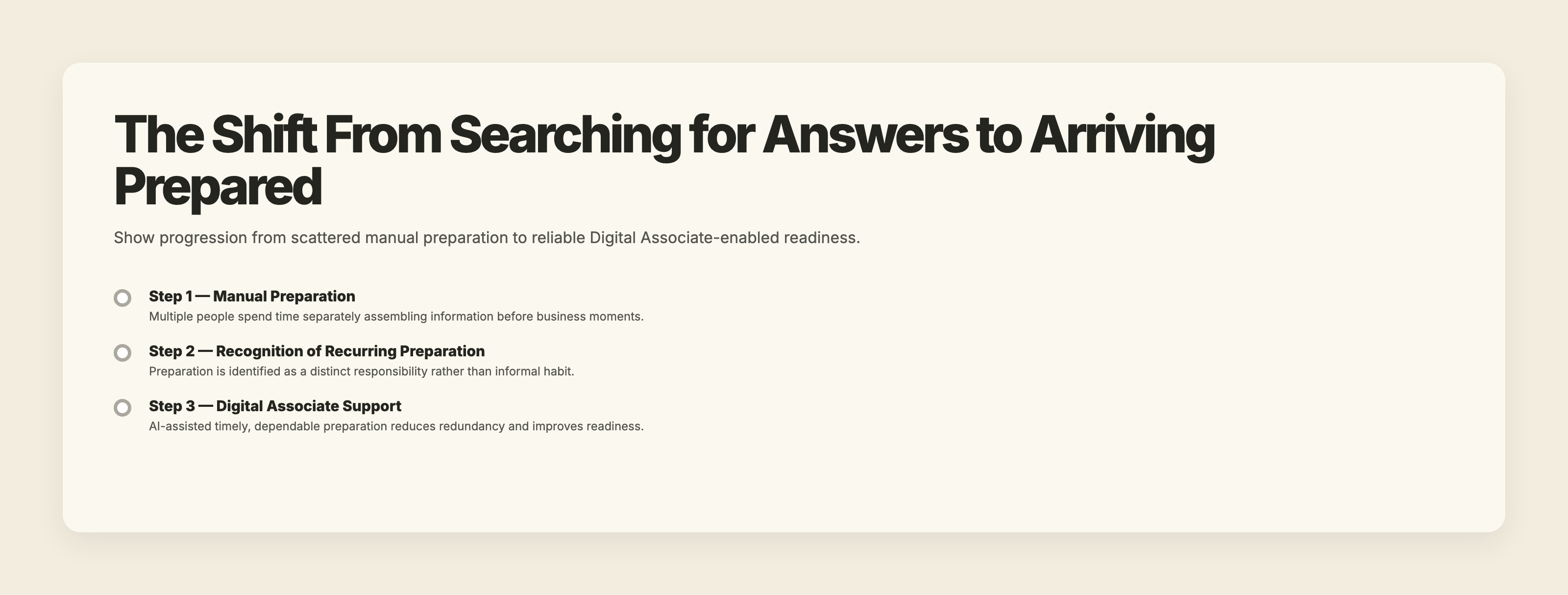
The Shift From Searching for Answers to Arriving Prepared
The most meaningful change is not that AI can produce text. Companies already have abundant text: emails, notes, reports, messages, comments, and system entries. The change is that recurring preparation can become a recognized responsibility rather than an informal habit performed by whichever experienced person happens to remember.
A local distributor illustrates the shift. Before a recurring customer call, the account manager usually spends 20 minutes checking recent orders and messages. The operations coordinator sends a late update, so the manager revises the notes. The owner then asks whether an older pricing commitment still applies. Three people participate in preparing for a call that only one person will attend.
With a Digital Associate supporting that routine, the first account brief can be assembled before the participants begin their day. The operations coordinator adds a clarification instead of creating a separate recap. The owner sees the pricing question identified as unresolved rather than discovering it five minutes before the call. The account manager still determines how to conduct the conversation, but begins with a more complete view.
The same shift can occur without an account call. Before technicians leave in the morning, a service company needs to know which jobs have missing parts, which customers were promised an arrival window, and which unfinished visit affects today’s route. Before a nonprofit board meeting, someone must connect program updates, funding questions, and decisions carried forward from the previous month. Before a design review, changed assumptions need to be separated from comments that require no decision. These businesses are not performing the same work, but each has a recurring moment when raw activity must become usable context.
That is why the category will become relevant to more businesses as work spreads across inboxes, team tools, customer systems, documents, and spoken interactions. The need does not arise from a futuristic vision of autonomous companies. It comes from an ordinary expectation: people responsible for decisions should not spend so much of their day rebuilding the preparation required to make them.
Not every business needs the same form of Digital Associate today. A sole operator with a small number of customers may still carry the relevant context without much friction. But the pressures behind the category are increasingly universal. Customers communicate in fragments. Employees work across more than one system. Commitments are made in one place and fulfilled in another. The cost of delay rises as response expectations tighten. Even simple businesses eventually reach a point where memory and manual reconstruction become an unreliable bridge between those moments.
The inevitability is therefore not based on every company becoming complex in the same way. It is based on every company needing continuity between activity and action. As digital records accumulate, the scarce resource is no longer information alone. It is prepared attention: a reliable account of what changed, what remains open, and what the next decision depends on.
Where TMMN Fits In
TMMN approaches Digital Associates through the connection between customer contact, internal preparation, and everyday follow-through. A conversation is rarely an isolated event. It may affect a quote, an order review, a project decision, or tomorrow morning’s priorities. Supporting the contact alone leaves much of the resulting work untouched.
The operating perspective begins with the work already happening inside the company, not with finding places to insert AI. The relevant question is, “What needs to be ready for the team after this activity occurs?” For one company, the answer may be an account brief. For another, it may be a production summary, a collection of open design decisions, a field-service handoff, or a concise board recap. The output needs to fit the rhythm of the company rather than create an additional routine around the software.
This perspective also informs how Spoken Touch may develop over time. Communication systems can support an individual interaction while also contributing useful details to the work surrounding it. The product reference is secondary to the operating principle: information from contact becomes more valuable when it can support a later review, decision, or internal update without forcing someone to reconstruct the entire exchange.
That direction is not about turning every conversation into an elaborate process. Many interactions require nothing further. The value appears when a detail changes a promise, introduces a question, affects another person’s work, or needs to be present at a later business moment. A workable approach links customer conversations to internal preparation, so questions, commitments, and ownership carry into the next business moment instead of remaining trapped in an isolated interaction.
The category exists because those consequences already exist, regardless of which system supports them.
Key Takeaways
- Digital Associates prepare recurring work from information a business already produces.
- Available information is not the same as a complete, current picture.
- The strongest responsibilities sit close to a real decision, commitment, or customer response.
- Dependable preparation reduces private checking, duplicate recaps, and last-minute searching.
- The enduring need is continuity between business activity and the next action.
Conclusion
The first useful Digital Associate will not take charge of an entire business. It will earn a place by doing one recurring form of preparation well enough that people notice when it is absent. A sensible place to begin is the piece of mental preparation an owner or experienced employee performs every week: the summary they rebuild, the open items they gather, the changed assumptions they compare, or the briefing they wish someone had prepared.
Over time, nearly every business encounters this need because nearly every business reaches a point where its commitments exceed one person’s reliable memory. The decisive change is not the arrival of more information. It is the recognition that preparing information for use is work in its own right.
When that work remains invisible, experienced people absorb it, customers wait through it, and meetings expose it. When it becomes a defined responsibility, people arrive closer to the decision. A 14-day free trial can help a team test whether clearer communication context improves the continuity of everyday customer work.
That recurring responsibility is where the Digital Associate category becomes concrete, useful, and eventually difficult to operate without.

.svg)