
A customer texts an alterations shop to ask whether to bring their shoes for a trouser fitting. The answer needs to reach them before they leave home; at the counter, it could be too late to prepare.
A helpful reply solves the immediate question. Using conversation intelligence to improve customer experience means going further: changing what the next customer receives so they can complete the fitting they booked.
What should change before another customer reaches that point?
How Conversation Intelligence Improves the Customer Experience After the Reply
Conversation intelligence means reviewing customer exchanges for patterns that can inform business decisions. Software can help group and count conversations when there are too many to read by hand, but deciding what to change still takes someone who knows the service. For the broader idea, see what conversation intelligence means.
The question about shoes gives the shop a specific detail to check in its trouser-fitting confirmation.
You can start by reading the relevant conversations yourself. You do not need another analytics subscription to decide whether your booking confirmation leaves out useful information.
If you still need to identify the pattern, our guide to finding repeated customer questions covers that work.
Keep the intended change concrete. “Improve customer experience” is too broad to evaluate. “Help customers arrive with what they need for this fitting” gives you an appointment outcome to look for.
Check What Your Existing Answer Leaves the Customer to Figure Out
Read the Reply Beside the Customer’s Next Action
Read both sides of the exchange, including the messages after your answer.
What did the customer need to decide or do? Did the reply give them enough information? Did they have to ask again, search through general instructions or work out whether a rule applied to their appointment?
An answer can be accurate and still leave the practical question open. Referring someone to a preparation page helps only if they can find the relevant instruction and understand how to apply it.
Pay particular attention to facts your employees supply from memory. Those details may be obvious inside the business while remaining absent from everything a new customer receives.
Check Your Own Instructions Before Adding More
Compare the employee’s reply with the booking page, confirmation and preparation information the customer had at that point. Look for missing details, conflicting wording and instructions sent after the customer needed them.
In our own support work, we verify what is happening on our end before pointing to a problem on the client’s end. Apply that same discipline before deciding customers simply need to read more carefully.
The Government Digital Service describes using support-ticket analysis to repair documentation gaps and investigate harder problems through usability testing. That is a useful distinction: sometimes the explanation needs repair; sometimes you need to watch someone attempt the task to understand the difficulty.
Replace confusing wording before adding another reminder. Otherwise, you may give the customer more copies of an answer they still cannot use.
Prepare the Customer Before the Fitting Appointment
Return to the alterations shop and the customer’s question about shoes.
The employee can answer that customer. If similar questions recur, the owner should also read the booking confirmation beside those replies.
Does the confirmation explain what to bring? Does it distinguish this fitting from other appointments? Is the useful instruction buried beneath general shop information?
Before rewriting anything, ask the person doing the fittings what preparation genuinely matters. The message should reflect how that shop performs the booked work, rather than borrowing a general checklist that may not fit.
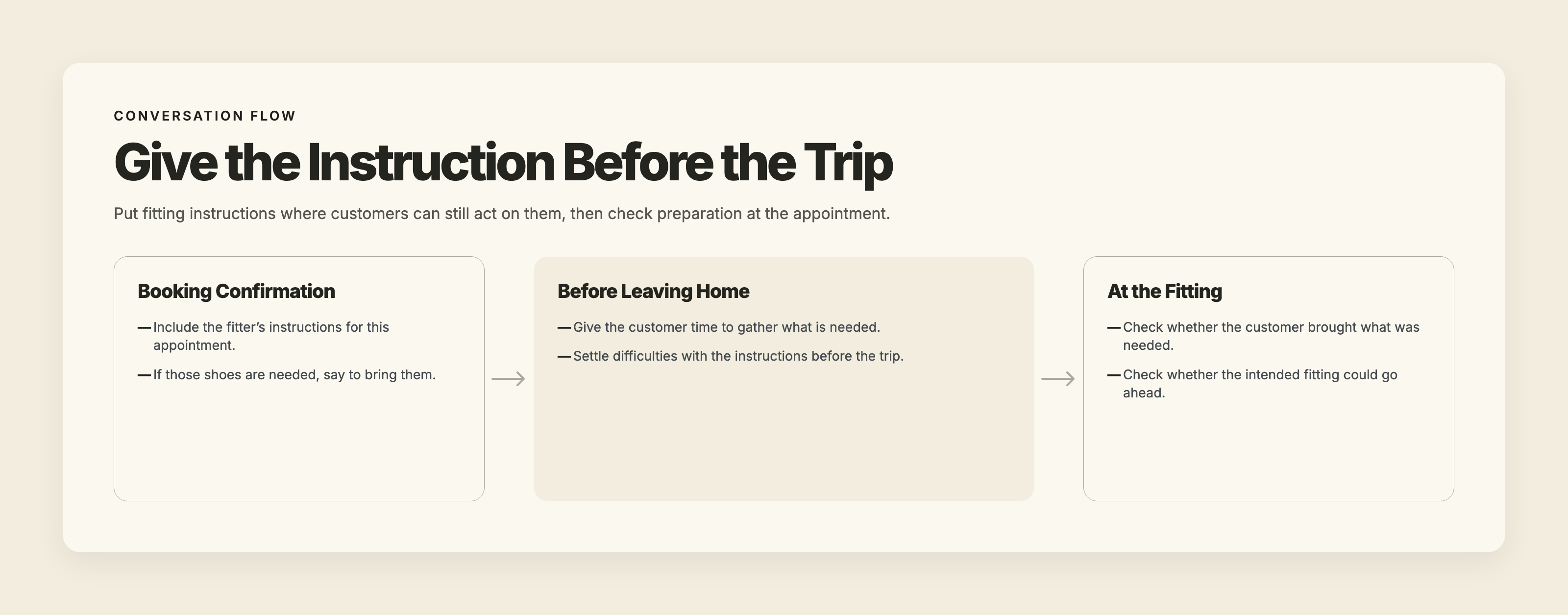
If the fitter says the customer should bring those shoes, place that instruction in the trouser-fitting confirmation. Give the customer time to act on it before leaving home. Update the saved response so an employee answering later gives the same advice.
Before the change, a confirmation without preparation details leaves the customer texting to ask what to bring, with an exception potentially discovered only at the counter. The revised approach should tell them what to bring for this fitting and settle exceptions before the trip, so they can arrive prepared. Judge the change at the appointment: could the fitter complete the intended work?
Keep the instruction specific to the appointment. A useful detail for a trouser fitting should not automatically appear in every alteration confirmation.
Also make sure customers have a way to ask about a difficulty with the instructions. Someone who cannot bring a requested item needs to find out what happens next.
Change the Work When Better Instructions Are Not Enough
Give Appointment Exceptions a Clear Decision Point
Continue the alterations example. The customer says they cannot bring something the fitter ordinarily needs.
A longer preparation message cannot decide whether the visit should proceed.
Have the appropriate employee settle that question before the appointment. They might decide that the planned fitting can go ahead, that only part of the work can be done or that another appointment is needed. The decision depends on the shop’s actual work.
Tell the customer what has been decided and write it where the employee handling the appointment will find it. Avoid leaving the customer with a vague reassurance that the person at the counter will “sort it out.”
This is where reviewing conversations can lead beyond better wording. The recurring difficulty may expose a missing decision before the visit. Fixing that step requires the person who understands the service, not just the person who writes the replies.
Keep the Customer’s Words Separate From Your Proposed Fix
Do not let your preferred solution replace the evidence.
A customer asking whether to bring shoes shows that the question arose. It does not automatically tell you whether the confirmation omitted the instruction, the customer overlooked it or their circumstances changed.
Keep a short record of the change:
- Identify the source exchange and the customer task affected.
- Write down what you observed without guessing at the customer’s motives.
- Describe the proposed change and name the person responsible.
- Record when the change takes effect.
- State what customers should be able to do during later comparable appointments.
Keep the original exchange accessible to the people reviewing the change. That lets a colleague challenge your interpretation without relying on your recollection.
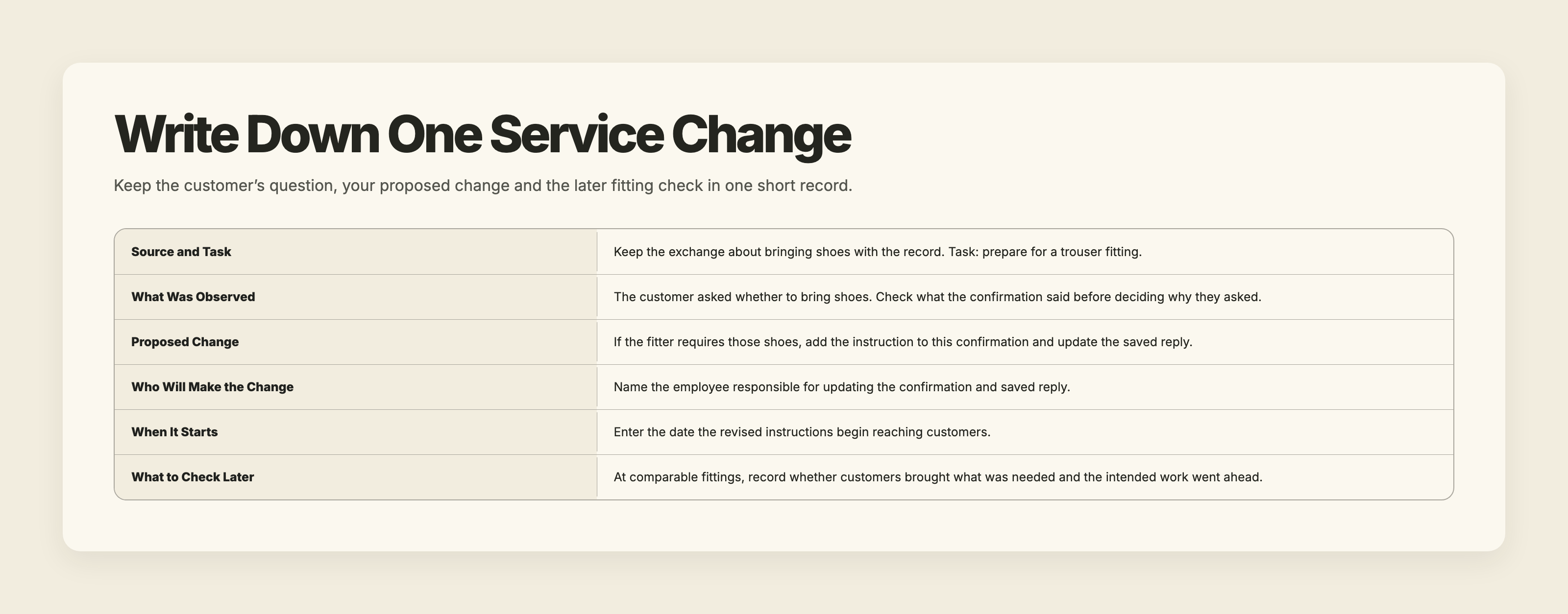
The record can be brief. Its job is to preserve why you changed something and what you expect customers to find easier.
Check the Appointment, Even When the Messages Stop
After revising the instructions, look beyond the text thread.
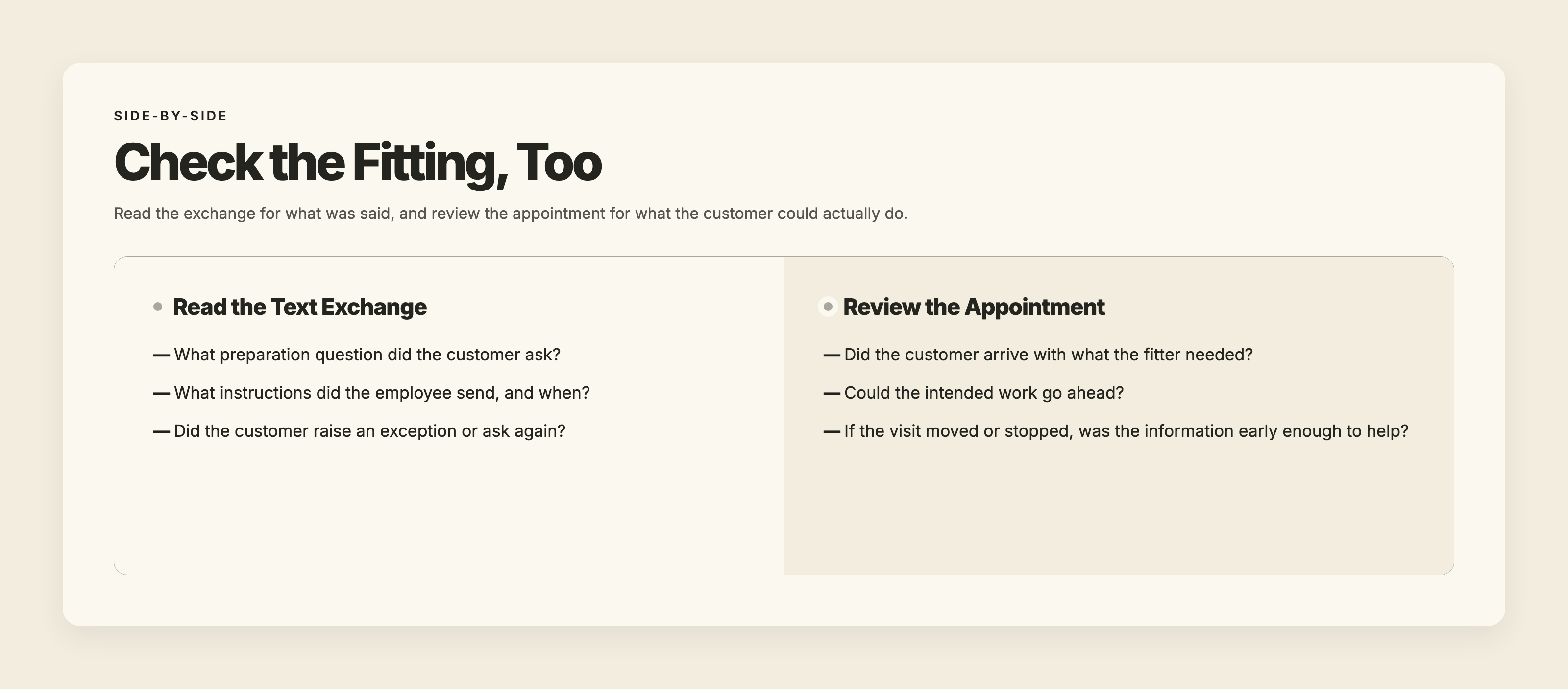
Could later customers prepare for the fitting? Did the appointment accomplish what they booked? Were exceptions settled before arrival, or did the same uncertainty reappear at the counter?
Ask a focused question about the changed step: did anything they needed for the fitting come as a surprise?
Include appointments that moved or did not proceed. A customer who reschedules after learning what is required is part of the picture, too. Find out whether they received the information early enough to make a useful decision.
GOV.UK’s guidance on measuring user satisfaction distinguishes finishing an online transaction from reaching the end of the actual service. It recommends gathering feedback at the service endpoint and continuing to monitor changes. For the alterations shop, the completed booking is an early step. The fitting is where preparation gets tested.
Fewer preparation texts are worth noting, but silence alone tells you little about readiness. Customers might stop asking and still arrive without what they need.
Compare similar appointments. Note other changes that could affect what you observe, such as a different fitter, a revised booking process or a change in the work being offered.
Describe the result plainly: whether customers brought what was needed, whether the fitting went ahead and what remained unresolved. Those observations give you a reason to keep the revised instructions or change them again.
Use TMMN’s Text Record to Support the Review
TMMN gives your team a shared text record to review. Each employee signs in separately to read the conversations for their assigned number; outgoing texts are attributed to the sending employee in the message log. For more on that setup, see team texting from one business number.
With the appropriate message-log permission, a reviewer can download an Excel, CSV or PDF export. That gives the reviewer a way to read relevant exchanges together rather than relying on whichever conversation an employee remembers.
Once your team approves revised wording, you can save it as a message template. Employees can insert the template into the message box and edit it before sending. Template counts depend on the plan.
TMMN has no built-in conversation-intelligence or AI-analysis feature. Your team reviews the record and decides what to change.
Start a 14-day free trial to try shared texting on your existing business number.
Choose a recurring preparation difficulty and identify the last moment when the customer can still act on the answer. Put the useful information before that moment, then see how the next fitting goes.
An instruction received while the customer is still at home can change how they prepare. The same instruction delivered at the counter may only explain why the visit cannot go ahead.